100–300kW DC EV Charging Pile: A Commercial Buyer’s Guide

A commercial charging site needs to serve vehicles efficiently while managing grid capacity, user demand, equipment utilization, operating costs, safety, and future expansion. Therefore, buyers should evaluate more than the maximum power shown on a charger.
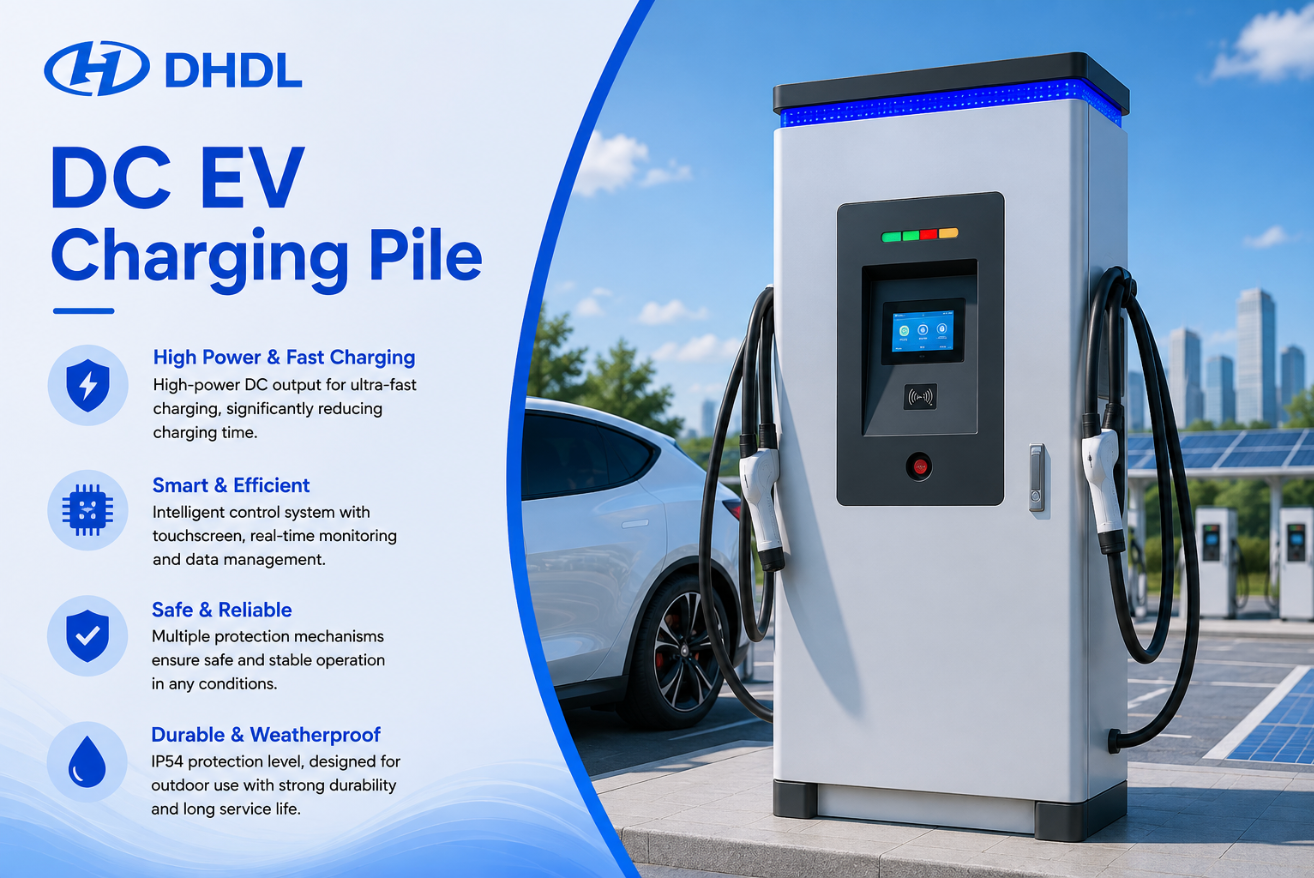
The DHDL DC EV Charging Pile provides configurable output power from 100kW to 300kW. DHDL developed it for commercial charging stations, public parking areas, highway service areas, fleet-charging sites, and other high-power electric-vehicle charging projects.
Moreover, buyers can select a single-connector or dual-connector configuration. The charger also supports intelligent charging control, 4G real-time monitoring, backend operation management, charging-data visibility, and multiple electrical-protection functions.
However, DHDL does not publish one universal input voltage, output-voltage range, connector standard, efficiency value, enclosure rating, or cabinet dimension for every configuration. Consequently, the final charger must follow the project’s power demand, vehicle types, grid conditions, connector requirements, operating model, environment, and applicable standards.
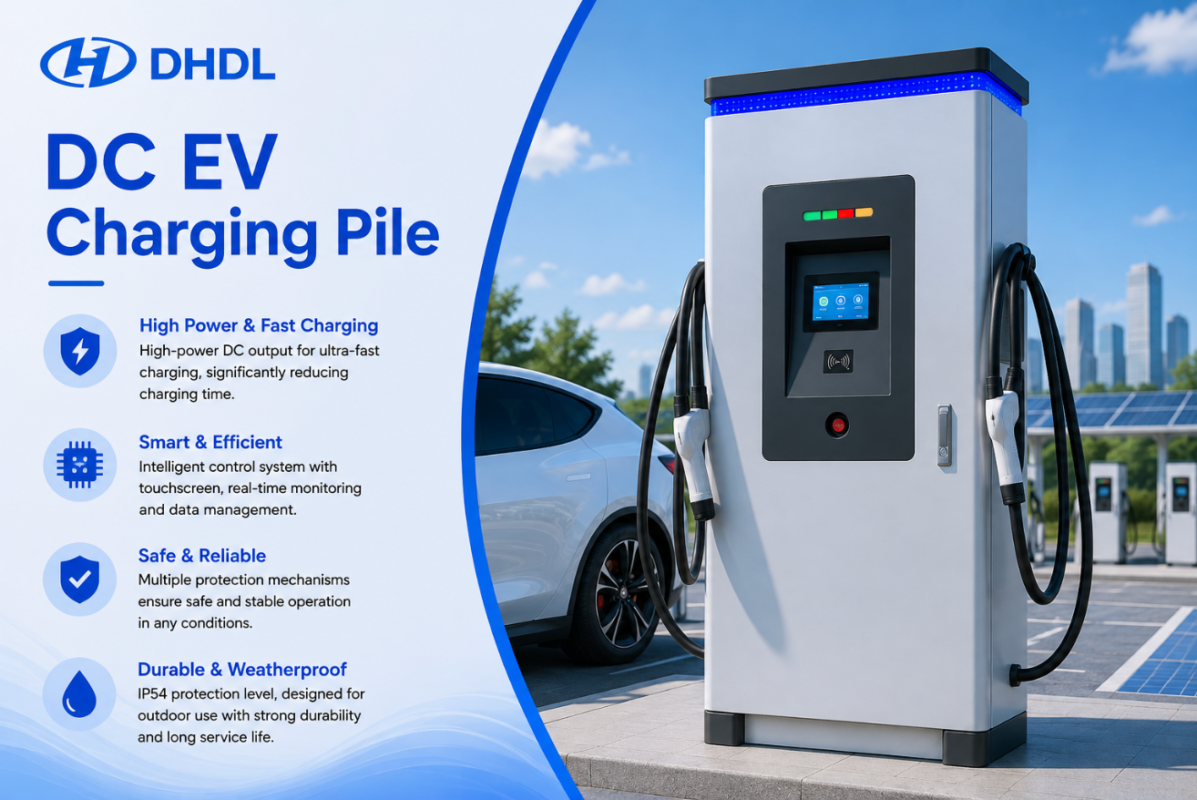
DHDL high-power DC EV charging pile with configurable 100–300kW output, single or dual connectors, intelligent control, and 4G monitoring.
What Is a DC EV Charging Pile?
A DC EV charging pile converts incoming electrical power into controlled direct-current output for a compatible electric vehicle.
Unlike an AC charger, which relies on the vehicle’s onboard charging equipment for power conversion, a DC charger performs the main conversion inside the charging equipment. It can then supply controlled DC power to the vehicle battery system through a compatible charging interface.
DHDL positions this product for applications that require rapid energy replenishment, including:
- Commercial charging stations
- Public parking areas
- Highway service areas
- Bus stations
- Fleet-charging sites
- Logistics parks
- Factory parks
- Passenger-vehicle charging
- Bus and logistics-vehicle charging
- Heavy-duty new-energy vehicle projects
- Solar-storage-charging projects
Still, the target vehicle must support the proposed connector, voltage, current, communication protocol, and charging power. A 300kW charger cannot automatically deliver 300kW to every connected vehicle.
Published Technical Specifications
DHDL publishes a configurable product framework rather than one fixed charger model.
| Item | Published product information |
|---|---|
| Product type | DC EV Charging Pile |
| Charging type | High-power DC fast charging for commercial EV applications |
| Output power | 100–300kW, configurable according to project charging demand |
| Connector configuration | Single or dual connector |
| Monitoring | 4G network-based real-time charging-status monitoring |
| Operation functions | Backend management, charging-data visibility, and remote charging-session management |
| Safety protection in specification table | Overvoltage, undervoltage, overload, short-circuit, and over-temperature protection |
| Additional protection listed in FAQ | Overcurrent, leakage, temperature monitoring, lightning protection, and intelligent protection |
| Applications | Commercial stations, public parking, fleets, highway service areas, and high-power charging projects |
| Customizable items | Charging power, connector quantity, communication mode, backend connection, protection configuration, and operating requirements |
| Additional customization listed in FAQ | Installation method, display system, management platform, and appearance |
The 100–300kW figure defines the published configurable range. Nevertheless, DHDL should confirm the exact rated power, input and output values, connector, cable, cooling, protection, environmental rating, and standards in the project-specific datasheet.
How Does a Commercial DC Charger Work?
Power Conversion
The charger converts the incoming electrical supply into regulated DC output.
The vehicle’s battery management and charging-control systems communicate with the charger. Together, they determine the power that the vehicle can accept under the current conditions.
Therefore, the actual charging rate can depend on:
- Vehicle charging capability
- Battery voltage
- Battery state of charge
- Battery temperature
- Vehicle control limits
- Charger output capability
- Shared-power logic
- Cable and connector ratings
- Site power-management strategy
Consequently, buyers should not promise a fixed charging time based only on the charger’s maximum power.
Charging Communication
A DC charger must exchange charging and safety information with the connected vehicle.
The product page does not publish one universal connector or vehicle-communication standard. Therefore, buyers should identify:
- Destination market
- Target vehicle types
- Connector standard
- Communication requirements
- Battery-voltage range
- Maximum vehicle charging power
- Cable requirements
- Single- or dual-connector arrangement
DHDL can then evaluate the appropriate configuration.
Charging Control
DHDL includes intelligent charging control within the product.
This function supports charging-session management according to the charger, vehicle, backend, and protection logic. However, buyers should request a clear description of the startup process, power-allocation method, fault response, emergency stop, session termination, and platform controls.
Backend Operation
The charger supports backend control and operation management.
As a result, operators can potentially monitor charger status, manage sessions, and view charging information through the approved platform configuration.
However, the product page does not name one standard backend platform. Therefore, buyers should confirm the software scope, communication protocol, server arrangement, account management, remote functions, data retention, platform charges, and third-party integration.
How Should Buyers Select the Charging Power?
The correct rating depends on the site and vehicles rather than a general preference for the highest available power.
Start with Vehicle Demand
Different vehicles can accept different DC power levels. Moreover, one vehicle may reduce charging power as its battery fills or when its thermal-control system limits charging.
Therefore, buyers should analyze:
- Passenger cars
- Taxis
- Buses
- Logistics vehicles
- Fleet vans
- Heavy-duty trucks
- Daily driving distance
- Battery capacity
- Charging windows
- Required vehicle turnaround
DHDL states that its configurable DC chargers can support passenger cars, buses, logistics vehicles, heavy-duty trucks, and other new-energy vehicles. Nevertheless, DHDL must match the charger to the actual vehicle interfaces.
Review the Required Charging Window
A highway service area may need shorter sessions than an overnight fleet depot. Similarly, a logistics fleet may prioritize predictable vehicle availability rather than maximum public throughput.
Therefore, define:
- Required energy per vehicle
- Available parking time
- Vehicles per day
- Peak arrival periods
- Target sessions per connector
- Expected utilization
- Queue tolerance
- Operational reserve
Check the Available Grid Capacity
A high-power charger creates a substantial electrical load. Moreover, several chargers can operate simultaneously.
The project team should review:
- Utility connection capacity
- Transformer capacity
- Medium- or low-voltage supply
- Main switchboard capacity
- Cable ratings
- Protection coordination
- Power quality
- Existing site demand
- Simultaneous charging
- Future expansion
- Demand-management strategy
If the site lacks sufficient capacity, the project may need a transformer, switchgear, distribution-cabinet upgrade, controlled power allocation, or energy storage.
Define Future Expansion
A site may start with a limited number of chargers and expand later. Therefore, buyers should reserve:
- Grid connection capacity
- Transformer capacity
- Switchgear feeders
- Cable routes
- Foundations
- Communication ports
- Backend licenses
- Parking positions
- Space for future chargers
- Load-management capacity
Planning these interfaces early can reduce later reconstruction.
Single-Connector vs. Dual-Connector Configuration
DHDL offers both configurations.
| Selection factor | Single-connector charger | Dual-connector charger |
| Published availability | Available | Available |
| Simultaneous vehicle positions | One connected charging position | Up to two connected positions, subject to approved operating logic |
| Physical layout | Simpler connector and cable arrangement | Requires access and cable planning for two vehicle positions |
| Power-allocation question | Full charger operation relates to one connector | Buyer must confirm whether and how the charger shares power |
| Suitable operational focus | Dedicated vehicle position or predictable single-session use | Sites seeking greater connection flexibility |
| Parking design | One charger-to-space relationship | Charger placement must serve two spaces safely |
| Buyer verification | Connector, power, vehicle, cable, and access | Total power, per-connector output, allocation logic, connectors, and simultaneous operation |
A dual-connector enclosure does not prove that each connector can deliver the charger’s full rated power simultaneously. The product page does not publish the power-allocation logic.
Therefore, buyers should request the following values:
- Maximum total charger power
- Maximum power per connector
- Simultaneous-output capability
- Dynamic or fixed power-sharing logic
- Minimum assignable power
- Priority rules
- Behavior when the second vehicle connects
What Does 4G Monitoring Provide?
DHDL lists built-in 4G communication for:
- Real-time charging-status monitoring
- Backend operation management
- Charging-data visibility
- Remote charging-session management
These functions can support multi-site or multi-charger operation. Nevertheless, buyers should define the complete digital architecture.
Confirm:
- Supported communication protocol
- Backend platform
- SIM-card responsibility
- Mobile-network requirements
- Data plan
- Offline operating behavior
- Local data storage
- Remote start and stop
- Alarm notifications
- User authentication
- Payment integration
- API requirements
- Cybersecurity requirements
- Software updates
- Platform ownership and fees
A charger with 4G hardware does not automatically integrate with every charging-management platform.
What Protection Functions Does DHDL Publish?
The technical table and FAQ collectively list:
- Overvoltage protection
- Undervoltage protection
- Overcurrent protection
- Overload protection
- Short-circuit protection
- Leakage protection
- Over-temperature protection
- Temperature monitoring
- Lightning protection
- Intelligent protection functions
These protections support the charger’s safety design. However, DHDL should confirm the exact protective devices, thresholds, response sequence, residual-current arrangement, surge protection, emergency stop, insulation monitoring, grounding requirements, and upstream protection for the selected configuration.
Furthermore, the site’s transformer, switchgear, cables, grounding system, and fire-protection design must coordinate with the charger.
Where Can Buyers Use DC EV Charging Piles?
Commercial Charging Stations
Commercial stations need to balance charging speed, equipment utilization, user access, payment, maintenance, and site capacity.
A 100–300kW configurable charger can support different station concepts. However, operators should base the design on realistic vehicle traffic and charging demand.
Highway Service Areas
Highway users generally expect shorter charging stops. Therefore, highway sites may prioritize high charging power, multiple connectors, reliable backend operation, clear vehicle circulation, and future expansion.
Nevertheless, the project should evaluate peak travel periods, queue formation, heavy-vehicle requirements, available grid capacity, weather exposure, lighting, signage, and maintenance response.
Public Parking Areas
Public parking projects may combine charging with longer shopping, business, or leisure visits.
Consequently, the operator should determine whether every space needs high-power DC charging or whether the site should combine DC fast chargers with lower-power AC EV charging piles.
Fleet Depots
Taxi, bus, delivery, logistics, and corporate fleets often have planned routes and charging windows.
Therefore, fleet buyers should provide:
- Number of vehicles
- Vehicle battery capacity
- Daily energy consumption
- Return times
- Departure deadlines
- Dwell time
- Number of spare vehicles
- Required state of charge
- Simultaneous charging
- Connector arrangement
- Future fleet growth
A depot may gain more value from coordinated charging schedules than from giving every position the highest possible power.
Bus Stations
Buses can require high energy within fixed operating schedules. However, the charger must match the bus connector, voltage, battery system, charging protocol, and depot plan.
Moreover, the project may need higher-capacity transformers and distribution equipment. Buyers should evaluate the complete station rather than the charger alone.
Logistics Parks
Logistics vehicles may charge between routes, during loading, or overnight.
The correct power depends on vehicle utilization and route distance. Consequently, buyers should model the fleet schedule before selecting charger quantity and power.
Heavy-Duty Vehicle Projects
The product FAQ includes heavy-duty trucks among the supported vehicle categories.
However, DHDL must confirm the specific truck voltage, connector, communication protocol, required charging power, cable handling, parking geometry, and operating environment.
Solar-Storage-Charging Projects
DHDL lists integrated solar-storage-charging projects as an application.
A project can combine PV generation, battery storage, and EV charging within a coordinated electrical system. Nevertheless, the engineering team must define the PV capacity, storage capacity, charging load, grid connection, EMS logic, transformer, switchgear, and protection.
For related storage equipment, buyers can review DHDL’s All-in-One Air-Cooled Energy Storage Cabinet.
DC vs. AC EV Charging Piles
DHDL offers both charging types.
| Selection factor | DHDL DC EV Charging Pile | DHDL AC EV Charging Pile |
| Published output power | Configurable from 100–300kW | 3.5kW or 7kW |
| Charging approach | Supplies controlled DC power to a compatible vehicle | Supplies AC power for conversion by the vehicle’s onboard charger |
| Primary charging role | High-power fast charging | Daily charging during longer parking periods |
| Typical applications | Commercial stations, highways, fleets, public parking, buses, and logistics | Homes, residential communities, offices, hotels, private parking, and property projects |
| Connector options | Single or dual connector | Product-specific vehicle connector requires confirmation |
| Installation | Project-specific installation method can be customized | Wall-mounted or floor-mounted |
| Monitoring | 4G real-time monitoring and backend management | Network charging, backend control, and 4G monitoring |
| Site-power demand | Much higher published power per unit | Lower published power per unit |
| Main buyer priority | Throughput, vehicle turnaround, grid capacity, and operation | Parking duration, daily charging, available power, and user access |
| Best project decision | Use where high-power rapid charging supports the operating model | Use where vehicles remain parked for sufficient time |
DC charging fits high-demand sites that need faster energy replenishment. Conversely, AC charging may provide a more practical solution for long-duration parking.
Many sites can use a mixed strategy. For example, a commercial facility could reserve DC charging for short-stay users while using AC chargers for employees or overnight parking.
DC Charging Pile vs. Charging Site
A common procurement mistake is to treat the charger as the entire charging station.
| Project element | Included or supported by the charger page | Requires project-level confirmation |
| DC power conversion | Yes | Exact ratings and electrical interface |
| Single or dual connector | Yes | Connector standard and power sharing |
| 4G monitoring | Yes | Platform, protocol, SIM, data, and API |
| Charger protection | Multiple functions published | Exact devices, settings, and site coordination |
| Transformer | Not stated as part of the charger | Capacity and voltage conversion |
| MV/LV switchgear | Not stated as part of the charger | Distribution and protection architecture |
| External cables | Not defined | Size, route, length, installation, and responsibility |
| Civil works | Not defined | Foundation, drainage, parking, bollards, and access |
| Payment platform | Not specifically defined | Commercial operation and settlement |
| Energy storage | Not stated as part of charger | Capacity, PCS, EMS, and operating logic |
| Installation and commissioning | Customizable scope requires confirmation | Site and supplier responsibilities |
Therefore, buyers should request both a charger quotation and a clear list of external station requirements.
What Can DHDL Customize?
DHDL lists the following customization options:
- Output power
- Number of connectors
- Connector type
- Installation method
- Communication protocol
- Communication mode
- Backend-system connection
- Display system
- Operation-management platform
- Protection configuration
- Operating requirements
- Appearance design
Still, buyers should ask DHDL to classify every item as standard, optional, or project-specific. The technical proposal should also identify included software, external devices, installation, commissioning, training, warranty, and documentation.
Key Buyer Checks Before Ordering
Confirm Input Power Requirements
The product page asks buyers to provide the required input voltage but does not publish one standard input for every 100–300kW configuration.
Therefore, submit:
- Available input voltage
- Frequency
- Grid capacity
- Transformer data
- Short-circuit level
- Earthing system
- Existing site load
- Voltage variation
- Power-quality requirements
- Planned charger quantity
Confirm Output and Vehicle Compatibility
Provide:
- Vehicle categories
- Vehicle models where available
- Battery-voltage range
- Maximum charging power
- Connector type
- Communication standard
- Required cable length
- Single- or dual-connector preference
- Simultaneous charging requirement
Confirm the Site Load Plan
The installed maximum load may differ from the realistic simultaneous load. Therefore, the project should define:
- Number of chargers
- Rated power per charger
- Expected utilization
- Peak simultaneous sessions
- Power-sharing strategy
- Load-management limit
- Expansion stage
- Other site loads
Confirm the Backend and Payment Model
Identify:
- Private or public use
- User authentication
- Payment method
- Tariff structure
- Backend platform
- Remote operation
- Charging records
- Financial settlement
- API integration
- Data ownership
- Network coverage
Confirm Environmental Conditions
Provide:
- Indoor or outdoor location
- Minimum and maximum temperature
- Humidity
- Rainfall
- Flooding risk
- Dust
- Salt or corrosive atmosphere
- Altitude
- Solar exposure
- Snow and ice
- Vehicle-impact risk
The product page does not publish a fixed IP rating or operating-temperature range for this DC charger. Therefore, DHDL must confirm the enclosure and environmental configuration.
Confirm Civil and Traffic Design
High-power charging sites need safe vehicle circulation.
The site plan should address:
- Charger foundation
- Parking geometry
- Connector reach
- Cable management
- Wheel stops
- Bollards
- Heavy-vehicle turning radius
- Pedestrian paths
- Accessibility
- Drainage
- Emergency access
- Maintenance clearance
Target-Market Considerations
DHDL’s target markets include Ukraine, Ethiopia, Vietnam, Thailand, Myanmar, Uzbekistan, Russia, and Nigeria. However, each project requires local grid, vehicle, connector, climate, and operation data.
| Target market | Project information buyers should confirm |
| Ukraine | Grid voltage, minimum temperature, snow and wind, connector requirements, vehicle types, network coverage, and local standards |
| Ethiopia | Available grid capacity, altitude, ambient heat, dust, vehicle fleet, transport conditions, and 4G availability |
| Vietnam | Grid capacity, humidity, rainfall, flooding, coastal corrosion where relevant, connector mix, and backend requirements |
| Thailand | High temperature, humidity, solar exposure, drainage, vehicle traffic, connector requirements, and station operation |
| Myanmar | Grid reliability, monsoon exposure, communication coverage, vehicle types, site access, and maintenance capability |
| Uzbekistan | Seasonal temperature range, dust and sand, grid voltage, fleet requirements, 4G coverage, and logistics |
| Russia | Minimum temperature, snow, grid requirements, vehicle connector mix, communication, heating needs, and standards |
| Nigeria | Grid availability, transformer capacity, generator or storage coordination, heat, rain, dust, security, and network coverage |
For example, a charging site in Nigeria may need to evaluate grid limitations and backup supply alongside charger selection. Meanwhile, a project in Russia may place greater emphasis on low-temperature operation and cable handling.
Therefore, buyers should submit measured site data and target-vehicle information instead of relying only on the country name.
Information DHDL Needs for a Quotation
| RFQ information | Why it matters |
| Project application | Defines public, highway, fleet, bus, logistics, factory, or mixed use |
| Required charging power | Establishes the configuration within 100–300kW |
| Charger quantity | Supports total load and project planning |
| Input voltage and frequency | Defines the charger’s electrical interface |
| Available grid capacity | Shows whether the site can support the proposed load |
| Target vehicles | Supports voltage, power, connector, and cable selection |
| Connector type | Defines vehicle compatibility |
| Single or dual connectors | Defines layout and charging-session capacity |
| Simultaneous charging requirement | Defines power sharing and site demand |
| Installation environment | Supports enclosure and thermal design |
| Site layout | Supports foundation, parking, cable, and access design |
| Communication protocol | Defines charger-to-platform integration |
| Backend platform | Supports remote monitoring and operation |
| Payment requirements | Defines the commercial user process |
| Protection requirements | Supports charger and site coordination |
| Applicable charging standards | Establishes the design and approval basis |
| Project quantity and phases | Supports current deployment and expansion |
| Destination and schedule | Supports logistics and production planning |
If the project remains at the planning stage, provide the vehicle types, charger quantity, desired power, available grid capacity, installation location, and operating model first. DHDL can then identify which technical inputs still need confirmation.
Frequently Asked Questions
What output-power range does DHDL publish?
DHDL publishes a configurable range from 100kW to 300kW.
Can buyers choose one or two charging connectors?
Yes. DHDL offers single-connector and dual-connector configurations. Buyers should confirm power sharing and simultaneous-output requirements for a dual-connector charger.
Does the charger support remote monitoring?
Yes. The product page lists 4G real-time charging-status monitoring, backend operation management, charging-data visibility, and remote charging-session management.
Which vehicles can the charger support?
The FAQ lists passenger cars, buses, logistics vehicles, heavy-duty trucks, and other new-energy vehicles. However, DHDL must match the connector, voltage, communication, and charging power to the target vehicles.
Which safety functions are published?
The page lists overvoltage, undervoltage, overcurrent, overload, short-circuit, leakage, over-temperature, temperature monitoring, lightning protection, and intelligent protection across its specification and FAQ sections.
Can DHDL customize the management platform?
Yes. DHDL lists the communication protocol, backend connection, display, operation-management platform, and operating requirements as customizable.
Does the product page publish a fixed input voltage?
No. The RFQ section asks the buyer to provide the required input voltage. Therefore, DHDL should confirm the electrical input for the selected power configuration.
Does 300kW guarantee a specific charging time?
No. Actual charging power and time depend on the vehicle, battery, state of charge, temperature, connector, charger configuration, and operating limits.
Is a DC charger enough to build a complete station?
Not necessarily. The site may also need transformer capacity, switchgear, distribution cabinets, external cables, foundations, networking, payment systems, signage, parking design, and commissioning.
Design the Charging Site Around Real Vehicle Demand
The DHDL DC EV Charging Pile provides configurable high-power charging from 100kW to 300kW. Moreover, buyers can select single or dual connectors and configure communication, backend management, protection, display, installation, and operating functions.
Therefore, the product can support commercial stations, highways, public parking, fleets, buses, logistics parks, factory sites, heavy-duty vehicles, and solar-storage-charging projects.
However, the correct configuration depends on the vehicles, charging window, connector, grid capacity, simultaneous demand, backend, environment, civil layout, protection, and applicable standards.
To request a project-specific proposal, send your required power, input voltage, target vehicles, connector standard, single- or dual-connector requirement, charger quantity, available grid capacity, installation environment, communication protocol, backend requirements, site layout, destination, and project schedule through the DHDL contact page.