3.5kW and 7kW AC EV Charging Pile: A Practical Buyer’s Guide

Drivers often leave their vehicles parked at home, at work, or in a commercial parking area for several hours. Consequently, these locations do not always require high-power DC fast charging. Instead, they may need an AC charging solution that fits regular parking periods, available electrical capacity, access-control requirements, and property-management systems.
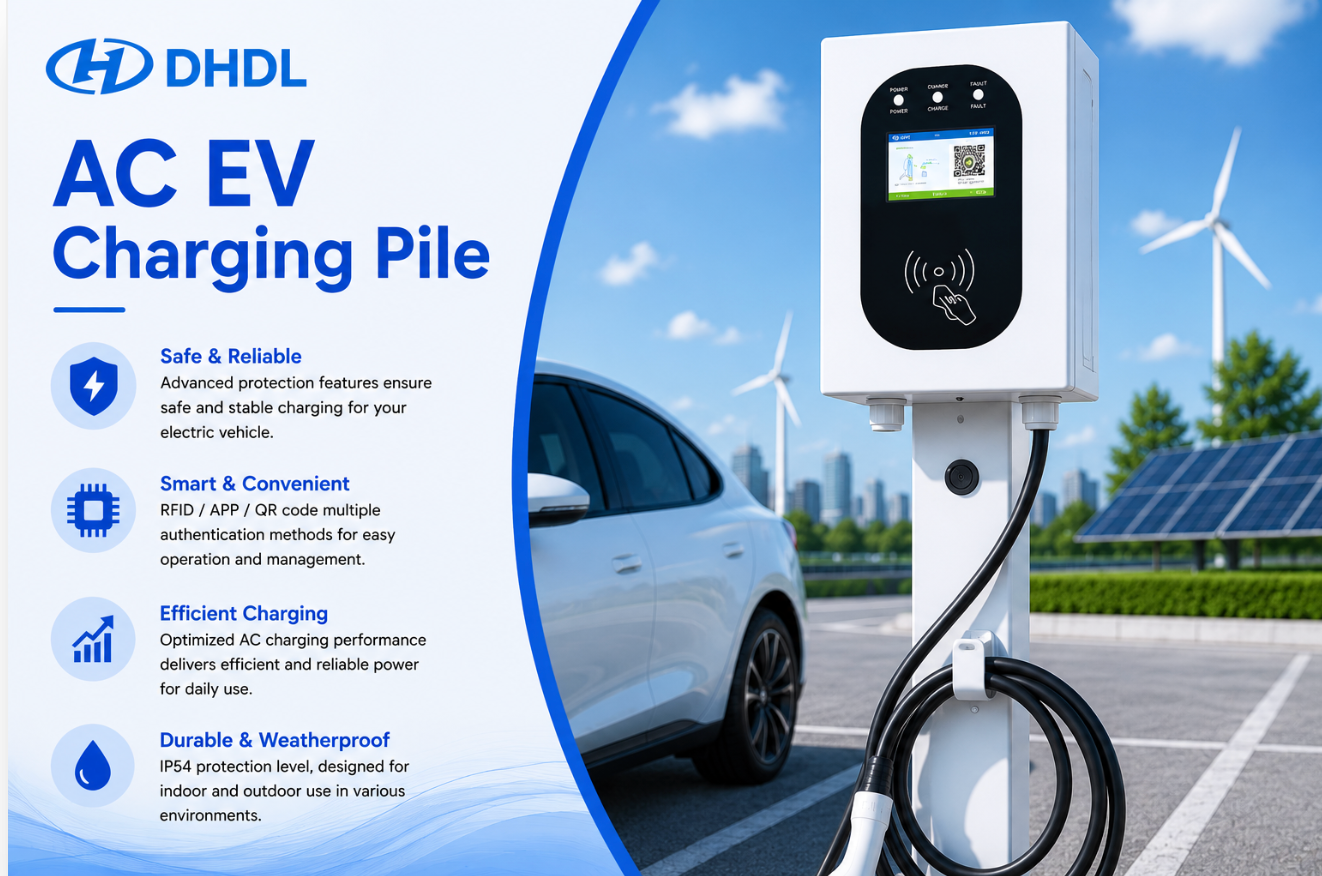
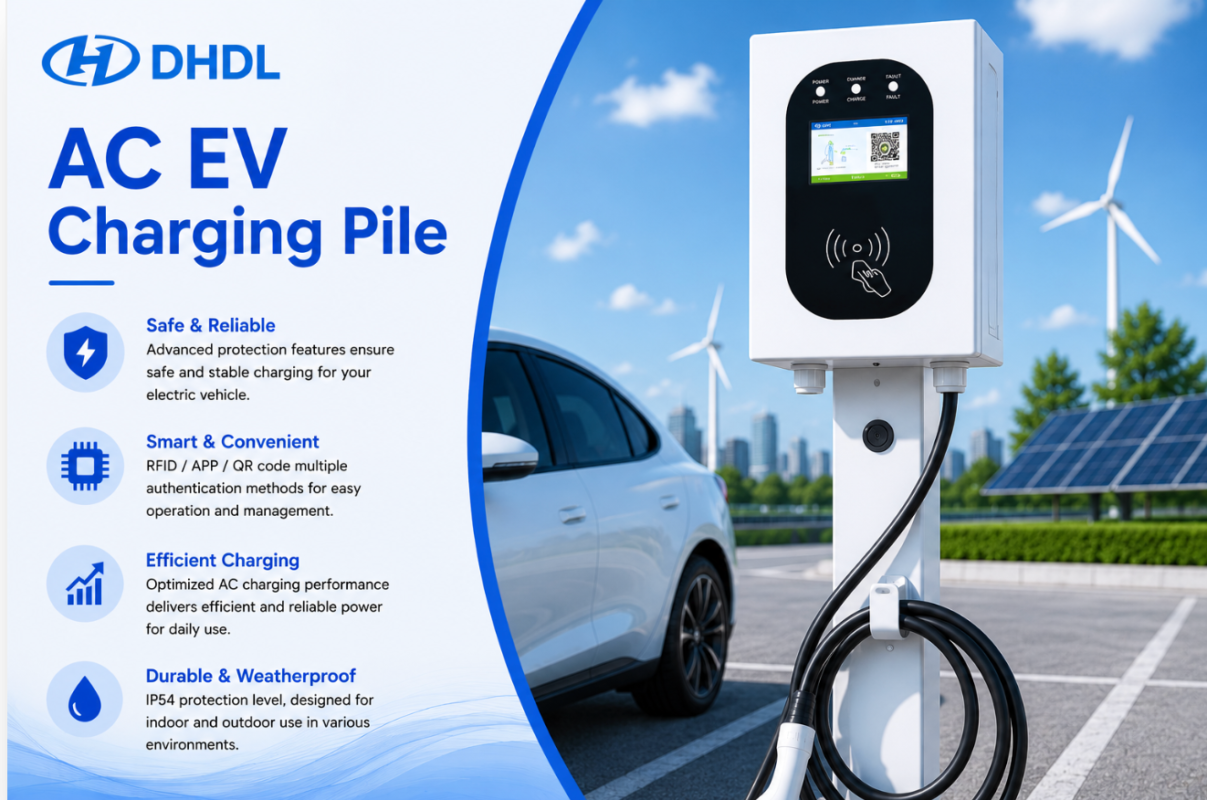
The DHDL AC EV Charging Pile provides 3.5kW or 7kW AC charging from a 220V input. DHDL offers wall-mounted and floor-mounted installation, an IP54-rated sheet-metal enclosure, network charging, backend control, operation management, and 4G real-time charging-status monitoring.
Moreover, buyers can select between the YX-ACB-B Smart Type and YX-ACB-Z Flagship Type. The flagship configuration adds options such as a 4.3-inch HD touchscreen, QR-code startup, local or online scheduled charging, and a 485 electricity meter.
However, a charging project involves more than selecting a 3.5kW or 7kW label. Buyers must also verify the vehicle interface, electrical supply, cable capacity, installation environment, access method, communication protocol, metering, protection, quantity, and local requirements.
DHDL AC EV charging pile for residential communities, private parking spaces, commercial parking facilities, and property developments.
What Is an AC EV Charging Pile?
An AC EV charging pile supplies alternating-current power to a compatible electric vehicle. The vehicle’s onboard charging system then handles the required AC-to-DC conversion for the battery.
DHDL developed this product for:
- Residential communities
- Private parking spaces
- Property developments
- Commercial parking lots
- Office buildings
- Hotels
- Public parking areas
- Enterprise parks
- Daily electric-vehicle charging
The specified DHDL models use a 220V input and provide either 3.5kW or 7kW charging power. Therefore, they primarily target daily charging during longer parking periods rather than the high-power fast-charging role of a commercial DC charging station.
The charger supports both wall-mounted and floor-mounted installation. As a result, buyers can adapt the physical arrangement to the parking-space layout.
Published AC Charging Pile Specifications
DHDL publishes two model configurations on the product page.
| Item | YX-ACB-B Smart Type | YX-ACB-Z Flagship Type |
|---|---|---|
| Product dimensions | 370 × 250 × 100mm | 370 × 250 × 100mm |
| Installation method | Wall-mounted or floor-mounted | Wall-mounted or floor-mounted |
| Operating temperature | -20°C to 65°C | -20°C to 65°C |
| Protection level | IP54 | IP54 |
| Output power | 3.5kW or 7kW | 3.5kW or 7kW |
| Input voltage stated in overview | 220V | 220V |
| Standby power consumption | No more than 0.1% of output power | No more than 0.1% of output power |
| Screen | No screen | Optional 4.3-inch HD touchscreen |
| Network charging | Supported | Supported |
| Operation management | Supported | Supported |
| Startup method | Card swiping | Card swiping or QR-code scanning |
| Backend control | Supported | Supported |
| Scheduled charging | Not supported | Local or online settings supported |
| Metering method | Metering chip | Metering chip or 485 electricity meter |
| Surge protection | Board-mounted | Board-mounted surge protector |
These values describe the two published models. Nevertheless, buyers should ask DHDL to confirm the connector, charging cable, current, communication protocol, metering accuracy, protective-device arrangement, and applicable standards for the proposed configuration.
How Do the Main Functions Support Daily Charging?
3.5kW or 7kW Charging Power
DHDL offers two published power options: 3.5kW and 7kW.
A higher charging-power label does not automatically make a charger the correct choice. Instead, the buyer should consider:
- Vehicle onboard-charger capability
- Available electrical capacity
- Charging window
- Daily driving distance
- Number of chargers
- Simultaneous charging rate
- Building load
- Cable and protection capacity
- Future expansion
For example, a vehicle cannot necessarily use the full available output merely because the charger carries a 7kW rating. The actual charging rate also depends on the vehicle and the complete electrical system.
Therefore, buyers should confirm vehicle compatibility and site capacity before choosing between 3.5kW and 7kW.
Smart Charging Management
Both published models support network charging, operation management, and backend control.
Moreover, DHDL states that the chargers can support 4G real-time charging-status monitoring. These functions can help property managers or operators supervise multiple chargers through an approved management arrangement.
However, the product page does not identify one universal backend platform or communication protocol. Consequently, buyers should confirm:
- Platform ownership
- Communication protocol
- 4G requirements
- SIM and data responsibilities
- Charger onboarding process
- User-account management
- Charging records
- Alarm reporting
- Remote-control permissions
- Data-storage requirements
- Software or platform charges, if applicable
A general statement that a charger supports networking does not guarantee compatibility with every third-party platform.
Card and QR-Code Startup
The YX-ACB-B Smart Type uses card swiping as its published startup method.
In contrast, the YX-ACB-Z Flagship Type supports card swiping and QR-code scanning. Therefore, the flagship model offers an additional access method for projects that need scan-code operation.
Still, buyers should define the intended user journey. A private parking space may need a simpler authorization process than an apartment complex, hotel, office campus, or paid public parking area.
Scheduled Charging
The Smart Type does not include scheduled charging in its published specification.
The Flagship Type, however, supports local or online scheduled-charging settings. This function can help users or operators define charging periods according to their operating strategy.
Nevertheless, the financial or grid benefit depends on the local tariff, building load, charging demand, and control logic. Buyers should therefore define the required schedule and control authority during the project review.
Metering
The Smart Type uses a metering chip. Meanwhile, the Flagship Type can use a metering chip or a 485 electricity meter.
This difference may matter when a project needs an external meter interface or a specific management arrangement. However, the product page does not publish a universal billing-meter certification or accuracy class.
Therefore, projects that use charging data for financial settlement should specify their metering and certification requirements.
Smart Type vs. Flagship Type
The following table translates the published differences into buyer-oriented selection criteria.
| Buyer requirement | YX-ACB-B Smart Type | YX-ACB-Z Flagship Type |
| Basic daily AC charging | Suitable within the published configuration | Suitable within the published configuration |
| 3.5kW or 7kW selection | Available | Available |
| Wall or pedestal installation | Available | Available |
| Network management | Supported | Supported |
| Backend control | Supported | Supported |
| Card access | Supported | Supported |
| QR-code access | Not listed | Supported |
| Touchscreen | No screen | Optional 4.3-inch HD touchscreen |
| Scheduled charging | Not supported | Local or online settings supported |
| 485 electricity meter | Not listed | Available as a metering option |
| Suitable decision priority | Simpler smart charging with card startup | More user-interface, access, scheduling, and metering options |
The Flagship Type offers a broader published feature set. However, the Smart Type may remain sufficient when the project does not need QR-code access, a touchscreen, scheduled charging, or 485-meter integration.
Therefore, buyers should select features according to the operating model rather than automatically choosing the configuration with more options.
Why Consider This AC Charging Solution?
Flexible Installation
Both models support wall-mounted and floor-mounted installation.
Wall mounting may suit parking spaces with an appropriate structural surface and cable route. Conversely, floor mounting can support locations where the charger needs a dedicated pedestal.
However, buyers should verify:
- Mounting surface
- Pedestal foundation
- Parking-space dimensions
- Cable route
- Vehicle charging-port position
- Charging-cable reach
- Bollards or impact protection
- Accessibility requirements
- Drainage
- Pedestrian movement
- Maintenance access
The mounting method should follow the site layout rather than visual preference alone.
Compact Dimensions
Both published configurations measure 370 × 250 × 100mm.
This compact enclosure can help buyers plan the charger within residential or commercial parking areas. Nevertheless, the complete installation also needs space for the connector and cable, user access, electrical protection, mounting hardware, and safe vehicle movement.
IP54 Enclosure
DHDL publishes an IP54 protection level for both models. The product page describes the charger as suitable for indoor and protected outdoor parking environments.
Therefore, buyers should not interpret IP54 as permission to install the charger in every exposed location without further review. Instead, they should consider rain exposure, flooding, drainage, direct sunlight, dust, temperature, corrosion, and mechanical impact.
Broad Published Operating-Temperature Range
The published operating-temperature range is -20°C to 65°C.
However, the project team should still verify whether this range applies to the complete selected configuration, cable, display, communication equipment, metering option, and installation conditions.
Moreover, operating within an ambient range does not automatically guarantee full output under every thermal condition. Buyers with demanding environments should request project-specific confirmation.
Low Published Standby Consumption
DHDL lists standby power consumption at no more than 0.1% of output power for both configurations.
Buyers should preserve the exact qualifier when using this value in procurement documents. In addition, they should confirm the measurement conditions if standby consumption forms part of a tender evaluation.
What Protection Functions Are Available?
The product page identifies the following AC charger protection functions:
- Overvoltage protection
- Overcurrent protection
- Leakage protection
- Short-circuit protection
- Over-temperature protection
- Lightning protection
- Intelligent control protection
- Surge-protection options
These functions support the charger’s electrical safety strategy. Nevertheless, buyers should ask DHDL to confirm the exact devices, ratings, thresholds, protective-earth arrangement, residual-current protection, upstream breaker requirements, and surge-protection configuration.
In addition, the building or site may require external protective devices beyond the charger itself. Therefore, a qualified project designer should coordinate the charger with the upstream electrical distribution system.
Where Can Buyers Install AC EV Charging Piles?
Residential Communities
Residential parking usually provides long dwell times. Consequently, 3.5kW or 7kW AC charging can support regular overnight or idle-time charging for compatible vehicles.
However, residential projects should consider:
- Available transformer capacity
- Building maximum demand
- Number of parking spaces
- Simultaneous charging
- User authorization
- Individual or shared metering
- Property-management platform
- Future charger growth
- Cable routes
- Fire and parking requirements
A development that starts with a small number of chargers should also plan the electrical and communication infrastructure for later expansion.
Private Parking Spaces
A private user may need a straightforward wall-mounted or floor-mounted charger with card access.
Nevertheless, the buyer should confirm the household or property supply, vehicle compatibility, charging cable, connector, mounting location, and protective equipment.
Property Developments
Developers can plan AC chargers as part of residential or commercial supporting infrastructure.
Moreover, DHDL can customize the charging power, installation method, communication protocol, access method, remote monitoring, management platform, and appearance.
Still, developers should decide which responsibilities belong to the property manager, charger operator, utility, homeowner, and maintenance provider.
Commercial Parking Lots
Commercial parking sites may need network management, user access, charging records, and remote status monitoring.
The Flagship Type’s QR-code startup, optional touchscreen, scheduling, and 485-meter option may support a broader operating model. However, the project should confirm whether the proposed backend and payment workflow meet its exact requirements.
Office Buildings and Enterprise Parks
Employees may leave vehicles parked for several working hours. Therefore, AC charging can align with the available dwell time.
However, the operator may also need load allocation, access control, user identification, charging schedules, and multiple-charger management.
Hotels
Hotel guests may charge vehicles during overnight stays. Nevertheless, the hotel should define charger access, parking allocation, metering, user support, cable management, and backend operation.
Public Parking Areas
The product FAQ lists public parking as an application.
However, public charging may require additional payment, metering, accessibility, signage, connector, communication, cybersecurity, and regulatory functions. Buyers should specify these requirements rather than assume the base charger includes them.
AC vs. DC EV Charging Piles
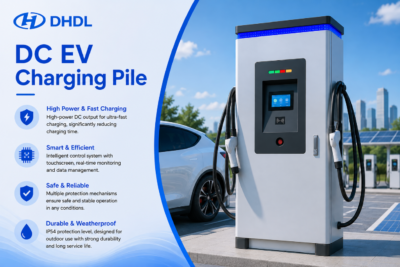
DHDL also supplies a DC EV Charging Pile. Its product page lists power options from 100kW to 300kW for commercial and public fast-charging applications.
| Selection factor | DHDL AC EV Charging Pile | DHDL DC EV Charging Pile |
| Published output power | 3.5kW or 7kW | 100–300kW |
| Published input for target models | 220V | Project-specific input should be confirmed |
| Charging role | Daily AC slow charging during longer parking periods | High-power DC fast charging |
| Typical published applications | Residential communities, private parking, properties, offices, hotels, and parking areas | Commercial stations, public parking, highway service areas, fleets, and high-power charging |
| Vehicle conversion | Uses the vehicle’s onboard AC charging system | Charger supplies controlled DC power to the vehicle |
| Installation options | Wall-mounted or floor-mounted | Model and project configuration should be confirmed |
| Network functions | Network charging, backend control, operation management, and 4G monitoring | 4G monitoring, backend control, and project-specific operation functions |
| Site-power requirement | Lower per-charger published power | Significantly higher published charger power |
| Main selection factor | Parking duration, vehicle compatibility, electrical capacity, access, and management | Fast-charging demand, vehicle type, input capacity, connector, utilization, and station design |
The AC charger fits locations where vehicles remain parked long enough for regular charging. Conversely, the DC product targets sites where users need much higher charging power and shorter charging sessions.
However, charging time does not depend on charger power alone. It also depends on vehicle compatibility, battery state, battery-management limits, temperature, and other operating conditions. Therefore, buyers should not publish a guaranteed charging time without verified vehicle-specific evidence.
3.5kW vs. 7kW AC Charging
| Selection factor | 3.5kW option | 7kW option |
| Published charger power | 3.5kW | 7kW |
| Typical buyer priority | Lower power demand and longer available charging windows | Higher available AC power and shorter required charging windows |
| Electrical-capacity impact | Lower charger demand | Higher charger demand |
| Vehicle requirement | Vehicle must support the proposed AC connection | Vehicle must accept the available AC charging power to use it fully |
| Multi-charger planning | May allow more chargers within a fixed capacity, depending on design | May require greater site capacity or load management |
| Best selection basis | Daily energy need, parking duration, vehicle, and site capacity | Daily energy need, parking duration, vehicle, and site capacity |
The 7kW option provides twice the nominal output power of the 3.5kW option. Nevertheless, the vehicle and electrical system determine whether the project can use that additional power.
For a multi-charger project, buyers should calculate both the installed maximum and the expected simultaneous demand.
What Can DHDL Customize?
According to the product page, DHDL can customize:
- Charging power
- Installation method
- Communication protocol
- Card-based access
- Remote monitoring
- Smart-management platform
- Appearance design
- Touchscreen configuration
- Metering solution
- Surge protection
- Scheduled-charging functions
However, buyers should distinguish between standard, optional, and project-specific functions. The final proposal should clearly identify:
- Included hardware
- Optional hardware
- Included software functions
- Platform responsibilities
- Communication charges
- Installation scope
- External electrical equipment
- Commissioning
- Training
- Warranty and support
Important Buyer Checks Before Ordering
Confirm Vehicle and Connector Compatibility
The product page does not publish one universal connector standard for every configuration.
Therefore, buyers should provide:
- Target vehicle models
- Required connector type
- Cable or socket arrangement
- Local charging standard
- Vehicle onboard-charger rating
- Required cable length
- User handling requirements
DHDL should confirm compatibility in the technical proposal.
Confirm Site Electrical Capacity
The project must support the total charging load.
Buyers should provide:
- Grid voltage and frequency
- Transformer capacity
- Main switchboard capacity
- Existing peak demand
- Charger quantity
- 3.5kW or 7kW selection
- Simultaneous charging assumption
- Future expansion
- Cable routes
- Upstream protective devices
- Earthing arrangement
Where the existing supply cannot support all chargers simultaneously, the project may need load management or electrical-system upgrades.
Confirm Access and Operating Method
Decide whether users will start charging through:
- Card swiping
- QR-code scanning
- Backend authorization
- Local operation
- Scheduled charging
- Online scheduled charging
The selected method affects the model, backend, communication, user accounts, and operating process.
Confirm Metering and Payment Requirements
A private charger may use a simpler metering arrangement than a public commercial site.
Therefore, clarify whether the project needs:
- Energy monitoring
- Internal management records
- Tenant allocation
- Financial settlement
- Certified billing meter
- 485-meter communication
- Payment-platform integration
- Invoice or receipt functions
The product page does not claim that every metering option holds every market-specific billing approval.
Confirm Communication Requirements
Specify:
- 4G availability
- Communication protocol
- Backend platform
- SIM responsibility
- Network-security requirements
- Remote monitoring
- Remote control
- Alarm reporting
- Offline behavior
- Data retention
Confirm the Installation Environment
Provide:
- Indoor or protected outdoor location
- Minimum and maximum temperature
- Rain exposure
- Flooding risk
- Humidity
- Dust
- Salt or corrosive atmosphere
- Direct sunlight
- Wall or pedestal mounting
- Vehicle-impact risk
- Parking-space dimensions
Target-Market Considerations
DHDL’s target markets include Ukraine, Ethiopia, Vietnam, Thailand, Myanmar, Uzbekistan, Russia, and Nigeria. Nevertheless, DHDL must adapt the configuration to each project’s supply, climate, vehicle base, connector requirements, and operating model.
| Target market | Information buyers should confirm |
| Ukraine | Supply voltage and frequency, minimum temperature, installation exposure, connector requirement, communication coverage, and local technical rules |
| Ethiopia | Supply stability, ambient temperature, dust, altitude, vehicle compatibility, site access, and communication availability |
| Vietnam | Supply conditions, humidity, rainfall, flooding, coastal corrosion where applicable, connector type, and backend requirements |
| Thailand | Ambient heat, humidity, direct sunlight, drainage, vehicle compatibility, communication, and property-management needs |
| Myanmar | Grid stability, monsoon exposure, site access, vehicle types, communication network, and maintenance capability |
| Uzbekistan | Seasonal temperature range, dust, supply voltage, vehicle connectors, 4G coverage, and installation environment |
| Russia | Minimum temperature, snow exposure, supply requirements, connector compatibility, communication, and applicable standards |
| Nigeria | Grid availability, backup generation, temperature, humidity, rain, site security, connector needs, and communication coverage |
Country-level information cannot confirm one charger configuration. For example, the published models use 220V input, but the project still needs to verify the actual supply and installation design.
Likewise, connector requirements can vary by vehicle population and market. Therefore, buyers should provide the intended vehicles and local technical specification.
What Information Does DHDL Need for a Quotation?
| RFQ information | Why it matters |
| Project type | Defines residential, hotel, office, commercial parking, property, or another use |
| Installation country and site | Establishes environmental and technical context |
| Charger quantity | Supports system capacity and commercial planning |
| Required power | Confirms 3.5kW or 7kW selection |
| Grid voltage and frequency | Confirms the electrical interface |
| Vehicle types | Supports connector and charging-compatibility review |
| Charger connector | Defines the vehicle interface |
| Installation method | Confirms wall or floor mounting |
| Indoor or outdoor location | Supports enclosure and environmental review |
| Access method | Defines card, QR code, backend, or other operation |
| Scheduled charging | Determines whether the flagship configuration is required |
| Screen requirement | Defines the optional touchscreen |
| Metering requirement | Defines the metering chip or 485-meter arrangement |
| Communication protocol | Supports platform integration |
| 4G and backend requirements | Defines remote management |
| Payment requirements | Clarifies the operating platform and metering needs |
| Protection requirements | Supports charger and upstream electrical design |
| Project scale and expansion | Supports distribution and communication planning |
| Applicable standards | Establishes the technical and documentation basis |
| Appearance requirements | Supports project-specific enclosure design |
If the project is still at the concept stage, provide the number of parking spaces, charger quantity, available power, target vehicles, installation location, and operating model first. DHDL can then identify the remaining technical inputs.
Frequently Asked Questions
What power options does DHDL publish?
The product page lists 3.5kW and 7kW for both the YX-ACB-B Smart Type and YX-ACB-Z Flagship Type.
What input voltage do the published models use?
The product overview specifies 220V input. Buyers should still provide the actual grid voltage and frequency so DHDL can confirm compatibility.
Can buyers choose wall or floor installation?
Yes. Both published models support wall-mounted and floor-mounted installation.
What is the enclosure protection level?
DHDL publishes an IP54 rating for both models. The company describes them as suitable for indoor and protected outdoor parking environments.
What is the difference between the Smart and Flagship models?
The flagship model adds QR-code startup, optional touchscreen, local or online scheduled charging, and a 485 electricity-meter option. The Smart Type uses card startup, has no screen, and does not list scheduled charging.
Does the charger support remote management?
Yes. The product page lists network charging, backend control, operation management, and 4G real-time charging-status monitoring.
What protection functions does DHDL list?
DHDL lists overvoltage, overcurrent, leakage, short-circuit, over-temperature, lightning, intelligent-control, and surge-protection functions or options.
Can DHDL customize the charger?
Yes. DHDL can customize charging power, installation, communication, access method, remote monitoring, smart-management platform, metering, scheduled charging, protection, and appearance according to the proposed configuration.
Does the product page specify the connector standard?
No. Therefore, buyers should provide the destination market, target vehicles, required connector, cable arrangement, and applicable standard.
Select the Charger Around the Parking and Power Strategy
The DHDL AC EV Charging Pile provides 3.5kW or 7kW charging from a published 220V input. Both models use a compact 370 × 250 × 100mm enclosure, support wall or floor mounting, carry an IP54 rating, and operate within a published -20°C to 65°C range.
Moreover, network charging, backend control, operation management, card access, and 4G monitoring support managed charging projects. The flagship model adds QR-code startup, an optional touchscreen, scheduled charging, and expanded metering options.
However, the correct solution depends on the vehicle, connector, electrical capacity, parking duration, charger quantity, simultaneous demand, access method, backend, environment, and local requirements.
To request a project-specific proposal, send the installation environment, charger quantity, grid voltage, required power, target vehicle and connector, wall or floor installation, access method, communication requirements, metering needs, project scale, destination, and applicable standards through the DHDL contact page.