All-in-One Air-Cooled Energy Storage Cabinet: A Buyer’s Guide for Commercial and Industrial Projects

Commercial and industrial energy storage projects need more than battery cells. They also require battery management, power conversion, energy management, thermal control, electrical protection, fire protection, monitoring, and communication functions.
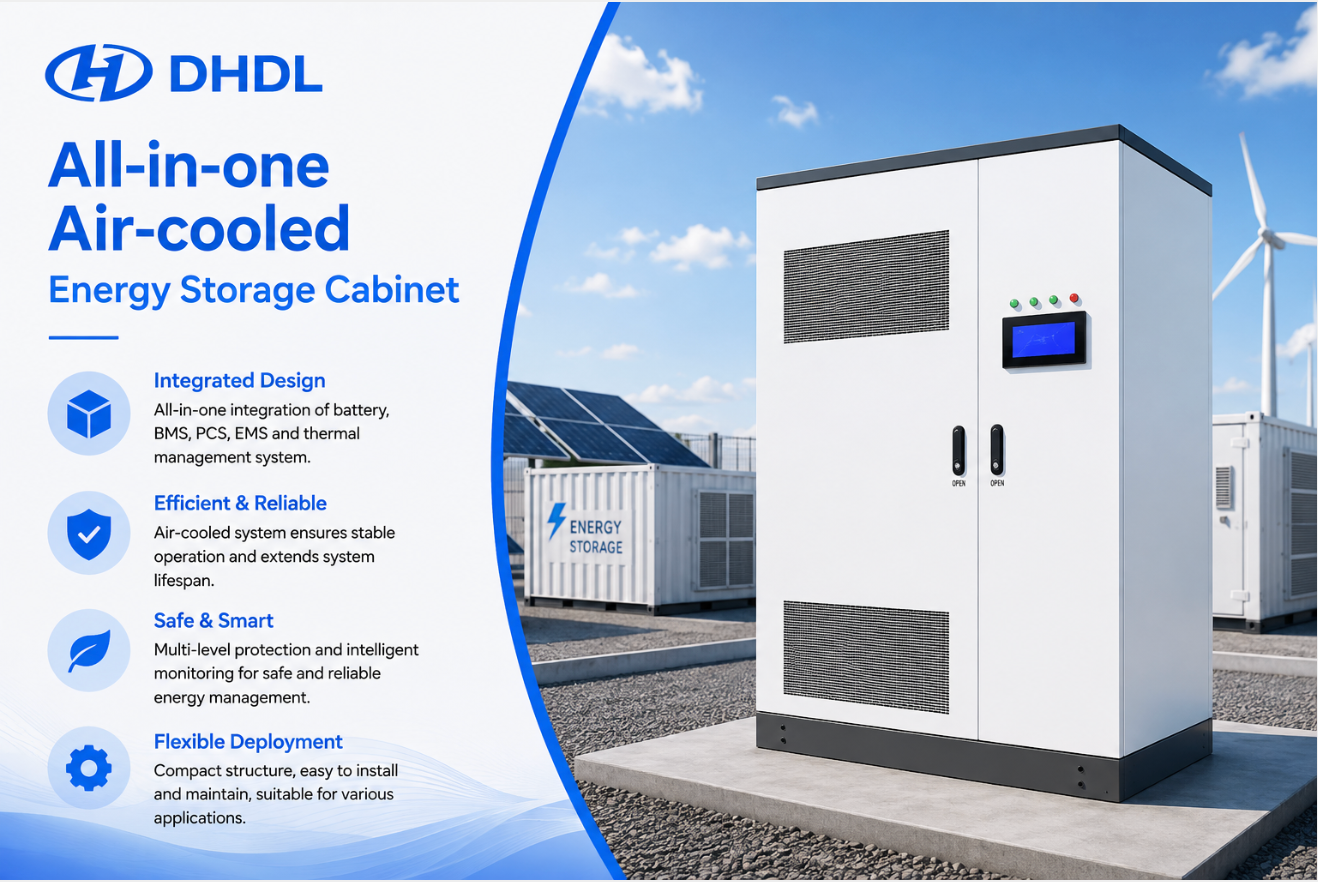
The DHDL All-in-One Air-Cooled Energy Storage Cabinet integrates these functions within one compact enclosure. Its core components include battery modules, a battery management system, an energy management system, a power conversion system, an air-cooling system, electrical protection, fire protection, and monitoring units.
Therefore, the cabinet provides an integrated platform for energy storage, charge and discharge control, peak shaving, backup power, energy management, and system protection.
Moreover, DHDL can customize the system capacity, PCS rating, battery configuration, cabinet layout, communication protocol, protection requirements, and grid-connection mode. However, buyers must first define their application, capacity, power, operating mode, grid conditions, environment, and equipment interfaces.
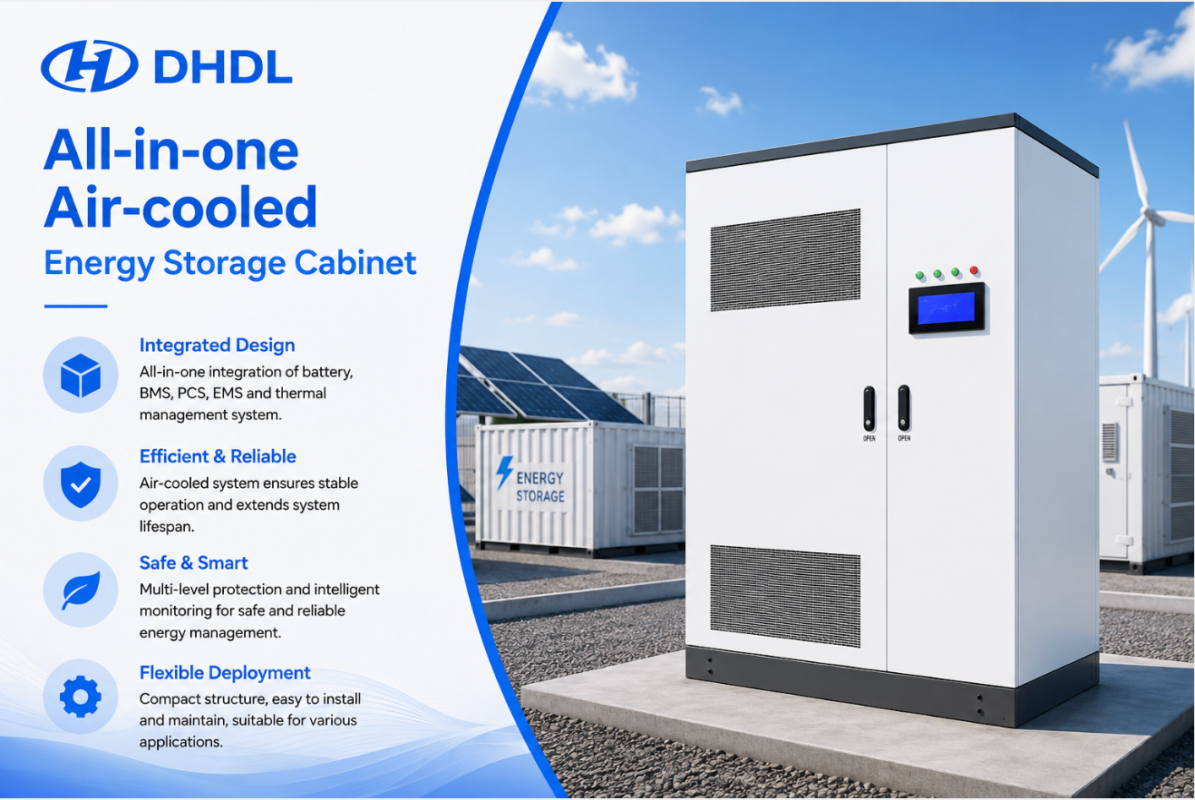
DHDL all-in-one air-cooled energy storage cabinet integrating battery modules, BMS, EMS, PCS, thermal management, protection, and monitoring.
What Is an All-in-One Air-Cooled Energy Storage Cabinet?
An all-in-one air-cooled energy storage cabinet combines the principal battery storage, power conversion, control, cooling, safety, and monitoring functions within one enclosure.
DHDL integrates:
- Battery modules
- Battery management system, or BMS
- Energy management system, or EMS
- Power conversion system, or PCS
- Air-cooling thermal-management system
- Electrical protection
- Fire-protection system
- Monitoring units
Instead of asking the site team to arrange every subsystem separately, DHDL coordinates the equipment inside an integrated cabinet. As a result, the design can simplify equipment positioning, installation, operation, and maintenance.
However, “all-in-one” does not mean that every external system falls within the cabinet. Buyers still need to confirm the grid connection, transformers, external switchgear, site controller, renewable-energy equipment, communication network, foundations, and external cables.
Therefore, every quotation should contain a clear scope-of-supply and interface table.
How Do the Integrated Systems Work Together?
Battery Modules Store Electrical Energy
The battery modules provide the cabinet’s energy-storage capacity. During charging, the system stores electrical energy in the batteries. During discharging, it releases energy through the power conversion system.
DHDL can customize the battery capacity and configuration according to the project. In addition, the product FAQ states that buyers can request a cell brand according to the proposed solution.
Still, buyers should evaluate more than the nominal capacity in kWh. They should also confirm:
- Required usable energy
- Required power in kW
- Charge and discharge duration
- Daily operating cycles
- Depth-of-discharge requirements
- Expected operating mode
- Ambient conditions
- Capacity-retention requirements
- Project service-life expectations
- Battery warranty terms
The product page does not publish one fixed battery capacity, cell chemistry, cycle life, degradation curve, or warranty for every configuration. Consequently, DHDL must confirm these details in the project-specific proposal.
BMS Monitors and Protects the Battery
The battery management system monitors battery operation and supports protective control.
According to the product page, the safety arrangement includes an intelligent BMS, temperature monitoring, overcharge protection, over-discharge protection, short-circuit protection, and multi-level safety interlocks.
Therefore, the BMS forms an important part of battery supervision. However, the final protection thresholds, sensing arrangement, control hierarchy, and communication functions depend on the selected battery configuration.
Buyers should request:
- BMS architecture
- Monitoring scope
- Alarm list
- Trip and shutdown logic
- Communication protocol
- State-of-charge information
- State-of-health information, if included
- Data-recording functions
- Interface with PCS, EMS, and fire protection
PCS Controls Power Conversion
The PCS manages electrical power conversion during charging and discharging. DHDL can customize the PCS rating and, according to the product FAQ, can review a requested PCS brand.
The PCS must match:
- Battery operating-voltage range
- Required charging and discharging power
- AC-side voltage
- Grid frequency
- Grid-connected or off-grid mode
- Reactive-power requirements
- Protection logic
- Communication protocol
- Transformer interface, where applicable
A mismatch between the battery, PCS, and external power system can cause technical revisions during commissioning. Therefore, buyers should provide the grid and battery interface requirements early.
EMS Coordinates Energy Operation
The EMS supports energy management and operating control. It can coordinate charging and discharging according to the approved project strategy.
For example, the system may support peak shaving, backup power, photovoltaic integration, or microgrid operation. Nevertheless, each operating objective needs different control inputs and priorities.
Buyers should define:
- Primary operating objective
- Charging schedule
- Discharging schedule
- Power limits
- Backup-power reserve
- Grid import or export limits
- PV coordination
- Tariff or demand-control logic
- Remote dispatch requirements
- Required data and reports
The product page does not publish one universal EMS algorithm or third-party-platform interface. Therefore, DHDL should confirm the final EMS functions and communication scope in writing.
Air Cooling Manages Cabinet Temperature
The cabinet uses air-cooling thermal management to help maintain a stable operating temperature.
The cooling system moves conditioned or controlled air through the relevant cabinet spaces. As a result, it can remove heat from the integrated equipment while supporting convenient maintenance.
However, the product page does not publish a fixed operating-temperature range, cooling capacity, temperature uniformity, or auxiliary-power consumption. Buyers should submit the site temperature, humidity, altitude, solar exposure, installation location, and expected operating load so that DHDL can confirm the thermal design.
Protection and Monitoring Support System Safety
The product integrates electrical protection, fire protection, temperature monitoring, and system monitoring.
The published safety functions include:
- Intelligent BMS
- Temperature monitoring
- Fire-protection system
- Overcharge protection
- Over-discharge protection
- Short-circuit protection
- Multi-level safety interlocks
These functions create several layers of monitoring and response. Nevertheless, buyers should request the exact detection devices, extinguishing method, alarm sequence, shutdown logic, external fire-system interface, and applicable project requirements.
Published Technical Specifications
The product page publishes a configurable system framework rather than one fixed capacity model.
| Item | Published product information |
|---|---|
| Product type | All-in-One Air-Cooled Energy Storage Cabinet |
| System design | Integrated cabinet for battery storage, power conversion, energy management, safety protection, and monitoring |
| Cooling method | Air-cooling thermal management for stable temperature control and convenient maintenance |
| Core components | Battery modules, BMS, EMS, PCS, air-cooling system, electrical protection, fire protection, and monitoring units |
| Main functions | Energy storage, charge and discharge control, peak shaving, backup power, energy management, and system protection |
| Applications | Commercial and industrial storage, distributed-energy projects, PV integration, backup-power systems, and microgrids |
| Customizable items | System capacity, PCS rating, battery configuration, cabinet layout, communication protocol, protection requirements, and grid-connection mode |
| Additional customization stated in FAQ | Output power, cell brand, PCS brand, protection level, and parallel-operation solution |
| Referenced standards | IEC, UL, and other relevant international standards according to project requirements |
| Referenced reports or documents | CE, UN38.3, MSDS, and other certification or test reports available according to project requirements |
The listed certificates and reports are not presented as universal documents for every possible configuration. Therefore, buyers should identify the required standards, certifications, battery-transport documents, test reports, issuing bodies, and applicable editions during the RFQ stage.
What Can the Cabinet Do for a C&I Project?
Peak Shaving
The system can charge during selected periods and discharge when the site requires additional power, according to the configured operating strategy.
This function can support peak shaving. However, the financial result depends on the local tariff, demand-charge structure, load profile, battery efficiency, cycling strategy, degradation, and system cost.
Therefore, buyers should provide interval load data instead of selecting capacity from the monthly electricity bill alone.
Backup Power
The cabinet can support backup-power applications. Nevertheless, backup operation requires a complete system design.
Buyers should define:
- Loads that require backup
- Required backup duration
- Maximum starting current
- Acceptable transfer time
- Grid-connected or off-grid operation
- Black-start requirements
- External transfer equipment
- Generator coordination
- Required reserve state of charge
The product page does not guarantee uninterrupted power or a specific transfer time. Consequently, DHDL must review the complete backup-power architecture.
Photovoltaic Integration
The cabinet can store energy from a PV system and coordinate charging and discharging according to the project strategy.
For example, a project may want to increase local PV use, limit export, or shift solar energy to a later period. However, the buyer must provide the PV inverter data, generation profile, grid restrictions, load profile, and operating objective.
Energy Management
The integrated EMS can coordinate the storage system’s operating schedule and power commands.
Moreover, monitoring functions can provide operators with relevant system information according to the approved configuration. Buyers should still confirm the dashboard, remote access, data retention, alarm notifications, reports, and third-party-system interfaces.
Microgrid Operation
DHDL lists microgrids among the product applications.
However, microgrid operation may require coordination with generation sources, loads, transformers, switchgear, protection devices, controllers, and the utility connection. Therefore, the cabinet should form part of an approved microgrid design rather than operate as an isolated solution.
Where Can Buyers Use the Cabinet?
Factories and Industrial Facilities
Factories may use storage for peak shaving, PV integration, backup power, or broader energy management.
However, industrial buyers should provide:
- Load profile
- Critical-load list
- Motor loads
- Harmonic sources
- Production schedule
- Existing transformer capacity
- Grid-connection voltage
- PV or generator information
- Backup requirements
- Installation environment
DHDL can then review the energy capacity, PCS power, operating mode, and external interfaces.
Commercial Buildings
Shopping centers, offices, hotels, logistics sites, campuses, and other commercial properties may have variable daily loads.
An integrated cabinet can support an energy-storage strategy without distributing the main battery and control components across multiple enclosures. Nevertheless, the buyer should confirm available space, fire requirements, noise limits, access, ventilation, grid rules, and load profile.
Solar-Plus-Storage Projects
The cabinet can combine with a PV project for distributed-energy applications.
Accordingly, buyers should provide the PV capacity, inverter data, expected generation, site load, export restrictions, point-of-connection voltage, and target operating strategy.
Charging Stations
The FAQ lists charging stations as a suitable application.
Storage may support the wider electrical arrangement of a charging site. However, the required capacity depends on charger power, simultaneous use, grid-connection capacity, daily vehicle demand, and recharge windows.
Buyers can review DHDL’s EV charging equipment range when planning a combined charging and storage project.
Data Centers
The product FAQ also lists data centers. Still, data-center projects require careful analysis of power continuity, transfer time, redundancy, fault tolerance, protection, monitoring, and fire safety.
Therefore, buyers should not assume that a general C&I cabinet replaces a data-center UPS or emergency-power architecture. Instead, the engineering team should define its exact role within the approved system.
Distributed-Energy and Microgrid Projects
The cabinet can serve distributed-energy and microgrid applications with project-specific grid, control, and communication configurations.
Moreover, DHDL can customize the grid-connection mode and protocol. Nevertheless, the buyer should provide the complete single-line diagram and system-control philosophy.
Air-Cooled vs. Immersion Liquid-Cooled Energy Storage
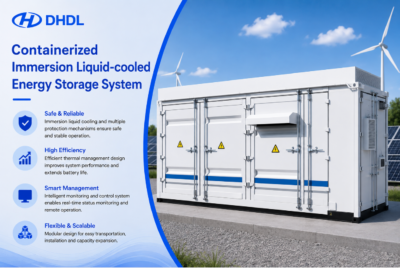
DHDL also offers a Containerized Immersion Liquid-Cooled Energy Storage System. The two products address different system scales and thermal-management priorities.
| Selection factor | All-in-one air-cooled cabinet | Containerized immersion liquid-cooled system |
| Published primary application | Commercial and industrial energy storage | Large-scale energy storage |
| Physical structure | Integrated cabinet | Containerized system |
| Cooling method | Air-cooling thermal management | Battery cells directly immersed in coolant |
| Integrated systems | Battery modules, BMS, EMS, PCS, cooling, protection, fire protection, and monitoring | Battery modules, BMS, EMS, PCS, immersion cooling, protection, and intelligent monitoring |
| Thermal-management emphasis | Stable temperature control and convenient maintenance | Fast, uniform heat dissipation and improved cell temperature consistency |
| Capacity approach | Modular battery-capacity configuration | Modular system design for capacity expansion |
| Deployment emphasis | Flexible C&I deployment in a compact cabinet | Transport, installation, deployment, and expansion of larger systems |
| Typical buyer priority | Integrated C&I system, compact layout, and air-cooling maintenance | Large capacity, high-load thermal management, and containerized expansion |
| Final selection basis | Capacity, PCS power, duty cycle, environment, space, grid mode, and maintenance strategy | MWh/MW requirements, load rate, cooling needs, container layout, environment, and expansion plan |
An air-cooled cabinet may provide a more focused solution for suitable commercial and industrial projects. In contrast, DHDL positions the immersion liquid-cooled product for large-scale applications that need more intensive and uniform thermal management.
However, the cooling method alone should not determine the purchase. Buyers should compare capacity, power, duty cycle, environment, auxiliary consumption, maintenance, space, system complexity, safety requirements, and lifecycle costs.
All-in-One vs. Split Equipment Architecture
Some projects integrate the battery, PCS, EMS, and supporting equipment in one cabinet. Others use separate equipment packages.
| Decision factor | All-in-one cabinet | Split equipment architecture |
| Equipment arrangement | Integrates key storage, conversion, control, cooling, and protection functions | Places major subsystems in separate cabinets or equipment packages |
| Interface coordination | DHDL coordinates internal interfaces within the proposed cabinet | Buyer or EPC coordinates more cross-supplier interfaces |
| Site layout | Uses a consolidated cabinet footprint | Requires space and routes for several equipment packages |
| Installation | Can simplify equipment positioning and internal coordination | Requires additional site-level equipment and cable coordination |
| Maintenance | Provides an integrated service location | May allow separate access to individual subsystem packages |
| Customization | Capacity, PCS, batteries, protocol, layout, protection, and grid mode can be customized | Each subsystem may use its own supplier and specification |
| Best fit | Projects seeking a compact and coordinated C&I storage package | Projects requiring deliberate component separation or an established multi-vendor design |
The all-in-one design can simplify project coordination. However, buyers must still review internal access, equipment replacement, thermal separation, fire protection, external interfaces, and maintenance responsibilities.
What Can DHDL Customize?
Battery and Capacity Configuration
DHDL can customize:
- Energy-storage capacity
- Battery configuration
- Cell brand, according to the FAQ
- Modular capacity arrangement
- Parallel-operation solution
Buyers should specify both the required kWh and kW. Energy capacity alone does not define the system’s power capability.
PCS and Electrical Configuration
DHDL can customize:
- PCS rating
- PCS brand, according to the FAQ
- Output power
- Grid-connected or off-grid mode
- Grid-connection arrangement
- Electrical-protection requirements
- Parallel-operation configuration
The PCS must match both the battery and the external electrical system.
Communication and Control
DHDL can customize:
- Communication protocol
- Monitoring functions
- EMS configuration
- External control interface
- Project-specific operating logic
Buyers should provide the target platform, protocol, signal list, remote-control requirements, and cybersecurity requirements where applicable.
Cabinet and Environmental Configuration
DHDL can review:
- Cabinet layout
- Installation environment
- Protection level
- Air-cooling configuration
- Monitoring arrangement
- Fire-protection requirements
- Applicable project standards
However, the product page does not publish a universal IP rating, corrosion category, temperature range, altitude limit, or cabinet dimension. Therefore, DHDL should confirm these values for the proposed configuration.
Key Risks Buyers Should Address
Selecting Capacity Without Load Data
A capacity value in kWh does not show how much power the system must deliver or when it must operate.
Therefore, buyers should submit interval load data, expected charging windows, required discharge duration, and target operating strategy.
Ignoring the kW-to-kWh Relationship
A project needs both energy capacity and PCS power.
For example, two projects may request the same kWh capacity but require different charge and discharge rates. Consequently, they may need different PCS ratings, battery configurations, thermal designs, and cable interfaces.
Leaving Grid Mode Undefined
Grid-connected, off-grid, and microgrid applications need different control and protection arrangements.
Accordingly, buyers should define:
- Point of connection
- Grid voltage
- Import and export rules
- Islanding requirements
- Grid-loss response
- Reconnection logic
- Utility protection
- External transformer and switchgear
Assuming Every EMS Interface Works Automatically
A general communication capability does not guarantee compatibility with every platform.
Therefore, request a written protocol and signal confirmation before approving the design.
Under-Specifying the Installation Environment
Air-cooling performance depends on the actual environment and operating load.
Buyers should provide:
- Indoor or outdoor location
- Minimum and maximum temperature
- Humidity
- Altitude
- Dust exposure
- Salt or corrosive atmosphere
- Solar exposure
- Ventilation conditions
- Available clearances
- Noise requirements
Treating Fire Protection as a Generic Feature
The cabinet includes fire protection, but the buyer should still verify the system design, detection logic, extinguishing approach, alarm outputs, shutdown sequence, and interface with site fire systems.
Moreover, local authorities may require additional project-level measures beyond the cabinet configuration.
Considerations for DHDL Target Markets
DHDL’s target markets include Ukraine, Ethiopia, Vietnam, Thailand, Myanmar, Uzbekistan, Russia, and Nigeria. However, country-level descriptions cannot replace exact project data.
| Target market | Project information buyers should prioritize |
| Ukraine | Minimum temperature, heating, grid conditions, installation location, fire requirements, and documentation language |
| Ethiopia | Altitude, ambient heat, dust, grid voltage, charging source, transport route, and site access |
| Vietnam | Humidity, condensation, rainfall, flooding, coastal corrosion where applicable, and cooling conditions |
| Thailand | High ambient temperature, humidity, solar exposure, ventilation, drainage, and grid requirements |
| Myanmar | Monsoon conditions, site access, grid reliability, communication infrastructure, and maintenance resources |
| Uzbekistan | Seasonal temperature range, dust and sand, altitude, grid conditions, transport, and cooling requirements |
| Russia | Minimum temperature, heating provisions, snow, grid standards, fire requirements, and documentation |
| Nigeria | Temperature, humidity, rainfall, dust, grid availability, backup-power objective, and site security |
For example, a cabinet installed outdoors in Thailand may need a different thermal and weather-protection review from a climate-controlled indoor installation. Similarly, a high-altitude project in Ethiopia requires different cooling inputs from a low-altitude site.
Therefore, buyers should provide measured or specified site conditions with the RFQ.
Standards, Certification, and Documentation
The product page references IEC, UL, and other relevant international standards. It also states that CE, UN38.3, MSDS, and other certification or test reports can be available according to project requirements.
However, these documents may apply to different components, configurations, shipment requirements, or target markets. Therefore, buyers should specify:
- Required standard and edition
- Target country
- Required product certification
- Battery-cell documentation
- UN38.3 transport report
- MSDS
- CE documentation
- Component certifications
- Factory test requirements
- Witness-inspection requirements
- Shipping documents
- Installation and operating manuals
- Warranty documents
- Document language
DHDL should confirm the exact document package for the proposed configuration before order approval.
What Information Does DHDL Need for a Quotation?
| RFQ information | Why it matters |
| Application scenario | Defines peak shaving, PV integration, backup power, microgrid, charging, or another objective |
| Energy capacity in kWh | Establishes the required storage quantity |
| Power requirement in kW | Supports PCS and discharge-rate selection |
| Load profile | Shows when and how the site uses electricity |
| Grid-connected or off-grid requirement | Defines the control and protection architecture |
| Grid voltage and frequency | Establishes the external electrical interface |
| PV, generator, or charger data | Supports multi-system coordination |
| Backup-load list | Defines required power, duration, and starting conditions |
| Battery preference | Supports cell and battery-configuration review |
| PCS requirements | Establishes power conversion and AC-side interfaces |
| Communication protocol | Defines EMS and monitoring integration |
| Installation environment | Supports cooling, cabinet, protection, and fire-system design |
| Available installation space | Supports cabinet layout and clearances |
| Applicable standards | Establishes the technical and documentation basis |
| Required certifications | Clarifies approval and transport documents |
| Project quantity | Supports production and commercial planning |
| Destination and schedule | Supports logistics and project planning |
If the project is still at the concept stage, submit the application, estimated kWh, required kW, grid voltage, load profile, site location, and operating objective first. DHDL can then identify which inputs still require confirmation.
Frequently Asked Questions
What applications suit this cabinet?
DHDL lists commercial and industrial storage, solar-plus-storage, wind-plus-storage, distributed energy, microgrids, charging stations, data centers, and backup-power systems.
However, DHDL must configure the capacity, PCS, protection, cooling, and external interfaces for the specific application.
Does the cabinet include the battery and PCS?
The published core components include battery modules, BMS, EMS, PCS, air cooling, electrical protection, fire protection, and monitoring units. Buyers should still confirm the exact equipment list and brands in the proposal.
Can DHDL customize the capacity and output power?
Yes. DHDL can customize the battery capacity, output power, PCS rating, battery configuration, and parallel-operation solution.
Can buyers request specific battery-cell or PCS brands?
The product FAQ states that DHDL supports cell-brand and PCS-brand customization. Nevertheless, availability and final compatibility require project-specific confirmation.
Does the cabinet support grid-connected and off-grid applications?
DHDL lists grid-connection mode as customizable, while the RFQ guidance asks buyers to specify grid-connected or off-grid demand. The final functions depend on the approved electrical and control design.
What safety functions does the system include?
The product page lists intelligent BMS, temperature monitoring, fire protection, overcharge and over-discharge protection, short-circuit protection, and multi-level safety interlocks.
The final component models, thresholds, and response logic require confirmation.
Does DHDL publish a fixed capacity range?
No fixed kWh or kW range appears on the product page. DHDL configures the capacity and PCS rating according to the project.
Is air cooling suitable for every energy storage project?
Not automatically. Air cooling can suit the commercial and industrial applications targeted by this cabinet. However, the correct cooling method depends on system capacity, power, duty cycle, environment, footprint, maintenance strategy, and thermal requirements.
Configure the Cabinet Around the Actual Operating Strategy
The DHDL All-in-One Air-Cooled Energy Storage Cabinet combines battery modules, BMS, EMS, PCS, air-cooling thermal management, electrical protection, fire protection, and monitoring in one integrated enclosure.
Therefore, it can provide a flexible platform for C&I energy storage, PV integration, peak shaving, backup power, charging infrastructure, distributed energy, and microgrid applications.
However, the right configuration depends on the project’s kWh capacity, kW power, load profile, grid mode, battery choice, PCS interface, communication system, operating environment, protection requirements, and applicable standards.
To request a project-specific solution, send your application, load profile, capacity in kWh, power in kW, grid voltage, grid-connected or off-grid requirement, PV or generator information, backup-load data, communication protocol, installation environment, quantity, destination, and required certifications through the DHDL contact page.