Prefabricated Substation Cabin: Design, Applications, and Buyer’s Guide

Prefabricated Substation Cabin: A Modular Power Distribution Solution for Faster Project Deployment
Building a conventional substation at the project site can require extensive civil work, equipment installation, internal wiring, interface coordination, and testing. Moreover, construction sites, mines, industrial facilities, grid-expansion projects, and temporary power applications may need electricity before a permanent building-based substation becomes practical.
The DHDL Prefabricated Substation Cabin provides an alternative approach. DHDL integrates the transformer, high- and low-voltage switchgear, metering devices, protection equipment, control systems, and monitoring functions inside a standardized modular enclosure.
DHDL assembles, wires, and inspects the internal equipment before delivery. Therefore, site work can focus more directly on cabin positioning, external cable connections, inspection, and commissioning.
However, a prefabricated cabin is not a universal off-the-shelf box. DHDL engineers the voltage, system capacity, internal layout, cabin dimensions, equipment selection, monitoring system, cable entry, environmental protection, and auxiliary systems according to the project.
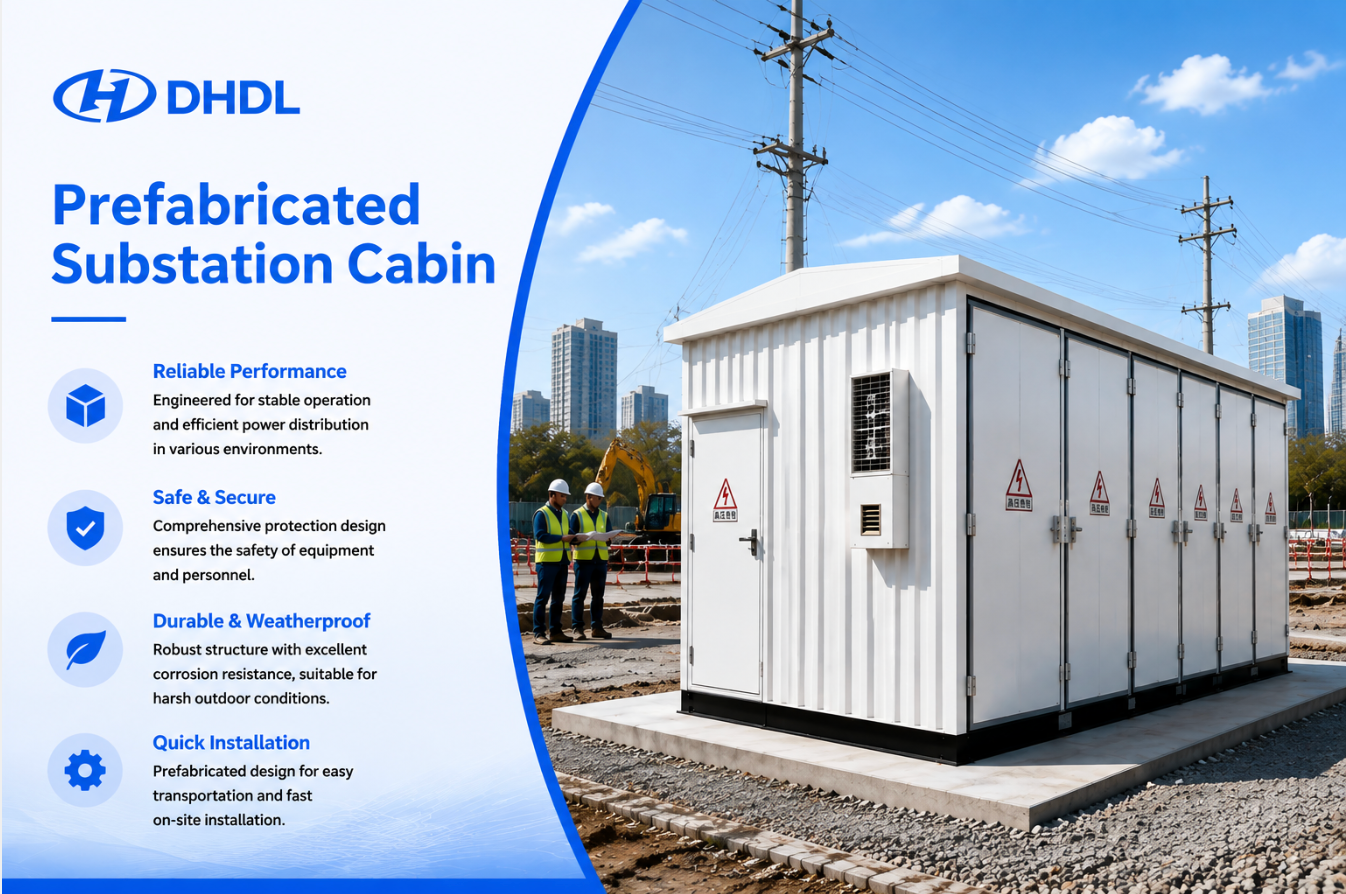
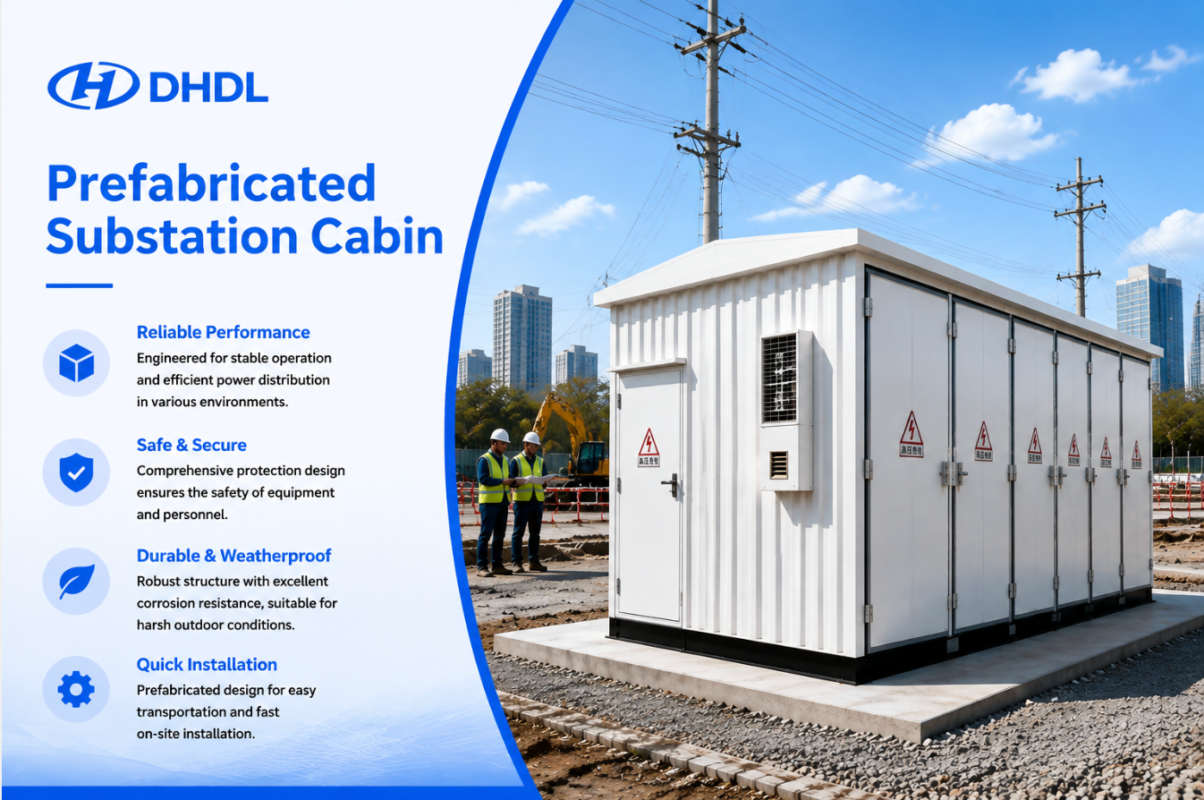
DHDL prefabricated substation cabin with a modular enclosure for integrated transformers, switchgear, protection, metering, control, and monitoring equipment.
What Is a Prefabricated Substation Cabin?
A prefabricated substation cabin is a factory-integrated power distribution system installed inside a modular enclosure.
DHDL combines the following equipment within the cabin:
- Power transformer system
- High-voltage switchgear
- Low-voltage switchgear
- Metering equipment
- Protection devices
- Control system
- Monitoring system
Instead of installing and wiring all these components independently at the site, DHDL completes much of the assembly and wiring in the factory. As a result, the project can reduce part of its on-site installation workload.
The cabin can use a single-compartment or multi-compartment configuration. Moreover, DHDL offers fixed and movable arrangements for different deployment plans.
How Does a Prefabricated Cabin Support the Power System?
The Transformer Provides Voltage Conversion
The transformer changes the incoming voltage to the level required by the downstream distribution system.
DHDL does not publish one fixed transformer voltage or capacity for every cabin. Instead, the company customizes the voltage level according to the power system and determines the capacity from the project load.
Therefore, buyers should provide:
- Incoming voltage
- Required output voltage
- Frequency
- Connected load
- Maximum demand
- Load growth
- Continuous and peak loading
- Motor-starting requirements
- Harmonic sources, if relevant
- Grounding requirements
DHDL can then select the transformer system and coordinate it with the other cabin equipment.
High-Voltage Switchgear Controls the Incoming Supply
The high-voltage switchgear performs the required incoming, switching, isolation, and protection functions according to the project design.
However, the product page does not identify one mandatory switchgear type or rating for every cabin. Consequently, buyers should submit the single-line diagram, nominal voltage, rated current, short-circuit level, protection philosophy, and operating sequence.
Depending on the system design, buyers may also review DHDL’s high-voltage distribution cabinet range when planning the cabin configuration.
Low-Voltage Switchgear Distributes Power to the Loads
The low-voltage section distributes the transformed power to downstream circuits.
Its final configuration may depend on:
- Rated voltage
- Main bus current
- Number of outgoing feeders
- Circuit-breaker requirements
- Motor loads
- Metering
- Power-factor correction
- Automatic transfer requirements
- External cable arrangement
- Future feeder reserves
DHDL can integrate the appropriate equipment according to the approved electrical design. In addition, buyers can review the company’s low-voltage cabinet category for related equipment.
Metering and Protection Support System Operation
The cabin can include metering and protection devices. These systems help operators measure electrical values and respond to abnormal operating conditions.
Nevertheless, the buyer must define the required functions. A general request for “complete protection” does not specify relay logic, current-transformer ratios, voltage-transformer arrangements, communication signals, or upstream and downstream coordination.
Therefore, the RFQ should include:
- Protection single-line diagram
- Relay-function list
- Metering requirements
- CT and VT requirements
- Trip and alarm logic
- Interlocking requirements
- Utility metering boundary
- Remote signal requirements
Control and Monitoring Improve System Visibility
DHDL offers local control and optional remote monitoring.
A local-control configuration can support operation at the cabin. Alternatively, remote monitoring may allow the project’s control platform to receive operating status, measurements, and alarm information, depending on the approved design.
However, “remote monitoring” does not define a universal communication scope. Buyers should provide the required communication protocol, signal list, control authority, network arrangement, cybersecurity requirements, and target monitoring platform.
Published Technical Specifications
The following table summarizes the information published on the product page.
| Item | Published product information |
|---|---|
| Product type | Prefabricated Substation Cabin |
| Structural design | Standardized modular enclosure |
| Integrated equipment | Transformer, high- and low-voltage switchgear, metering, protection, and control systems |
| Voltage level | Customizable according to project requirements |
| Rated capacity | Customizable according to load requirements |
| Internal layout | Single-compartment or multi-compartment configuration |
| Installation method | Factory assembled, pre-wired, and ready for site installation |
| Deployment type | Fixed or movable configuration available |
| Monitoring system | Local control or optional remote monitoring |
| Environmental protection | Dust, moisture, and fire protection designed for the project environment |
| Customization options | Cabin dimensions, equipment selection, compartment layout, cable entry, and auxiliary systems |
These specifications describe the cabin’s available design scope. Nevertheless, DHDL determines the final configuration from the required voltage, capacity, installation environment, applicable standards, and approved project drawings.
Consequently, buyers should use the approved equipment list, technical datasheets, single-line diagram, layout, and interface drawings as the final project references.
Why Do Projects Use Prefabricated Substation Cabins?
Factory Assembly Can Reduce Site Work
DHDL assembles and pre-wires the electrical equipment in the factory. Therefore, the site team can focus on foundation preparation, cabin positioning, grounding, external cabling, inspection, and commissioning.
This approach can help projects reduce:
- On-site equipment assembly
- Internal wiring work
- Cross-equipment installation activities
- Part of the construction labor
- Exposure to unpredictable site working conditions
However, the actual schedule still depends on design approval, manufacturing, civil readiness, transport, unloading, cable completion, inspection, and commissioning.
Buyers should therefore avoid treating “prefabricated” as a guaranteed delivery date. Instead, they should coordinate the factory schedule with the site construction program.
Modular Integration Can Reduce the Footprint
The cabin places multiple electrical systems inside one modular enclosure. As a result, it can reduce the land required for separately constructed equipment rooms and dispersed electrical equipment.
Moreover, DHDL can customize the cabin dimensions and internal layout to match the available site.
Still, a compact enclosure must preserve:
- Electrical clearances
- Operating access
- Maintenance access
- Equipment-removal routes
- Ventilation and heat dissipation
- Fire separation
- Emergency exits where required
- Cable-bending space
- Future expansion space
Therefore, buyers should review the layout from both a footprint and a lifecycle-maintenance perspective.
Fixed and Movable Configurations Support Different Projects
DHDL supplies fixed and movable configurations.
A fixed cabin may suit a long-term industrial, utility, mining, or infrastructure project. In contrast, a movable configuration may support temporary power, phased construction, changing installation locations, emergency applications, or capacity upgrades.
However, “movable” does not necessarily mean that operators can relocate the cabin without planning. Each relocation may still require electrical isolation, cable disconnection, lifting, transport, foundation preparation, inspection, and recommissioning.
Project-Specific Protection Addresses the Environment
DHDL designs the cabin’s dust, moisture, and fire protection according to the project environment.
This approach matters because a mining area, humid coastal location, cold region, dusty construction site, and urban utility project can create very different operating conditions.
Nevertheless, the product page does not publish one universal IP rating, fire-resistance rating, corrosion category, or temperature range. Buyers should specify the required values instead of assuming a general enclosure description covers every site.
Where Can Buyers Use a Prefabricated Substation Cabin?
Construction Projects
Construction sites often need power before permanent electrical rooms become available. A movable or fixed prefabricated cabin can provide an integrated distribution solution during the construction phase.
Moreover, the project may relocate a movable cabin as the work area changes. However, buyers should coordinate transport access, lifting, grounding, cable routes, protection, and recommissioning.
Mining Projects
Mines may need electrical equipment near changing loads or remote operating areas. Therefore, a movable modular cabin can help the project adapt its distribution arrangement.
Still, mining buyers should provide exact information about:
- Dust exposure
- Humidity
- Ambient temperature
- Altitude
- Corrosive conditions
- Transport route
- Vibration
- Load types
- Motor starting
- Network fault level
- Relocation frequency
A standard general-purpose cabin should not be assumed to meet flameproof underground requirements unless DHDL explicitly confirms the relevant design and certification. For underground coal-mine transformer applications, buyers should separately review the Mining Flameproof Transformer.
Industrial Facilities
Factories and industrial parks may use prefabricated cabins for new production lines, facility expansion, temporary power, replacement projects, or additional distribution capacity.
The integrated structure can help coordinate the transformer, switchgear, protection, metering, and control equipment. Nevertheless, buyers should provide the process-load information, motor list, operating continuity requirements, harmonic data, and expansion plan.
Urban Grid Expansion
Utilities may need additional capacity in developed areas where conventional substation construction would require more time or space.
A prefabricated cabin can provide a compact, factory-integrated system for an approved urban location. However, the utility must still confirm the system voltage, protection coordination, cable network, civil design, fire requirements, access, noise, and applicable standards.
Temporary and Emergency Power
Movable cabins can support temporary power arrangements and emergency capacity requirements.
However, the cabin is not a generator or energy source by itself. The project must connect it to a suitable incoming supply. Therefore, the emergency plan should define the source, voltage, capacity, switching sequence, cable connections, protection, and operating responsibility.
Renewable-Energy Projects
The product page also identifies renewable-energy applications within DHDL’s broader solution scope. A prefabricated cabin may integrate transformer, switchgear, protection, metering, and control equipment for solar, wind, energy storage, or microgrid projects when DHDL configures it accordingly.
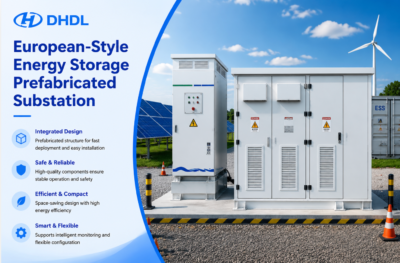
For battery-focused integration, buyers can also review the European-Style Energy Storage Prefabricated Substation.
Data-Center Power Infrastructure
A prefabricated cabin can support a data-center campus when the approved design requires modular medium-voltage intake, transformation, distribution, protection, and monitoring infrastructure.
Nevertheless, data-center buyers should specify redundancy, maintainability, protection selectivity, monitoring interfaces, expansion phases, and operating continuity. The product page does not publish a standardized redundancy level for every cabin.
Prefabricated Cabin vs. Traditional Site-Built Substation
The following comparison helps buyers understand the project-delivery differences. It does not imply that one option fits every site.
| Decision factor | Prefabricated substation cabin | Traditional site-built substation |
| Main construction approach | DHDL integrates equipment inside a factory-assembled modular enclosure | Project constructs the substation building and installs equipment at the site |
| Internal assembly | Major equipment is factory assembled and pre-wired | Site teams complete more equipment installation and internal wiring |
| Layout | DHDL customizes the modular cabin and compartment arrangement | Project team designs the building and separate equipment rooms |
| Site work | Focuses on foundation, positioning, external cables, grounding, and commissioning | Includes building construction, equipment placement, wiring, and commissioning |
| Deployment options | Fixed or movable configurations are available | Normally designed as a permanent site structure |
| Space approach | Integrates multiple systems inside one compact enclosure | Space depends on the building and equipment-room design |
| Expansion | Can use additional modular cabins or project-specific expandable arrangements | Expansion depends on available building space and original civil design |
| Best fit | Rapid deployment, modular projects, restricted sites, temporary power, or phased capacity | Projects that require a purpose-built permanent substation building |
A prefabricated cabin can reduce part of the site construction and installation workload. Conversely, a site-built substation may offer greater freedom when the project requires a highly specialized permanent building.
Therefore, buyers should compare the full project scope, not only the electrical-equipment price.
Prefabricated Cabin vs. Compact Box-Type Substation
A prefabricated substation cabin and a compact box-type substation both integrate electrical equipment, but DHDL describes them at different system levels.
| Selection factor | Prefabricated substation cabin | Compact box-type substation |
| Published system concept | Higher-level modular power-station integration | Single compact integrated equipment unit |
| Internal arrangement | Single- or multi-compartment layout | Typically uses a defined compact equipment arrangement |
| Equipment scope | Can integrate transformer, HV and LV switchgear, metering, protection, control, and monitoring | Scope depends on the selected box-type substation model |
| Deployment | Fixed or movable configurations | Model-specific installation arrangement |
| Layout customization | Cabin dimensions, equipment, compartments, cable entry, and auxiliary systems | Customization depends on the selected product |
| Typical buyer priority | Broader system integration, layout flexibility, monitoring, and deployment planning | Compact packaged transformation and distribution |
The prefabricated cabin is appropriate when the buyer needs a project-specific modular electrical station with a flexible compartment arrangement.
However, a smaller compact substation may remain sufficient when the project only needs a defined transformer-and-switchgear package. Buyers can review DHDL’s broader prefabricated substation range before deciding.
Single-Compartment vs. Multi-Compartment Layout
DHDL offers both layout options.
| Decision factor | Single-compartment layout | Multi-compartment layout |
| Internal division | Places equipment within one principal cabin space | Separates equipment into multiple functional sections |
| Space use | May support a simpler compact arrangement | Requires space for compartment walls and separate access |
| Equipment separation | Depends on the approved internal layout | Supports clearer physical separation between selected systems |
| Access planning | Uses the access arrangement defined for the shared space | Can provide separate access to different functional sections |
| Best selection basis | Equipment scope, clearances, access, maintenance, and project rules | Separation, operating responsibility, fire strategy, and maintenance requirements |
Neither option is automatically better. The buyer should select the layout through the equipment list, electrical clearances, fire strategy, access requirements, maintenance plan, and applicable standards.
What Can DHDL Customize?
Electrical Configuration
DHDL can engineer:
- Voltage level
- Rated capacity
- Transformer selection
- High-voltage switchgear
- Low-voltage switchgear
- Metering
- Protection devices
- Control system
- Monitoring functions
- Internal connections
Cabin Configuration
DHDL can customize:
- Cabin dimensions
- Single- or multi-compartment layout
- Equipment arrangement
- Fixed or movable structure
- Doors and access arrangement
- Cable entry
- Internal space allocation
- Auxiliary systems
The product page does not publish fixed cabin dimensions. Therefore, buyers should provide the available site footprint, transport limitations, and equipment requirements.
Environmental Protection
DHDL designs the protection arrangement according to the environment.
Buyers should specify:
- Ambient temperature
- Relative humidity
- Altitude
- Rainfall
- Wind
- Dust
- Moisture
- Coastal salt exposure
- Corrosive atmosphere
- Snow and ice
- Solar radiation
- Seismic conditions
- Fire requirements
- Required enclosure-protection rating
Monitoring and Control
The standard scope can include local control, while DHDL offers remote monitoring as an option.
For remote functions, provide:
- Required monitoring points
- Control commands
- Alarm list
- Communication protocol
- Network architecture
- SCADA or management platform
- Remote-control authority
- Data-storage requirements
- Cybersecurity requirements
What Should Buyers Verify Before Ordering?
Confirm the Complete Scope of Supply
The phrase “prefabricated substation cabin” can cover different equipment packages. Therefore, buyers should request an itemized scope.
Confirm whether the proposal includes:
- Transformer
- HV switchgear
- LV switchgear
- Metering equipment
- Protection relays
- Control system
- Remote monitoring
- Auxiliary power
- Lighting
- Heating or ventilation
- Fire-protection equipment
- Internal cables
- External cables
- Grounding materials
- Installation
- Testing
- Commissioning
- Spare parts
- Documentation
Confirm Transport and Site Access
A factory-assembled cabin must reach the installation site.
Consequently, provide:
- Transport route
- Road width
- Height restrictions
- Bridge or weight restrictions
- Port or border requirements
- Crane availability
- Lifting conditions
- Site turning radius
- Foundation position
- Maximum transport dimensions
DHDL can then review whether the cabin should ship as one unit or use another project-specific arrangement.
Confirm the Foundation and Cable Interfaces
The civil and electrical interfaces must match the approved cabin design.
Confirm:
- Foundation dimensions
- Load-bearing requirements
- Cable trenches
- Cable-entry positions
- Grounding points
- Drainage
- Flood level
- Access platforms
- Equipment clearances
- External cable termination responsibilities
Confirm Testing and Documentation
Buyers should specify:
- Applicable standards
- Required routine tests
- Integrated functional tests
- Protection tests
- Interlocking tests
- Communication tests
- Factory inspection
- Witness testing
- Drawings
- Equipment datasheets
- Test reports
- Operation manuals
- Packing lists
- Documentation language
DHDL lists material inspection, assembly control, routine testing, and final inspection within its general quality-control scope. However, the buyer should confirm the exact project test package in the quotation.
Considerations for DHDL Target Markets
DHDL’s target markets include Ukraine, Ethiopia, Vietnam, Thailand, Myanmar, Uzbekistan, Russia, and Nigeria. Each project still requires exact site data.
| Target market | Information buyers should prioritize |
| Ukraine | Minimum temperature, snow, wind, heating, utility requirements, transport conditions, and documentation language |
| Ethiopia | Altitude, ambient heat, dust, transport route, grid voltage, and site access |
| Vietnam | Humidity, condensation, rainfall, flooding, coastal corrosion, and cooling requirements |
| Thailand | High temperature, humidity, drainage, solar exposure, condensation, and utility requirements |
| Myanmar | Monsoon conditions, site access, transport, grid characteristics, and maintenance resources |
| Uzbekistan | Seasonal temperatures, dust, sand, altitude, road restrictions, and local standards |
| Russia | Minimum temperature, snow and wind loads, heating, transport restrictions, standards, and technical documentation |
| Nigeria | Temperature, humidity, rainfall, dust, grid conditions, site security, and physical protection |
For example, a cabin for Ethiopia may require careful altitude and heat-dissipation review. In contrast, a project in Vietnam may prioritize humidity, condensation, drainage, and corrosion protection.
Therefore, destination-country information should start the engineering review, not replace project-specific environmental data.
What Information Does DHDL Need for a Quotation?
| RFQ information | Why it matters |
| Project application | Defines whether the cabin supports construction, mining, industry, utilities, temporary power, renewable energy, or another use |
| Single-line diagram | Establishes the complete electrical architecture |
| Incoming and outgoing voltage | Defines the voltage-transformation and distribution requirements |
| Frequency | Confirms system compatibility |
| Rated capacity and load list | Supports transformer and equipment selection |
| Short-circuit level | Supports switchgear and protection selection |
| Protection philosophy | Defines relay functions and coordination |
| Metering requirements | Defines project or utility measurement functions |
| Cabin location | Establishes environmental and logistics requirements |
| Available footprint | Supports dimensional and layout design |
| Fixed or movable requirement | Defines the deployment structure |
| Compartment requirements | Supports single- or multi-compartment planning |
| Cable schedule | Defines cable entry, terminals, and internal interfaces |
| Monitoring requirements | Defines local or remote monitoring scope |
| Environmental data | Supports enclosure and auxiliary-system design |
| Applicable standards | Establishes the engineering and documentation basis |
| Required tests | Clarifies factory and site verification |
| Transport route | Establishes cabin shipping limitations |
| Project schedule | Supports design, production, delivery, and site coordination |
If the project remains at an early stage, send the available single-line diagram, estimated load, voltage, site location, application, and available installation area first. DHDL can then identify the missing design inputs.
Frequently Asked Questions
Does the cabin include a transformer and switchgear?
Yes. The published integrated-equipment scope includes the transformer, high- and low-voltage switchgear, metering, protection, and control systems. However, buyers should confirm the exact equipment list in the project proposal.
Can DHDL customize the cabin dimensions?
Yes. DHDL can engineer the cabin dimensions and equipment layout according to the project and operating environment.
Can buyers select a multi-compartment design?
Yes. DHDL offers single-compartment and multi-compartment configurations.
Does DHDL offer a movable cabin?
Yes. Fixed and movable configurations are available. Nevertheless, buyers should provide the expected relocation method and frequency.
Does the product support remote monitoring?
DHDL lists local control and optional remote monitoring. The buyer should define the communication protocol, signals, platform, and required control functions.
Can the cabin support later expansion?
The modular structure can support project-specific expansion planning, additional cabins, or phased deployment. However, the original design must reserve the required land, cables, electrical capacity, protection, and communication interfaces.
Is it suitable for a mining project?
DHDL lists mining projects as an application. Nevertheless, underground coal mines or hazardous locations may require specialized flameproof equipment and certifications beyond a general prefabricated cabin.
Does prefabrication eliminate all on-site work?
No. The project still needs civil preparation, positioning, grounding, external cable installation, inspection, testing, and commissioning. The factory-integrated design reduces part of the site work rather than eliminating it.
Plan the Cabin Around the Complete Power System
The DHDL Prefabricated Substation Cabin integrates transformer, switchgear, metering, protection, control, and monitoring equipment inside a modular factory-assembled enclosure.
Therefore, it can support construction sites, mining projects, industrial facilities, utility expansion, renewable-energy infrastructure, temporary power, capacity upgrades, and other project-specific distribution needs.
Moreover, DHDL can customize the voltage, capacity, equipment selection, cabin dimensions, compartments, cable entry, environmental protection, monitoring functions, and auxiliary systems.
However, successful deployment depends on accurate electrical, civil, environmental, and logistical inputs. Buyers should confirm the single-line diagram, load, protection, layout, foundation, transport route, monitoring, standards, testing, and responsibilities before approving the design.
To request a technical solution, send your single-line diagram, voltage, capacity, load list, project application, site conditions, cabin dimensions, fixed or movable requirement, equipment scope, monitoring needs, applicable standards, transport destination, and schedule through the DHDL contact page.