American-Style Three-Phase Pad-Mounted Transformer: Buyer’s Guide

Industrial parks, commercial facilities, residential developments, factories, and utility networks all need reliable voltage transformation and power distribution. However, buyers may also need to limit the installation footprint, simplify cable connections, protect live equipment, and adapt the transformer to an outdoor environment.
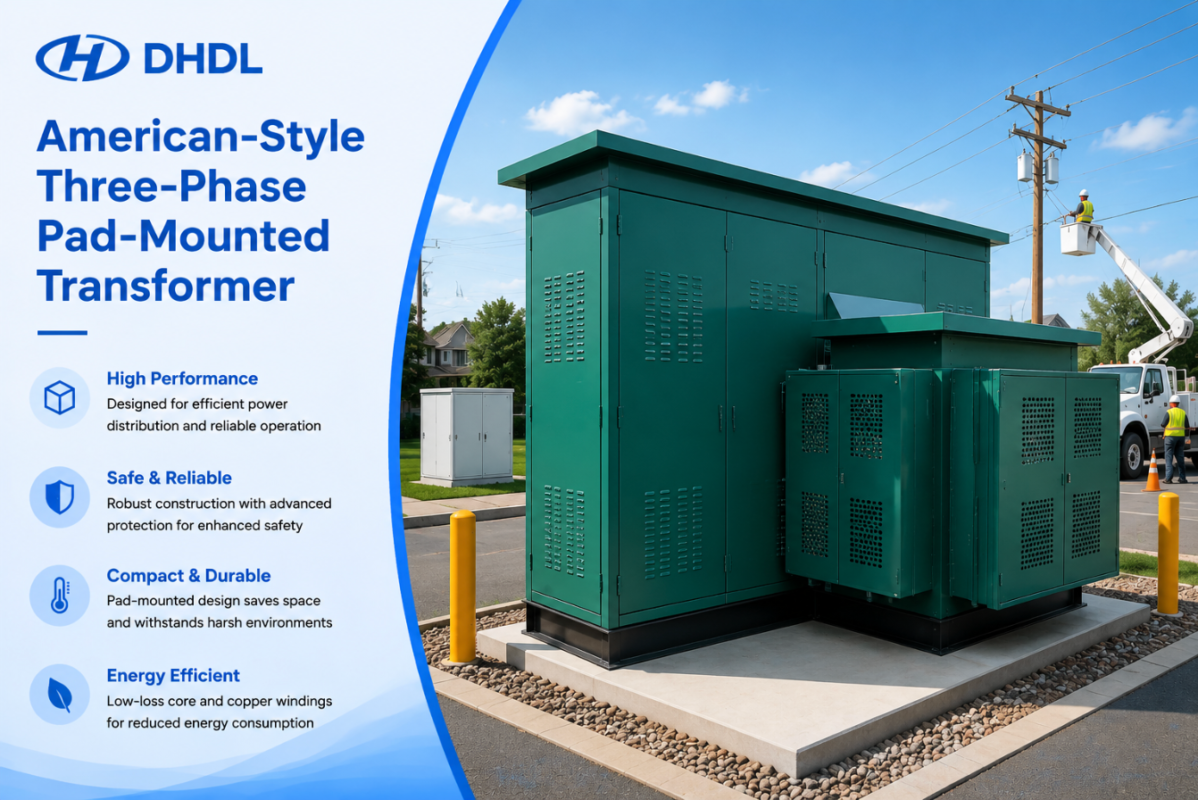
The DHDL American-Style Three-Phase Pad-Mounted Transformer combines a three-phase oil-immersed transformer, high-voltage switching and protection devices, a dedicated low-voltage connection compartment, and a weather-resistant enclosure in one factory-assembled unit.
As a result, the product offers a compact ground-level solution for medium-voltage distribution projects. Moreover, DHDL can customize its voltage level, rated capacity, protection scheme, terminal arrangement, enclosure layout, and auxiliary systems.
Still, buyers should not select the transformer from its appearance or product name alone. The final configuration depends on the actual load, voltage system, protection philosophy, cable arrangement, operating environment, applicable standards, and approved project drawings.
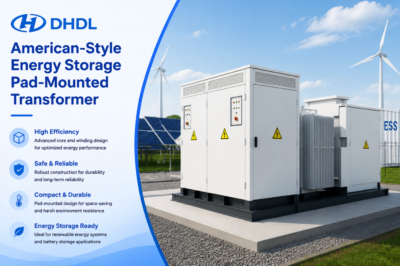
DHDL American-style three-phase pad-mounted transformer with an integrated oil-immersed transformer, high-voltage protection, low-voltage connections, and an outdoor enclosure.
What Is an American-Style Three-Phase Pad-Mounted Transformer?
An American-style three-phase pad-mounted transformer is a ground-level distribution unit that places the transformer and associated connection and protection sections inside a secure outdoor enclosure.
DHDL’s product includes four core components:
- Three-phase oil-immersed transformer
- High-voltage switching and protection system
- Low-voltage connection compartment
- Weather-resistant outdoor enclosure
The factory-assembled structure reduces the number of separately positioned transformer-side components. Consequently, it can simplify transportation, positioning, cable connection, maintenance access, and on-site commissioning.
The unit supports three-phase medium-voltage distribution systems. Typical applications include industrial parks, factories, commercial facilities, residential developments, urban distribution networks, and utility projects.
However, DHDL does not publish one fixed voltage range or capacity range for this product. Instead, the company customizes the electrical configuration according to the project’s distribution system and load requirements.
How Does the Integrated Structure Work?
The product combines electrical transformation, high-voltage switching, protection, and low-voltage connection functions within one enclosure.
Three-Phase Oil-Immersed Transformer
The transformer converts the incoming voltage to the required distribution voltage for three-phase loads.
DHDL uses oil-immersed insulation with natural heat dissipation. According to the product page, this construction supports effective cooling, stable continuous operation, and low operating noise under demanding load conditions.
Nevertheless, buyers must match the transformer to the actual load profile. A project with continuous industrial loads may require a different capacity and thermal evaluation from a commercial facility with a variable daily load.
Therefore, buyers should provide:
- Connected load
- Maximum demand
- Expected load growth
- Continuous and peak loading
- Motor-starting requirements
- Power factor
- Load balance
- Harmonic information when relevant
DHDL can then evaluate the required transformer capacity and configuration.
Integrated High-Voltage Switching and Protection
DHDL installs the high-voltage switching and protection devices inside the enclosure. This integration can simplify the external power distribution arrangement and keep the high-voltage functions within a coordinated transformer package.
However, the protection system still needs to match the network. Buyers should provide the upstream protection, available fault current, grounding method, required switching functions, protection coordination, and utility requirements.
DHDL can then configure the high-voltage system according to the approved protection scheme.
Dedicated Low-Voltage Connection Compartment
The transformer includes a dedicated low-voltage connection compartment. Moreover, DHDL can customize the outgoing arrangement according to the project.
This flexibility can help the unit connect with downstream switchboards, distribution cabinets, motors, commercial loads, residential networks, or other electrical equipment.
Still, buyers should confirm:
- Secondary voltage
- Number of outgoing circuits
- Rated outgoing current
- Cable quantity and size
- Cable entry direction
- Terminal arrangement
- Neutral and grounding requirements
- Phase sequence
- Interface with the downstream switchboard
A detailed cable schedule and approved terminal drawing can help prevent modifications during installation.
Weather-Resistant Outdoor Enclosure
DHDL designs the enclosure to protect the internal equipment from rain, wind, dust, and sand. Therefore, the unit can support outdoor installations in a range of demanding environments.
However, the phrase “weather-resistant” does not define every environmental rating or site condition. Buyers should submit precise values for temperature, humidity, altitude, rainfall, wind, dust, salt mist, flooding risk, seismic conditions, and solar exposure.
DHDL can then confirm the final enclosure and auxiliary-system requirements.
Published Technical Specifications
The following table contains the product information published on the official DHDL page.
| Item | Published specification |
|---|---|
| Product type | American-Style Three-Phase Pad-Mounted Transformer |
| Phase configuration | Three-phase |
| Transformer structure | Compact oil-immersed pad-mounted design |
| Voltage level | Customizable according to the power distribution system |
| Rated capacity | Customizable according to project load requirements |
| Insulation and cooling | Oil-immersed insulation with efficient natural heat dissipation |
| High-voltage system | Integrated high-voltage switching and protection devices |
| Low-voltage system | Dedicated low-voltage connection compartment with customizable outgoing configuration |
| Connection arrangement | Cable terminals and internal connections configured according to project requirements |
| Enclosure design | Weather-resistant outdoor enclosure for protection from rain, wind, dust, and sand |
| Installation method | Ground-level pad-mounted installation with simplified positioning and cable connection |
| Operating characteristics | Stable heat dissipation, low operating noise, and reliable continuous operation |
| Typical applications | Industrial parks, factories, commercial facilities, residential developments, urban grids, and utility projects |
| Customization options | Voltage level, capacity, protection scheme, terminal arrangement, enclosure layout, and auxiliary systems |
These specifications describe the product’s general configuration rather than one fixed transformer model. Accordingly, DHDL determines the final values from the required voltage, capacity, protection scheme, cable arrangement, environment, applicable standards, and approved drawings.
Why Do Buyers Choose a Three-Phase Pad-Mounted Design?
Compact Ground-Level Installation
The pad-mounted structure reduces the installation space and places the equipment at ground level. Therefore, it can support projects where pole installation is impractical or where the electrical plan requires an enclosed ground-mounted unit.
Typical situations include:
- Industrial or commercial sites with substantial three-phase loads
- Projects with underground cable distribution
- Locations that cannot use overhead transformer structures
- Sites that need an integrated outdoor enclosure
- Urban developments with limited electrical space
- Utility projects that require ground-level access
Nevertheless, the project still needs a suitable foundation, cable route, drainage arrangement, operating clearance, maintenance area, and vehicle protection where applicable.
Simplified Equipment Arrangement
The unit integrates the transformer, high-voltage switching and protection, and low-voltage connections. Consequently, it can reduce the need to arrange these transformer-side functions as separate outdoor assemblies.
This integration may simplify the equipment layout and cable coordination. However, the buyer must define the exact scope of supply so that the quotation clearly identifies included and excluded equipment.
Efficient Oil Cooling
The oil-immersed design provides insulation and natural heat dissipation. As a result, the transformer can support stable operation under continuous-load conditions when DHDL selects the correct capacity and configuration.
Still, buyers should not use the phrase “continuous operation” as permission to exceed the approved load. Instead, the final transformer must operate within its confirmed ratings and project conditions.
Protected Outdoor Construction
The weather-resistant enclosure shields the internal equipment from several common outdoor conditions. Moreover, the secure compartment arrangement separates functional sections and supports protected operation.
Nevertheless, project owners must follow the approved operating and maintenance instructions. They should also control access, inspect accessible components, maintain the surrounding area, and protect the installation from vehicle impact or flooding where these risks exist.
Flexible Project Configuration
DHDL can customize the electrical, mechanical, and auxiliary configuration. This flexibility helps buyers match the transformer to different distribution systems instead of forcing every project into one standard design.
Available customization areas include:
- Voltage level
- Rated capacity
- Protection scheme
- High-voltage switching arrangement
- Low-voltage outgoing configuration
- Terminal arrangement
- Cable connections
- Enclosure layout
- Auxiliary systems
- Applicable project standards
For an accurate proposal, send DHDL the single-line diagram and load information instead of requesting only a general three-phase transformer price.
Where Can Buyers Use This Transformer?
Industrial Parks and Factories
Industrial facilities often operate motors, production lines, process equipment, workshops, compressors, pumps, ventilation systems, and other three-phase loads.
Therefore, buyers should evaluate more than the total connected load. They should also review the maximum demand, motor starting, load changes, harmonic sources, power factor, fault level, and future expansion.
The compact outdoor structure may help an industrial project place the transformer close to the load center. However, the site must still provide safe access, cable routing, drainage, fire separation, and maintenance space.
Commercial Facilities
Shopping centers, office campuses, hotels, hospitals, logistics facilities, and mixed-use developments may require substantial three-phase distribution capacity.
In these projects, the transformer can supply downstream low-voltage distribution equipment. Buyers can also review DHDL’s low-voltage cabinet range when planning the complete power distribution interface.
Nevertheless, the project engineer must coordinate the transformer with the main switchboard, protection devices, metering arrangement, grounding system, and building loads.
Residential Developments
Large residential developments may use pad-mounted transformers as part of an underground distribution network.
The enclosed ground-level construction can support a planned outdoor equipment area. However, developers should consider public access, physical barriers, landscaping clearances, drainage, noise requirements, maintenance routes, and utility approval.
Urban Distribution Networks
Urban distribution projects often face limited installation space and extensive underground cable systems. Accordingly, the compact pad-mounted design may fit locations where overhead transformer installation is unsuitable.
Still, utility requirements differ between regions. Buyers should provide the applicable utility specification, voltage level, cable interface, protection scheme, labeling requirements, and documentation package.
Utility Power Distribution
Utilities can configure the transformer according to their distribution voltage, load, protection, terminal, and enclosure requirements.
Moreover, DHDL offers other pad-mounted transformer products for different network needs. Reviewing the wider range can help a utility distinguish between single-phase, three-phase, and project-specific applications.
Three-Phase vs. Single-Phase Pad-Mounted Transformers
DHDL also supplies a Single-Phase Pad-Mounted Transformer. The correct phase configuration depends on the distribution network and load rather than a general claim that one design is always better.
| Selection factor | American-style three-phase pad-mounted transformer | Single-phase pad-mounted transformer |
| Phase configuration | Three-phase | Single-phase |
| Main product scope | Three-phase medium-voltage distribution | Single-phase underground distribution |
| Published capacity | Customized according to project load requirements; no fixed range published | Standard configurations from 25–500kVA |
| Published primary voltage | Customized according to the distribution system; no fixed range published | 13.2kV, 13.8kV, 24kV, or 34.5kV as standard configurations |
| Published secondary voltage | Customized; no fixed values published | 120/240V or 240/120V as standard configurations |
| Typical load fit | Industrial, commercial, urban, residential-development, and utility three-phase systems | Residential communities and other single-phase distribution applications |
| High-voltage arrangement | Integrated switching and protection configured for the project | Loop-feed or radial-feed; dead-front or live-front configurations are published |
| Installation | Outdoor ground-level pad mounting | Outdoor ground mounting |
| Cooling | Oil-immersed insulation with natural heat dissipation | ONAN—Oil Natural Air Natural |
| Best selection basis | Three-phase load, voltage, capacity, protection, cables, environment, and standards | Single-phase utility voltage, capacity, feed arrangement, connections, and standards |
A three-phase pad-mounted transformer fits projects that need to serve three-phase distribution systems and three-phase loads. In contrast, the single-phase product targets single-phase underground distribution and publishes a specific range of standard configurations.
Therefore, buyers should begin with the load and network phase configuration. They should not replace several single-phase units with one three-phase unit—or make the opposite change—without a complete system study.
Pad-Mounted vs. Pole-Mounted Transformer
The installation method also affects project planning.
| Decision factor | Three-phase pad-mounted transformer | Pole-mounted transformer |
| Installation position | Ground-level concrete pad or prepared foundation | Utility pole or overhead structure |
| Cable arrangement | Commonly coordinated with ground-level or underground cable entry | Commonly associated with overhead distribution |
| Equipment access | Ground-level access within a secure enclosure | Elevated equipment access |
| Site requirements | Foundation, drainage, cable trenches, clearances, and physical protection | Pole structure, overhead clearances, access, and mechanical loading review |
| Typical selection driver | Industrial loads, medium-to-large project capacity, enclosed equipment, or sites unsuitable for pole mounting | Overhead networks and projects designed around pole installation |
| Main planning risk | Insufficient foundation, drainage, cable space, or vehicle protection | Insufficient pole capacity, clearances, or overhead-line coordination |
The product page identifies floor-standing equipment as suitable for industrial loads, medium-to-large capacity requirements, and projects that cannot use pole installation. However, buyers should still compare total project requirements rather than selecting solely by installation appearance.
What Should Buyers Verify Before Ordering?
Electrical Ratings
Confirm:
- High-voltage system voltage
- Low-voltage output
- Frequency
- Required rated capacity
- Load profile
- Short-circuit conditions
- Impedance requirement
- Winding connection
- Tap requirements
- Grounding method
- Allowable losses
- Harmonic conditions, if relevant
The target product page does not publish fixed values for these items. Therefore, DHDL must confirm them in the project-specific proposal.
Protection and Switching
Confirm:
- Required switching functions
- Fuse or protection-device arrangement
- Surge-protection requirements
- Upstream and downstream coordination
- Fault-current data
- Interlocking requirements
- Operating sequence
- Utility protection requirements
Cable and Terminal Interfaces
Confirm:
- Incoming and outgoing cable sizes
- Number of cables per phase
- Cable entry direction
- Terminal type
- Phase spacing
- Neutral and grounding connections
- Cable-compartment dimensions
- Interface with downstream switchgear
Physical Installation
Confirm:
- Available footprint
- Foundation dimensions
- Cable trench or conduit layout
- Drainage
- Flood level
- Delivery access
- Lifting and positioning route
- Operating clearance
- Maintenance clearance
- Vehicle-impact protection
- Public-access controls
Environmental Conditions
Confirm:
- Minimum and maximum temperature
- Humidity
- Altitude
- Rainfall
- Wind
- Dust and sand
- Coastal salt exposure
- Solar radiation
- Seismic conditions
- Required enclosure protection
- Corrosion-protection requirements
Considerations for DHDL Target Markets
DHDL’s target markets include Ukraine, Ethiopia, Vietnam, Thailand, Myanmar, Uzbekistan, Russia, and Nigeria. However, country-level assumptions cannot replace exact site data.
| Target market | Information buyers should prioritize |
| Ukraine | Minimum temperature, snow and wind conditions, utility voltage, heating provisions, and documentation requirements |
| Ethiopia | Altitude, ambient heat, dust exposure, transport route, grid voltage, and load profile |
| Vietnam | Humidity, condensation, rainfall, flooding, coastal exposure where applicable, and local utility requirements |
| Thailand | High temperature, humidity, drainage, solar exposure, corrosion conditions, and cable arrangement |
| Myanmar | Monsoon conditions, temperature, site access, grid characteristics, and maintenance resources |
| Uzbekistan | Seasonal temperature range, dust and sand, altitude, transport restrictions, and local standards |
| Russia | Minimum temperature, snow, wind, heating provisions, grid standards, and technical documentation |
| Nigeria | Temperature, humidity, rainfall, dust, fault level, grid conditions, and site security |
For example, a transformer installed near the Vietnamese coast may need a different enclosure review from one installed in a dry region of Uzbekistan. Likewise, a high-altitude Ethiopian project requires different engineering inputs from a low-altitude urban installation.
Consequently, buyers should provide measured or specified site conditions with the RFQ.
What Information Does DHDL Need for a Quotation?
A complete RFQ helps DHDL select the transformer configuration and identify missing technical inputs.
| RFQ information | Why it matters |
| Project application | Defines the industrial, commercial, residential, urban, or utility context |
| Project location | Establishes environmental, transport, and documentation requirements |
| Single-line diagram | Shows the complete electrical arrangement |
| Primary and secondary voltage | Defines the voltage transformation |
| Frequency | Confirms system compatibility |
| Required capacity | Establishes the transformer rating |
| Load list and demand | Supports capacity selection |
| Load characteristics | Identifies motors, harmonics, continuous loads, and load changes |
| Short-circuit level | Supports protection and equipment selection |
| Protection scheme | Defines switching and protection functions |
| Cable schedule | Determines terminal and compartment arrangements |
| Grounding requirements | Defines neutral and earthing connections |
| Site conditions | Supports enclosure, cooling, insulation, and auxiliary-system review |
| Layout or foundation drawing | Supports physical configuration |
| Applicable standards | Establishes the design and documentation basis |
| Required tests and documents | Clarifies inspection and approval requirements |
| Delivery destination and schedule | Supports production and logistics planning |
If the project specification remains incomplete, provide the single-line diagram, required voltage, estimated load, installation location, and utility requirements first. DHDL can then identify which details require further confirmation.
Frequently Asked Questions
Does DHDL publish a standard capacity range for this three-phase transformer?
No. The target product page states that DHDL customizes the rated capacity according to project load requirements. Therefore, buyers should submit the load information for confirmation.
Does the product include high-voltage protection?
Yes. DHDL integrates high-voltage switching and protection devices into the enclosure. However, the final device arrangement depends on the approved protection scheme.
Can DHDL customize the low-voltage outgoing arrangement?
Yes. The transformer has a dedicated low-voltage connection compartment, and DHDL can customize the outgoing configuration and terminal arrangement.
Is it suitable for outdoor installation?
Yes. DHDL designs it as an outdoor pad-mounted unit with an enclosure intended to address rain, wind, dust, and sand. Nevertheless, the manufacturer still needs exact site conditions.
Can buyers use it for an industrial facility?
Yes. DHDL lists industrial parks and factories among the typical applications. Buyers should provide the industrial load profile, motor information, continuous demand, fault level, and future expansion plan.
Does low operating noise represent a guaranteed numerical limit?
The product page lists low operating noise as an operating characteristic but does not publish a fixed decibel value. Therefore, buyers with a numerical noise requirement should request project-specific confirmation.
Can the product comply with different project standards?
The product page states that the applicable standards form part of the final project specification. Consequently, buyers should identify the required country, utility, or project standards in the RFQ.
What determines the final technical specifications?
DHDL determines the final specifications from the voltage level, system capacity, protection scheme, cable arrangement, operating environment, applicable standards, and approved project drawings.
Configure the Transformer Around the Actual Distribution System
The DHDL American-Style Three-Phase Pad-Mounted Transformer combines a three-phase oil-immersed transformer, integrated high-voltage switching and protection, customizable low-voltage connections, and a weather-resistant outdoor enclosure.
Therefore, it can provide a compact ground-level distribution solution for industrial parks, factories, commercial facilities, residential developments, urban networks, and utility projects.
However, the best configuration depends on the actual system. Buyers should confirm the voltage, capacity, load profile, protection scheme, cable interfaces, environmental conditions, physical layout, standards, and documentation requirements before approving production.
To request a project-specific proposal, send your single-line diagram, primary and secondary voltages, load list, required capacity, protection requirements, cable schedule, site conditions, applicable standards, and delivery destination through the DHDL contact page. DHDL can then review the project and prepare an appropriate transformer configuration.