Single-Phase Pad-Mounted Transformer: Specifications and Buyer’s Guide

Single-Phase Pad-Mounted Transformer: Specifications, Applications, and Buyer Considerations
Underground power distribution projects need transformers that can safely connect medium-voltage cables to residential, commercial, or other single-phase loads. At the same time, utilities and project developers may need a compact ground-mounted structure, flexible feed arrangements, protected connections, and equipment that matches their network standards.
The DHDL Single-Phase Pad-Mounted Transformer is an oil-immersed distribution transformer for underground power networks. Its standard configurations cover 25–500kVA, primary voltages of 13.2kV, 13.8kV, 24kV, or 34.5kV, and secondary voltages of 120/240V or 240/120V.
Moreover, DHDL offers loop-feed or radial-feed arrangements and dead-front or live-front high-voltage configurations. Buyers can also customize the voltage, capacity, impedance, winding material, insulation fluid, protection devices, enclosure structure, accessories, and cable connections.
However, buyers should treat the published values as standard configurations rather than a universal specification. The final transformer must match the utility network, load, cable system, protection philosophy, environment, and applicable standards.
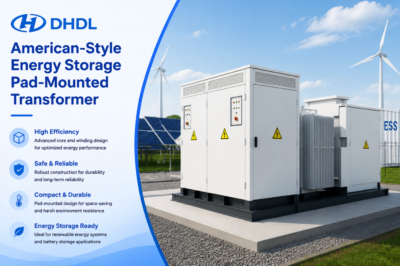
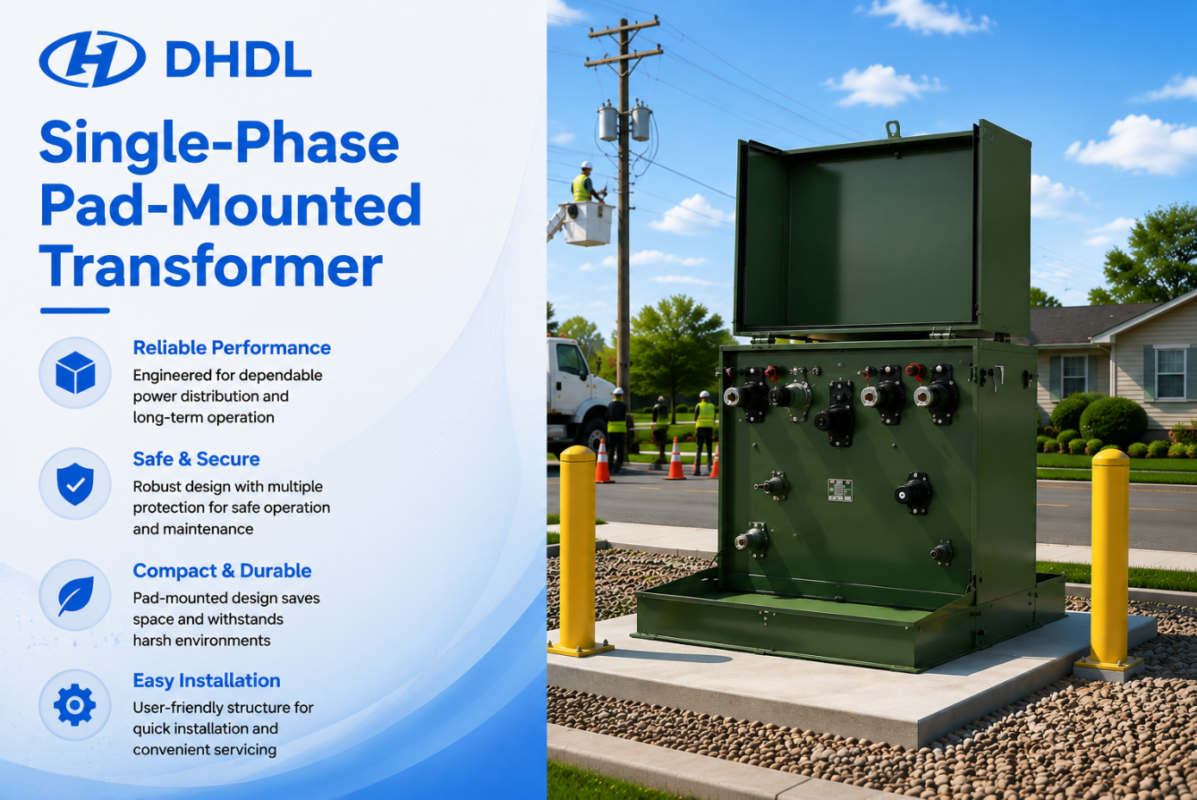
DHDL single-phase oil-immersed pad-mounted transformer with integrated high- and low-voltage compartments.
What Is a Single-Phase Pad-Mounted Transformer?
A single-phase pad-mounted transformer is a ground-installed distribution transformer that connects to an underground power network.
Unlike a conventional pole-mounted unit, DHDL integrates the transformer body, high-voltage compartment, and low-voltage compartment within a fully enclosed outdoor steel housing. Consequently, the equipment can support a compact ground-level installation without placing the transformer on a utility pole.
DHDL developed the product for:
- Residential communities
- Commercial developments
- Industrial parks
- Solar power projects
- Urban underground networks
- Utility distribution projects
The core configuration includes:
- Single-phase oil-immersed transformer
- Integrated high- and low-voltage compartments
- Loop-feed or radial-feed arrangement
- Fully enclosed outdoor steel housing
This structure suits projects that use underground cables and require a single-phase distribution supply. Nevertheless, the project engineer must confirm whether the connected network and loads actually require a single-phase transformer.
Published Technical Specifications
DHDL publishes the following standard configurations for its single-phase pad-mounted transformer.
| Item | Standard configuration |
|---|---|
| Product type | Oil-immersed Single-Phase Pad-Mounted Transformer |
| Applicable standards | IEEE C57.12.38 and IEEE C57.12.28 |
| Rated capacity | 25–500kVA |
| Primary voltage | 13.2kV, 13.8kV, 24kV, or 34.5kV |
| Secondary voltage | 120/240V or 240/120V |
| Phase | Single-phase |
| Frequency | 50Hz or 60Hz |
| Cooling method | ONAN—Oil Natural Air Natural |
| Connection symbol | Ii0 |
| Feed configuration | Loop feed or radial feed |
| High-voltage configuration | Dead front or live front |
| Tap changer | No-load tap changer, or NLTC |
| Tap range | ±2 × 2.5% |
| Impedance | 2%–4% |
| Winding material | Copper or aluminum |
| Installation | Outdoor ground-mounted installation |
These values provide a useful starting point. However, DHDL states that it can customize the electrical parameters, losses, dimensions, enclosure material, insulation fluid, protection devices, accessories, and cable arrangements according to utility and project requirements.
Therefore, buyers should ask DHDL to confirm every project-specific value in the technical proposal and approved drawings.
How Does the Transformer Support Underground Distribution?
The Transformer Steps Down the Distribution Voltage
The transformer receives single-phase power at the specified primary voltage and supplies the required lower secondary voltage.
DHDL publishes 13.2kV, 13.8kV, 24kV, and 34.5kV as standard primary-voltage options. Meanwhile, the published secondary options are 120/240V and 240/120V.
However, the buyer must confirm the utility’s nominal voltage, operating range, grounding arrangement, and required secondary service. Similar-looking voltage descriptions do not always represent identical utility requirements.
The Enclosure Integrates High- and Low-Voltage Sections
DHDL places the high-voltage compartment, low-voltage compartment, and transformer body in one steel enclosure. This integrated structure can reduce the site area required for separately arranged transformer components.
Moreover, the enclosure protects the connection sections from direct public access when the project installs and operates the equipment correctly.
Still, the site needs suitable access control, working clearances, drainage, foundation design, cable routing, and physical protection. The enclosure alone cannot address every installation risk.
ONAN Cooling Removes Heat Naturally
The transformer uses ONAN cooling, which means Oil Natural Air Natural. In this system, the insulating oil circulates naturally, while the surrounding air removes heat from the transformer enclosure or cooling surfaces without forced-air equipment in the standard configuration.
According to DHDL, the product uses high-quality grain-oriented silicon steel and an optimized winding design to help reduce no-load and load losses.
Nevertheless, the product page does not publish one guaranteed loss value for every configuration. Buyers should therefore specify their required loss limits or efficiency requirements in the RFQ.
How Should Buyers Choose the Feed Configuration?
DHDL offers loop-feed and radial-feed configurations. This choice affects how the transformer connects to the underground primary distribution network.
| Decision factor | Loop-feed configuration | Radial-feed configuration |
| Primary connection concept | Supports an incoming and continuing network arrangement | Supplies the transformer through a single radial circuit |
| Typical network purpose | Used where the underground distribution design requires loop continuity or sectionalizing arrangements | Used where the transformer sits at the end of a radial branch |
| Cable interfaces | Usually requires coordination of incoming and outgoing primary cables | Usually uses one primary supply path |
| Switching requirements | Depend on the utility’s loop operating and sectionalizing scheme | Depend on the radial feeder and protection design |
| Main buyer input | Utility loop diagram, cable arrangement, switching philosophy, and protection requirements | Radial single-line diagram, cable data, fault level, and protection requirements |
| Selection authority | Utility or project distribution design | Utility or project distribution design |
A loop-feed transformer is not automatically more suitable than a radial-feed transformer. Instead, the distribution-network architecture determines the correct arrangement.
Therefore, buyers should send DHDL the primary single-line diagram and utility connection requirements. DHDL can then configure the cable interfaces, switching devices, and protection accessories accordingly.
Dead-Front vs. Live-Front High-Voltage Configuration
The high-voltage interface represents another important selection point.
| Selection factor | Dead-front configuration | Live-front configuration |
| General interface characteristic | Uses a shielded or insulated connection arrangement designed to limit exposure to energized parts during normal conditions | Uses an arrangement where energized components may remain exposed inside the opened compartment |
| Access consideration | Supports protected cable interfaces when correctly installed | Requires operating procedures appropriate for accessible energized components |
| Cable and accessory selection | Must match the specified dead-front connectors and utility requirements | Must match the specified live-front terminals and clearances |
| Project decision basis | Utility practice, cable system, safety procedures, and connector standards | Utility practice, terminal arrangement, operating procedures, and clearance requirements |
| DHDL product availability | Published as an available high-voltage configuration | Published as an available high-voltage configuration |
DHDL confirms that both configurations are available. However, the target page does not publish the exact connector ratings, bushing interfaces, or component models.
Consequently, buyers should include the required high-voltage interface and accessory specifications in the inquiry.
What Benefits Does the Product Offer?
Compact Integrated Structure
The transformer combines the oil-immersed transformer and both connection compartments in one compact enclosure.
As a result, it can support projects with limited equipment space and underground cable distribution. In addition, the ground-mounted design can provide a cleaner visual arrangement than an overhead installation in planned communities or commercial developments.
However, appearance should remain a secondary consideration. The project must first meet electrical, utility, safety, environmental, and access requirements.
IEEE-Based and Customizable Design
DHDL states that it manufactures this product in accordance with IEEE C57.12.38 and IEEE C57.12.28.
Moreover, buyers can customize:
- Voltage
- Rated capacity
- Impedance
- Winding material
- Insulation fluid
- Protection devices
- Enclosure material
- Cable connections
- Accessories
Still, buyers should specify the required edition, utility amendments, testing scope, and documentation instead of requesting only “IEEE compliance.”
Optional Protection Accessories
DHDL lists the following optional accessories:
- Surge arresters
- Bay-O-Net fuses
- ELSP current-limiting fuses
- Load-break switches
- Oil-level gauges
- Thermometers
- Pressure-relief valves
- Grounding terminals
- Stainless-steel enclosures
These accessories allow the project team to adapt the transformer to the protection, monitoring, operating, and environmental requirements.
Nevertheless, buyers should not add every option automatically. The project engineer should select accessories through the single-line diagram, protection study, operating procedures, and utility specification.
Coastal Configuration Options
For coastal or highly corrosive environments, DHDL lists stainless-steel enclosures, anti-corrosion coatings, and FR3 insulating fluid as available options.
Therefore, buyers can request a project-specific configuration for high-salt or high-humidity locations.
However, the product page does not publish a corrosion category, coating thickness, salt-spray duration, stainless-steel grade, or FR3 performance specification. Buyers should state the required values and request written confirmation.
Copper or Aluminum Windings
DHDL can supply copper or aluminum windings. Both options appear in the standard configuration table.
The final choice should consider the approved technical specification, conductor design, dimensions, losses, temperature-rise requirements, weight, price, and utility practice. Buyers should not compare winding materials by name alone.
DHDL should confirm the complete performance of the proposed transformer, regardless of the selected conductor material.
Where Can Buyers Use a Single-Phase Pad-Mounted Transformer?
Residential Communities
Residential developments commonly use underground distribution because it removes overhead equipment from the planned streetscape.
A single-phase pad-mounted transformer can serve suitable residential distribution sections with 120/240V or 240/120V requirements. However, the utility must determine the number of customers, diversity factor, load growth, transformer capacity, feeder arrangement, and placement.
Developers should also plan:
- Public clearances
- Vehicle-impact protection
- Landscaping clearance
- Drainage
- Flood protection
- Maintenance access
- Cable routes
- Noise requirements
- Utility ownership boundaries
Commercial Developments
Smaller commercial facilities or mixed-use developments may require single-phase underground distribution.
Nevertheless, the buyer should verify the load phase. Large motors, elevators, HVAC equipment, commercial kitchens, or other three-phase loads may require a three-phase distribution solution instead.
Therefore, submit the complete load list rather than selecting a transformer from the building type alone.
Urban Underground Networks
The compact ground-mounted enclosure suits urban distribution systems that use underground primary and secondary cables.
Moreover, loop-feed or radial-feed options allow the transformer to fit different utility-network arrangements. The final configuration still depends on the network diagram, cable interfaces, switching philosophy, and fault level.
Industrial Parks
The product page lists industrial parks among its applications. In this context, the transformer may serve appropriate single-phase loads within the wider facility or development.
However, buyers should not assume that one single-phase transformer can supply the entire industrial distribution system. The load study must identify which circuits require single-phase or three-phase power.
For larger three-phase loads, buyers can also review DHDL’s American-Style Three-Phase Pad-Mounted Transformer.
Solar Power Projects
DHDL also lists solar power projects as an application.
Still, the product configuration must match the inverter output, collection-system voltage, grounding method, capacity, harmonics, load profile, and utility point of connection. The project engineer should confirm these interfaces before selecting the transformer.
Single-Phase vs. Three-Phase Pad-Mounted Transformers
The connected load and distribution system should determine the phase configuration.
| Selection factor | Single-phase pad-mounted transformer | American-style three-phase pad-mounted transformer |
| Phase | Single-phase | Three-phase |
| Published capacity | 25–500kVA standard configurations | Customized according to project load requirements; no fixed range published |
| Published primary voltage | 13.2kV, 13.8kV, 24kV, or 34.5kV | Customized according to the distribution system |
| Published secondary voltage | 120/240V or 240/120V | Customized; no fixed values published |
| Main network type | Single-phase underground distribution | Three-phase medium-voltage distribution |
| Typical applications | Residential communities, commercial developments, urban underground networks, and suitable project loads | Industrial parks, factories, commercial facilities, residential developments, urban grids, and utility projects |
| Feed options | Loop feed or radial feed | Configured according to project requirements |
| Standards published on page | IEEE C57.12.38 and IEEE C57.12.28 | Applicable standards determined for the project |
| Primary selection question | Does the network and load require single-phase service? | Does the network and load require three-phase power? |
The single-phase product provides specific standard ratings for utility-style underground distribution. In contrast, DHDL configures the three-phase product around the project’s three-phase load and distribution system.
Therefore, buyers should confirm the phase requirement before comparing capacity or price.
Pad-Mounted vs. Pole-Mounted Transformers
DHDL also supplies a Single-Phase Pole-Mounted Distribution Transformer.
| Decision factor | Single-phase pad-mounted transformer | Single-phase pole-mounted transformer |
| Installation | Outdoor ground mounting on a prepared foundation | Outdoor installation on a utility pole |
| Network arrangement | Developed for underground distribution systems | Developed for overhead distribution lines |
| Equipment structure | Transformer with integrated high- and low-voltage compartments inside a steel enclosure | Compact pole-mounted structure |
| Feed options published | Loop feed or radial feed | Customized according to project requirements |
| Typical applications | Residential communities, commercial developments, urban underground networks, solar projects, and utility systems | Residential, rural, remote-area, small commercial, and outdoor overhead distribution |
| Main site requirement | Foundation, underground cables, drainage, clearances, and physical protection | Suitable pole structure, overhead clearances, line hardware, and installation access |
| Best selection basis | Underground-network design and ground-level equipment plan | Overhead-network design and pole installation plan |
A pad-mounted transformer provides the more relevant structure for underground cable distribution. Conversely, a pole-mounted transformer fits networks designed around overhead lines and pole installation.
The total project design—not the transformer price alone—should determine the installation method.
Key Buyer Checks Before Ordering
Verify the Capacity
The published capacity range is 25–500kVA. However, buyers still need to calculate the required rating from the load.
Provide:
- Connected load
- Maximum demand
- Diversity factor
- Load growth
- Continuous load
- Seasonal load changes
- Starting currents
- Power factor
- Required loading margin
An oversized transformer may increase initial cost and no-load losses, while an undersized transformer may create operating and thermal problems. Therefore, use an approved load calculation.
Verify Voltage and Frequency
Standard primary voltages include 13.2kV, 13.8kV, 24kV, and 34.5kV, while the listed secondary voltages are 120/240V and 240/120V. The transformer supports 50Hz or 60Hz.
Nevertheless, buyers must verify the utility’s exact nominal voltage and operating requirements. DHDL should also confirm any requested non-standard configuration.
Verify the Impedance
DHDL publishes a standard impedance range of 2%–4%.
Impedance can affect fault current, voltage regulation, and system coordination. Therefore, buyers should obtain approval from the utility or project engineer before selecting a value.
Verify the Tap Arrangement
The standard design includes a no-load tap changer with a ±2 × 2.5% tap range.
Operators must use an NLTC according to the manufacturer’s approved instructions. Buyers should not treat it as an on-load voltage-regulating device.
Verify Protection Accessories
Select the fuses, surge arresters, switches, and monitoring accessories through the protection scheme.
For example, Bay-O-Net and ELSP fuse selections require project-specific coordination. The product page confirms their optional availability but does not publish universal fuse ratings for every transformer.
Verify the Enclosure and Environment
Confirm:
- Enclosure material
- Required coating
- Corrosion requirements
- Coastal exposure
- Temperature range
- Humidity
- Altitude
- Flood level
- Dust
- Solar exposure
- Public access
- Vehicle-impact risk
DHDL can then review standard steel, stainless-steel, coating, and insulation-fluid options.
Target-Market Considerations
DHDL’s target markets include Ukraine, Ethiopia, Vietnam, Thailand, Myanmar, Uzbekistan, Russia, and Nigeria. Nevertheless, the project site—not the country name—must determine the final configuration.
| Target market | Information buyers should prioritize |
| Ukraine | Minimum temperature, snow, wind, utility voltage, underground-cable practice, and documentation requirements |
| Ethiopia | Altitude, ambient heat, dust, utility frequency and voltage, transport route, and load growth |
| Vietnam | Humidity, condensation, rainfall, flooding, coastal salt exposure where applicable, and corrosion requirements |
| Thailand | High temperature, humidity, drainage, solar exposure, cable requirements, and utility standards |
| Myanmar | Monsoon conditions, temperature, site access, grid characteristics, and maintenance capability |
| Uzbekistan | Seasonal temperature range, dust and sand, altitude, transport restrictions, and utility specifications |
| Russia | Minimum temperature, snow, wind, utility standards, heating provisions, and technical documentation |
| Nigeria | Temperature, humidity, rainfall, dust, grid conditions, fault level, security, and physical protection |
For example, a coastal installation in Vietnam may require stainless steel or a specified anti-corrosion coating. In contrast, a dusty site in Uzbekistan may place greater emphasis on sealing, temperature range, and sand exposure.
However, these examples do not define every project. Buyers should submit exact environmental values for DHDL’s technical review.
What Information Does DHDL Need for a Quotation?
The product page requests several essential RFQ inputs. Adding technical documents can further improve quotation accuracy.
| RFQ information | Why it matters |
| Rated capacity in kVA | Defines the basic transformer rating |
| Primary voltage | Establishes the medium-voltage interface |
| Secondary voltage | Establishes the load-side service |
| Frequency | Confirms 50Hz or 60Hz operation |
| Destination country | Provides environmental, logistics, and documentation context |
| Applicable standard | Establishes the design and testing basis |
| Feed configuration | Defines loop-feed or radial-feed arrangement |
| High-voltage interface | Defines dead-front or live-front construction |
| Impedance | Supports network and protection coordination |
| Winding material | Confirms copper or aluminum construction |
| Protection accessories | Defines fuses, arresters, switches, and monitoring devices |
| Enclosure requirements | Defines steel, stainless steel, coating, and environmental treatment |
| Cable data | Defines terminals, cable quantity, and connection arrangement |
| Purchase quantity | Supports production and commercial planning |
| Application | Clarifies the residential, commercial, utility, solar, or other use |
| Project drawings | Support final interface and dimensional approval |
If available, also attach the single-line diagram, utility specification, cable schedule, load calculation, environmental data, and required document list.
Frequently Asked Questions
What capacity range does DHDL offer?
The published standard range is 25–500kVA. DHDL can review customized capacity requirements according to the utility or project specification.
What primary voltages are available?
The standard options are 13.2kV, 13.8kV, 24kV, and 34.5kV.
What secondary voltages are published?
DHDL lists 120/240V and 240/120V as standard secondary configurations.
Can buyers choose loop feed or radial feed?
Yes. DHDL publishes both loop-feed and radial-feed configurations. The underground distribution design should determine the correct arrangement.
Can DHDL provide dead-front and live-front configurations?
Yes. Both high-voltage configurations appear in the published specification table.
Which protection accessories are available?
Options include surge arresters, Bay-O-Net fuses, ELSP current-limiting fuses, load-break switches, oil-level gauges, thermometers, pressure-relief valves, grounding terminals, and other project-specific accessories.
Is the transformer suitable for coastal environments?
DHDL offers stainless-steel enclosures, anti-corrosion coatings, and FR3 insulating fluid as options for high-salt, high-humidity, or harsh coastal environments. However, buyers should specify the required material, coating, corrosion rating, and insulation-fluid details.
Can DHDL customize the transformer for a utility?
Yes. DHDL can customize the voltage, capacity, impedance, tap changer, accessories, enclosure, insulation fluid, winding material, and cable arrangement. Buyers should provide the utility specification for confirmation.
Configure the Transformer for the Actual Underground Network
The DHDL Single-Phase Pad-Mounted Transformer provides a compact oil-immersed solution for residential communities, commercial developments, urban underground networks, utilities, solar projects, and other suitable single-phase applications.
Its published standard configurations cover 25–500kVA, several primary-voltage options up to 34.5kV, 120/240V or 240/120V output, 50Hz or 60Hz operation, loop or radial feed, and dead-front or live-front construction.
Moreover, DHDL offers extensive customization in electrical ratings, winding material, insulation fluid, protection accessories, enclosure construction, and cable interfaces.
However, the correct configuration depends on the actual network. To request a technical proposal, send your capacity, primary and secondary voltages, frequency, feed arrangement, high-voltage interface, impedance requirement, protection accessories, cable details, environment, applicable standard, quantity, and destination through the DHDL contact page.