
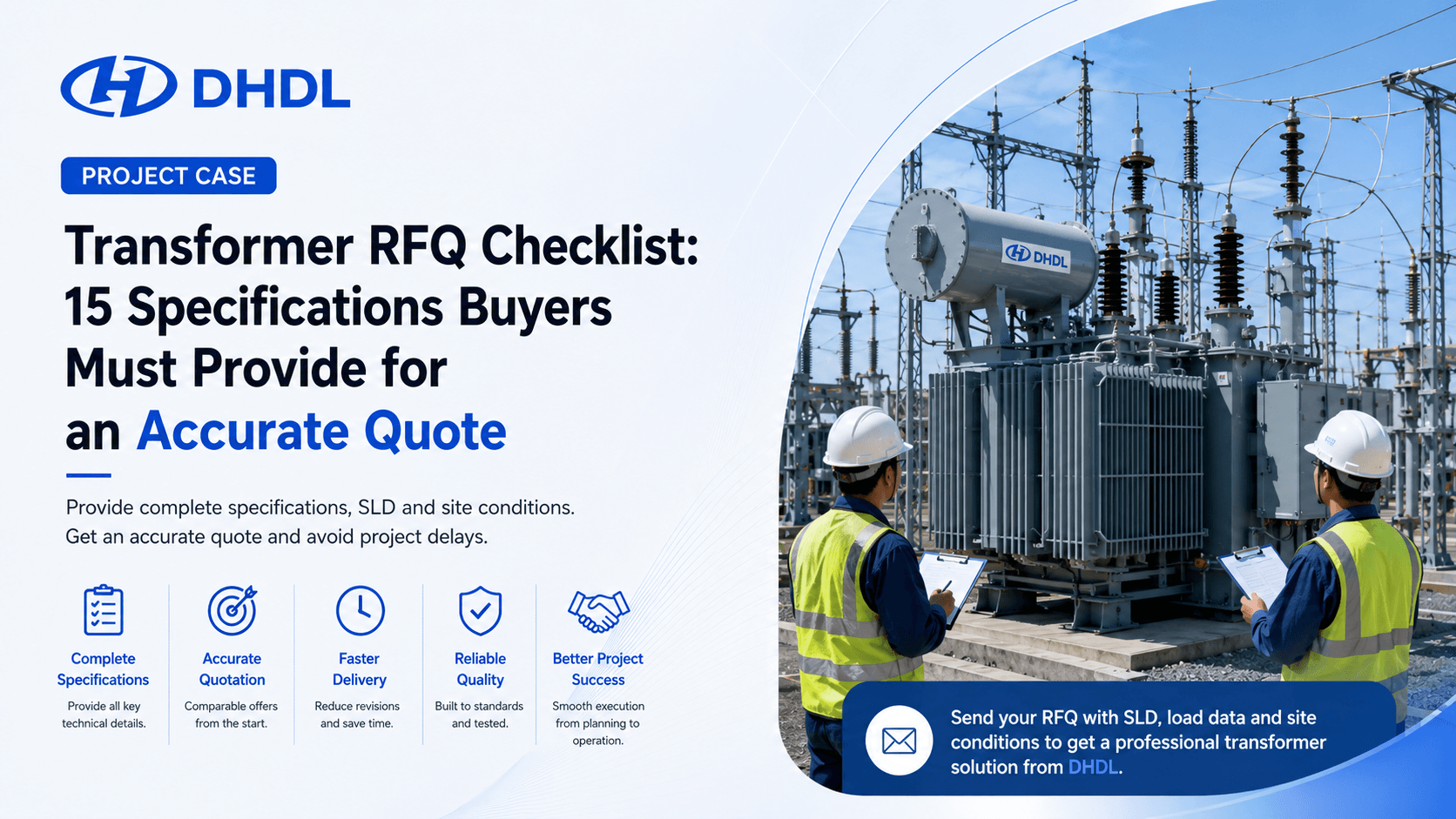
Transformer RFQ Checklist: Specifications Buyers Must Provide for an Accurate Quote

“Please quote a 1,000 kVA transformer.”
It looks like a clear inquiry, but for a transformer manufacturer, this information is far from enough to prepare an accurate technical and commercial quotation.
Two transformers with the same 1,000 kVA rating can have very different voltage ratios, vector groups, impedance, winding materials, losses, cooling methods, accessories, insulation requirements and installation conditions. These differences directly affect transformer design, manufacturing cost, dimensions and delivery.
For EPC contractors, utilities, industrial buyers and distributors, a complete transformer RFQ (Request for Quotation) can reduce repeated technical clarification and make quotations from different transformer suppliers easier to compare.
The basic principle is simple:
Complete Specifications → Accurate Engineering → Comparable Quotation → Fewer Revisions
So, what information should you send when requesting a transformer quotation?
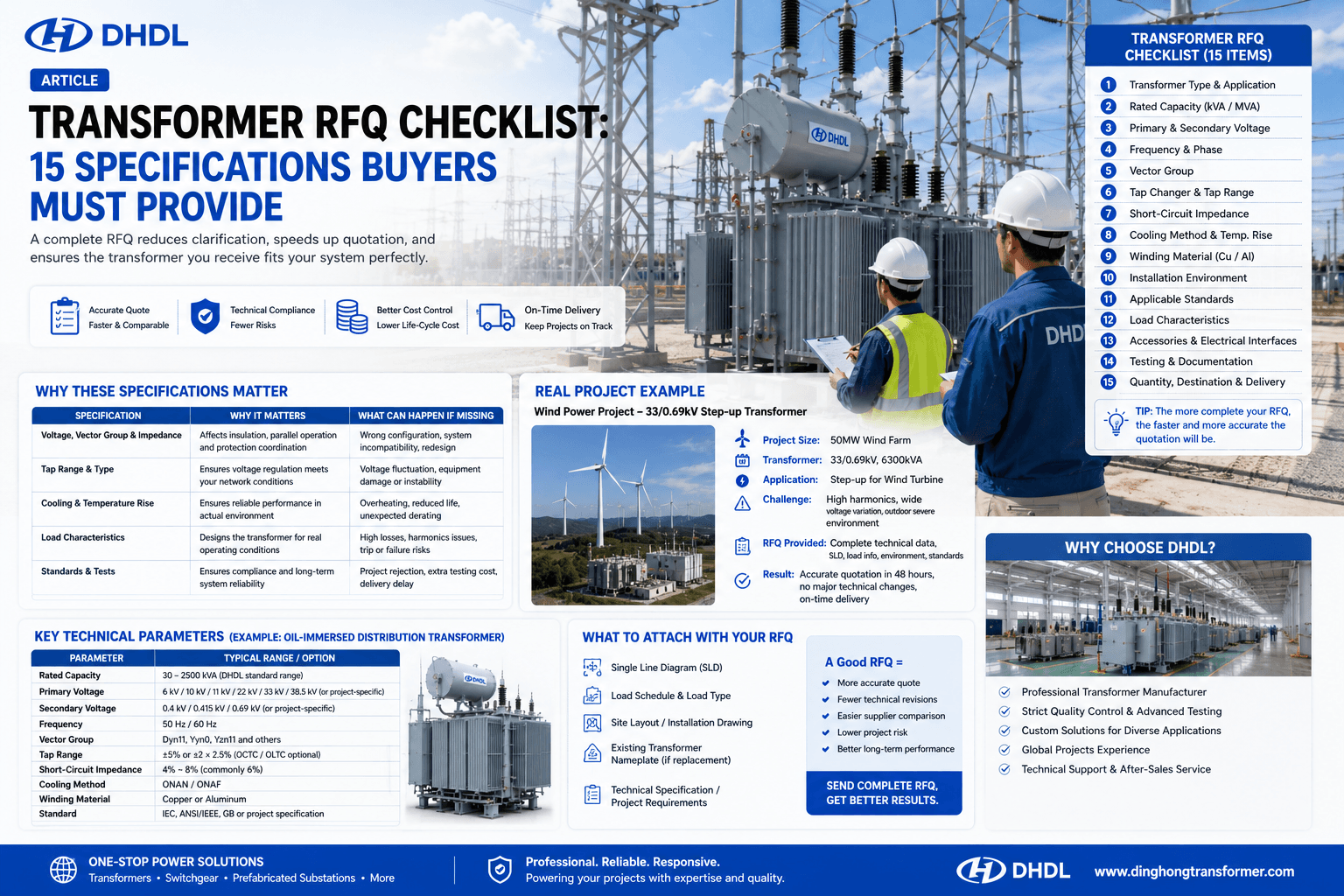
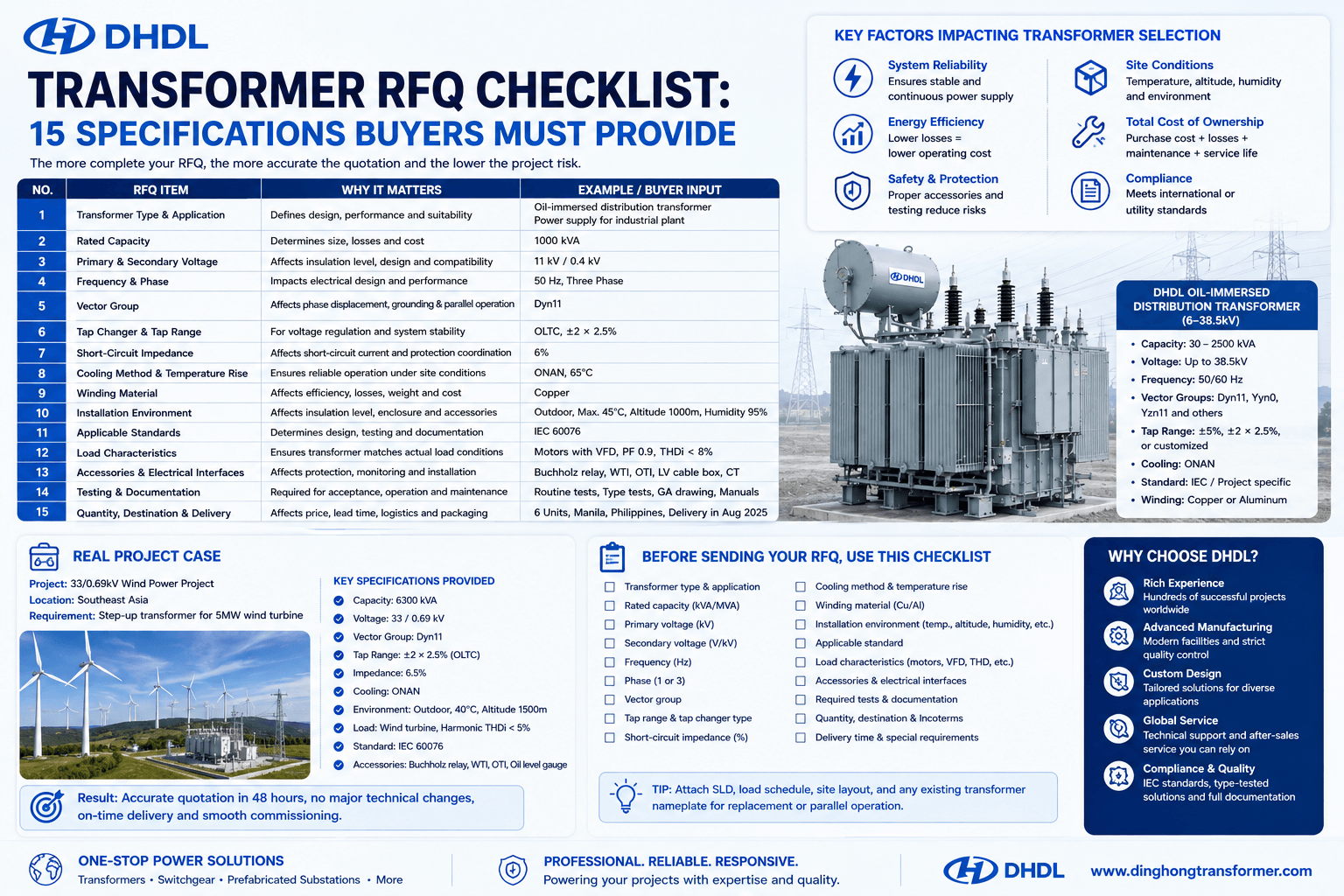
1.Quick Transformer RFQ Checklist
If you need a preliminary quotation quickly, provide at least the following information:
| Required Specification | Example |
|---|---|
| Transformer Type | Oil-Immersed Distribution Transformer |
| Rated Capacity | 1,000 kVA |
| Primary Voltage | 11 kV |
| Secondary Voltage | 0.4 kV |
| Phase | Three Phase |
| Frequency | 50 Hz |
| Vector Group | Dyn11 |
| Tap Range | ±2 × 2.5% |
| Short-Circuit Impedance | 6% |
| Cooling Method | ONAN |
| Winding Material | Copper |
| Installation | Outdoor |
| Standard | IEC / Project Specification |
| Quantity | 6 Units |
| Destination | Manila, Philippines |
These parameters give the manufacturer a starting point for transformer selection and design.
However, capacity and voltage are only the beginning. Some of the most important RFQ information is often hidden in the actual operating conditions.
6-20KV-2.png)
2. Load Characteristics: The Specification Buyers Often Miss
One of the most common transformer RFQ mistakes is simply writing:
That does not tell the transformer manufacturer enough about the actual electrical load.
A transformer supplying ordinary commercial building loads may operate very differently from one supplying large motors, variable frequency drives, EV charging equipment, UPS systems, solar inverters, or electric furnaces.
A better description would be:
Application: Steel processing plant supplying large motors, VFDs, and auxiliary production equipment.
For special loads, buyers should provide information such as:
- Connected load
- Maximum demand
- Power factor
- Largest motor capacity
- Motor starting method
- Normal operating load
- Peak load
- Harmonic characteristics
- Future expansion requirements
For renewable energy projects, inverter or turbine output characteristics are also important.
For example, saying “We need a transformer for a 5 MW wind turbine” does not automatically mean a 5,000 kVA transformer should be selected.
The engineering team may still need to evaluate output current, reactive power, harmonics, overload conditions, and grid requirements.
RFQ Tip: If the transformer supplies VFDs, rectifiers, UPS systems, EV chargers, or other nonlinear loads, tell the manufacturer during the quotation stage rather than after the transformer has already been designed.
3. Voltage, Vector Group, Impedance, and Tap Changer
Instead of writing only “35 kV transformer,” provide the complete voltage ratio.
Typical examples include:
| Application | Example Voltage |
|---|---|
| Distribution | 11 / 0.4 kV |
| Industrial | 10 / 0.4 kV |
| Renewable Energy | 35 / 0.69 kV |
| Commercial | 33 / 0.415 kV |
| High-Voltage Project | 110 / 35 / 10 kV |
For medium- and high-voltage projects, buyers should also confirm the required vector group, short-circuit impedance, and tap range.
A typical specification might be:
33/0.69 kV · Dyn11 · 6.5% Impedance · ±2 × 2.5% Taps
Vector group influences:
- Phase displacement
- Grounding
- Neutral configuration
- Harmonic behavior
- Parallel operation
Short-circuit impedance affects:
- Fault current
- Voltage drop
- Protection coordination
- Parallel operation
- Downstream equipment selection
Tap settings are used to accommodate voltage variation within the electrical network.
If voltage adjustment is required, specify whether the transformer needs an Off-Circuit Tap Changer (OCTC) or an On-Load Tap Changer (OLTC).
If a new transformer will operate in parallel with existing equipment, provide the existing transformer’s nameplate and available test data.
Do not rely only on capacity and voltage when selecting a transformer for parallel operation.
4. Site Conditions Matter More Than “Indoor or Outdoor”
Installation environment is another frequently overlooked part of a transformer technical specification.
Writing only “Installation: Outdoor” is often insufficient.
The transformer manufacturer needs to understand the actual environment in which the equipment will operate.
Typical site information should include:
| Site Condition | Example |
|---|---|
| Installation | Outdoor |
| Maximum Temperature | +45°C |
| Minimum Temperature | -10°C |
| Altitude | 1,500 m |
| Relative Humidity | 95% |
| Environment | Coastal |
| Pollution | Salt / High Humidity |
These conditions can influence insulation design, cooling performance, temperature rise, enclosure design, corrosion protection, and material selection.
A transformer installed in a hot and humid coastal region may require different engineering considerations from the same-capacity transformer installed in a dry inland industrial area.
High-altitude installations may also require additional thermal and insulation review.
A useful rule for international transformer procurement is:
Country name alone is not an engineering specification.
Always provide actual site conditions whenever possible.
5. Winding Material, Cooling, and Accessories
Construction requirements can create significant differences between transformer quotations.
Copper or Aluminum Windings
State whether the project requires Copper (Cu) or Aluminum (Al) windings.
If both materials are acceptable, ask the manufacturer to provide technically comparable alternatives.
Do not compare two transformer quotations only by final price if one supplier is offering copper windings and another is offering aluminum.
Instead, compare:
- Winding material
- No-load loss
- Load loss
- Temperature rise
- Efficiency
- Dimensions
- Weight
- Short-circuit performance
Cooling Method
Common transformer cooling methods include:
| Transformer Type | Typical Cooling |
|---|---|
| Oil-Immersed Distribution Transformer | ONAN |
| Larger Oil-Immersed Transformer | ONAN / ONAF |
| Dry-Type Transformer | AN |
| Forced-Air Dry-Type Transformer | AF |
Cooling requirements become particularly important for high ambient temperatures, continuous heavy loads, and restricted installation spaces.
Transformer Accessories
Depending on the transformer type and project requirements, buyers may need to specify:
- Buchholz relay
- Pressure relief device
- Oil level indicator
- Oil temperature indicator
- Winding temperature indicator
- Cooling fans
- Surge arresters
- Cable boxes
- Current transformers
- Monitoring devices
- Communication interfaces
One detail buyers frequently overlook is cable entry and terminal arrangement.
A transformer may be electrically correct but still create installation problems if its HV/LV terminals or cable boxes do not match the electrical room or substation layout.
6. Standards, Testing, and Documentation
Do not simply write “International Standard” in the RFQ.
Specify the applicable requirement, such as:
- IEC
- ANSI/IEEE
- GB
- Utility-specific standard
- Project technical specification
The required standard may influence transformer insulation, testing, accessories, nameplate information, and technical documentation.
Testing requirements should also be agreed during the RFQ stage rather than after production.
Typical transformer tests may include:
- Winding resistance test
- Voltage ratio test
- Vector group verification
- No-load loss test
- Load loss test
- Short-circuit impedance test
- Insulation resistance test
- Withstand voltage test
Depending on transformer type and project requirements, additional testing may also be required.
Buyers should specify the technical documents required for project approval.
Common documents include:
- General Arrangement Drawing
- Technical Datasheet
- Nameplate Drawing
- Wiring Diagram
- Foundation Drawing
- Routine Test Reports
- Type Test Reports when required
- Packing List
- Operation and Maintenance Manual
For EPC projects, documentation requirements should be confirmed early because drawing and document approval can affect the manufacturing schedule.
7. Real Project Scenario: 33–38.5 kV Wind Power Transformer
Consider a wind power project using a 33–38.5 kV collection system.
The buyer initially sends:
“Please quote a transformer for a 5 MW wind turbine.”
From a procurement perspective, this may appear sufficient.
From an engineering perspective, several important questions remain.
The transformer manufacturer may still need to know:
- Turbine output voltage
- Maximum output current
- Required HV voltage
- System frequency
- Required vector group
- Short-circuit impedance
- Harmonic characteristics
- Tap range
- Project altitude
- Maximum and minimum ambient temperature
- Installation environment
- Grid standard
A more useful RFQ might include:
| Parameter | Project Requirement |
|---|---|
| Application | Wind Turbine Step-Up |
| Capacity | Confirmed by Load Data |
| HV Voltage | 33 / 38.5 kV Class |
| LV Voltage | Turbine Output Voltage |
| Frequency | 50 Hz |
| Vector Group | Project Specific |
| Installation | Outdoor / Nacelle / Project Specific |
| Environment | Based on Project Site Conditions |
| Standard | IEC / Project Specification |
The lesson is straightforward:
Do not select a transformer based on MW or kVA alone.
Actual operating conditions should be considered before the final transformer design is confirmed.
8. The Hidden Cost of an Incomplete Transformer RFQ
The lowest transformer quotation is not necessarily the lowest project cost.
Supplier A may offer:
- Aluminum winding
- Standard losses
- Basic accessories
- Standard ambient design
- Routine testing only
Supplier B may offer:
- Copper winding
- Guaranteed losses
- High-temperature design
- Additional protection
- Project-specific testing
- More complete technical documentation
These two quotations are not technically equivalent.
A better transformer quotation comparison should consider:
Technical Compliance + Purchase Price + Energy Losses + Accessories + Testing + Delivery
This is especially important for EPC, industrial, renewable energy, and utility projects where a small purchasing saving can later be outweighed by redesign, installation changes, additional testing, or higher operating losses.
We have provided some articles related to RFQs:
Transformer RFQ Checklist: Specifications Buyers Must Provide for an Accurate Quote
Transformer RFQ Checklist: 15 Specifications Buyers Must Provide for an Accurate Quote
Copy-and-Use Transformer RFQ Checklist
Before sending your next transformer inquiry, complete as much of this information as possible:
| RFQ Item | Buyer Input |
|---|---|
| Transformer Type | __________ |
| Application | __________ |
| Rated Capacity | _____ kVA / MVA |
| HV / LV Voltage | _____ / _____ kV |
| Frequency / Phase | __________ |
| Vector Group | __________ |
| Short-Circuit Impedance | _____ % |
| Tap Range / Tap Changer | __________ |
| Winding Material | Copper / Aluminum |
| Cooling Method | __________ |
| Maximum / Minimum Temperature | __________ |
| Altitude | _____ m |
| Installation | Indoor / Outdoor |
| Applicable Standard | __________ |
| Load Characteristics | __________ |
| Required Accessories | __________ |
| Required Tests | __________ |
| Quantity | _____ Units |
| Destination | __________ |
| Required Delivery | __________ |
Recommended RFQ Attachments
Whenever available, attach:
- Single-Line Diagram (SLD)
- Technical specification
- Load schedule
- Site-condition information
- Site layout or transformer room layout
- Required test and documentation list
For transformer replacement or parallel-operation projects, also provide:
- Existing transformer nameplate
- Existing transformer technical data
- Available factory or site test reports
These documents often answer technical questions faster than several rounds of email clarification.
Need a Transformer Quote?
DHDL provides transformer and power distribution solutions for industrial facilities, utilities, renewable energy projects, and infrastructure applications.
When requesting a quotation, send your capacity, voltage ratio, SLD, load information, site conditions, applicable standard, quantity, and destination.
A complete RFQ allows the engineering team to prepare a more accurate technical proposal, identify project-specific requirements earlier, and reduce unnecessary revisions before production.
DHDL — Customized Transformer Solutions for Industrial, Utility, and Renewable Energy Projects.
Choose DHDL for Your Transformer Solutions
DHDL is a professional transformer manufacturer specializing in dry-type transformers, oil-immersed transformers, power transformers, distribution transformers, and complete power distribution solutions.
We support customized transformer designs based on project voltage, capacity, frequency, installation environment, and international standards.
Whether for industrial facilities, renewable energy projects, data centers, utilities, or infrastructure applications, DHDL delivers reliable, efficient, and customized power solutions worldwide.
Contact DHDL today for professional transformer selection support and a customized quotation.
FAQ
1. What information is required for a transformer RFQ?
At minimum, provide transformer type, application, rated capacity, primary and secondary voltage, frequency, phase, quantity, and destination.
For a more accurate quotation, also provide vector group, impedance, winding material, site conditions, applicable standards, accessories, and testing requirements.
2. Why is transformer capacity alone not enough for a quotation?
Transformers with the same kVA rating can have different voltage ratios, vector groups, impedance, winding materials, cooling systems, losses, accessories, and installation requirements.
These differences directly affect transformer engineering and quotation price.
3. What documents should I attach to a transformer RFQ?
The most useful documents include:
- Single-Line Diagram (SLD)
- Technical specification
- Load schedule
- Site-condition information
- Site or electrical-room layout
For replacement or parallel-operation projects, also provide the existing transformer nameplate and available test data.
4. Should site temperature and altitude be included in the RFQ?
Yes.
High ambient temperature, altitude, humidity, salt, dust, and other environmental factors can affect transformer cooling, insulation, enclosure design, and corrosion protection.
5. How should buyers compare transformer quotations?
Do not compare transformer quotations by purchase price alone.
Compare:
- Technical compliance
- Winding material
- Guaranteed losses
- Short-circuit impedance
- Cooling method
- Accessories
- Testing
- Applicable standards
- Documentation
- Delivery schedule
- Final price
This makes it easier to determine whether different transformer quotations are technically comparable before selecting a supplier.