
Replacing an Existing Transformer: 10 Critical Specifications & Site Checks Before Ordering

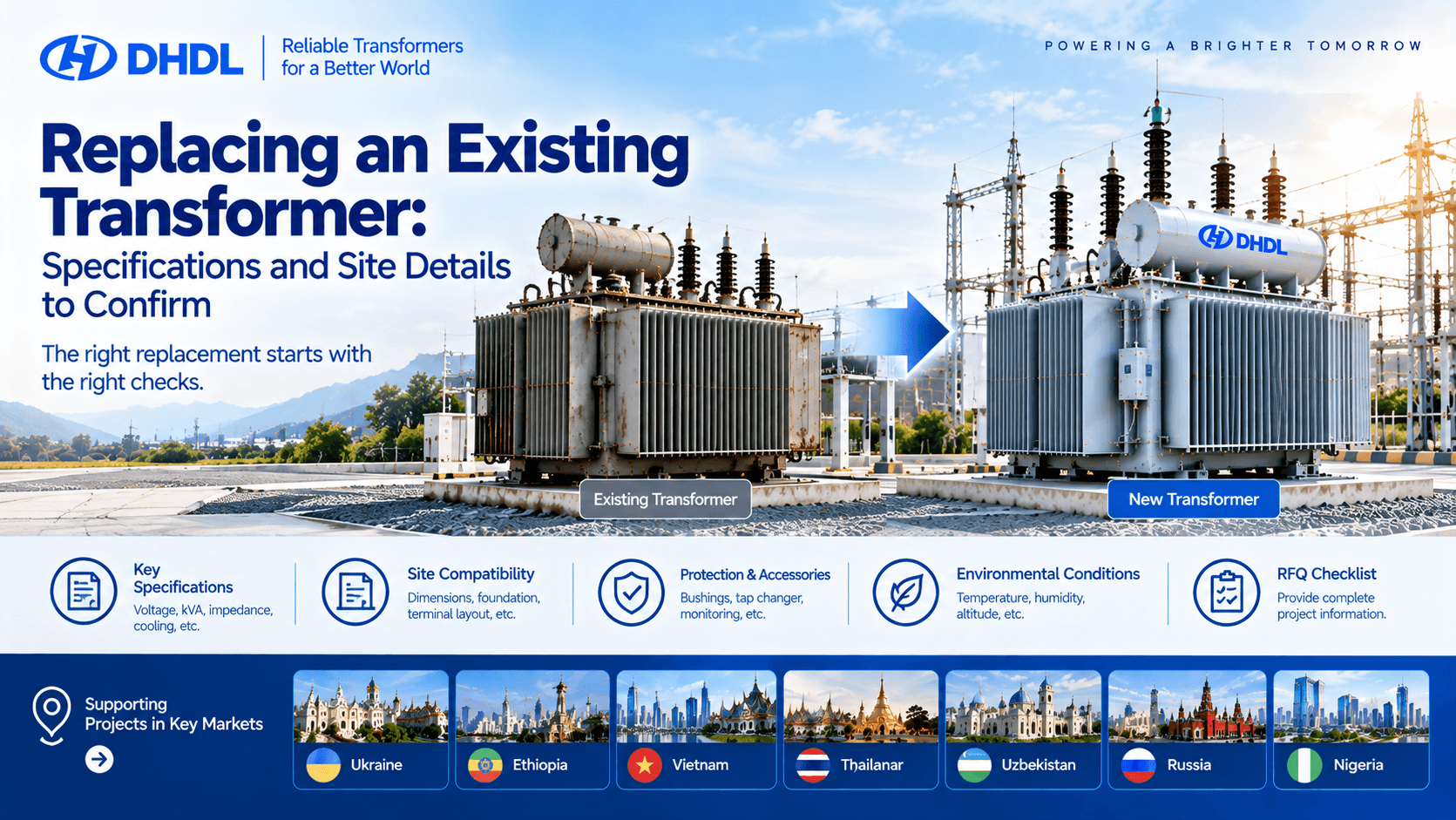
Replacing an existing transformer is rarely as simple as matching the old unit’s kVA rating and voltage.
A new transformer may have the correct electrical capacity but different terminal positions, short-circuit impedance, foundation dimensions, cooling requirements, or protection accessories. These differences can delay installation, increase project costs, and extend planned shutdowns.
For industrial facilities, substations, and power distribution projects in Ukraine, Ethiopia, Vietnam, Thailand, Myanmar, Uzbekistan, Russia, and Nigeria, replacement planning should begin with a detailed assessment of the existing transformer and installation site.
This guide explains ten critical specifications to confirm, common hidden replacement costs, and how to prepare an accurate transformer replacement RFQ.
1. Confirm the Existing Transformer Capacity and Actual Demand
The first step is to check the existing transformer’s rated capacity and compare it with the facility’s current load.
For example, a factory may have a 1,000kVA transformer installed ten years ago. Since then, additional production equipment may have increased electricity demand.
Before ordering, verify:
- Existing rated capacity (kVA/MVA)
- Maximum recorded electrical demand
- Operating power factor
- Motor starting requirements
- Historical overload conditions
- Expected future expansion
- Required backup or redundancy
Example: Replacing a 1,000kVA Transformer
| Parameter | Illustrative Value |
|---|---|
| Existing Transformer | 1,000kVA |
| Maximum Demand | 900kW |
| Power Factor | 0.90 |
| Calculated Demand | 1,000kVA |
| Expected Expansion | 20% |
| Future Requirement | 1,200kVA |
A 1,250kVA replacement may be considered, subject to thermal limits and electrical system verification.
However, increasing transformer capacity can also increase prospective short-circuit current and require modifications to switchgear or protection equipment.
Procurement insight: Do not increase transformer capacity without checking the downstream electrical system.
2. Verify Primary Voltage, Secondary Voltage and Frequency
Replacement transformers must match the actual utility and facility electrical requirements.
| Parameter | Example Values |
|---|---|
| Primary Voltage | 6 / 10 / 11 / 22 / 33kV |
| Secondary Voltage | 400 / 415V |
| Frequency | 50 / 60Hz |
| Phase | Three-Phase |
| Tap Range | ±5% / ±2 × 2.5% |
| Vector Group | Dyn11 / Yyn0, as specified |
These are example configurations rather than universal specifications.
For projects in Thailand, Vietnam, Ethiopia, and Nigeria, buyers should confirm the actual utility connection voltage rather than assuming that all facilities use the same distribution standard.
The same applies to older industrial networks in Ukraine, Russia, Uzbekistan, and Myanmar.
3. Match Vector Group, Phase Sequence and Grounding
Vector group compatibility is essential when replacing a transformer connected to an existing electrical system.
A transformer with a different vector group may change the phase displacement between primary and secondary voltages.
This can create serious compatibility problems, especially where transformers operate in parallel.
Confirm:
- Existing vector group
- Phase sequence
- Terminal identification
- Neutral configuration
- Grounding arrangement
- Parallel operation requirements
- Existing protection settings
Hidden risk: Matching the voltage ratio does not guarantee that the new transformer can safely operate with existing transformers.
4. Check Short-Circuit Impedance and Protection Coordination
Transformer impedance influences fault current, voltage regulation, and parallel load sharing.
Consider this example:
| Parameter | Existing Unit | Proposed Replacement |
|---|---|---|
| Capacity | 1,000kVA | 1,250kVA |
| Voltage | 11/0.4kV | 11/0.4kV |
| Impedance | 6% | 5% |
| Vector Group | Dyn11 | Dyn11 |
The replacement transformer has higher capacity and lower impedance.
This combination may increase prospective fault current.
Before approving the replacement, check:
- Circuit-breaker interrupting capacity
- Busbar short-time withstand rating
- Protection relay settings
- Cable short-circuit withstand
- Existing switchgear condition
- Parallel transformer arrangements
A short-circuit and protection coordination study may be necessary before installation.
5. Measure Transformer Dimensions and Foundation Compatibility
One of the most expensive replacement mistakes is ordering a transformer that does not fit the existing installation.
Check:
- Overall length, width and height
- Foundation dimensions
- Mounting-hole locations
- Wheel spacing or rail gauge
- Transformer weight
- Lifting points
- Transportation access
- Door and corridor clearances
- Maintenance access
- Radiator clearance
For indoor dry-type transformer replacements, ventilation and enclosure dimensions are particularly important.
For outdoor oil-immersed transformers, confirm oil containment, foundation loading, and radiator clearance.
Practical tip: Provide the manufacturer with an existing General Arrangement Drawing and photographs showing measured dimensions.
6. Confirm Cooling, Insulation and Environmental Conditions
A replacement transformer must operate safely under the actual site conditions, not just standard factory test conditions.
For oil-immersed transformers, confirm:
- ONAN or ONAF cooling arrangement
- Insulating oil specification
- Maximum and minimum ambient temperatures
- Oil containment and fire protection
- Radiator clearance
- Temperature monitoring and alarms
For dry-type transformers, confirm:
- Insulation system and temperature-rise limits
- AN or AF cooling requirements
- Enclosure IP rating
- Ventilation and airflow
- Temperature sensors and protection contacts
Environmental conditions vary across DHDL’s target markets.
| Target Market | Site Details to Confirm |
|---|---|
| Ukraine | Winter temperatures, installation access, grid restoration requirements |
| Ethiopia | Site altitude, ambient temperature, dust and outdoor exposure |
| Vietnam | Humidity, ventilation, corrosion and industrial operating conditions |
| Thailand | High temperatures, humidity and cooling performance |
| Myanmar | Moisture exposure, site access and maintenance conditions |
| Uzbekistan | Seasonal temperature variation, dust and substation layout |
| Russia | Low-temperature operation, oil suitability and condensation |
| Nigeria | Heat, dust, utility compatibility and maintenance access |
These are site-planning considerations, not universal specifications for each country. Final requirements should be based on measured or documented local conditions.
7. Check Terminals, Bushings and Protection Accessories
Even a correctly rated transformer may require costly modifications if its connections differ from the existing equipment.
| Component | Replacement Check |
|---|---|
| HV Bushings | Type, location, insulation and termination |
| LV Terminals | Position, quantity and current rating |
| Cable Connections | Cable size, lugs and entry arrangement |
| Bus Duct | Flange dimensions and connection position |
| Tap Changer | Type, range and operating mechanism |
| Temperature Monitoring | Sensors, alarms and trip contacts |
| Protection Accessories | Pressure relief, gas relay where applicable |
| Earthing | Grounding terminals and connections |
| Control Wiring | Supply voltage, terminal layout and signals |
Before manufacturing, ask the supplier to provide an approved General Arrangement Drawing, terminal connection drawings, and accessory list.
Hidden cost: Relocating busbars or replacing cable terminations during a short shutdown can cost more than specifying the correct terminal arrangement during procurement.
8. Real Project Reference: DHDL Thailand Industrial Park
DHDL’s Thailand Industrial Park Power Distribution Expansion Project illustrates how transformer specifications, site conditions and delivery requirements affect an existing power network upgrade.
The project involved adding an 8,000kVA oil-immersed transformer to support growing industrial electricity demand.
| Parameter | Published Project Data |
|---|---|
| Country | Thailand |
| Application | Industrial Park Expansion |
| Transformer Model | S-8000/33 |
| Rated Capacity | 8,000kVA |
| Voltage | 33/0.416kV |
| Frequency | 50Hz |
| Cooling Classification | ONAN |
| Installation | Outdoor |
| Production and Testing | 38 Days |
The customer required equipment within a tight project schedule, and the site experienced hot, humid conditions. DHDL reports completing production and testing in 38 days, followed by shipment to Thailand.
Important distinction: This was a documented capacity-expansion project, not a confirmed like-for-like transformer replacement. It is relevant because both project types require careful coordination with an existing distribution network.
For replacement projects in Thailand, Vietnam, Nigeria and Ethiopia, the same procurement principles apply: verify network compatibility, environmental conditions, factory testing and the installation schedule before ordering.
9. Plan Factory Testing, Delivery and the Shutdown Window
A transformer replacement schedule should cover the complete process:
- Existing equipment inspection and technical data collection
- Replacement specification and drawing approval
- Material preparation and manufacturing
- Factory Acceptance Testing (FAT)
- Packaging and international transportation
- Customs clearance and inland delivery
- Existing transformer isolation and removal
- Foundation and connection verification
- New transformer installation
- Site testing, protection checks and energization
Typical factory documentation should include voltage-ratio, winding-resistance, vector-group, insulation, no-load-loss, load-loss and impedance test results, plus additional tests required by the project.
DHDL’s procurement guidance also emphasizes that lead time depends on customization, drawing approval, testing and logistics, rather than manufacturing alone.
For projects in Ukraine, Ethiopia, Vietnam, Thailand, Myanmar, Uzbekistan, Russia and Nigeria, buyers should distinguish between factory completion date, shipping date, site delivery date and energization date.
A transformer arriving on time will not prevent delays if the foundation, protection settings or utility approval is incomplete.
10. Transformer Replacement RFQ Checklist
Before requesting a quotation, prepare a side-by-side comparison of the existing transformer and proposed replacement.
| RFQ Parameter | Existing Transformer | Required Replacement |
|---|---|---|
| Rated Capacity | _____ kVA | _____ kVA |
| Primary Voltage | _____ kV | _____ kV |
| Secondary Voltage | _____ V/kV | _____ V/kV |
| Frequency | _____ Hz | _____ Hz |
| Vector Group | _____ | _____ |
| Short-Circuit Impedance | _____ % | _____ % |
| Tap Range | _____ | _____ |
| Cooling Method | _____ | _____ |
| Transformer Type | Oil / Dry | Oil / Dry |
| Winding Material | Cu / Al | Cu / Al |
| Insulation Level | _____ | _____ |
| No-Load Loss | _____ W | _____ W |
| Load Loss | _____ W | _____ W |
| Dimensions | L × W × H | Maximum Allowed |
| Total Weight | _____ kg | Maximum Allowed |
| Terminal Arrangement | _____ | _____ |
| Foundation / Wheel Spacing | _____ | _____ |
| Protection Accessories | _____ | _____ |
| Applicable Standards | _____ | _____ |
| Required Delivery Date | — | _____ |
Documents to Include in Your RFQ
- Existing transformer nameplate photographs
- Single-Line Diagram (SLD)
- Existing General Arrangement Drawing
- Transformer foundation dimensions
- HV/LV cable and busbar connection drawings
- Maximum operating load and expansion requirements
- Existing transformer test reports
- Short-circuit and protection coordination studies
- Installation site photographs
- Ambient temperature, altitude and humidity information
- Required factory testing and certification
- Destination country and delivery schedule
DHDL’s published transformer RFQ guidance identifies voltage, capacity, impedance, cooling, environmental requirements and supporting technical drawings as important inputs for an accurate quotation.
Replace Your Existing Transformer with DHDL
DHDL supplies oil-immersed distribution transformers, dry-type transformers, power transformers and related electrical distribution equipment for industrial, utility and infrastructure applications.
For transformer replacement projects in Ukraine, Ethiopia, Vietnam, Thailand, Myanmar, Uzbekistan, Russia and Nigeria, buyers can submit their existing equipment information for a project-specific technical review.
A suitable replacement must meet more than the original kVA rating. It should match the electrical network, installation space, protection system, environmental conditions and required delivery schedule.
For an accurate quotation, send:
Existing Nameplate + Rated Capacity + HV/LV Voltage + Impedance + Dimensions + Terminal Drawings + Site Conditions + Destination
DHDL — Customized Transformer Solutions for Global Power Distribution Projects.
Website: https://dinghongtransformer.com/