Lista de verificación para solicitudes de presupuesto de transformadores: Especificaciones que los compradores deben proporcionar para una cotización precisa

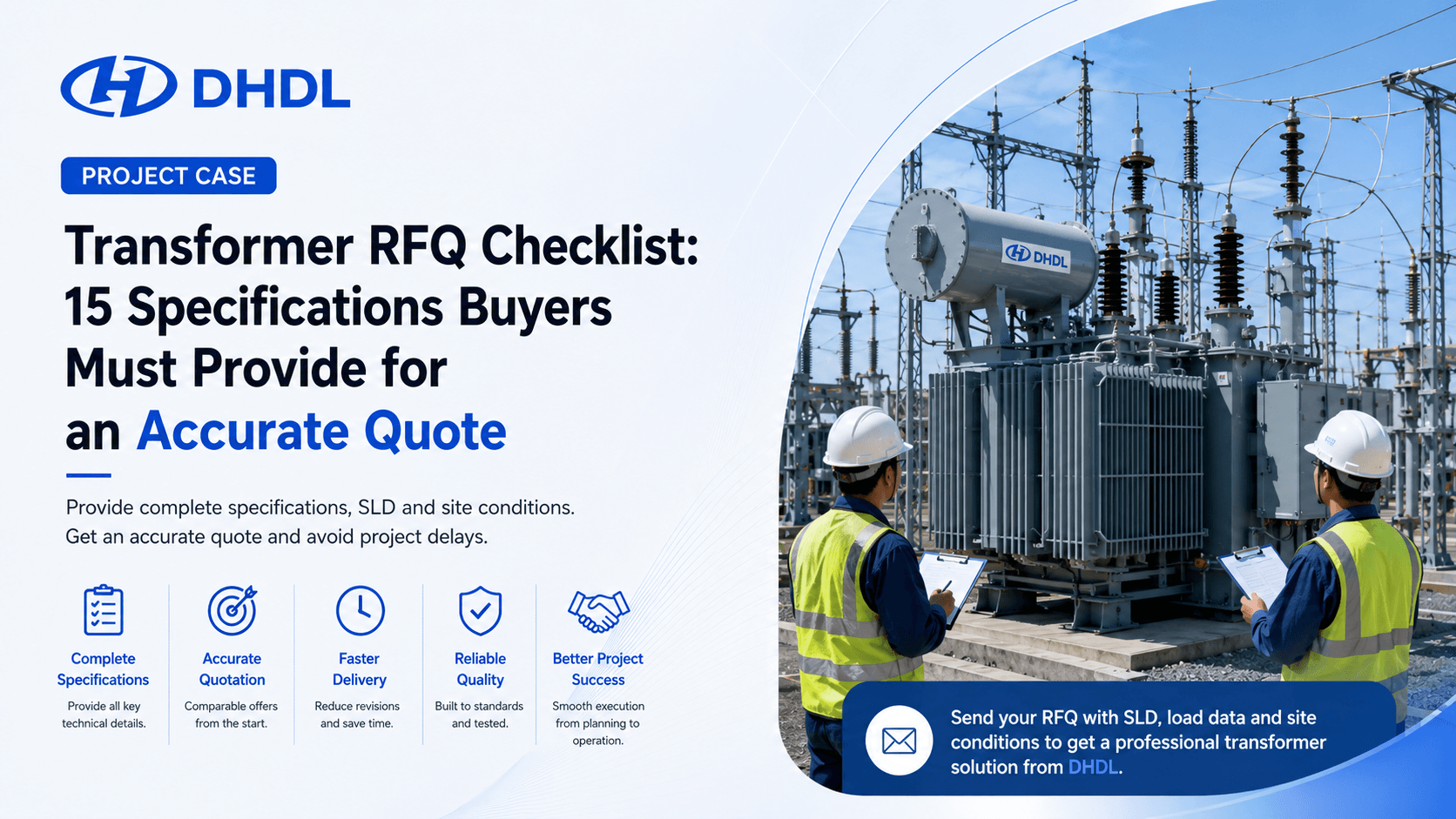
“Por favor, cotice un transformador de 1,000 kVA.”
Parece una consulta clara, लेकिन para un fabricante de transformadores, esta información está lejos de ser suficiente para preparar una cotización técnica y comercial precisa.
Dos transformadores con la misma potencia nominal de 1000 kVA pueden tener relaciones de transformación, grupos de conexión, impedancia, materiales de bobinado, pérdidas, métodos de refrigeración, accesorios, requisitos de aislamiento y condiciones de instalación muy diferentes. Estas diferencias afectan directamente al diseño del transformador, al coste de fabricación, a las dimensiones y al plazo de entrega.
Para contratistas EPC, empresas de servicios públicos, compradores industriales y distribuidores, un completo Solicitud de cotización de transformador puede reducir las aclaraciones técnicas repetidas y facilitar la comparación de cotizaciones de diferentes proveedores de transformadores.
El principio básico es sencillo:
Especificaciones Completas → Ingeniería Precisa → Cotización Comparable → Menos Revisiones
Entonces, ¿qué información debe enviar al solicitar una cotización de transformador?
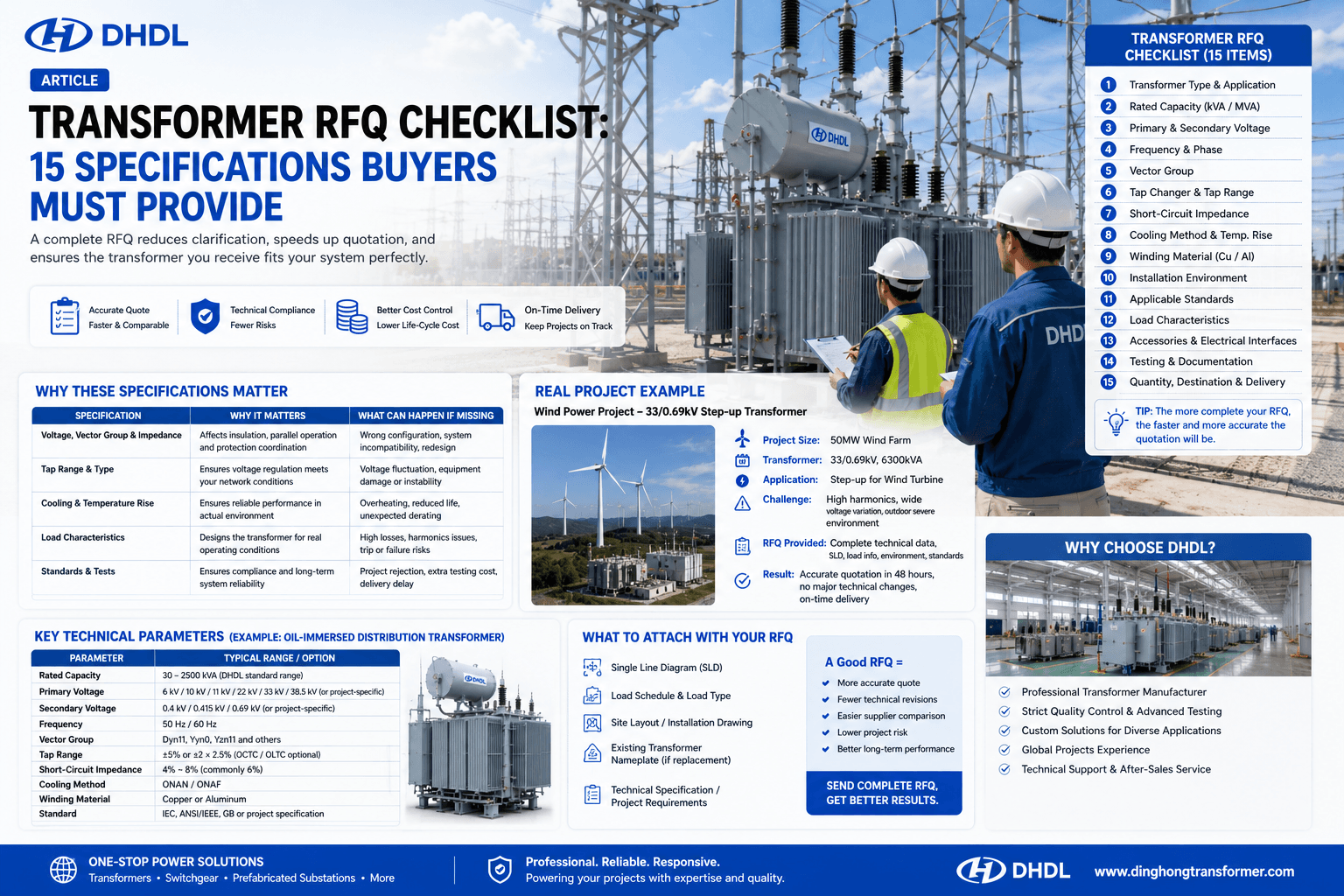
1. Lista de verificación rápida para RFQ de transformadores
Si necesita un presupuesto preliminar rápidamente, proporcione al menos la siguiente información:
| Especificación requerida | Ejemplo |
|---|---|
| Tipo de transformador | Transformador de distribución sumergido en aceite |
| Capacidad nominal | 1.000 kVA |
| Voltaje primario | 11 kV |
| Tensión secundaria | 0,4 kV |
| Fase | Trifásico |
| Frecuencia | 50 Hz |
| Vector Group | Dyn11 |
| Rango de toques | ±2 × 2,51 TP3T |
| Impedancia de cortocircuito | 6% |
| Método de enfriamiento | Onán |
| Material de bobinado | Cobre |
| Instalación | Al aire libre |
| Estándar | IEC / Especificación del proyecto |
| Cantidad | 6 Unidades |
| Destino | Manila, Filipinas |
Estos parámetros proporcionan al fabricante un punto de partida para la selección y el diseño del transformador.
Sin embargo, la capacidad y el voltaje son solo el principio. Parte de la información más importante sobre las solicitudes de cotización (RFQ) suele estar oculta en las condiciones reales de operación.
6-20KV-2.png)
2. Características de carga: La especificación que los compradores suelen pasar por alto
Uno de los errores más comunes en las solicitudes de cotización (RFQ) de transformadores es simplemente escribir:
Eso no le dice lo suficiente al fabricante del transformador sobre la carga eléctrica real.
Un transformador que alimenta cargas de edificios comerciales ordinarios puede operar de manera muy diferente a uno que alimenta motores grandes, variadores de frecuencia, equipamiento de carga para vehículos eléctricos, Sistemas UPS, inversores solares, o hornos eléctricos.
Una mejor descripción sería:
Aplicación: Planta siderúrgica que suministra motores grandes, variadores de frecuencia (VFD) y equipos de producción auxiliares.
Para cargas especiales, los compradores deben proporcionar información como:
- Carga conectada
- Demanda máxima
- Factor de potencia
- Mayor capacidad de motor
- Método de arranque del motor
- Carga normal de operación
- Punta de carga
- Características armónicas
- Requisitos de expansión futura
Para los proyectos de energía renovable, las características de salida de los inversores o turbinas también son importantes.
Por ejemplo, diciendo “Necesitamos un transformador para un aerogenerador de 5 MW” no significa automáticamente que deba seleccionarse un transformador de 5.000 kVA.
Es posible que el equipo de ingeniería todavía necesite evaluar la corriente de salida, la potencia reactiva, los armónicos, las condiciones de sobrecarga y los requisitos de la red.
Consejo para solicitudes de cotización: Si el transformador alimenta variadores de frecuencia (VFD), rectificadores, sistemas UPS, cargadores de vehículos eléctricos u otras cargas no lineales, infórmese al fabricante durante la etapa de cotización en lugar de después de que el transformador ya haya sido diseñado.
3. Tensión, Grupo de Conexión, Impedancia y Conmutador de Tomas
En lugar de escribir solo “transformador de 35 kV,” proporcione la relación de tensión completa.
Ejemplos típicos incluyen:
| Solicitud | Voltaje de ejemplo |
|---|---|
| Distribution | 11 / 0.4 kV |
| Industrial | 10 / 0.4 kV |
| Renewable Energy | 35 / 0.69 kV |
| Commercial | 33 / 0.415 kV |
| High-Voltage Project | 110 / 35 / 10 kV |
For medium- and high-voltage projects, buyers should also confirm the required vector group, short-circuit impedance, and tap range.
A typical specification might be:
33/0.69 kV · Dyn11 · 6.5% Impedance · ±2 × 2.5% Taps
Vector group influences:
- Phase displacement
- Grounding
- Neutral configuration
- Harmonic behavior
- Parallel operation
Short-circuit impedance affects:
- Fault current
- Voltage drop
- Protection coordination
- Parallel operation
- Downstream equipment selection
Tap settings are used to accommodate voltage variation within the electrical network.
If voltage adjustment is required, specify whether the transformer needs an Off-Circuit Tap Changer (OCTC) or an On-Load Tap Changer (OLTC).
If a new transformer will operate in parallel with existing equipment, provide the existing transformer’s nameplate and available test data.
Do not rely only on capacity and voltage when selecting a transformer for parallel operation.
4. Las condiciones del sitio importan más que “interior o exterior”
Installation environment is another frequently overlooked part of a transformer technical specification.
Writing only “Installation: Outdoor” is often insufficient.
The transformer manufacturer needs to understand the actual environment in which the equipment will operate.
Typical site information should include:
| Site Condition | Ejemplo |
|---|---|
| Instalación | Al aire libre |
| Maximum Temperature | +45°C |
| Minimum Temperature | -10°C |
| Altitude | 1,500 m |
| Relative Humidity | 95% |
| Environment | Coastal |
| Pollution | Salt / High Humidity |
These conditions can influence insulation design, cooling performance, temperature rise, enclosure design, corrosion protection, and material selection.
A transformer installed in a hot and humid coastal region may require different engineering considerations from the same-capacity transformer installed in a dry inland industrial area.
High-altitude installations may also require additional thermal and insulation review.
A useful rule for international transformer procurement is:
Country name alone is not an engineering specification.
Always provide actual site conditions whenever possible.
5. Material de bobinado, refrigeración y accesorios
Construction requirements can create significant differences between transformer quotations.
Bobinados de Cobre o Aluminio
State whether the project requires Copper (Cu) or Aluminum (Al) windings.
If both materials are acceptable, ask the manufacturer to provide technically comparable alternatives.
Do not compare two transformer quotations only by final price if one supplier is offering copper windings and another is offering aluminum.
Instead, compare:
- Winding material
- No-load loss
- Load loss
- Temperature rise
- Efficiency
- Dimensions
- Weight
- Short-circuit performance
Método de enfriamiento
Common transformer cooling methods include:
| Tipo de transformador | Typical Cooling |
|---|---|
| Transformador de distribución sumergido en aceite | Onán |
| Larger Oil-Immersed Transformer | ONAN / ONAF |
| Transformador seco | AN |
| Forced-Air Dry-Type Transformer | AF |
Cooling requirements become particularly important for high ambient temperatures, continuous heavy loads, and restricted installation spaces.
Accesorios para transformadores
Depending on the transformer type and project requirements, buyers may need to specify:
- Buchholz relay
- Pressure relief device
- Oil level indicator
- Oil temperature indicator
- Winding temperature indicator
- Cooling fans
- Surge arresters
- Cable boxes
- Current transformers
- Monitoring devices
- Communication interfaces
One detail buyers frequently overlook is cable entry and terminal arrangement.
A transformer may be electrically correct but still create installation problems if its HV/LV terminals or cable boxes do not match the electrical room or substation layout.
6. Normas, pruebas y documentación
Do not simply write “International Standard” in the RFQ.
Specify the applicable requirement, such as:
- CEI
- ANSI/IEEE
- GB
- Utility-specific standard
- Project technical specification
The required standard may influence transformer insulation, testing, accessories, nameplate information, and technical documentation.
Testing requirements should also be agreed during the RFQ stage rather than after production.
Typical transformer tests may include:
- Winding resistance test
- Voltage ratio test
- Vector group verification
- No-load loss test
- Load loss test
- Short-circuit impedance test
- Insulation resistance test
- Withstand voltage test
Depending on transformer type and project requirements, additional testing may also be required.
Buyers should specify the technical documents required for project approval.
Common documents include:
- General Arrangement Drawing
- Technical Datasheet
- Nameplate Drawing
- Wiring Diagram
- Foundation Drawing
- Routine Test Reports
- Type Test Reports when required
- Packing List
- Operation and Maintenance Manual
For EPC projects, documentation requirements should be confirmed early because drawing and document approval can affect the manufacturing schedule.
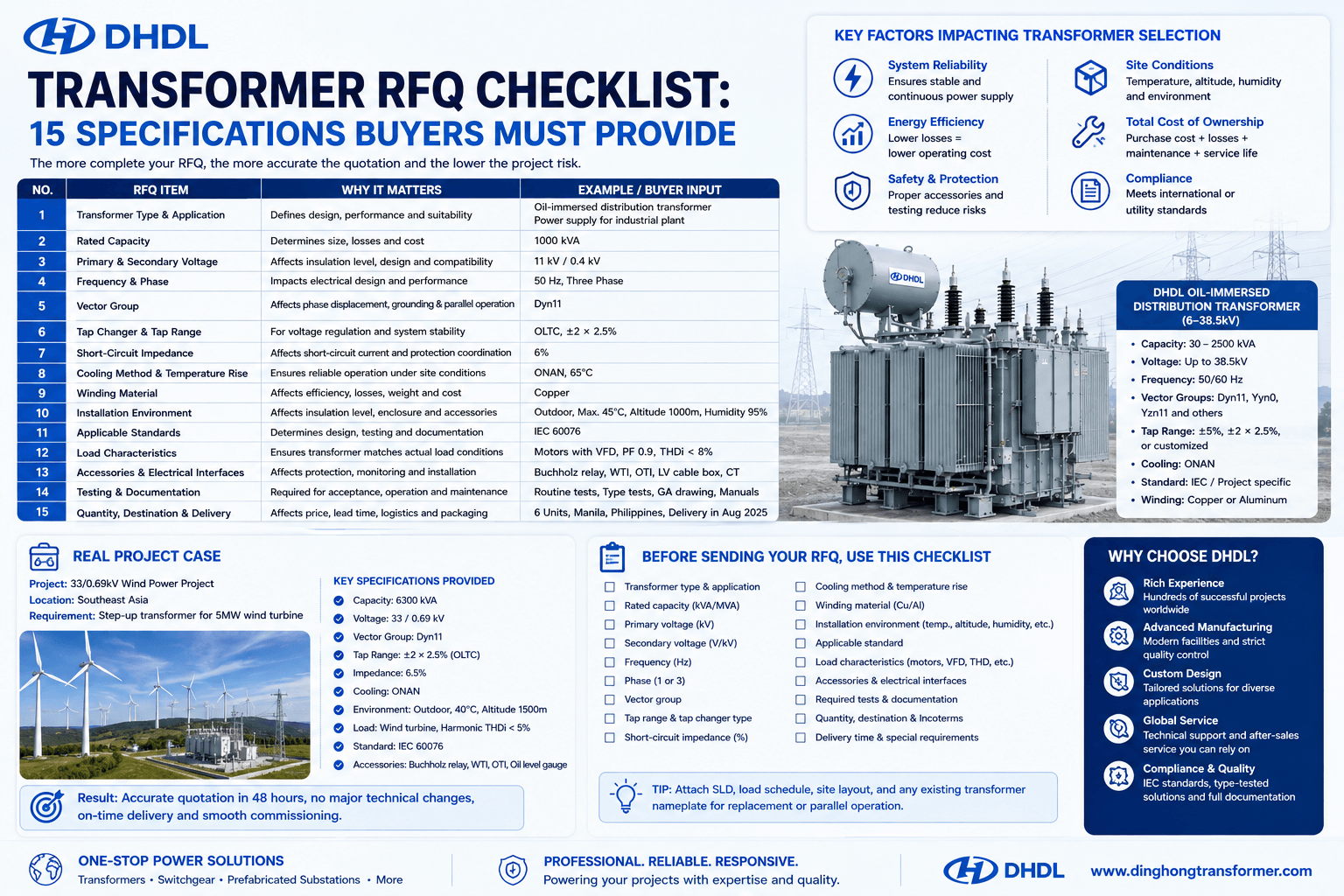
7. Real Project Scenario: 33–38.5 kV Wind Power Transformer
Consider a wind power project using a 33–38.5 kV collection system.
The buyer initially sends:
“Please quote a transformer for a 5 MW wind turbine.”
From a procurement perspective, this may appear sufficient.
From an engineering perspective, several important questions remain.
The transformer manufacturer may still need to know:
- Turbine output voltage
- Maximum output current
- Required HV voltage
- System frequency
- Required vector group
- Short-circuit impedance
- Características armónicas
- Tap range
- Project altitude
- Maximum and minimum ambient temperature
- Installation environment
- Grid standard
A more useful RFQ might include:
| Parameter | Project Requirement |
|---|---|
| Solicitud | Wind Turbine Step-Up |
| Capacity | Confirmed by Load Data |
| HV Voltage | 33 / 38.5 kV Class |
| LV Voltage | Turbine Output Voltage |
| Frecuencia | 50 Hz |
| Vector Group | Project Specific |
| Instalación | Outdoor / Nacelle / Project Specific |
| Environment | Based on Project Site Conditions |
| Estándar | IEC / Especificación del proyecto |
The lesson is straightforward:
Do not select a transformer based on MW or kVA alone.
Actual operating conditions should be considered before the final transformer design is confirmed.
8. El costo oculto de una solicitud de cotización (RFQ) de transformadores incompleta
The lowest transformer quotation is not necessarily the lowest project cost.
Supplier A may offer:
- Aluminum winding
- Standard losses
- Basic accessories
- Standard ambient design
- Routine testing only
Supplier B may offer:
- Copper winding
- Guaranteed losses
- High-temperature design
- Additional protection
- Project-specific testing
- More complete technical documentation
These two quotations are not technically equivalent.
A better transformer quotation comparison should consider:
Technical Compliance + Purchase Price + Energy Losses + Accessories + Testing + Delivery
This is especially important for EPC, industrial, renewable energy, and utility projects where a small purchasing saving can later be outweighed by redesign, installation changes, additional testing, or higher operating losses.
We have provided some articles related to RFQs:
Transformer RFQ Checklist: 15 Specifications Buyers Must Provide for an Accurate Quote
Lista de verificación de RFQ para transformadores de copiar y usar
Before sending your next transformer inquiry, complete as much of this information as possible:
| RFQ Item | Buyer Input |
|---|---|
| Tipo de transformador | __________ |
| Solicitud | __________ |
| Capacidad nominal | _____ kVA / MVA |
| HV / LV Voltage | _____ / _____ kV |
| Frequency / Phase | __________ |
| Vector Group | __________ |
| Impedancia de cortocircuito | _____ % |
| Tap Range / Tap Changer | __________ |
| Material de bobinado | Copper / Aluminum |
| Método de enfriamiento | __________ |
| Maximum / Minimum Temperature | __________ |
| Altitude | _____ m |
| Instalación | Indoor / Outdoor |
| Applicable Standard | __________ |
| Load Characteristics | __________ |
| Required Accessories | __________ |
| Required Tests | __________ |
| Cantidad | _____ Units |
| Destino | __________ |
| Required Delivery | __________ |
Adjuntos recomendados para RFQ
Whenever available, attach:
- Single-Line Diagram (SLD)
- Technical specification
- Load schedule
- Site-condition information
- Site layout or transformer room layout
- Required test and documentation list
For transformer replacement or parallel-operation projects, also provide:
- Existing transformer nameplate
- Existing transformer technical data
- Available factory or site test reports
These documents often answer technical questions faster than several rounds of email clarification.
¿Necesitas una cita de Transformers?
DHDL provides transformer and power distribution solutions for industrial facilities, utilities, renewable energy projects, and infrastructure applications.
When requesting a quotation, send your capacity, voltage ratio, SLD, load information, site conditions, applicable standard, quantity, and destination.
A complete RFQ allows the engineering team to prepare a more accurate technical proposal, identify project-specific requirements earlier, and reduce unnecessary revisions before production.
DHDL — Customized Transformer Solutions for Industrial, Utility, and Renewable Energy Projects.
Choose DHDL for Your Transformer Solutions
DHDL is a professional transformer manufacturer specializing in dry-type transformers, oil-immersed transformers, power transformers, distribution transformers, and complete power distribution solutions.
We support customized transformer designs based on project voltage, capacity, frequency, installation environment, and international standards.
Whether for industrial facilities, renewable energy projects, data centers, utilities, or infrastructure applications, DHDL delivers reliable, efficient, and customized power solutions worldwide.
Contact DHDL today for professional transformer selection support and a customized quotation.
Preguntas frecuentes
1. ¿Qué información se requiere para una solicitud de cotización (RFQ) de un transformador?
At minimum, provide transformer type, application, rated capacity, primary and secondary voltage, frequency, phase, quantity, and destination.
For a more accurate quotation, also provide vector group, impedance, winding material, site conditions, applicable standards, accessories, and testing requirements.
2. ¿Por qué la capacidad del transformador por sí sola no es suficiente para una cotización?
Transformers with the same kVA rating can have different voltage ratios, vector groups, impedance, winding materials, cooling systems, losses, accessories, and installation requirements.
These differences directly affect transformer engineering and quotation price.
3. ¿Qué documentos debo adjuntar a una solicitud de cotización (RFQ) de un transformador?
The most useful documents include:
- Single-Line Diagram (SLD)
- Technical specification
- Load schedule
- Site-condition information
- Site or electrical-room layout
For replacement or parallel-operation projects, also provide the existing transformer nameplate and available test data.
4. ¿Se deben incluir la temperatura y la altitud del sitio en la RFQ?
Yes.
High ambient temperature, altitude, humidity, salt, dust, and other environmental factors can affect transformer cooling, insulation, enclosure design, and corrosion protection.
5. ¿Cómo deben los compradores comparar las cotizaciones de transformadores?
Do not compare transformer quotations by purchase price alone.
Compare:
- Technical compliance
- Winding material
- Guaranteed losses
- Short-circuit impedance
- Cooling method
- Accesorios
- Testing
- Applicable standards
- Documentation
- Delivery schedule
- Final price
This makes it easier to determine whether different transformer quotations are technically comparable before selecting a supplier.