
Can Transformers Operate in Parallel? Key Requirements for Load Sharing

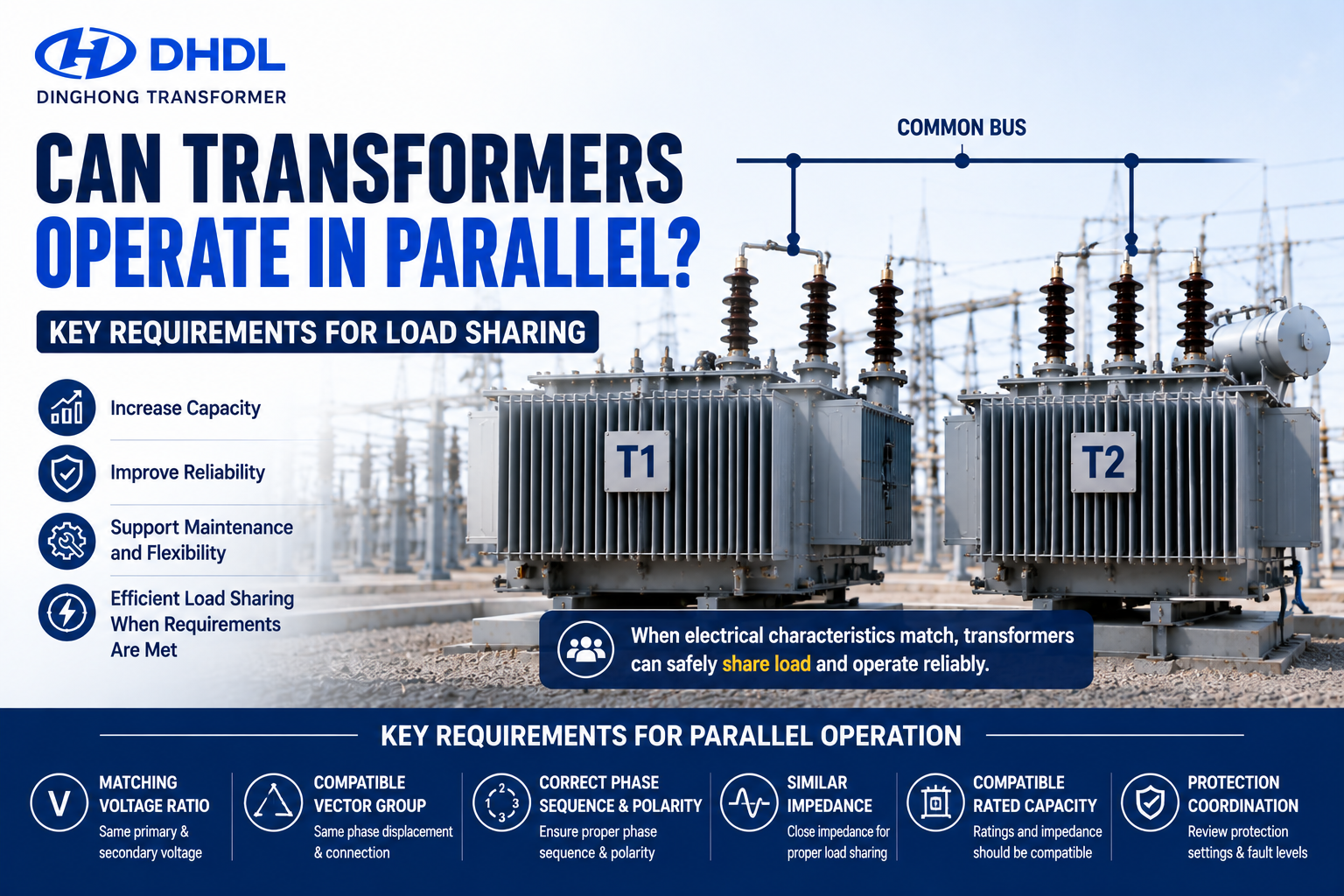
Parallel transformer operation allows two or more transformers to supply the same electrical bus simultaneously.
This arrangement can increase available capacity, improve system flexibility, support maintenance, and provide redundancy for industrial facilities, substations, renewable-energy projects, and commercial power networks.
However, transformers cannot simply be connected in parallel because they have the same Kva rating.
Their electrical characteristics must be compatible. Incorrect parallel operation can cause circulating current, unequal load sharing, overheating, protection problems, and equipment damage.
Understanding the requirements for transformers in parallel is essential when designing or expanding a Power Distribution System.
Why Operate Transformers in Parallel?
One major reason is increased capacity.
Instead of using one very large transformer, a facility may use multiple smaller transformers operating together.
Parallel operation can also improve reliability.
If one transformer is removed for maintenance, the remaining units may continue supplying part of the load, depending on the system design and available capacity.
Can Any Transformers Operate in Parallel?
No. Transformers intended to operate in parallel must satisfy several electrical requirements.
The most important factors include voltage ratio, vector group, phase sequence, impedance, rated capacity, polarity, frequency, and tap position.
Engineers should compare the nameplate and test data of existing and new transformers before connecting them.
1. Matching Voltage Ratio
The transformers should have compatible primary and secondary voltage ratios.If their secondary voltages differ significantly, a voltage difference can exist between the transformer outputs even when the external load is small.
This can create circulating current between the transformers.Tap settings also matter. If one transformer is on a different tap position from the other, their output voltages may not match.
2. Matching Vector Group
For three-phase transformers, the vector group defines the phase displacement between high-voltage and low-voltage windings.
Transformers connected in parallel generally need compatible vector groups and phase displacement. An incompatible vector group can create serious circulating currents or even a short circuit when the transformers are connected together.
This is why vector group should be confirmed during transformer procurement, especially when a new transformer will operate alongside an existing unit.
3. Correct Phase Sequence and Polarity
Phase sequence and polarity must also be correct.
If phases are incorrectly connected, the transformers may not produce synchronized voltages at the common bus.
This can create severe electrical faults when the connection is closed.
Qualified engineers should verify phase sequence, polarity, terminal identification, and connection diagrams before parallel operation.
4.Similar Transformer Impedance
Transformer impedance is particularly important for load sharing.
When transformers operate in parallel, their impedance affects how much current each transformer carries.
Transformers with significantly different impedances may not divide the load evenly.
The lower-impedance transformer tends to carry a greater share of the load, potentially causing it to reach its thermal limit while the higher-impedance transformer remains underutilized.
This is one reason impedance should be specified carefully when purchasing transformers for parallel operation.
5. Compatible Rated Capacity
Parallel transformers do not necessarily have to be identical, but their ratings and impedance characteristics must be compatible with the intended load-sharing arrangement.
Two transformers with different capacities can potentially operate together if their impedance and voltage characteristics are appropriately coordinated.
However, using identical or closely matched units often simplifies engineering, protection, maintenance, and load management.
How Does Load Sharing Work?
When transformers operate correctly in parallel, the total load is divided between them according to their electrical characteristics.
Ideally, the load distribution should remain within the rated capacity of each transformer.
If one unit carries substantially more current than expected, engineers should investigate voltage ratio, impedance, tap position, connections, and transformer condition.
Poor load sharing can increase temperature and reduce the usable capacity of the overall system.
Protection and Parallel Transformers
Protection systems must also be designed for parallel operation.Engineers may need to review circuit breakers, differential protection, overcurrent protection, relay settings, fault-current levels, and protection coordination.
Adding a transformer can change the available short-circuit current at the bus.
Therefore, the protection study should be updated before commissioning a new parallel transformer.
Practical Checklist Before Connection
Before placing transformers in parallel, confirm the nameplate ratings, voltage ratios, vector groups, phase sequence, polarity, impedance, tap positions, frequency, and protection settings. Review the single-line diagram and calculate expected load sharing and fault levels.
Conduct appropriate pre-energization checks and follow the manufacturer’s installation and commissioning instructions.
These steps help identify incompatibilities before they become costly electrical problems.
This is especially important for critical industrial systems.
Final Thoughts
Transformers can operate in parallel, but successful load sharing depends on careful electrical coordination.
Voltage ratio, vector group, phase sequence, polarity, impedance, rated capacity, tap position, frequency, and protection settings all need to be considered.
The goal is to ensure that transformers share load predictably without creating excessive circulating current or overloading one unit.
Before connecting transformers in parallel, engineers should compare the technical data of every unit, perform the necessary calculations and protection studies, and verify the installation through appropriate testing.
For industrial and utility projects, selecting transformers with compatible specifications from the beginning can make parallel operation safer, simpler, and more reliable.
When planning a new transformer alongside an existing unit, working with a manufacturer such as DinghongTransformer can help ensure the proposed equipment is designed around the actual requirements of the power system.