
ONAN vs ONAF Transformer Cooling: Key Differences, Capacity Ratings & Buyer’s Guide

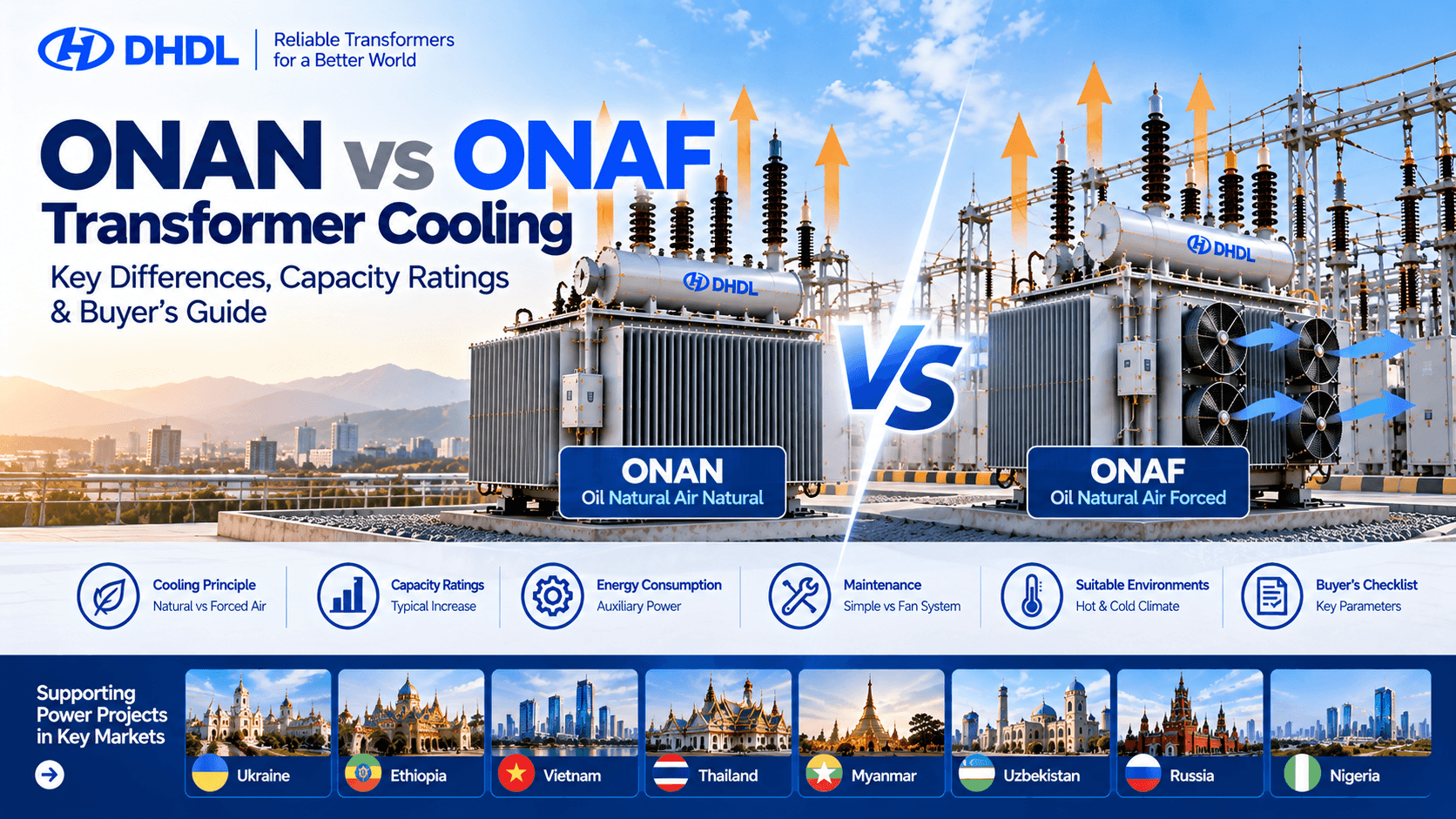
Choosing between an ONAN and ONAF transformer is not simply a question of whether a transformer has cooling fans.
The cooling method affects rated capacity, temperature rise, operating flexibility, maintenance requirements, noise, and long-term reliability.
For industrial substations, renewable energy projects, utility networks, and power distribution systems in Ukraine, Ethiopia, Vietnam, Thailand, Myanmar, Uzbekistan, Russia, and Nigeria, selecting the correct cooling arrangement can also influence equipment performance under local environmental conditions.
A transformer designed for a hot industrial site in Thailand may require different thermal considerations from one installed in a cold region of Russia or Uzbekistan.
This guide explains how ONAN and ONAF cooling work, when forced-air cooling is worth specifying, and which technical details buyers should confirm before ordering an oil-immersed transformer.
1. What Does ONAN Mean in a Transformer?
ONAN stands for Oil Natural Air Natural.
It is a common cooling method for oil-immersed transformers.
The transformer uses natural oil circulation inside the tank and natural air movement around the external cooling surfaces.
Heat generated by the core and windings is transferred into the insulating oil. As the oil warms, it circulates through the transformer and radiators, where heat is released to the surrounding air.
The cooling process does not require electrically driven radiator fans or oil pumps.
Key characteristics include:
- Natural oil circulation
- Natural air cooling
- No radiator fan operation required
- Relatively simple cooling equipment
- Lower auxiliary cooling power consumption
- Fewer mechanical cooling components to maintain
ONAN cooling is commonly considered for distribution transformers and power transformers where natural cooling provides sufficient thermal capacity.
For industrial projects in Vietnam, Myanmar, Ethiopia, and Nigeria, ONAN can be a practical option when the transformer rating, site temperature, and operating load are properly matched.
However, natural cooling does not eliminate the need for adequate ventilation and radiator clearance.
2. What Does ONAF Mean in a Transformer?
ONAF stands for Oil Natural Air Forced.
Like ONAN, the transformer uses natural circulation of insulating oil.
The difference is that electrically driven fans force air across the radiators or cooling surfaces.
This increases heat transfer and can allow a suitably designed transformer to carry a higher load under its specified ONAF rating.
Key characteristics include:
- Natural oil circulation
- Forced-air cooling using fans
- Higher cooling capability when fans operate
- Potentially higher rated capacity
- Additional fan motors and control equipment
- Auxiliary power requirements
- More maintenance points than a basic ONAN arrangement
ONAF cooling is commonly used where additional thermal capacity or operating flexibility is required.
For example, a power transformer may have separate ONAN and ONAF ratings, allowing it to operate at a lower rating without fans and a higher rating when the cooling fans are available.
Important: ONAF does not automatically increase every transformer’s capacity by a fixed percentage. The actual ratings must be established by the transformer design, temperature-rise limits, and applicable standards.
3. ONAN vs ONAF Transformer: Technical Comparison
| Parameter | ONAN Transformer | ONAF Transformer |
|---|---|---|
| Full Name | Oil Natural Air Natural | Oil Natural Air Forced |
| Oil Circulation | Natural | Natural |
| Air Cooling | Natural | Forced by Fans |
| Cooling Fans | Not Required | Required for ONAF Rating |
| Oil Pumps | Not Required | Not Required |
| Cooling Capacity | Natural Cooling Design | Enhanced Air-Side Cooling |
| Auxiliary Power | Minimal for Cooling | Fan Power Required |
| Maintenance | Simpler Cooling Arrangement | Fan and Control Maintenance |
| Noise | No Cooling Fan Noise | Additional Fan Noise |
| Capacity Rating | ONAN Rating | ONAF Rating |
| Common Application | Distribution and Power Transformers | Power Transformers and Higher-Load Applications |
| Main Procurement Concern | Ambient Temperature and Thermal Margin | Fan Reliability, Controls and Rated Capacity |
Both cooling methods can provide reliable service when the transformer is correctly designed and maintained.
The better choice depends on the project’s loading requirements, environment, and operating strategy.
4. How Much Additional Capacity Can ONAF Provide?
This is one of the most important questions buyers ask when comparing ONAN and ONAF transformer specifications.
Some transformers are designed with multiple cooling ratings.
For example, consider an illustrative transformer with:
| Parameter | Example Value |
|---|---|
| Rated Voltage | 110/35kV |
| Frequency | 50Hz |
| ONAN Capacity | 30MVA |
| ONAF Capacity | 40MVA |
| Cooling Arrangement | ONAN/ONAF |
| Fan Control | Automatic / Manual |
| Installation | Outdoor Substation |
In this example, the ONAF rating is approximately 33.3% higher than the ONAN rating.
However, this is only a calculation example, not a universal capacity increase or a confirmed DHDL product specification.
A transformer must be specifically designed, tested, and rated for the stated ONAN and ONAF capacities.
Simply adding fans to an existing transformer does not guarantee that its permissible loading can be increased.
Why the Capacity Difference Matters
Suppose an industrial substation normally operates at 25MVA but experiences periodic demand peaks approaching 35MVA.
A transformer with appropriately engineered ONAN/ONAF ratings may provide additional operating flexibility.
However, buyers must confirm:
- Maximum continuous loading
- Duration and frequency of peak demand
- Ambient temperature
- Top-oil temperature limits
- Winding hot-spot temperature limits
- Fan starting and stopping settings
- Available auxiliary power
- Required capacity if the fans fail
Hidden procurement risk: A transformer rated 40MVA under ONAF conditions may not be capable of carrying 40MVA continuously if its fans are unavailable.
The protection and operating strategy should reflect this limitation.
5. Real DHDL Project: ONAN/ONAF Transformer in Uzbekistan
DHDL’s published Uzbekistan textile industrial park project provides a relevant example of why cooling selection matters.
The industrial park required additional substation capacity to support spinning workshops, weaving production lines, and future industrial expansion.
The project involved a high-voltage power transformer with ONAN/ONAF cooling. DHDL’s homepage identifies a 45MVA S-45000/110 unit, while the detailed Tashkent project page describes a 40MVA OSFZ-40000/110 unit. Both sources identify ONAN/ONAF cooling, but the capacity discrepancy should be resolved before using one rating in formal project marketing.
| Project Parameter | Published Information |
|---|---|
| Country | Uzbekistan |
| Application | Textile Industrial Park |
| Voltage | 110/35kV |
| Cooling Method | ONAN/ONAF |
| Tap Changer | On-Load Tap Changer |
| Site Conditions | High Temperature and Dust |
| Main Challenge | Industrial Expansion and Continuous Loading |
| Detailed Project Page Production Period | 62 Days |
According to the detailed project description, summer temperatures at the site can reach approximately 45°C.
DHDL addressed the thermal requirements through cooling-system design, winding optimization, heat-dissipation measures, and environmental protection.
For buyers in Uzbekistan, Thailand, Nigeria, and Ethiopia, this is especially relevant when industrial substations must operate under high ambient temperatures.
6. ONAN vs ONAF for Eight Target Markets
Environmental conditions can influence cooling-system selection, but they do not automatically determine whether ONAN or ONAF is required.
The following table provides practical engineering considerations for DHDL’s target markets.
| Country | Cooling and Procurement Considerations |
|---|---|
| Ukraine | Winter operating conditions, temperature variation, load continuity and auxiliary supply |
| Ethiopia | Site altitude, outdoor temperatures, dust exposure and ventilation |
| Vietnam | Humidity, industrial load growth, corrosion exposure and radiator maintenance |
| Thailand | High ambient temperature, humidity and sustained industrial loading |
| Myanmar | Site-specific grid reliability, fan auxiliary power and maintenance access |
| Uzbekistan | Hot summers, dust, temperature variation and industrial expansion |
| Russia | Low-temperature operation, oil suitability, fan controls and condensation |
| Nigeria | High ambient temperature, dust, power quality and auxiliary supply reliability |
These are regional planning considerations, not uniform technical requirements across entire countries.
Hot-Climate Projects: Thailand, Vietnam, Ethiopia and Nigeria
For industrial projects in Thailand, Vietnam, Ethiopia, and Nigeria, the engineering team should assess the maximum ambient temperature and expected load duration.
ONAF may provide useful additional cooling capacity when the transformer is specifically designed for a higher forced-air rating.
However, forced-air cooling does not eliminate the effects of high ambient temperature.
A transformer rated under standard reference conditions may require a project-specific thermal review when installed at a hotter site.
Cold-Climate Projects: Russia, Ukraine and Uzbekistan
For projects in Russia, Ukraine, and Uzbekistan, buyers should consider minimum operating temperature, insulating-oil properties, condensation, and the performance of cooling accessories.
Cold weather does not automatically remove the need for forced-air cooling.
The required arrangement depends on transformer loading, seasonal operating conditions, and the manufacturer’s approved ratings.
Grid and Maintenance Considerations: Myanmar and Nigeria
For projects in Myanmar and Nigeria, buyers should evaluate the reliability of the auxiliary electrical supply used by cooling fans.
If the transformer relies on ONAF cooling to carry its required load, fan supply interruptions can reduce the available continuous capacity.
The specification should define how the transformer operates when one fan group or the complete forced-air cooling system becomes unavailable.
7. Hidden Costs of ONAF Transformers
A common purchasing mistake is comparing an ONAN transformer and an ONAF transformer only by purchase price.
An ONAF system can introduce additional components and operating costs.
These may include:
- Cooling fan motors
- Fan control cabinets
- Temperature sensors
- Auxiliary electrical supply
- Control wiring
- Fan alarms
- Spare fan assemblies
- Inspection and maintenance
- Additional operating noise
For example, consider an illustrative ONAF transformer with six cooling fans rated at 250W each.
Total fan power:
\[ 6\times250=1{,}500\text{ W}=1.5\text{ kW} \]
If all six fans operate for 4,000 hours annually:
\[ 1.5\times4{,}000=6{,}000\text{ kWh/year} \]
At an illustrative electricity cost of $0.10/kWh, annual fan energy cost would be approximately $600.
This example excludes control-system consumption, maintenance, and replacement costs.
It also does not mean ONAF is less efficient overall. Transformer losses, loading, cooling-stage operation, and thermal performance must be evaluated together.
Hidden buyer tip: Request guaranteed transformer losses and estimated cooling auxiliary power separately so that supplier quotations can be compared on a consistent basis.
8. Factory Testing and Cooling-System Verification
For transformers with ONAN/ONAF ratings, buyers should request evidence supporting both cooling stages.
Relevant factory documentation may include:
- Rated capacity for each cooling stage
- Temperature-rise test results
- No-load and load-loss test reports
- Winding resistance measurements
- Insulation test reports
- Fan motor specifications
- Fan control schematic
- Automatic cooling-stage operation
- Alarm and failure indication
- Temperature monitoring configuration
- Cooling-system inspection records
IEC 60076-2 addresses temperature rise for liquid-immersed transformers, including relevant thermal performance and test requirements.
For projects in Ukraine, Ethiopia, Vietnam, Thailand, Myanmar, Uzbekistan, Russia, and Nigeria, additional tests or documentation may be required by the utility, EPC contractor, or local technical specification.
The final testing scope should be agreed upon before manufacturing.
9. ONAN vs ONAF Transformer RFQ Checklist
Before requesting a quotation, provide the following information.
| RFQ Item | Buyer Input |
|---|---|
| Destination Country | __________ |
| Application | Industrial / Utility / Renewable Energy |
| Rated Capacity | _____ MVA / kVA |
| Required ONAN Rating | _____ MVA |
| Required ONAF Rating | _____ MVA |
| Primary Voltage | _____ kV |
| Secondary Voltage | _____ kV |
| Frequency | 50 / 60Hz |
| Vector Group | __________ |
| Short-Circuit Impedance | _____ % |
| Tap Changer | OCTC / OLTC |
| Cooling Method | ONAN / ONAF / ONAN-ONAF |
| Maximum Ambient Temperature | _____ °C |
| Minimum Ambient Temperature | _____ °C |
| Installation Altitude | _____ m |
| Load Profile | Continuous / Variable / Peak |
| Fan Control | Automatic / Manual |
| Auxiliary Supply Voltage | _____ V |
| Fan Failure Requirement | __________ |
| Temperature Monitoring | __________ |
| Noise Limit | _____ dB(A), with measurement conditions |
| Applicable Standard | IEC / ANSI / IEEE / Local |
| Factory Testing | __________ |
| Quantity | _____ Units |
| Delivery Destination | __________ |
| Required Delivery Date | __________ |
Recommended RFQ Attachments
- Single-Line Diagram (SLD)
- Transformer technical specification
- Daily and seasonal load profile
- Maximum ambient temperature data
- Installation altitude
- Existing transformer nameplate, if applicable
- Substation layout
- Cooling-system requirements
- Auxiliary power specification
- Protection and monitoring requirements
- Applicable testing standards
- Required delivery schedule
Providing this information allows the manufacturer to evaluate whether ONAN, ONAF, or a multi-stage cooling arrangement is appropriate.
10. Choose the Right Cooling Method with DHDL
DHDL manufactures oil-immersed distribution transformers, high-voltage power transformers, and customized transformer solutions for industrial, utility, renewable-energy, and infrastructure applications.
Its product and project information includes ONAN and ONAF cooling options, with technical configurations depending on transformer capacity, voltage class, site conditions, and operating requirements.
For transformer procurement in Ukraine, Ethiopia, Vietnam, Thailand, Myanmar, Uzbekistan, Russia, and Nigeria, DHDL can review cooling requirements alongside capacity, voltage, impedance, winding materials, and environmental specifications.
For an accurate technical proposal, send:
Transformer Capacity + HV/LV Voltage + ONAN/ONAF Rating + Load Profile + Ambient Temperature + Site Conditions + Destination
The best cooling arrangement is not necessarily the most complex one.
It is the configuration that delivers the required continuous capacity, acceptable temperature rise, maintainability, and lifecycle performance under actual operating conditions.
DHDL — Customized Oil-Immersed Transformer Solutions for Global Power Projects.