66kV High-Voltage Oil-Immersed Power Transformer: A Practical Buyer’s Guide

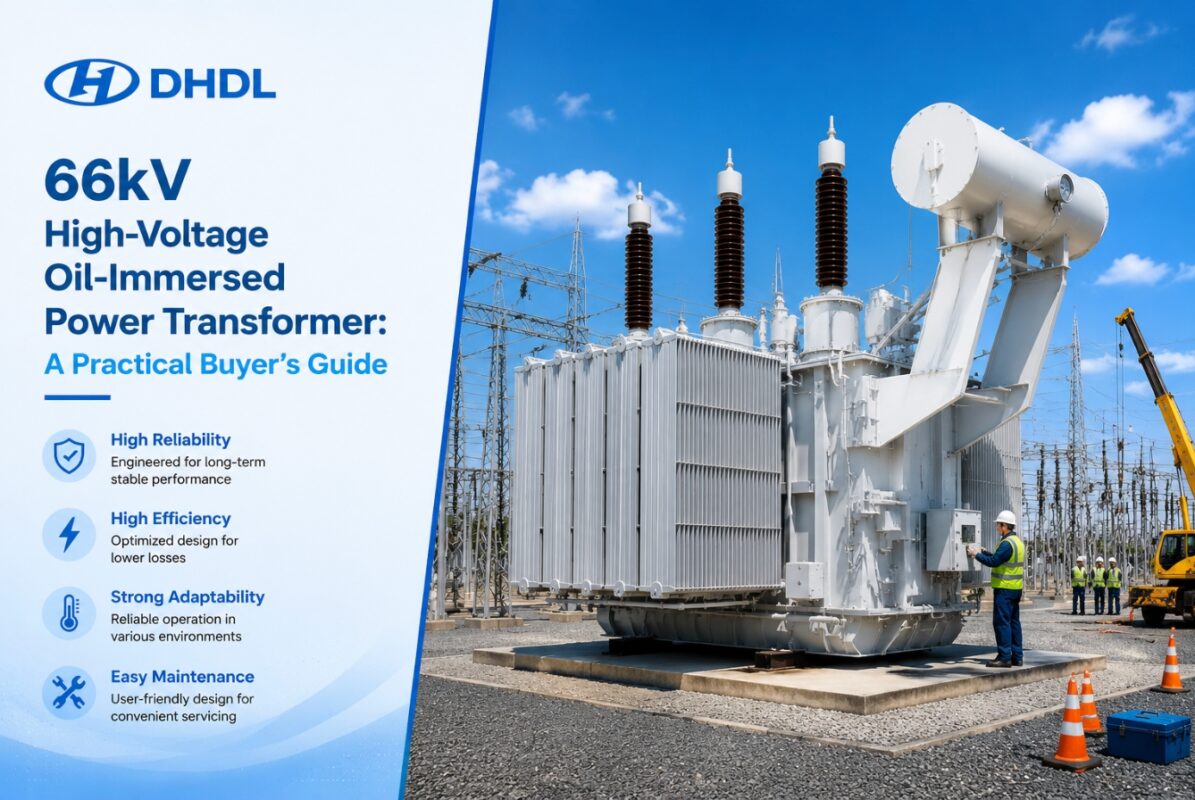
A 66kV transformer often sits at an important point between a regional high-voltage network and the downstream distribution or industrial power system.
Therefore, its role extends beyond changing voltage. The transformer can directly influence substation availability, voltage regulation, fault current, power losses, future expansion, and the continuity of critical loads.
For this reason, utility companies, EPC contractors, renewable energy developers, and industrial users should not select a 66kV power transformer by comparing capacity and price alone.
Instead, buyers should confirm whether the transformer matches the actual network, load profile, voltage ratio, impedance requirement, cooling demand, installation environment, protection scheme, and applicable standard.
The DHDL 66kV high-voltage oil-immersed power transformer is intended for power transmission and substation applications. Its rated capacity can be customized, while the published cooling options include ONAN and ONAF.
Moreover, the broader DHDL high-voltage transformer range supports project-based customization of voltage, capacity, impedance, cooling, insulation, accessories, and project standards.
This guide explains how to evaluate the product from a buyer’s perspective and how to reduce specification, installation, and operating risks before production begins.
What Is a 66kV Oil-Immersed Power Transformer?
A 66kV oil-immersed power transformer transfers electrical energy between a 66kV network and one or more lower-voltage systems.
Transformer oil provides electrical insulation and transfers heat from the active part to the tank and cooling equipment. Meanwhile, the core, windings, tank, bushings, cooling system, monitoring accessories, and protection devices work together to support reliable high-voltage operation.
DHDL publishes the following core product information:
| Product item | Published information |
|---|---|
| Product type | High-voltage oil-immersed power transformer |
| Voltage level | 66kV |
| Rated capacity | Customizable |
| Cooling methods | ONAN or ONAF |
| Main application | Power transmission and substations |
| Installation type | Outdoor or substation installation |
| Typical project areas | Regional power systems, industrial power supply, renewable energy grid connection, and infrastructure |
| Customization | Project-based electrical, cooling, insulation, accessory, and standard adaptation |
Because capacity and several electrical parameters remain project-specific, buyers should request an order-specific technical data sheet rather than assuming standard values.
Where Does a 66kV Transformer Fit in the Power System?
A 66kV transformer can serve several types of power project. However, the correct configuration depends on how the transformer connects to the network.
Regional and Municipal Substations
First, utilities may use a 66kV transformer in urban, township, or regional substations.
In this role, the transformer can reduce the 66kV network voltage to the level required by the downstream distribution system. Consequently, capacity, redundancy, fault level, and voltage regulation become important selection factors.
Industrial High-Voltage Power Supply
Large industrial facilities may receive power directly from a 66kV network.
Therefore, the transformer may supply:
- Industrial substations
- Production plants
- Mining facilities
- Processing lines
- Large motor systems
- Utility systems within an industrial park
- Other continuous industrial loads
In this situation, the cost of an outage may exceed the transformer’s purchase price impact. As a result, buyers should consider redundancy, spare strategy, monitoring, overload duty, and maintenance access during the design stage.
For broader industrial power planning, readers can also review DHDL’s complete guide to power transformers.
Renewable Energy Grid Connection
A 66kV transformer may also support wind, solar, energy storage, or other renewable energy grid-connection systems.
However, renewable energy projects can have variable loading, site-specific grid-code requirements, and remote installation conditions. Therefore, buyers should provide the generation profile, point-of-connection requirements, reactive-power conditions, harmonic information, and environmental data.
Infrastructure Power Supply
Transport facilities, water projects, industrial zones, and other infrastructure may also require 66kV intake substations.
In addition to normal electrical parameters, these projects may require:
- High availability
- Remote monitoring
- Specific communication interfaces
- Strict noise limits
- Corrosion protection
- Special fire-protection coordination
- Project-specific documentation
66kV Power Transformer vs. Distribution Transformer
Buyers sometimes compare a 66kV power transformer with a medium-voltage distribution transformer because both products reduce voltage. Nevertheless, they serve different positions in the power system.
| Comparison factor | 66kV power transformer | Medium-voltage distribution transformer |
| Typical network position | Regional transmission, primary substation, or industrial high-voltage intake | Downstream power distribution |
| Primary voltage | 66kV | Commonly medium-voltage distribution levels |
| Main duty | Transfers larger amounts of power between high-voltage and downstream systems | Supplies local distribution loads |
| Capacity | Project-specific and generally selected around substation or industrial system requirements | Often selected from more standardized distribution ranges |
| Protection coordination | Must coordinate with the high-voltage network and substation protection system | Coordinates with local distribution protection |
| Insulation requirements | Designed around the 66kV system and applicable insulation level | Designed around lower distribution voltage classes |
| Cooling | DHDL lists ONAN and ONAF for the 66kV product | Cooling depends on the distribution-transformer design |
| Engineering process | Usually project-specific | May use more standardized configurations |
| Transport planning | Requires early dimensional and weight review | Usually simpler, although still project-dependent |
| Typical buyer | Utility, EPC contractor, renewable developer, or large industrial user | Utility distributor, commercial project, or local industrial facility |
If your project requires a lower primary voltage for local distribution, the DHDL 6–38.5kV oil-immersed distribution transformermay provide a more relevant comparison.
Conversely, if your system belongs to a long-distance bulk transmission network, review the DHDL 330kV–500kV high-voltage transformer instead.
In other words, the correct product depends on the transformer’s position in the network, not merely on the desired secondary voltage.
Start with the Network Requirements
Before asking for a quotation, define how the transformer must operate within the complete power system.
Confirm the Voltage Ratio
Although the high-voltage side is 66kV, the required secondary voltage remains project-specific.
Therefore, provide:
- High-voltage rating
- Low-voltage rating
- Tertiary voltage, if required
- Number of windings
- Frequency
- Vector group
- Neutral arrangement
- Tap range
- Tap-changer type
- Maximum and minimum system voltage
A voltage ratio copied from another project may not match your existing busbar system or downstream equipment.
Determine the Correct Capacity
Capacity should reflect the actual load rather than the total connected nameplate power alone.
Accordingly, calculate:
- Maximum simultaneous demand
- Normal operating load
- Peak load
- Largest motor
- Motor-starting method
- Seasonal variation
- Planned expansion
- Required reserve margin
- N-1 operating strategy
- Emergency overload requirement
For example, a project with two transformers may require each unit to carry a larger load temporarily when the other transformer remains unavailable.
Therefore, buyers should define both normal and contingency loading before selecting capacity.
Confirm Short-Circuit Impedance
Short-circuit impedance influences fault current, voltage regulation, and load sharing between parallel transformers.
Consequently, the project engineer should provide:
- Required impedance
- Permitted tolerance
- Network fault level
- Protection clearing time
- Existing transformer impedance
- Parallel-operation conditions
If the impedance is too low for the network, fault current may become excessive. Conversely, if it is too high, voltage regulation and motor starting may become more difficult.
Thus, impedance should result from system coordination rather than a catalogue default.
Define the Insulation Level
A 66kV transformer must match the applicable network insulation requirements.
Therefore, specify:
- Lightning impulse level
- Power-frequency withstand level
- Neutral insulation requirement
- Bushing insulation level
- Surge-arrester coordination
- External electrical clearances
- Applicable utility or project standard
Furthermore, altitude and pollution conditions may affect external insulation performance. For this reason, high-altitude projects should also consider the guidance in How Altitude Affects Transformer Performance.
How to Choose Between ONAN and ONAF Cooling
DHDL lists ONAN and ONAF as available cooling options for the 66kV transformer.
Although both use transformer oil as the internal cooling medium, they manage external heat dissipation differently.
| Cooling method | General principle | Main buyer consideration |
| ONAN | Oil circulates naturally, while ambient air cools the radiators naturally | Simpler auxiliary system, although available capacity depends on the approved thermal design |
| ONAF | Oil circulates naturally, while fans force air through the cooling surfaces | Can support an additional cooling or loading stage, but requires fans, controls, alarms, auxiliary power, and maintenance |
The final selection depends on:
- Rated capacity
- Load profile
- Ambient temperature
- Altitude
- Available ventilation
- Required redundancy
- Noise restrictions
- Auxiliary power reliability
- Maintenance capability
Why ONAN May Suit Some Projects
ONAN uses natural oil and air circulation. Therefore, it has fewer active cooling components.
This arrangement may simplify operation and reduce dependence on fan auxiliary systems. Nevertheless, buyers still need to confirm the rated output, temperature rise, radiator arrangement, and maximum ambient temperature.
Why ONAF May Suit Higher or Variable Loads
ONAF adds forced-air cooling through fans.
Consequently, it may provide an additional cooling stage or help manage higher loading under the approved design.
However, buyers should also define:
- Number of fans
- Fan grouping
- Automatic starting temperature
- Alarm settings
- Failure indication
- Auxiliary supply voltage
- Operation after one fan group fails
- Spare fan requirements
Therefore, ONAF should not appear as a simple checkbox. It should form part of a complete cooling-control strategy.
Product Features That Matter to the Buyer
DHDL’s high-voltage transformer range highlights reliability, low losses, heat dissipation, insulation performance, mechanical strength, and custom engineering.
However, buyers should translate these features into verifiable requirements.
High Reliability
The product is intended for stable operation in high-voltage power systems.
Therefore, ask the supplier to confirm:
- Design standard
- Load profile
- Short-circuit duty
- Insulation level
- Cooling stages
- Protection accessories
- Test program
- Manufacturing quality plan
Low Loss and Operating Economy
DHDL states that optimized core and winding design helps reduce no-load and load losses.
Nevertheless, buyers should request guaranteed loss values rather than relying on a general efficiency statement.
No-load loss matters whenever the transformer remains energized. Meanwhile, load loss becomes more important as current increases.
Consequently, compare:
- Guaranteed no-load loss
- Guaranteed load loss
- Reference temperature
- Loss tolerance
- Auxiliary cooling power
- Expected annual loading
- Electricity cost
- Evaluation period
Material selection may also influence performance and price. Therefore, the article Copper vs. Aluminum Transformer Windings can support the buyer’s winding-material review without replacing the project specification.
Heat Dissipation
The oil-immersed structure transfers heat from the active part to the cooling surfaces.
However, actual performance depends on the transformer rating, losses, cooling configuration, ambient temperature, altitude, radiator arrangement, and airflow.
Accordingly, request the guaranteed temperature-rise data and rated capacity for each cooling stage.
Strong Insulation Performance
The insulation system must withstand normal operating voltage, switching conditions, and specified overvoltage stresses.
Therefore, insulation requirements should appear in the technical schedule and inspection plan.
Mechanical and Short-Circuit Strength
Fault current creates mechanical forces within the transformer windings.
Consequently, the design and manufacturing process must support the specified short-circuit duty.
Ask the supplier to confirm the applicable design criteria, network fault level, and required supporting calculations or reports.
Review the Transformer Drawing Before Production
Electrical parameters alone cannot confirm whether the transformer will fit the substation.
Therefore, review the product drawing before production.
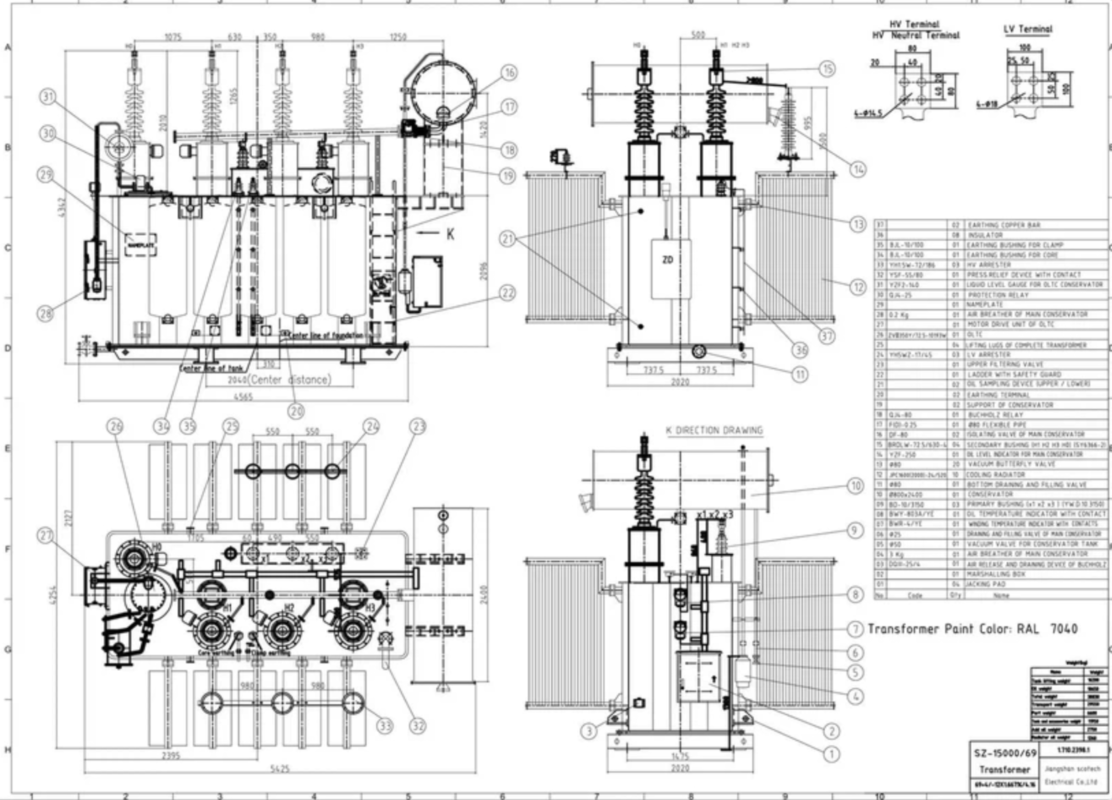
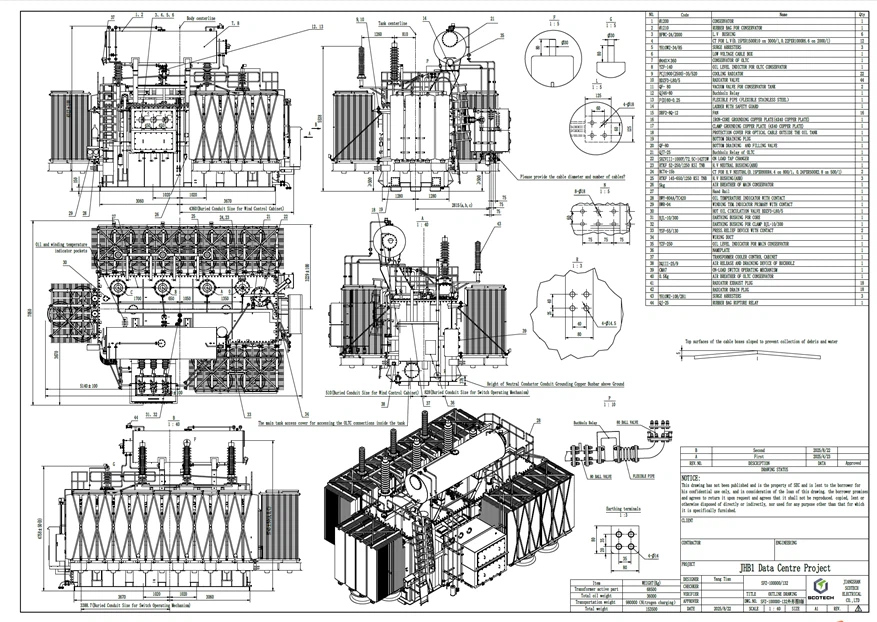
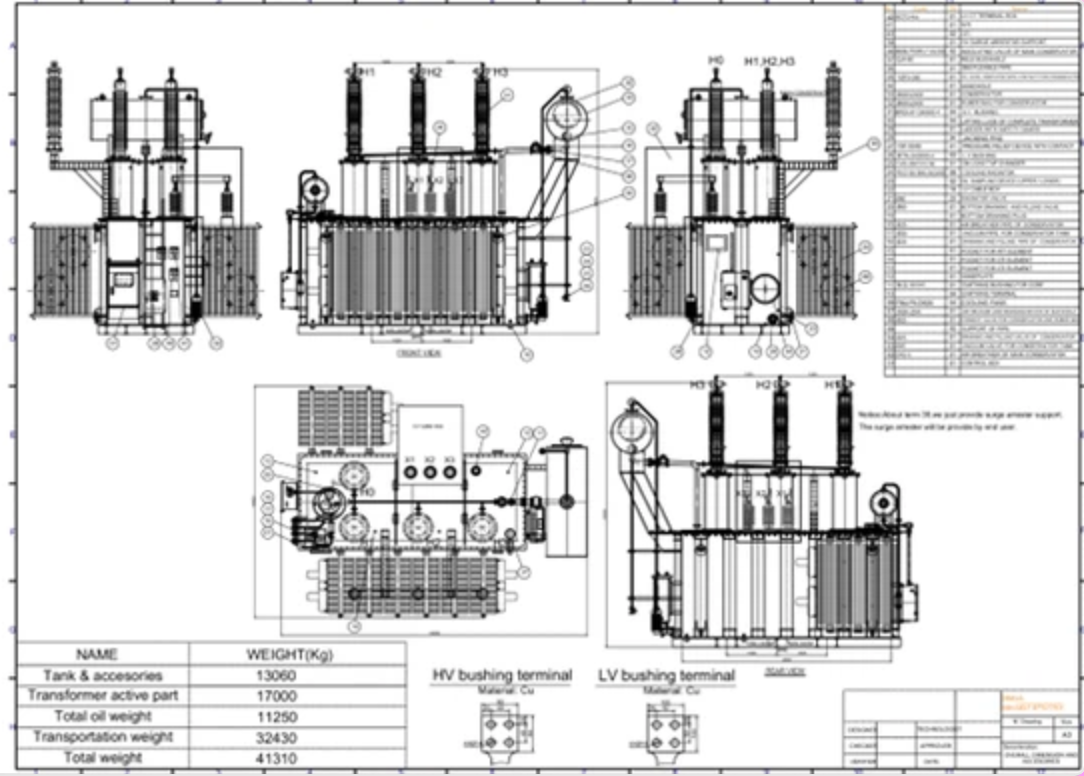
Check the following information:
| Drawing item | Buyer-side verification |
| Overall length, width, and height | Confirm compatibility with the substation layout and transport route |
| Total weight | Verify foundation, crane, and lifting capacity |
| Transport dimensions | Check roads, gates, bridges, ports, and site access |
| Transport weight | Confirm trailer, crane, and unloading requirements |
| HV bushing arrangement | Match the 66kV connection, gantry, or cable layout |
| LV bushing arrangement | Match the downstream switchgear or busbar |
| Phase spacing | Confirm electrical clearances |
| Cooler or radiator layout | Reserve airflow and maintenance space |
| Conservator position | Check access and installation clearance |
| Control cabinet position | Coordinate cable routing and operator access |
| Lifting and jacking points | Confirm erection and maintenance procedures |
| Foundation loads | Coordinate with the civil design |
| Oil filling and draining points | Support installation and maintenance planning |
| Fire-safety clearance | Match the substation fire-protection design |
The website drawing should serve as a reference unless DHDL confirms it as the final drawing for the specific order.
Accordingly, obtain an order-specific general arrangement drawing and coordinate it with the electrical, civil, mechanical, fire-protection, transport, and installation teams.
Protection and Monitoring Requirements
A 66kV transformer should integrate with the substation protection and control system.
Depending on the project, the buyer may need to define:
- Transformer differential protection
- Restricted earth-fault protection
- Overcurrent and earth-fault protection
- Temperature alarms and trips
- Oil-level indication
- Pressure-relief indication
- Gas-actuated protection where applicable
- Fan control
- Tap-changer monitoring
- Remote alarm contacts
- SCADA communication
- Online monitoring requirements
The final accessory package must match the transformer design and project standard.
Moreover, transformer energization can produce temporary inrush current. Therefore, protection engineers may also find DHDL’s guide on transformer inrush current and protection methods useful when coordinating energization and relay settings.
Factory Tests and Documentation
For a high-voltage transformer, testing should confirm the manufactured unit against the approved design and contract.
DHDL’s high-voltage product information lists the following routine test items:
| Factory test item | Test type |
| Insulation resistance test | Routine test |
| Winding DC resistance test | Routine test |
| Voltage ratio test | Routine test |
| Vector group test | Routine test |
| No-load loss and no-load current test | Routine test |
| Load loss and impedance voltage test | Routine test |
| Power-frequency withstand-voltage test | Routine test |
| Induced-withstand-voltage test | Routine test |
| Sealing test | Routine test |
| Transformer oil test | Routine test |
| Appearance and nameplate inspection | Routine test |
| Packing inspection before shipment | Routine test |
However, the final test scope must follow the transformer model, applicable standard, and project agreement.
Therefore, request an inspection and test plan that identifies:
- Routine tests
- Type tests, if required
- Special tests, if required
- Test standard
- Acceptance values
- Witness points
- Hold points
- Third-party inspection
- Report format
- Document submission date
In addition, require the supplier to provide the final approved drawing, test report, packing list, nameplate drawing, user manual, and other project documents.
Why Manufacturing Control Matters
Transformer reliability depends on internal process control, not only final appearance.
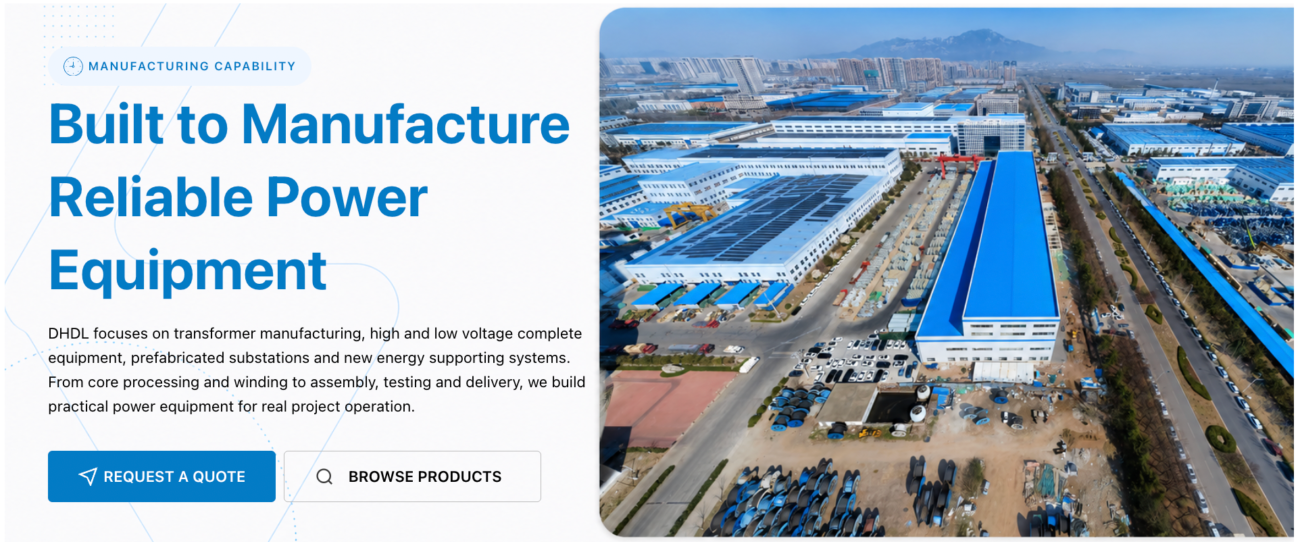
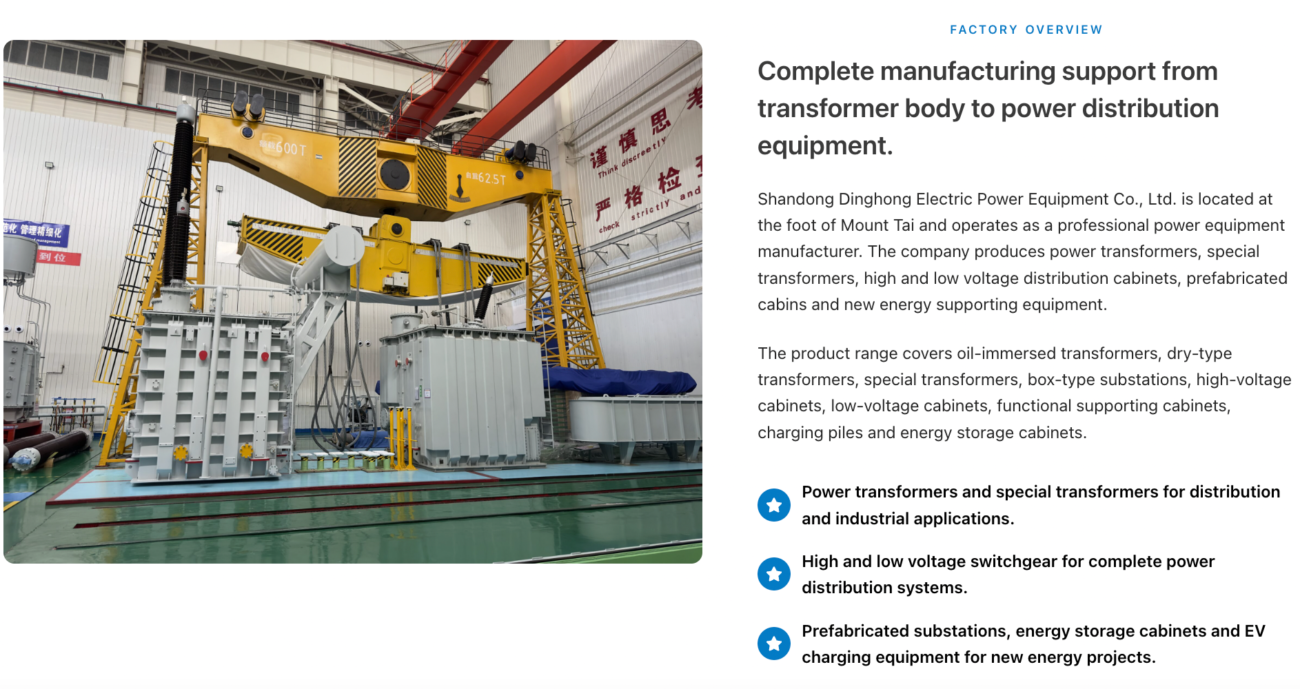
DHDL’s manufacturing capability information covers:
- Material preparation
- Core processing
- Winding production
- Insulation treatment
- Vacuum drying
- Assembly
- Final inspection
- Transformer testing
- Technical-document preparation
- Export packing
For buyers, these capabilities should become order-specific control points.
Therefore, request:
- Quality plan
- Material specifications
- Manufacturing schedule
- Process inspection points
- Drying records
- Oil-treatment records
- Approved test plan
- Final test report
- Packing procedure
- Shipping condition
- Nonconformance procedure
This approach provides more useful assurance than relying on a general factory statement.
A Related Project Perspective
Although every transformer project differs, DHDL’s Uzbekistan industrial park substation expansion case illustrates several useful buyer-side considerations.
The published case involved:
- A 110kV/35kV industrial-park substation
- Long-term full-load operation
- High ambient temperature
- Dusty site conditions
- ONAN/ONAF cooling
- Project-specific heat-dissipation and environmental design
This case does not prove the performance of a separate 66kV product. Nevertheless, it demonstrates why buyers should provide load, temperature, dust, cooling, and delivery requirements during the design stage.
In other words, the useful lesson lies in the project-confirmation process rather than direct product equivalence.
Common Procurement Mistakes
Comparing Only Purchase Price
Two 66kV quotations may differ in losses, materials, impedance, cooling, insulation, accessories, testing, documentation, and delivery scope.
Therefore, compare the complete technical and commercial offer.
Selecting Capacity Without a Load Study
If the transformer is too small, it may restrict operation or expansion. Conversely, an unnecessarily large unit may increase capital cost and no-load losses.
Thus, use realistic load, contingency, and expansion data.
Ignoring Parallel Operation
When a new transformer will operate in parallel with an existing unit, confirm:
- Voltage ratio
- Vector group
- Phase sequence
- Impedance
- Tap position
- Rated capacity
- Regulation
- Earthing arrangement
Otherwise, the transformers may not share load correctly.
Approving the Transformer Before the Substation Layout
Bushing positions, cooling layout, control cabinet location, clearances, and foundation loads affect the substation design.
Therefore, coordinate the drawing before production.
Leaving Site Conditions Undefined
High temperature, altitude, humidity, dust, corrosion, and seismic requirements can influence the design.
Accordingly, include complete environmental data in the RFQ.
Assuming Every Test Is Included
A supplier may not include optional tests unless the specification requests them.
Therefore, approve the inspection and test plan before ordering.
Information to Include in Your RFQ
To receive an accurate 66kV transformer proposal, provide the following information.
Electrical Data
- Rated capacity
- High-voltage rating
- Low-voltage rating
- Tertiary voltage, if required
- Frequency
- Number of phases
- Vector group
- Tap range
- Tap-changer type
- Short-circuit impedance
- Insulation levels
- System fault level
- Earthing arrangement
- Guaranteed losses
- Noise limit
- Parallel-operation requirements
Load Data
- Normal load
- Peak load
- Largest motor
- Motor-starting method
- Load cycle
- Future expansion
- N-1 requirement
- Emergency overload
- Daily operating hours
Site Data
- Indoor or outdoor installation
- Ambient temperature
- Altitude
- Relative humidity
- Dust level
- Pollution level
- Corrosion conditions
- Seismic requirement
- Wind condition
- Available ventilation
- Fire-protection requirements
Mechanical and Transport Data
- Maximum dimensions
- Maximum transport weight
- Transport route
- Bridge and road limits
- Gate dimensions
- Crane capacity
- Foundation information
- Bushing arrangement
- Cable or busbar connections
- Maintenance clearances
Standards and Documentation
- Destination country
- Applicable standard
- Utility specification
- Required tests
- Third-party inspection
- Drawing list
- Document language
- Installation support
- Commissioning support
- Spare-parts list
- Warranty requirements
Commercial Information
- Quantity
- Required delivery date
- Delivery destination
- Trade term
- Packing requirements
- Project schedule
If some parameters remain undecided, send the single-line diagram, load study, site conditions, existing transformer data, and substation layout.
Frequently Asked Questions
What is the rated capacity of the DHDL 66kV transformer?
The published product information identifies the rated capacity as customizable.
Therefore, buyers should provide the actual load, redundancy strategy, future expansion, and network data.
Which cooling methods are available?
DHDL lists ONAN and ONAF for the 66kV product.
However, the technical schedule should confirm the rated capacity, temperature rise, control logic, and equipment included for each cooling stage.
Is the transformer suitable for outdoor installation?
The high-voltage oil-immersed transformer range supports outdoor and substation installation.
Nevertheless, the final design must reflect temperature, altitude, humidity, pollution, corrosion, seismic conditions, and other site requirements.
Can the voltage ratio and impedance be customized?
DHDL states that its high-voltage transformer solutions can be customized according to voltage, capacity, ratio, impedance, insulation, cooling, accessories, and project standards.
Accordingly, provide the required values during the quotation stage.
Is a 66kV transformer suitable for renewable energy projects?
The DHDL high-voltage transformer range identifies renewable energy grid connection as an application.
However, suitability must still be confirmed against project capacity, voltage ratio, generation profile, grid code, harmonics, protection, and environmental conditions.
How should I compare 66kV transformer quotations?
Compare guaranteed technical data and supply scope, including:
- Capacity
- Voltage ratio
- Impedance
- Losses
- Insulation level
- Cooling rating
- Winding material
- Accessories
- Tests
- Dimensions
- Weight
- Documentation
- Warranty
- Delivery schedule
For additional oil-immersed transformer background, buyers can review DHDL’s oil-immersed transformer buyer’s guide.
What should I approve before production?
Approve at least:
- Technical data sheet
- General arrangement drawing
- Bushing and terminal arrangement
- Accessory list
- Cooling-system configuration
- Nameplate drawing
- Protection and control interfaces
- Inspection and test plan
- Document-delivery schedule
- Technical deviation list
Select the Transformer Around the Complete Project
A 66kV oil-immersed transformer should not be purchased as an isolated catalogue product.
Instead, select it around the complete network and substation:
- Confirm the voltage ratio.
- Complete the load study.
- Define capacity and redundancy.
- Confirm impedance and fault levels.
- Specify insulation requirements.
- Select the cooling strategy.
- Provide the site conditions.
- Coordinate protection and monitoring.
- Review transportation constraints.
- Approve the transformer drawing.
- Confirm tests and documentation.
- Close every technical deviation before production.
By following this process, buyers can reduce over-configuration, under-configuration, installation conflicts, protection problems, unexpected losses, and commissioning delays.
For a project-specific proposal, send DHDL your capacity, voltage ratio, frequency, vector group, impedance, cooling requirement, insulation level, site conditions, applicable standard, quantity, and destination country.
Contact DHDL to discuss a customized 66kV high-voltage oil-immersed power transformer for your substation, industrial facility, or renewable energy project.