
How to Transport a Large Power Transformer Without Damaging It

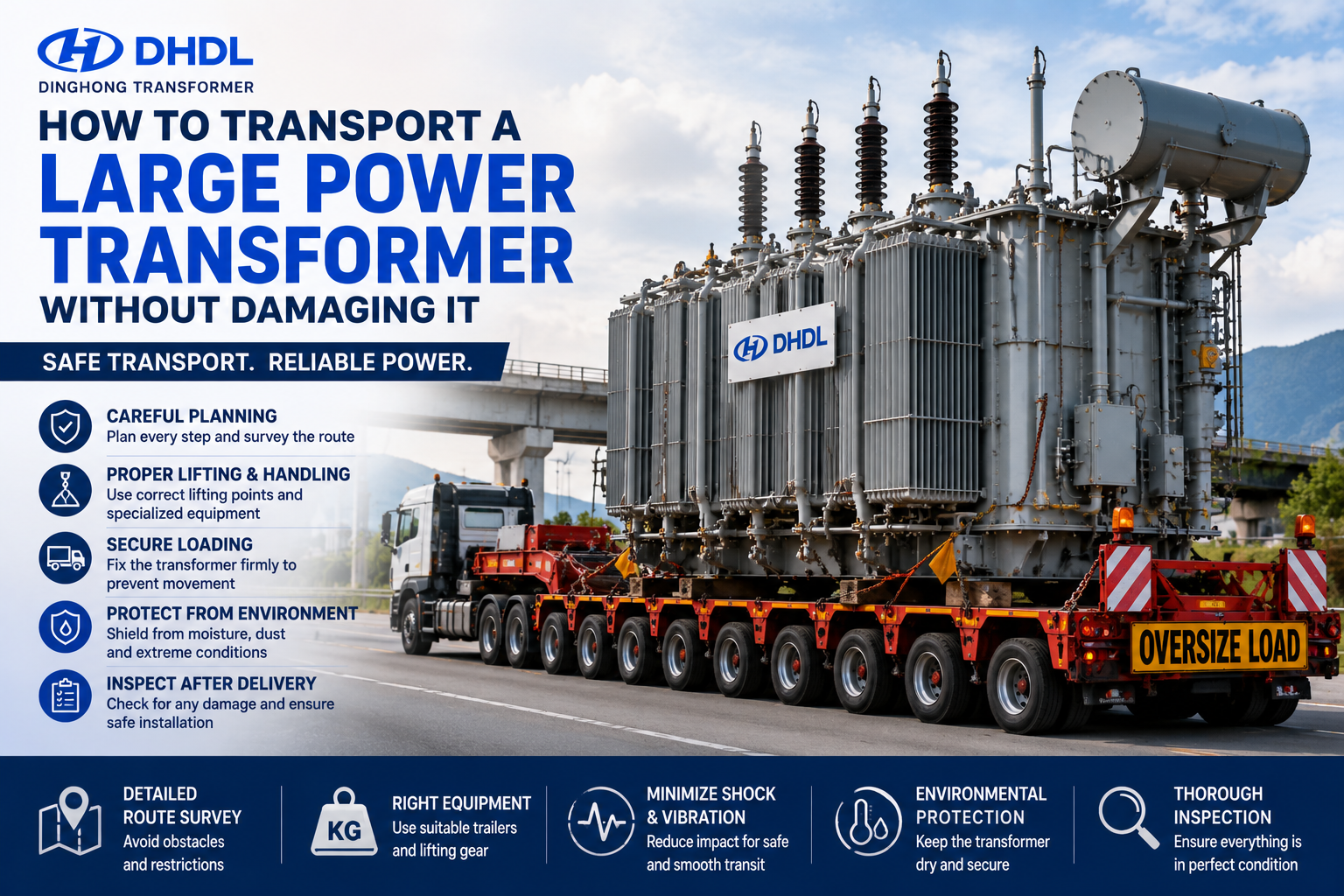
Transporting a large power transformer is one of the most challenging stages of a transformer project.
Unlike ordinary industrial equipment, a transformer contains precision-engineered windings, insulation systems, bushings, core assemblies, cooling equipment, and other components that can be affected by shock, vibration, moisture, and improper handling.
A successful power transformer transportation plan therefore requires careful preparation from the factory to the final installation site.
Poor handling during transportation can lead to mechanical damage, insulation problems, oil leakage, or costly commissioning delays.
Here is how large transformers can be transported safely without compromising their performance.
Why Large Power Transformers Require Special Transportation
Large power transformers can be extremely heavy and have sensitive internal components. Their dimensions may also make road, rail, or sea transportation more complicated than standard equipment delivery.
The transformer may encounter uneven roads, sudden braking, acceleration, vibration, lifting forces, and environmental exposure during transit.
Even when there is no obvious external damage, excessive mechanical shock can potentially affect internal components. This is why transportation should be treated as part of the transformer engineering process rather than simply a logistics operation.
1. Prepare the Transformer Before Shipment
The first step is determining exactly how the transformer will be transported.
Depending on its design and size, certain accessories may be removed before transportation. Bushings, radiators, conservator components, control cabinets, cooling equipment, and other accessories may be shipped separately when appropriate
.The manufacturer should establish which components can safely be removed and how they should be packaged.
For oil immersed transformer, the transportation condition of the transformer and insulating fluid must also be carefully planned according to the manufacturer’s instructions.
2. Choose the Right Transportation Method
Large transformers can be transported by road, rail, sea, or a combination of methods.Road transportation is commonly used for final delivery, but extremely heavy units may require specialized heavy-haul trailers.
Rail transportation can be suitable where appropriate infrastructure exists, while sea freight may be necessary for international projects.
The choice depends on transformer weight, dimensions, destination, available infrastructure, route restrictions, and project schedule.
3. Conduct a Detailed Route Survey
A route survey is one of the most important steps in large transformer transportation.
The logistics team should evaluate:
- Bridge weight restrictions
- Road width
- Turning radius
- Maximum vehicle height
- Road gradients
- Overhead power lines
- Railway crossings
- TunnelsTraffic restrictions
- Weak bridges
- Construction zones
- Port and unloading facilities
A transformer may leave the factory safely but encounter a problem at a bridge, narrow turn, or low-clearance section of the route.
Identifying these obstacles before transportation allows engineers to develop alternative routes or appropriate mitigation measures.
4. Use Proper Lifting and Loading Equipment
Large transformers should be lifted only from designated lifting points specified by the manufacturer.
Improper lifting can place forces on components that were not designed to support the transformer’s full weight.
Depending on the project, cranes, hydraulic lifting systems, specialized trailers, or other heavy-load equipment may be required.
The center of gravity should be considered carefully when loading and securing the transformer.
5. Protect the Transformer From Shock and Vibration
Shock and vibration are major transportation risks.
The transformer should be secured properly to prevent movement during acceleration, braking, cornering, and uneven-road conditions.
Special monitoring equipment may also be used to record shock and vibration levels during transportation.
This provides useful evidence of whether the transformer experienced conditions outside the agreed transportation limits.
For high-value power transformers, monitoring transportation conditions can provide additional confidence before commissioning.
6. Protect Against Moisture and Contamination
Environmental exposure is another important consideration.
Moisture, dust, rain, and salt contamination can affect exposed transformer components and insulation systems.
Components removed for transportation should therefore be appropriately sealed, protected, and packaged.
If a transformer or component requires controlled atmospheric protection during transportation, the manufacturer’s specified procedure should be followed.
Keeping the transformer dry and clean is particularly important before installation and commissioning.
7. Inspect the Transformer After Delivery
Transportation does not end when the transformer reaches the project site.
A thorough receiving inspection should be performed before installation.
Engineers should check for visible mechanical damage, oil leakage, damaged bushings, loose components, packaging damage, and abnormal conditions.
Transportation records and shock-monitoring data, where available, should also be reviewed.If significant impact or unusual transportation conditions occurred, additional inspections or electrical tests may be recommended before energization.
Dinghong Transformer for Large-Scale Projects
DinghongTransformer (DHDL) manufactures power transformers and distribution transformers for industrial, utility, infrastructure, and renewable-energy applications.
For large transformer projects, transportation considerations can be incorporated into the overall equipment planning process.
Transformer dimensions, weight, accessories, packaging, lifting points, installation requirements, and site conditions all influence successful delivery.
Dinghong Transformer can develop transformer solutions according to project-specific requirements, including voltage, capacity, cooling configuration, insulation system, impedance, installation environment, and applicable technical standards.
Working with the manufacturer early can help project teams coordinate transformer design with transportation and installation requirements.
Final Thoughts
Transporting a large power transformer safely requires much more than placing the equipment on a truck and securing it.
The process involves detailed planning, route surveys, appropriate lifting equipment, proper load securing, environmental protection, shock and vibration management, and careful inspection after delivery.
For major industrial and utility projects, transportation should be considered from the earliest stages of transformer procurement.
Understanding the transformer’s dimensions, weight, lifting requirements, transportation limitations, and installation conditions can prevent avoidable delays and damage.
With proper planning and coordination between the transformer manufacturer, logistics provider, engineers, and installation team, even large power transformers can be transported safely and prepared for reliable service at their final destination.