
Transformer Lead Times in 2026: How Custom Manufacturers Are Helping Projects Stay on Schedule

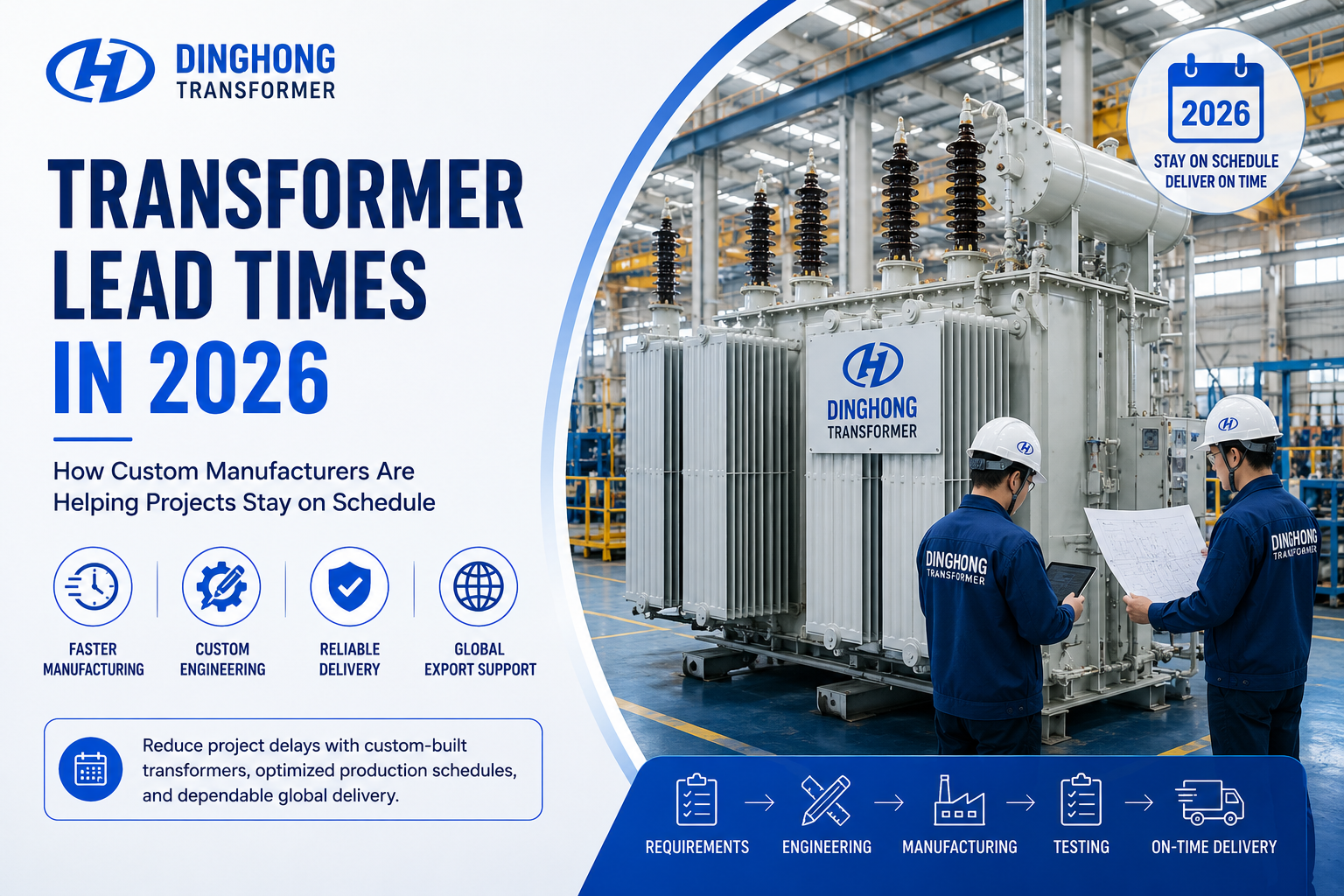
Transformer lead times in 2026 often stretch 18–36 months due to AI data center demand and material shortages. Discover why the crisis continues and how agile custom manufacturers are delivering faster, more reliable schedules for critical projects.
In 2026, transformer availability has become one of the biggest single risks to project success.
Data center developers, renewable energy EPCs, industrial plant owners, and utilities are all discovering the same hard truth: the transformer is no longer a commodity that can be ordered late in the design process. What used to be a 6–12 month item can now take 18, 24, or even 36 months for many standard medium-voltage units. Large power transformers frequently face waits of three years or more.
These delays are pushing back commercial operation dates, increasing financing costs, and in some cases forcing projects to be redesigned or postponed.Yet a growing number of projects are avoiding the worst of these delays.
They are doing so by working with flexible custom manufacturers that control their own design and production processes and can still offer realistic, accelerated delivery windows.
This guide explains the real state of transformer lead times in 2026, the forces driving the shortage, and the concrete ways custom manufacturers are helping buyers keep critical projects on schedule.
The Current Reality of Transformer Lead Times in 2026
Market feedback from project teams and industry analysts throughout 2025 and 2026 shows a consistent pattern:
- Medium-voltage distribution transformers (typically 10–35 kV, 500 kVA to 20 MVA): 12–24 months is now common from large global OEMs for standard designs. Complex or high-specification units often exceed 24 months.
- High-voltage and large power transformers: 24–48 months is frequent, with some quotes stretching beyond that.
- Specialized units (high K-factor for data centers, unusual voltage combinations, or strict efficiency requirements): frequently the longest waits.
These timelines are not expected to ease significantly before 2027–2028. The underlying imbalance between demand and manufacturing capacity remains structural.For any project with a fixed commercial operation date, ordering through conventional channels at the traditional design-freeze stage is often already too late.
Why Lead Times Became So Long
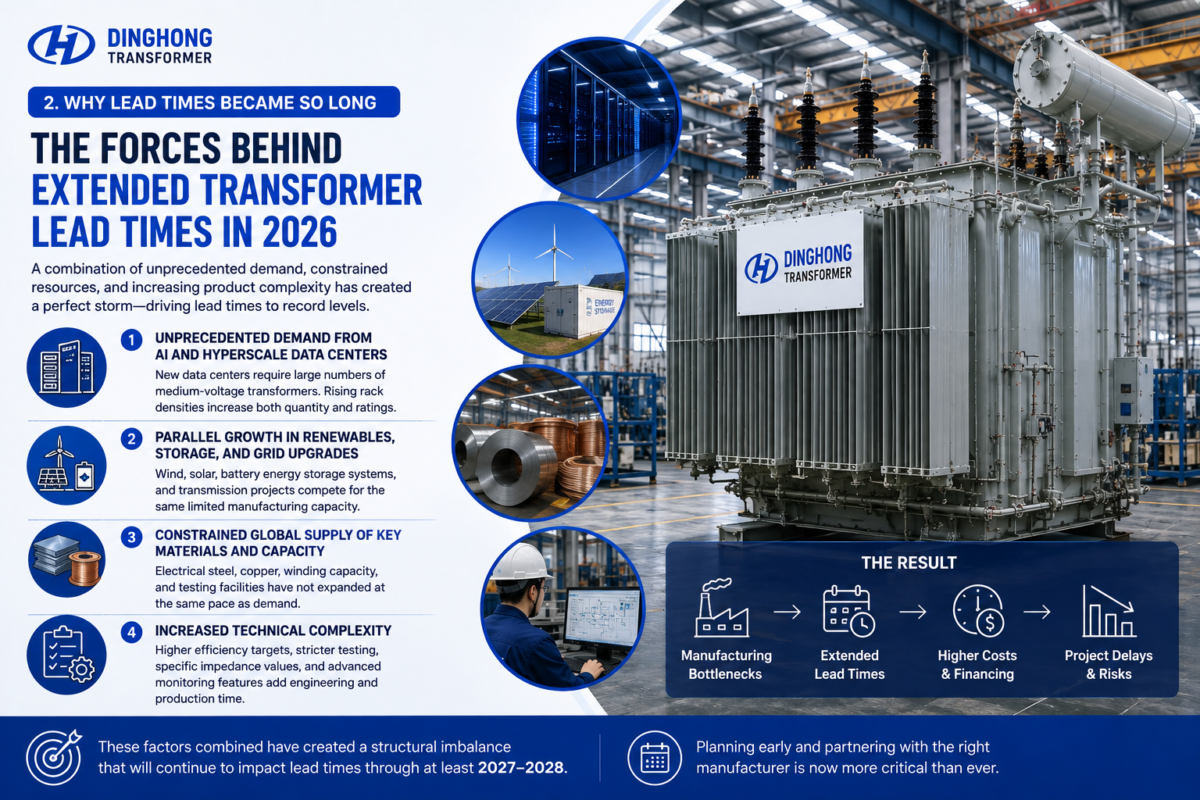
Four major forces collided to create the current situation:
- Unprecedented demand from AI and hyperscale data centersNew campuses require large numbers of medium-voltage transformers. Rising rack densities (now regularly exceeding 100 kW and heading higher) increase both the quantity and the rating of units needed.
- Parallel growth in renewables, storage, and grid upgradesWind, solar, battery energy storage systems, and transmission projects are competing for the same limited manufacturing slots.
- Constrained global supply of key materials and capacityElectrical steel, copper, specialized winding capacity, and testing facilities have not expanded at the same rate as demand. Many large factories are booked years ahead.
- Increased technical complexityBuyers now routinely request higher efficiency classes, more rigorous testing, specific impedance values, and additional monitoring features. Each requirement adds engineering and production time.
The result is a market in which the largest, best-known brands often carry the longest published lead times.
How Custom Manufacturers Are Delivering Faster Schedules
Agile custom manufacturers — particularly those that design, wind, assemble, and test in-house — are offering a practical alternative.
Their advantages typically include:
- Shorter engineering and approval cyclesWhen design, production, and testing sit under one roof, technical clarifications and drawing approvals can be completed in days or weeks rather than months.
- More flexible production planningMid-sized manufacturers often maintain greater scheduling agility. They can prioritize capacity for time-sensitive projects instead of following rigid multi-year production plans.
- Proven modular platformsMany custom houses have developed standardized yet configurable design platforms that already meet IEC, ANSI, or IEEE requirements. This reduces the need for fully unique engineering on every order.
- In-house testing capabilityFactories that perform routine tests and many type tests on site avoid external laboratory queues that can add significant time.
- Better control of material flowEstablished supplier relationships and strategic stocking of common components allow production to start earlier than companies that order materials only after a firm order is received.In practice, these factors frequently translate into delivery windows that are 30–50% shorter than quotes from larger, more rigid suppliers for distribution and medium-voltage units.
Comparison: Typical Lead Times in 2026
| Transformer Type | Large Global OEM(typical) | Agile Custom Manufacturer(Typical) | Potential Time Saving |
| Standard MV Distribution (10–35 kV) | 10-24 months | 7-14 months | 6-12 months |
| High K-factor / Data Center Spec | 10-30 months | 9-16months | 8-14 months |
| Energy Storage / BESS Interface | 16-28 months | 8-15 months | 7-13 months |
| Custom Voltage or Special Accessories | 20-36 months | 10-18months | 8-16months |
Note: Actual times depend on capacity, current order book, and specification complexity. Always request a current, itemized schedule.
Practical Strategies That Are Working for Buyers in 2026
Project teams that are successfully protecting their schedules tend to follow these practices:
- Start manufacturer engagement during conceptual or preliminary design, not after final load calculations.
- Prefer proven platform designs with defined customization options over fully unique engineering.
- Provide clear, complete RFQ information from the first submission (voltages, capacity range, impedance, vector group, cooling, standards, environment, and target date).
- Consider dual-sourcing or phased procurement — critical-path units from a faster custom supplier and longer-lead units from traditional sources.
- Build realistic contingency into the overall project schedule for shipping, customs clearance, and installation.
What to Evaluate When Choosing a Custom Manufacturer
Not every company that describes itself as “custom” can actually compress lead times. Useful selection criteria include:
- Genuine in-house design, core processing, winding, assembly, and testing capability
- Transparent communication about current production load and realistic milestonesDemonstrated experience with the voltage class and application (data center, storage, industrial, etc.)
- Ability to meet the required standards and supply complete test documentation
- Willingness to provide a detailed, dated production and delivery schedule rather than vague estimates
- Clear process for handling engineering changes without major schedule disruption
Manufacturers that control the core production steps generally offer the highest schedule reliability.
Frequently Asked Questions
How long are transformer lead times right now in 2026?
For medium-voltage distribution transformers, 12–24 months is typical from large OEMs. Agile custom manufacturers with available capacity often quote 7–14 months for comparable units.
Can a custom manufacturer really deliver faster than a major global brand?
In many cases yes, especially for distribution and mid-range power transformers. The advantage comes from shorter engineering cycles, more flexible scheduling, and less internal bureaucracy rather than greater total factory size.
Is it realistic to order before final load numbers are locked?
Yes — and it is increasingly necessary. Many manufacturers can begin work on a preliminary rating and finalize details later, provided the voltage class and approximate capacity band are defined early.
What information gives the most accurate lead-time quote?
Primary and secondary voltages, capacity (kVA or MVA), frequency, impedance range, vector group, cooling method, applicable standards, installation environment, required accessories, and desired delivery date.
Do shorter lead times only apply to completely standard designs?
No. Many custom manufacturers can accommodate reasonable variations in voltage, impedance, losses, and accessories while still maintaining competitive delivery times, as long as the request stays within their established design platforms.
How can I reduce the risk of further delays once an order is placed?
Choose a manufacturer that provides milestone tracking, responds quickly to technical queries, and has a proven record of on-time performance. Clear communication and early resolution of any specification questions are essential.
Conclusion: Treat Lead Time as a Core Project Decision
In 2026, transformer lead time is no longer a secondary commercial detail — it is a primary project risk.
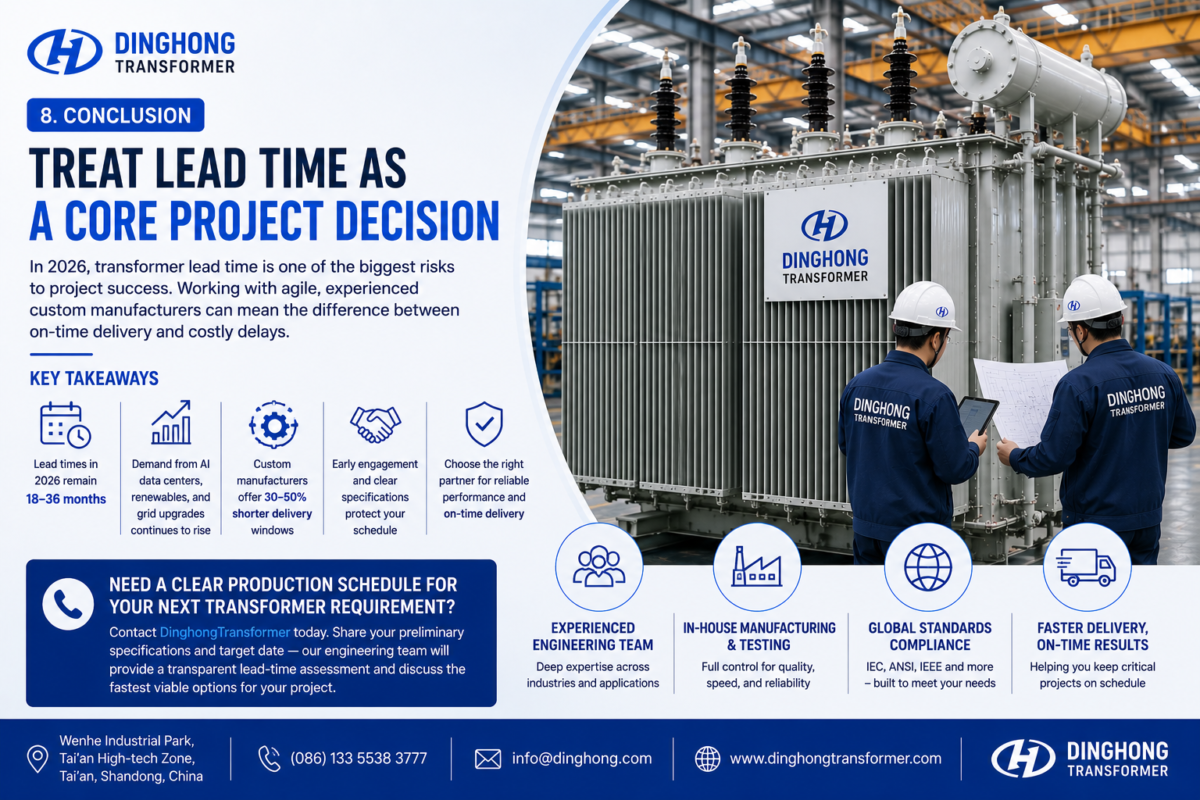
Relying exclusively on traditional large-scale suppliers exposes many data center, energy storage, industrial, and renewable projects to significant schedule pressure.
Custom manufacturers that combine competent engineering with genuine production flexibility are helping a growing number of buyers protect their timelines.
The most successful project teams are engaging these suppliers earlier, writing clearer specifications, and evaluating delivery reliability with the same seriousness they apply to technical performance and price.If your project faces a tight commercial operation date or you need a realistic view of current production availability, the next practical step is a direct technical discussion with an experienced custom manufacturer.
Need a clear production schedule for your next transformer requirement?
Contact DinghongTransformer today. Share your preliminary specifications and target date — our engineering team will provide a transparent lead-time assessment and discuss the fastest viable options for your project.