European-Style Energy Storage Prefabricated Substation: A Buyer’s Guide

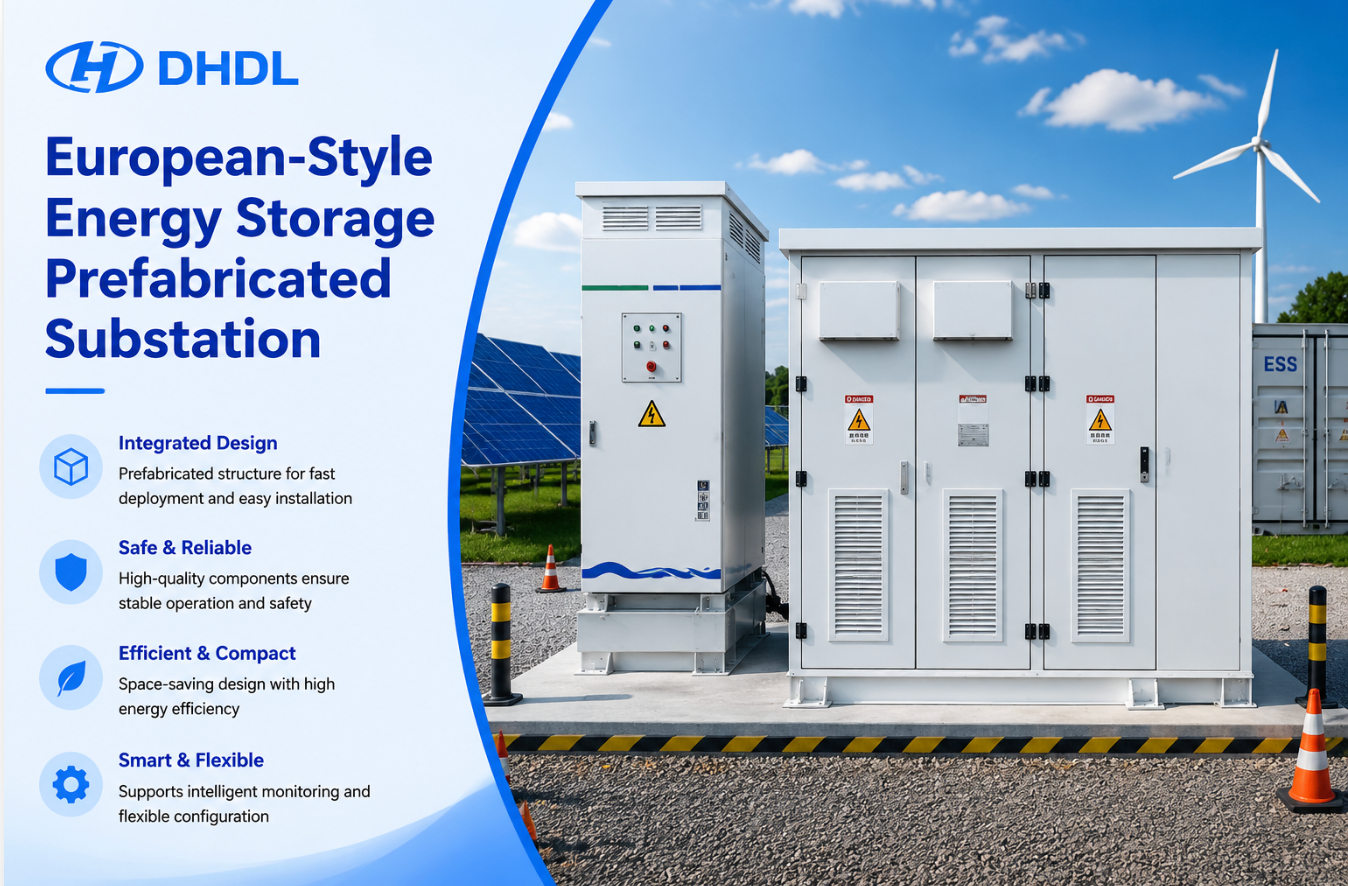
A battery energy storage project needs more than batteries. It also needs equipment that can convert and distribute power, connect with the selected battery solution, exchange information with the energy management platform, control operating functions, and manage heat inside the enclosure.
The DHDL European-Style Energy Storage Prefabricated Substation combines these functions in a compact, modular enclosure. DHDL developed the product for reliable power conversion, distribution, energy storage integration, and intelligent system management in residential, commercial, and industrial projects.
Moreover, DHDL can customize the system voltage, capacity, battery interface, electrical equipment, cooling configuration, control functions, enclosure layout, and auxiliary systems. This flexibility can help buyers coordinate the substation with their actual battery solution and power system.
However, customization also makes accurate project data essential. Before requesting a quotation, buyers should define the battery system, power conversion equipment, energy management platform, voltage level, system capacity, operating environment, expansion plan, and equipment interfaces.
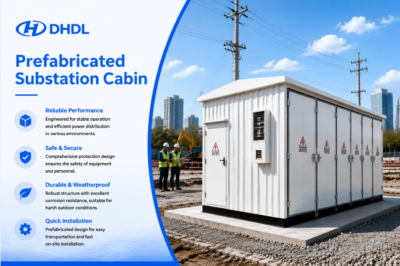
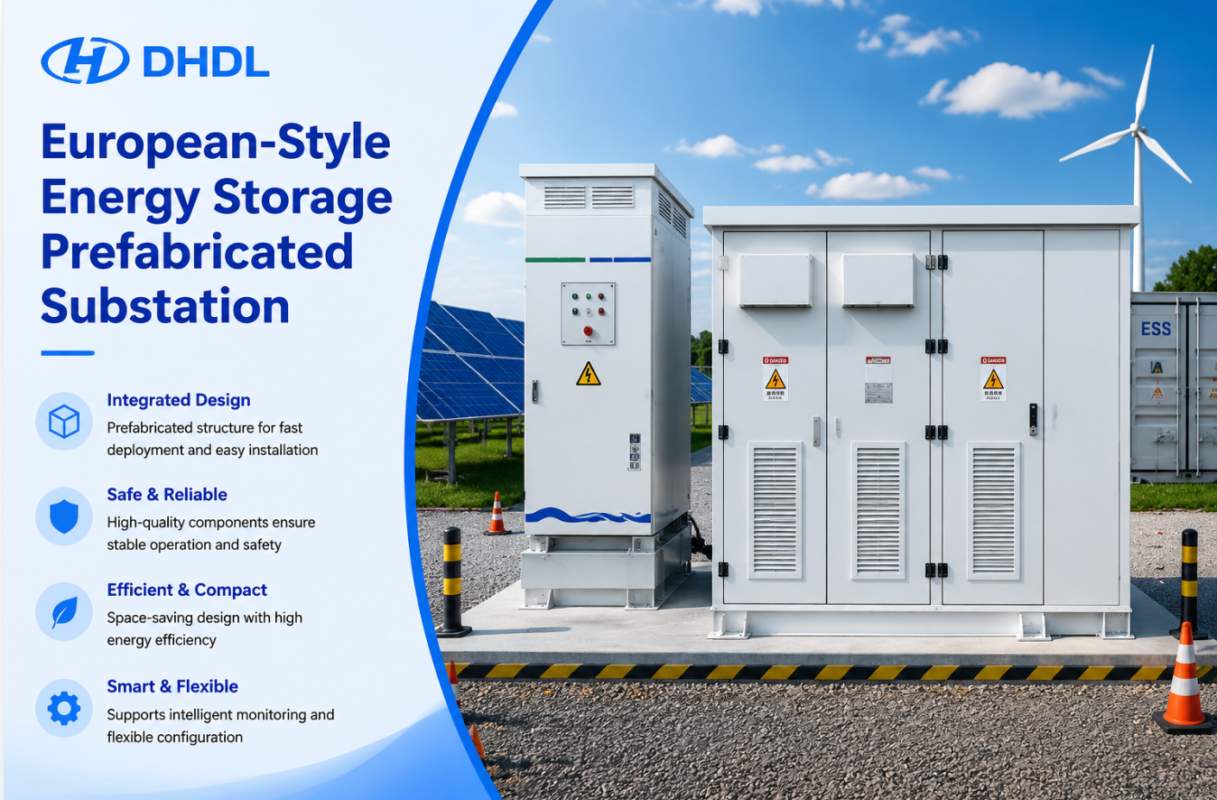
DHDL European-style energy storage prefabricated substation for power conversion, distribution, battery interface, cooling, monitoring, and energy management.
What Is a European-Style Energy Storage Prefabricated Substation?
A European-style energy storage prefabricated substation is an integrated electrical solution that combines multiple energy storage and distribution functions inside a modular enclosure.
According to DHDL, this product covers four principal system areas:
- Power conversion and distribution
- Energy storage battery interface
- Energy management system
- Cooling and intelligent monitoring
Therefore, buyers can use the product as an integrated part of a battery energy storage system rather than treating every electrical function as an isolated equipment package.
The system supports residential, commercial, and industrial energy storage projects. In addition, its modular configuration supports phased installation and future expansion as energy demand develops.
Still, the product does not use one fixed configuration for every project. DHDL engineers the electrical layout, system capacity, battery interface, cooling design, equipment selection, and control functions around the approved project requirements.
What Functions Does the Substation Integrate?
Understanding the system boundary helps buyers compare quotations correctly. A low price may not represent a lower total cost if the supplier excludes essential equipment, control functions, cooling systems, or interfaces.
Power Conversion and Distribution
The European-style energy storage prefabricated substation supports power conversion and distribution within the energy storage system.
An energy storage project may need to exchange electrical power between the battery system, power conversion equipment, site distribution network, or grid connection point. Consequently, the electrical configuration must match the project’s voltage, capacity, cable arrangement, protection requirements, and operating strategy.
DHDL customizes the voltage level according to the project power system. Similarly, it determines the system capacity according to the energy demand and load requirements.
Battery System Interface
DHDL states that the substation can work with multiple energy storage battery systems. This compatibility allows the engineering team to adapt the system around different project-specific battery solutions.
However, “compatible” does not mean that every battery system can connect without engineering work. The manufacturer still needs the battery supplier’s technical information, including:
- Battery system voltage
- Rated energy and power
- Charge and discharge characteristics
- Battery management system interface
- Communication protocol
- Alarm and shutdown signals
- Auxiliary power requirements
- Environmental operating limits
Therefore, buyers should involve the battery supplier, PCS supplier, EMS provider, and substation manufacturer during interface confirmation.
Energy Management System Interface
The product can work with project-specific energy management systems. Moreover, its intelligent monitoring and automated control functions help manage operating data and coordinate system performance.
A successful EMS interface requires clearly defined data points and control authority. For example, the project team should determine which system starts or stops equipment, sets power commands, records alarms, manages operating modes, and communicates with the site controller.
Buyers should therefore provide:
- EMS brand or platform information
- Communication protocol
- Signal list
- Control logic
- Remote-monitoring requirements
- Data storage requirements
- Alarm hierarchy
- Cybersecurity or network requirements, if applicable
DHDL can then review the required control functions against the proposed substation configuration.
Cooling and Intelligent Monitoring
Electrical and energy storage equipment produces heat during operation. Accordingly, the enclosure needs a suitable heat-dissipation design for the installed equipment and site environment.
DHDL uses an optimized enclosure and cooling design to support heat dissipation and stable operation under high-load conditions. Meanwhile, the intelligent monitoring system manages operating data and supports automated control.
Nevertheless, buyers should not assume one cooling configuration fits every climate or system capacity. DHDL determines the final cooling design from the installed equipment, operating load, ambient conditions, enclosure layout, and project requirements.
Published Technical Specifications
The following table summarizes the information published on the official product page.
| Item | Published product information |
|---|---|
| Product type | European-Style Energy Storage Prefabricated Substation |
| System function | Power conversion, distribution, energy storage integration, and intelligent system management |
| Application | Residential, commercial, and industrial energy storage projects |
| Voltage level | Customizable according to the project power system |
| System capacity | Customizable according to energy demand and load requirements |
| Battery compatibility | Compatible with multiple energy storage battery systems |
| Energy management | Compatible with project-specific energy management systems |
| Cooling design | Efficient heat dissipation designed for stable operation under high-load conditions |
| Capacity expansion | Modular configuration supports flexible future system expansion |
| Control system | Intelligent automated control for operating efficiency optimization |
| Internal configuration | Electrical layout and equipment selection customized according to project requirements |
| Customization options | System capacity, battery interface, cooling configuration, control functions, enclosure layout, and auxiliary systems |
These details define the product’s general engineering scope. However, DHDL determines the final specifications according to the system voltage, storage capacity, battery solution, energy management platform, installation environment, and approved project drawings.
Consequently, buyers should use the approved project datasheet, single-line diagram, equipment list, interface documents, and drawings as the final contractual references.
Why Consider a European-Style Energy Storage Substation?
It Combines Multiple System Functions
The product integrates electrical distribution, battery interfaces, energy management compatibility, cooling, monitoring, and control functions within one modular system.
As a result, the project team can coordinate several technical interfaces through one integrated design process. This approach can also help reduce unnecessary separation between independently designed equipment packages.
However, integration does not automatically eliminate interface risks. Instead, it moves more responsibility into the system design and technical confirmation stage. Therefore, buyers should define the scope of supply clearly before comparing proposals.
It Supports Different Battery and Management Platforms
DHDL can configure the substation to work with different energy storage batteries and project-specific energy management systems.
This flexibility matters because buyers may source batteries, power conversion systems, and management platforms from different suppliers. Moreover, some projects may replace or update specific subsystems during development.
Still, the buyer should request written interface confirmation. A general compatibility statement does not replace an approved communication matrix, signal list, cable schedule, equipment datasheet, and control-logic description.
It Supports Modular Expansion
The modular structure supports phased installation and future system expansion. Therefore, a project can consider additional storage capacity or electrical equipment as demand develops.
This feature can benefit projects where:
- The initial investment follows several construction phases
- Future electricity demand remains uncertain
- The site plans to add renewable-energy capacity
- The owner wants to reserve space for later battery expansion
- The distribution system may need additional circuits
Nevertheless, future expansion requires advance planning. Buyers should reserve sufficient land, cable routes, electrical capacity, protection margins, communication addresses, cooling capacity, and connection points.
In other words, modular equipment supports expansion only when the original system design also prepares for it.
It Provides Intelligent Monitoring and Control
DHDL’s intelligent monitoring and automated control functions help manage operating data and coordinate system performance.
For operators, this functionality can improve visibility into the integrated system. Moreover, project-specific control logic can coordinate equipment according to the intended operating strategy.
However, buyers should define which data and control functions they require. Otherwise, two suppliers may offer very different monitoring scopes under the same general description.
It Addresses Heat Dissipation During High-Load Operation
DHDL designed the enclosure and cooling arrangement to support efficient heat dissipation under high-load conditions.
This feature matters because the project’s equipment selection, load profile, ambient temperature, solar exposure, altitude, and enclosure arrangement can all influence thermal conditions.
Therefore, buyers should provide the expected operating profile rather than only the nominal system capacity. Continuous high-load operation may create different cooling requirements from short-duration or intermittent operation.
Where Can Buyers Use This Product?
Commercial Energy Storage
Commercial properties may use battery storage as part of their broader electricity-management strategy. These projects can include business parks, shopping facilities, office campuses, hospitals, hotels, and other large electricity users.
The European-style substation can integrate power distribution, battery interfaces, cooling, monitoring, and energy management functions. However, the buyer must still provide the building load profile, system capacity, available installation area, operating strategy, and network requirements.
Industrial Energy Storage
Industrial facilities often operate complex loads and require coordinated electrical protection and control.
Consequently, industrial buyers should explain:
- Normal and peak demand
- Critical production loads
- Motor or fluctuating loads
- Required backup duration
- Charge and discharge schedule
- Power-quality requirements
- Existing transformer and switchgear arrangement
- Expansion plan
- Site communication system
DHDL can then adapt the electrical configuration and equipment selection to the project requirements.
Renewable-Energy Projects
Solar, wind, and microgrid projects may combine variable generation with battery storage. Therefore, the project needs coordinated power conversion, distribution, storage integration, monitoring, and control.
The DHDL European-style energy storage prefabricated substation can serve this broader integration role. In addition, buyers can review DHDL’s energy storage cabinet range when planning the battery equipment alongside the substation.
Residential or Community Energy Projects
The product page also lists residential energy storage as an application. In this context, “residential” may refer to a centralized project serving residential or community loads rather than a small household battery.
Project developers should therefore confirm the intended installation scale, system capacity, enclosure location, noise limits, safety distances, maintenance access, and local approval requirements.
European-Style vs. American-Style Energy Storage Equipment
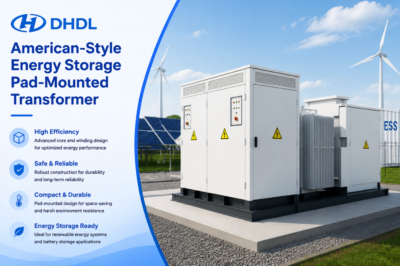
DHDL also supplies an American-Style Energy Storage Pad-Mounted Transformer. Although both products support energy storage projects, their published scopes emphasize different functions.
| Selection factor | European-style energy storage prefabricated substation | American-style energy storage pad-mounted transformer |
| Primary role | Power conversion, distribution, energy storage integration, and intelligent management | Power transformation and distribution for energy storage and renewable-energy systems |
| Published integrated systems | Power conversion and distribution, battery interface, EMS, cooling, and intelligent monitoring | Oil-immersed transformer, high-voltage protection, low-voltage connection, and outdoor enclosure |
| Battery compatibility | Supports multiple energy storage battery systems | Product page focuses on transformer-side integration rather than battery compatibility |
| Energy management | Supports project-specific EMS platforms | Product page does not specify EMS integration as a core function |
| Expansion | Modular configuration supports flexible future expansion | Product page does not publish a modular expansion claim |
| Cooling approach | Project-specific cooling configuration for the integrated system | Oil-immersed insulation with natural heat dissipation |
| High-voltage protection | Final electrical equipment and protection scope depend on project configuration | Integrated high-voltage protection configured according to project requirements |
| Main buyer priority | Broader system integration, control, compatibility, and expansion | Compact transformer integration, protection, connection, and outdoor installation |
| Final design basis | Voltage, capacity, battery solution, EMS, environment, and drawings | Voltage, capacity, protection, cable arrangement, environment, and drawings |
The European-style product offers the more appropriate published scope when a buyer needs battery-interface compatibility, energy management integration, intelligent control, and modular expansion within the prefabricated solution.
By contrast, the American-style product focuses more directly on a compact oil-immersed transformer, high-voltage protection, and low-voltage connection package.
Nevertheless, the final decision should follow the project single-line diagram and equipment boundary. Buyers should not choose a structure solely from the names “European-style” or “American-style.”
Integrated vs. Split Equipment Arrangement
A split arrangement sources and installs major components separately. An integrated prefabricated system coordinates them inside a planned enclosure and system architecture.
| Decision factor | Integrated prefabricated substation | Split equipment arrangement |
| System coordination | Manufacturer engineers several subsystems and interfaces as one solution | Project team coordinates multiple equipment packages and suppliers |
| Enclosure and layout | Uses an integrated modular enclosure | Requires separate equipment placement and site-layout coordination |
| Wiring and interfaces | Can consolidate internal equipment interfaces | May require more site-level interface coordination |
| Customization | DHDL engineers the layout and equipment according to project needs | Individual suppliers customize their own packages |
| Future expansion | DHDL’s modular structure supports planned expansion | Expansion depends on the original site layout and separate equipment designs |
| Buyer responsibility | Buyer must define system requirements and approve the integrated interfaces | Buyer or EPC must manage more cross-supplier interfaces |
| Best fit | Projects seeking coordinated system integration | Projects with established designs or a deliberate multi-supplier strategy |
The integrated approach can reduce coordination complexity, but it does not remove the need for technical review. Instead, the buyer must confirm the system boundary, excluded equipment, external interfaces, and responsibilities in writing.
What Can DHDL Customize?
Electrical System Configuration
DHDL can engineer:
- System voltage
- System capacity
- Electrical layout
- Electrical equipment selection
- Battery interface
- Power distribution arrangement
- Project-specific connection interfaces
The manufacturer bases these decisions on the project’s power system, storage capacity, battery solution, and approved drawings.
Cooling and Enclosure Configuration
DHDL can customize:
- Cooling configuration
- Enclosure layout
- Internal equipment arrangement
- Heat-dissipation design
- Auxiliary systems
Therefore, buyers should provide the installation environment, ambient temperature, humidity, altitude, dust level, solar exposure, and available site dimensions.
Monitoring and Control Functions
DHDL can customize the intelligent-control functions and adapt the system to the project-specific EMS.
The technical review should confirm:
- Required operating modes
- Communication protocols
- Signal list
- Remote monitoring
- Alarm and event records
- Start and stop authority
- Emergency shutdown logic
- Interface with the PCS and BMS
- Interface with the site or grid controller
Modular Expansion Provisions
If the project will expand later, buyers should define the expected final capacity during the initial design stage.
DHDL can then review:
- Reserved equipment positions
- Future cable routes
- Additional electrical circuits
- Communication expansion
- Cooling reserves
- Enclosure arrangement
- Protection coordination
- Future battery and PCS interfaces
This planning helps preserve the practical value of the modular structure.
Key Selection Risks Buyers Should Address
Unclear Equipment Boundaries
Different suppliers may interpret “integrated energy storage substation” differently. Therefore, buyers should request a detailed scope-of-supply table.
The table should show:
- Included electrical equipment
- Included energy storage equipment
- Battery interface boundary
- PCS interface boundary
- EMS and BMS interface boundary
- Cooling equipment
- Auxiliary power
- Monitoring and communication
- External cables
- Installation and commissioning responsibilities
- Required drawings and documentation
Without this list, buyers may compare proposals that cover different equipment scopes.
Battery, PCS, and EMS Mismatch
The product supports different battery and management platforms, but the engineering team must still match voltage ranges, power levels, signals, protocols, and control logic.
Consequently, buyers should provide official datasheets from each subsystem supplier. DHDL can then review the complete interface rather than rely on brand names alone.
Insufficient Cooling Data
A nominal system capacity does not fully describe the thermal load. The manufacturer also needs the operating cycle, equipment losses, ambient conditions, and internal equipment arrangement.
Therefore, submit the expected charge and discharge profile together with the site environmental data.
Unplanned Future Expansion
A project may choose modular equipment but forget to reserve land, cable routes, protection capacity, or communication resources.
As a result, a later expansion can still require expensive site modifications. Buyers should define both the initial phase and expected final phase during the original system design.
Incomplete Grid-Connection Information
The project voltage, frequency, fault level, grounding method, protection requirements, and grid code can affect the final electrical design.
Accordingly, the buyer should provide the point-of-connection requirements before DHDL confirms the system configuration.
Considerations for DHDL Target Markets
DHDL’s target markets include Ukraine, Ethiopia, Vietnam, Thailand, Myanmar, Uzbekistan, Russia, and Nigeria. However, one configuration cannot represent every project within these countries.
| Target market | Site information buyers should prioritize |
| Ukraine | Minimum temperature, wind and snow conditions, heating provisions, grid requirements, and documentation language |
| Ethiopia | Altitude, ambient temperature, dust exposure, transport route, grid voltage, and site access |
| Vietnam | High humidity, condensation, rainfall, flooding risk, coastal exposure where applicable, and grid interface |
| Thailand | Ambient heat, humidity, drainage, condensation control, solar exposure, and local utility requirements |
| Myanmar | Temperature, monsoon conditions, site access, communication infrastructure, and grid characteristics |
| Uzbekistan | Seasonal temperature range, dust and sand, altitude, transport restrictions, and local technical requirements |
| Russia | Minimum temperature, heating, snow and wind loads, grid standards, and documentation requirements |
| Nigeria | Temperature, humidity, rainfall, dust, fault level, grid conditions, and site-security requirements |
For example, an installation in coastal Vietnam may require a different enclosure and cooling review from a dry inland project in Uzbekistan. Likewise, a high-altitude project in Ethiopia needs different thermal and insulation inputs from a low-altitude location.
Therefore, buyers should submit exact site data instead of relying only on the destination country.
Information DHDL Needs for a Technical Proposal
A complete RFQ helps DHDL define the system boundary and prepare a more relevant technical solution.
| Required information | Why DHDL needs it |
| Project application | Defines the residential, commercial, industrial, renewable-energy, or microgrid context |
| Project location | Establishes environmental and transport requirements |
| Single-line diagram | Shows the intended electrical architecture |
| Required voltage level | Defines the project power-system interface |
| Initial and final system capacity | Supports current design and future expansion |
| Battery system datasheet | Establishes the battery interface and operating range |
| PCS datasheet | Supports electrical matching and control coordination |
| BMS information | Defines battery data, alarms, and shutdown interfaces |
| EMS platform and protocol | Establishes monitoring and control integration |
| Charge and discharge profile | Supports equipment and cooling design |
| Grid-connection requirements | Defines point-of-connection conditions |
| Protection requirements | Supports protection coordination |
| Installation environment | Determines enclosure, cooling, and auxiliary requirements |
| Available area | Supports enclosure and internal-layout design |
| Expansion plan | Identifies future equipment and interface reserves |
| Applicable standards | Establishes the technical and documentation basis |
| Required tests and documents | Clarifies inspection, approval, and handover requirements |
| Delivery destination and schedule | Supports production and logistics planning |
If the project remains in an early stage, send the available system concept, capacity target, site data, and battery or PCS information first. DHDL can then identify which inputs still require confirmation.
Frequently Asked Questions
Can the substation work with different battery systems?
DHDL states that the system supports multiple energy storage battery systems. However, DHDL must match the electrical characteristics, communication interfaces, control logic, and project requirements before confirming compatibility.
Can it connect with different energy management platforms?
Yes. DHDL can adapt the system to project-specific energy management platforms. Buyers should provide the protocol, signal list, control requirements, and platform information.
Does DHDL offer one standard system capacity?
No. DHDL customizes the system capacity according to the project’s energy demand and load requirements.
Can the system expand later?
The modular configuration supports future capacity expansion. Nevertheless, buyers should reserve the necessary electrical, physical, cooling, protection, and communication capacity during the initial design.
Does the product include intelligent control?
Yes. The product page specifies intelligent automated control and operating-data management. The exact monitoring points and control functions depend on the approved project configuration.
Is the cooling system fixed?
No. DHDL engineers the cooling configuration according to the installed equipment, operating conditions, environment, and project requirements.
Is this product only suitable for industrial projects?
No. DHDL lists residential, commercial, and industrial energy storage projects as its applications. However, the final system scale and configuration must match the actual project.
What documents should buyers request?
Buyers should define the required drawings, equipment list, technical datasheets, interface documents, test records, certificates, operation manuals, and commissioning documents in the RFQ. The product page does not publish a universal document package for every project, so DHDL should confirm the final list in the proposal.
Build the Substation Around the Complete Energy Storage System
The DHDL European-Style Energy Storage Prefabricated Substation offers more than a basic transformer enclosure. It combines power conversion and distribution, battery interface compatibility, energy management integration, cooling, monitoring, intelligent control, and modular expansion within a project-specific solution.
Moreover, DHDL can adapt the system capacity, battery interface, cooling arrangement, control functions, enclosure layout, electrical equipment, and auxiliary systems to the application.
However, successful integration depends on accurate project inputs. Buyers should confirm the battery, PCS, BMS, EMS, voltage, capacity, protection, cooling, environment, expansion plan, and scope of supply before approving the design.
To request a technical proposal, send your single-line diagram, battery and PCS datasheets, required voltage and capacity, EMS communication requirements, site conditions, expansion plan, applicable standards, and delivery destination through the DHDL contact page. DHDL can then review the interfaces and prepare a configuration for your specific energy storage project.