KYN28 Metal-Clad Withdrawable Switchgear: A Practical Buyer’s Guide

Medium-voltage switchgear sits between the incoming power source and the equipment that keeps a facility operating. Therefore, an incomplete specification can affect protection coordination, maintenance access, expansion plans, operating safety, and commissioning.
The DHDL KYN28 metal-clad withdrawable switchgear is designed for 3.6–12kV three-phase AC power systems. It receives, distributes, controls, protects, and monitors electrical power in substations, power plants, industrial facilities, infrastructure projects, commercial buildings, data centers, renewable energy projects, and medium-voltage power rooms.
Moreover, the cabinet uses a metal-clad compartment structure with a withdrawable circuit breaker truck. This structure provides isolation between functional areas and allows operators to withdraw the circuit breaker for inspection, testing, maintenance, or replacement.
However, buyers should not select KYN28 switchgear by voltage alone. Instead, they should confirm the system current, short-circuit duty, single-line diagram, circuit breaker, protection relay, cable arrangement, cabinet layout, interlocking, communication, and applicable standard.
This guide explains how to make those decisions from the buyer’s perspective.
KYN28 Product Overview
DHDL publishes the following product information:
| Product item | DHDL specification |
|---|---|
| Product type | KYN28 metal-clad withdrawable switchgear |
| Voltage range | 3.6–12kV |
| System type | Three-phase AC medium-voltage power system |
| Cabinet structure | Metal-clad compartment structure with withdrawable circuit breaker truck |
| Main functions | Power distribution, control, protection, and monitoring |
| Applications | Power plants, substations, industrial distribution systems, infrastructure projects, commercial buildings, data centers, renewable energy projects, and medium-voltage power rooms |
| Customizable items | Voltage level, rated current, circuit configuration, breaker type, protection relay, cabinet layout, and applicable standards |
| Additional project customization | Breaking capacity, main wiring scheme, circuit breaker brand, protection device, and communication system |
| Published standards | IEC 62271 and GB/T 3906 |
| Published warranty | One year |
Although this information defines the product family, the final configuration remains project-specific. Consequently, DHDL needs the electrical data and single-line diagram before it can confirm the technical solution.
Why Buyers Choose a Withdrawable Circuit Breaker Design
The circuit breaker represents a critical switching and protection component inside the cabinet. In KYN28 switchgear, DHDL places the breaker on a withdrawable truck.
As a result, operators can move the breaker between its defined positions and withdraw it for inspection, testing, maintenance, or replacement without complex cabinet disassembly.
Easier Inspection and Maintenance
A withdrawable breaker can simplify access to the breaker itself. Therefore, maintenance teams can inspect or service the unit outside its normal operating position.
Nevertheless, withdrawability does not mean that personnel can ignore isolation procedures. Operators must still follow the approved operating sequence, interlocking logic, safety rules, and site procedures.
More Practical Breaker Testing
The withdrawable arrangement supports defined service and test positions, depending on the final design.
Consequently, commissioning and maintenance teams can verify control, indication, and protection functions under the approved operating procedure.
Before ordering, buyers should confirm:
- Service position
- Test position
- Isolated position
- Breaker racking method
- Position indication
- Secondary plug arrangement
- Mechanical interlocking
- Electrical interlocking
- Shutter operation
- Breaker interchangeability requirements
Faster Replacement Planning
If a project keeps a compatible spare breaker, the withdrawable design can support a more practical replacement strategy.
However, the buyer must define what “interchangeable” means in the project. Breaker rating, control voltage, auxiliary contacts, secondary plug, mechanism, protection interfaces, and physical arrangement must all match.
Therefore, do not assume that two breakers are interchangeable only because they fit KYN28 cabinets.
How the Metal-Clad Compartment Structure Helps the User
DHDL describes the KYN28 cabinet as a metal-clad compartment structure.
In practical terms, the cabinet divides key functions into separate areas. Depending on the approved configuration, these areas may include the circuit breaker, busbar, cable connection, and low-voltage control functions.
This separation can help the project team organize operation, maintenance, and fault management. Moreover, it supports a structured equipment layout within the switchgear lineup.
Nevertheless, the buyer should verify the exact compartment arrangement on the project drawing rather than relying on a general product description.
Ask DHDL to identify:
- Circuit breaker compartment
- Busbar compartment
- Cable compartment
- Low-voltage control compartment
- Pressure-relief arrangement
- Internal shutters
- Earthing points
- Inspection windows
- Cable-entry direction
- Access requirements
Safety Starts with the Five-Prevention Interlocking System
DHDL states that the KYN28 switchgear includes a complete five-prevention interlocking system.
The system helps reduce the risk of incorrect opening or closing, load-switching errors, live earthing, and accidental entry into energized compartments.
For buyers, however, the phrase “five-prevention” should lead to a documented interlocking matrix.
Therefore, request written confirmation of how the cabinet prevents unsafe operating sequences.
| Interlocking review item | Buyer-side question |
| Circuit breaker operation | Under which conditions can the breaker open or close? |
| Breaker movement | Can personnel move the breaker truck while the breaker remains closed? |
| Earthing switch | What conditions allow the earthing switch to operate? |
| Cable compartment access | What prevents access when the relevant circuit remains energized? |
| Shutter system | How do the shutters cover energized primary contacts? |
| Breaker position | How does the system indicate service, test, and isolated positions? |
| Key interlocking | Does the project require coordination with upstream or downstream equipment? |
| Electrical interlocking | Which external permissive or blocking signals does the cabinet require? |
The five-prevention system can support safer operation. Nevertheless, operators still need approved procedures, training, labeling, maintenance, and site-specific risk controls.
Electrical Parameters Buyers Must Confirm
DHDL confirms a voltage range of 3.6–12kV. However, that range alone does not define a complete switchgear specification.
Rated Voltage
Select the switchgear voltage class according to the power system and applicable standard.
Provide:
- Nominal system voltage
- Highest voltage for equipment
- Frequency
- Earthing method
- Insulation requirements
- Operating voltage variation
Rated Current
The main busbar and each feeder must carry the required continuous current.
Therefore, provide:
- Incoming feeder current
- Outgoing feeder current
- Transformer feeder current
- Bus coupler current
- Future load
- Ambient temperature
- Diversity assumptions
Do not select every feeder from the total busbar current. Instead, define the actual duty of each circuit.
Short-Circuit Breaking Capacity
The circuit breaker must match the system fault level.
Consequently, provide:
- Calculated short-circuit current
- Required breaking capacity
- Required making capacity
- Short-time withstand current
- Short-circuit duration
- Protection clearing time
DHDL can customize the breaking capacity according to the project. Nevertheless, the buyer remains responsible for providing accurate network data.
Main Wiring Scheme
The single-line diagram defines how the switchgear must function.
It should show:
- Incoming feeders
- Outgoing feeders
- Transformer feeders
- Bus sections
- Bus coupler
- Metering
- Earthing
- Station service
- Future panels
- Protection zones
Without this diagram, suppliers may quote different equipment scopes. Therefore, always issue the latest approved revision with the RFQ.
Circuit Breaker Selection
DHDL can customize the breaker type and circuit breaker brand.
However, buyers should define the required performance instead of selecting a brand name alone.
Confirm:
- Rated voltage
- Rated current
- Breaking capacity
- Making capacity
- Operating sequence
- Mechanical endurance
- Electrical endurance
- Spring-charged or other approved operating mechanism
- Trip coil voltage
- Closing coil voltage
- Motor voltage
- Auxiliary contacts
- Anti-pumping function
- Position indication
- Interchangeability
- Spare-parts availability
Moreover, confirm whether the breaker supplier can support the destination market during the expected operating life.
Protection Relay and Communication Requirements
DHDL also lists protection relays and communication systems among the customizable items.
Therefore, the buyer should provide a protection philosophy rather than a general request for “digital protection.”
Depending on the circuit, the project may require:
- Overcurrent protection
- Earth-fault protection
- Transformer protection
- Motor protection
- Feeder protection
- Bus protection interfaces
- Under-voltage or over-voltage functions
- Frequency protection
- Arc-related protection where specified
- Metering
- Event recording
- Disturbance recording
- Communication with SCADA
In addition, confirm:
- Relay brand or approved vendor list
- Communication protocol
- Time synchronization
- Digital and analog point list
- Remote opening and closing
- Local and remote selector logic
- Cybersecurity requirements
- Language
- Setting-file responsibility
The relay does not work independently from the current transformers, voltage transformers, trip circuit, and communication system. Consequently, review the entire protection chain.
Current Transformer and Voltage Transformer Data
Instrument-transformer requirements can vary between metering and protection functions.
Therefore, provide:
- Ratio
- Number of cores
- Accuracy class
- Protection class
- Burden
- Accuracy limit factor where required
- Metering requirements
- Utility approval requirements
- Secondary earthing
- Test-terminal requirements
If the buyer leaves these details undefined, the proposed switchgear may not support the final relay and metering design.
Cable Entry, Exit, and Termination
DHDL specifically asks buyers to provide the cable entry and exit method when requesting a quotation.
This information affects the cabinet layout, cable compartment, supports, termination space, and installation plan.
Confirm:
- Bottom, top, rear, or project-specific cable entry
- Number of cables per phase
- Cable conductor size
- Cable insulation type
- Cable outside diameter
- Termination type
- Cable bending radius
- Surge arrester requirement
- Current transformer position
- Earthing cable
- Cable basement depth
- Required installation access
Moreover, check whether the cable contractor can install and test the terminations within the available compartment space.
Review the Cabinet Drawing Before Production
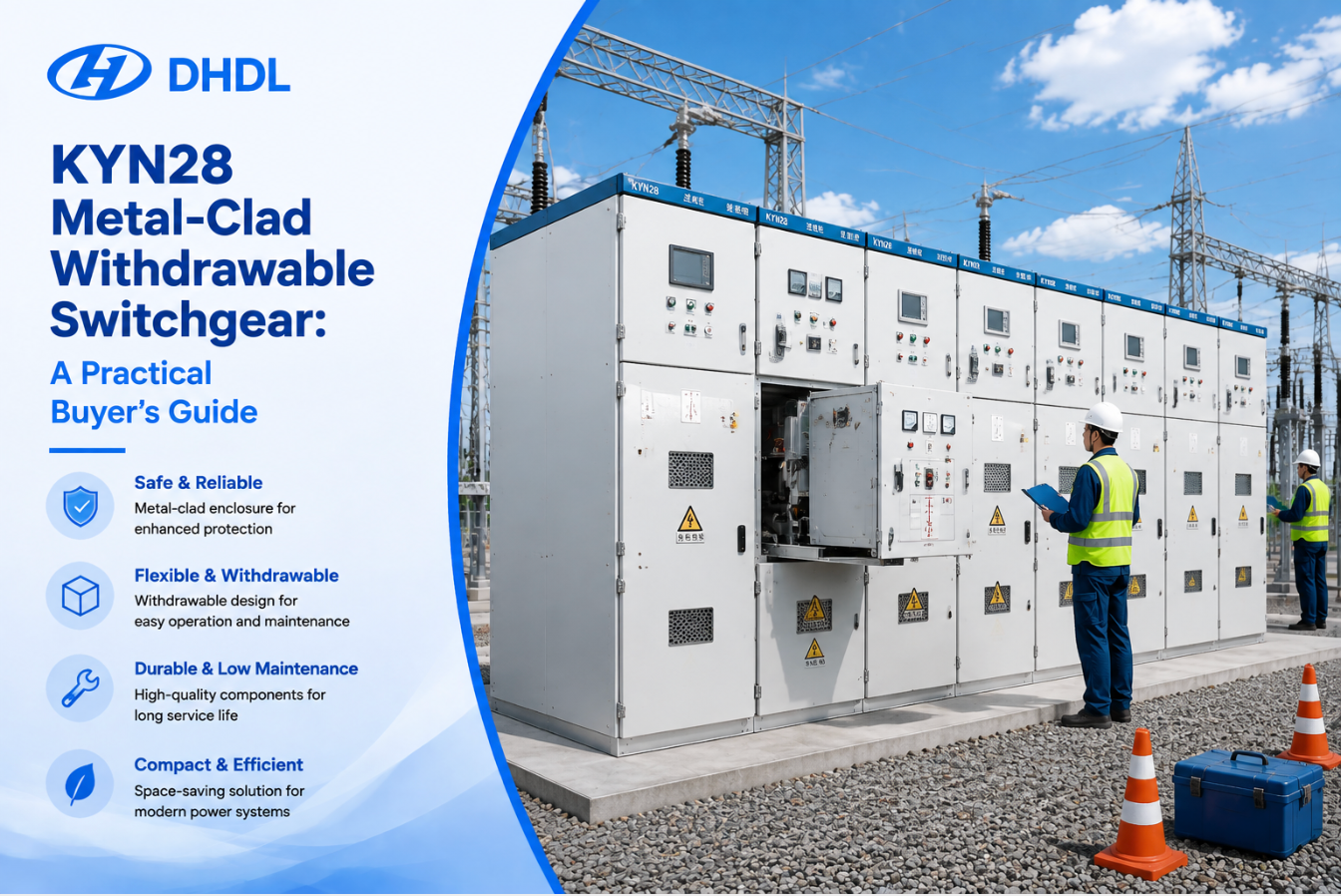
The standard product image shows the appearance of a KYN28 cabinet. However, it does not replace an order-specific drawing.
Image caption:
DHDL KYN28 metal-clad withdrawable switchgear for 3.6–12kV medium-voltage power systems.
Before production, ask DHDL to provide the lineup and cabinet drawings.
| Drawing item | Buyer-side verification |
| Total lineup length | Confirm that the complete switchgear fits the power room |
| Cabinet width | Check wall, column, and future-extension clearances |
| Cabinet height | Confirm ceiling, ventilation, and lifting clearance |
| Cabinet depth | Reserve front and rear access where required |
| Door opening | Verify safe operating and maintenance space |
| Cable compartment | Confirm cable quantity, bending radius, and termination access |
| Busbar position | Coordinate panel assembly and future extension |
| Pressure-relief direction | Keep the designated path clear |
| Foundation channels | Coordinate the civil design |
| Cable trench | Check position, width, and depth |
| Secondary cable entry | Coordinate protection, control, and SCADA wiring |
| Panel numbering | Match the single-line diagram |
| Shipping sections | Confirm door, truck, container, crane, and site access |
| Future panels | Reserve space and confirm extension interfaces |
Furthermore, coordinate the drawing with the civil, electrical, protection, cable, and installation teams.
KYN28 Applications from the Product Page
DHDL identifies several applications for KYN28 switchgear.
Power Plants
KYN28 can support medium-voltage power distribution, control, protection, and monitoring within power plant systems.
However, the project must define generator auxiliary loads, transformer feeders, motor duty, fault level, and operating sequence.
Substations
In substations, KYN28 can form part of the medium-voltage incoming, bus, transformer, and outgoing feeder arrangement.
Where the project also requires transformers, buyers can coordinate the switchgear with DHDL’s 6–37kV dry-type distribution transformer or 6–38.5kV oil-immersed distribution transformer, depending on the installation and project requirements.
These transformer links do not imply automatic compatibility. Therefore, confirm voltage ratio, rated current, fault level, protection, cable interfaces, and installation environment.
Industrial Distribution Systems
Factories, workshops, production lines, mining facilities, and industrial power systems may use KYN28 switchgear for medium-voltage control and protection.
In these projects, buyers should pay particular attention to:
- Large motors
- Motor-starting current
- Transformer inrush
- Frequent switching
- Process shutdown cost
- Maintenance windows
- Spare breaker strategy
Infrastructure Projects
KYN28 can also support infrastructure power rooms.
However, infrastructure projects may require specific documentation, redundancy, fire-safety coordination, remote monitoring, and phased commissioning.
Commercial Buildings and Data Centers
DHDL includes commercial buildings and data centers among the product applications.
Because these sites can place a high value on continuity, buyers should define:
- Redundant incomers
- Bus coupler logic
- Automatic transfer requirements
- Selective protection
- Remote monitoring
- Planned maintenance strategy
- Future capacity
Renewable Energy Projects
Solar, wind, energy storage, and microgrid projects may use medium-voltage switchgear for incoming, outgoing, transformer, and grid-connection circuits.
Nevertheless, the project must confirm power-flow direction, operating cycles, protection coordination, grid requirements, and communication interfaces.
Flexible Configuration and Future Expansion
DHDL states that the modular cabinet design supports flexible circuit combinations, layout adjustment, and future expansion.
Therefore, buyers should define realistic expansion needs during the initial design.
Confirm:
- Number of future panels
- Expansion direction
- Future busbar rating
- Prepared busbar interface
- Building space
- Cable trench extension
- Protection and communication capacity
- Auxiliary power capacity
A statement such as “allow for future expansion” remains too vague. Instead, specify the expected circuits and ratings.
Standards and Project Documentation
DHDL states that KYN28 switchgear follows IEC 62271, GB/T 3906, and other applicable international or domestic standards.
Moreover, DHDL states that it can provide type-test reports and relevant certification documents according to project requirements.
However, buyers should confirm the exact standard edition, product scope, rated parameters, and document availability before ordering.
Request:
- Applicable standard list
- Technical data sheet
- Type-test report
- Routine-test procedure
- Routine-test report
- General arrangement drawing
- Single-line diagram
- Schematic drawings
- Wiring diagrams
- Terminal plan
- Interlocking matrix
- Component list
- Nameplate drawing
- Installation manual
- Operation manual
- Maintenance manual
- Packing list
- Spare-parts list
Do not assume that a general report covers every customized configuration.
Factory Inspection and Testing
The KYN28 page does not publish a complete model-specific routine-test table. Therefore, the contract should define the required inspection and test plan.
The project may need to confirm:
- Visual and dimensional inspection
- Component verification
- Mechanical operation
- Circuit breaker racking
- Interlocking
- Main-circuit resistance
- Insulation testing
- Power-frequency withstand testing
- Control and auxiliary circuits
- Protection relay functions
- Metering
- Alarm and indication
- Communication
- Wiring continuity
- Phase sequence
- Nameplate
- Packing inspection
The exact test scope must follow the approved standard and project agreement.
DHDL’s manufacturing capability page describes switchgear installation, complete-equipment integration, material inspection, assembly control, final inspection, technical documentation, and export packing.
Therefore, buyers should convert these general capabilities into order-specific witness points and deliverables.
Common KYN28 Procurement Mistakes
Asking for a Price Without a Single-Line Diagram
Without the single-line diagram, DHDL cannot confirm the bay functions and component scope.
Consequently, the quotation may rely on assumptions.
Providing Voltage but Not Fault Level
A 10kV system, for example, does not automatically determine the required breaking capacity.
Therefore, provide the calculated fault current and required duration.
Selecting a Breaker Brand Without Defining Performance
A brand name does not define current, breaking duty, control voltage, endurance, auxiliary contacts, or communication.
Instead, specify performance first and approved brands second.
Ignoring Cable Dimensions
Cable quantity and bending radius can affect the cabinet and civil design.
Thus, provide cable data before approving the layout.
Treating Five-Prevention Interlocking as a Marketing Phrase
The project team should verify the actual operating logic.
Accordingly, review and approve the interlocking matrix.
Leaving Future Expansion Undefined
If the project may add panels, define the direction, busbar rating, interface, and reserved space.
Otherwise, future expansion may require extensive shutdown or modification.
Assuming Every Document Comes Standard
Some markets require specific drawings, certificates, languages, or inspection formats.
Therefore, attach a document schedule to the RFQ.
Information to Send for a KYN28 Quotation
DHDL requests the system voltage, single-line diagram, rated current, short-circuit breaking capacity, main wiring scheme, cable entry and exit method, and project quantity.
For a more complete quotation, send the following information.
Required Electrical Information
- System voltage
- Highest voltage for equipment
- Frequency
- Earthing method
- Rated busbar current
- Rated current for each feeder
- Short-circuit current
- Short-circuit duration
- Breaking capacity
- Making capacity
- Insulation level
- Auxiliary AC voltage
- DC control voltage
Required Circuit Information
- Single-line diagram
- Main wiring scheme
- Incoming feeders
- Outgoing feeders
- Transformer feeders
- Motor feeders
- Bus coupler
- Metering panels
- Station service
- Future panels
Required Component Information
- Circuit breaker type
- Preferred breaker brand, if applicable
- Protection relay functions
- Relay brand or approved list
- Current-transformer data
- Voltage-transformer data
- Metering requirements
- Surge arrester
- Communication protocol
- SCADA point list
Required Installation Information
- Indoor installation conditions
- Ambient temperature
- Altitude
- Humidity
- Dust
- Corrosion
- IP requirement
- Cable entry and exit
- Cable sizes
- Cable quantity
- Cable trench
- Switchgear room dimensions
- Future expansion direction
Required Commercial Information
- Project country
- Quantity
- Required delivery date
- Applicable standard
- Documentation language
- Inspection requirements
- Packing requirements
- Installation support
- Commissioning support
- Spare parts
- Warranty requirements
If some data remains undecided, send the latest single-line diagram and load information. DHDL can then identify the missing technical decisions.
Frequently Asked Questions
What voltage range does DHDL KYN28 switchgear cover?
DHDL specifies a voltage range of 3.6–12kV for three-phase AC medium-voltage power systems.
What does KYN28 switchgear do?
It receives, distributes, controls, protects, and monitors medium-voltage electrical power.
Where can buyers use KYN28 switchgear?
DHDL lists power plants, substations, industrial enterprises, infrastructure projects, commercial buildings, data centers, renewable energy projects, and medium-voltage power rooms.
Why does KYN28 use a withdrawable circuit breaker?
The withdrawable breaker truck supports inspection, testing, maintenance, and replacement without complicated cabinet disassembly.
However, operators must still follow the approved interlocking and safety procedures.
What is the difference between KYN28 and an RMU?
DHDL describes KYN28 as metal-clad withdrawable switchgear with a truck-type circuit breaker. In contrast, RMU and HXGN equipment provide more compact solutions mainly for ring-network and medium-to-small-capacity distribution projects.
Does KYN28 include five-prevention interlocking?
Yes. DHDL states that the product includes a complete five-prevention interlocking system to reduce incorrect operation and unsafe access risks.
Can DHDL customize KYN28 switchgear?
Yes. DHDL lists voltage, rated current, breaking capacity, circuit configuration, main wiring scheme, breaker type and brand, protection relay, cabinet layout, communication system, and applicable standards as customizable items.
Which standards does the product follow?
DHDL states that KYN28 switchgear follows IEC 62271, GB/T 3906, and other applicable international and domestic standards.
Nevertheless, buyers should confirm the exact edition, product scope, and required documentation.
What information does DHDL need for a quotation?
At minimum, provide:
- System voltage
- Single-line diagram
- Rated current
- Short-circuit breaking capacity
- Main wiring scheme
- Cable entry and exit method
- Quantity
Choose KYN28 Around the Complete Power System
KYN28 switchgear should not be treated as a row of standard cabinets.
Instead, the project team should select it around the complete power system:
- Confirm the voltage and system earthing.
- Issue the single-line diagram.
- Define every panel function.
- Calculate the rated current.
- Confirm the short-circuit duty.
- Select the circuit breaker.
- Coordinate protection and metering.
- Define the interlocking logic.
- Provide cable data.
- Review the cabinet lineup.
- Plan future expansion.
- Approve the inspection and test plan.
- Close all technical deviations before production.
By following this process, buyers can reduce missing scope, protection mismatches, cable conflicts, unsafe operating logic, building modifications, and commissioning delays.
Explore DHDL’s broader high-voltage cabinet range if the project requires related medium-voltage equipment.
Then, when you are ready to request a technical proposal, send DHDL your single-line diagram, system voltage, rated currents, fault level, cable schedule, relay requirements, quantity, destination country, and project timetable.
Contact DHDL to request a project-specific KYN28 metal-clad withdrawable switchgear solution.