Choosing the Right Voltage Class for Industrial Transformers | Complete Buyer’s Guide

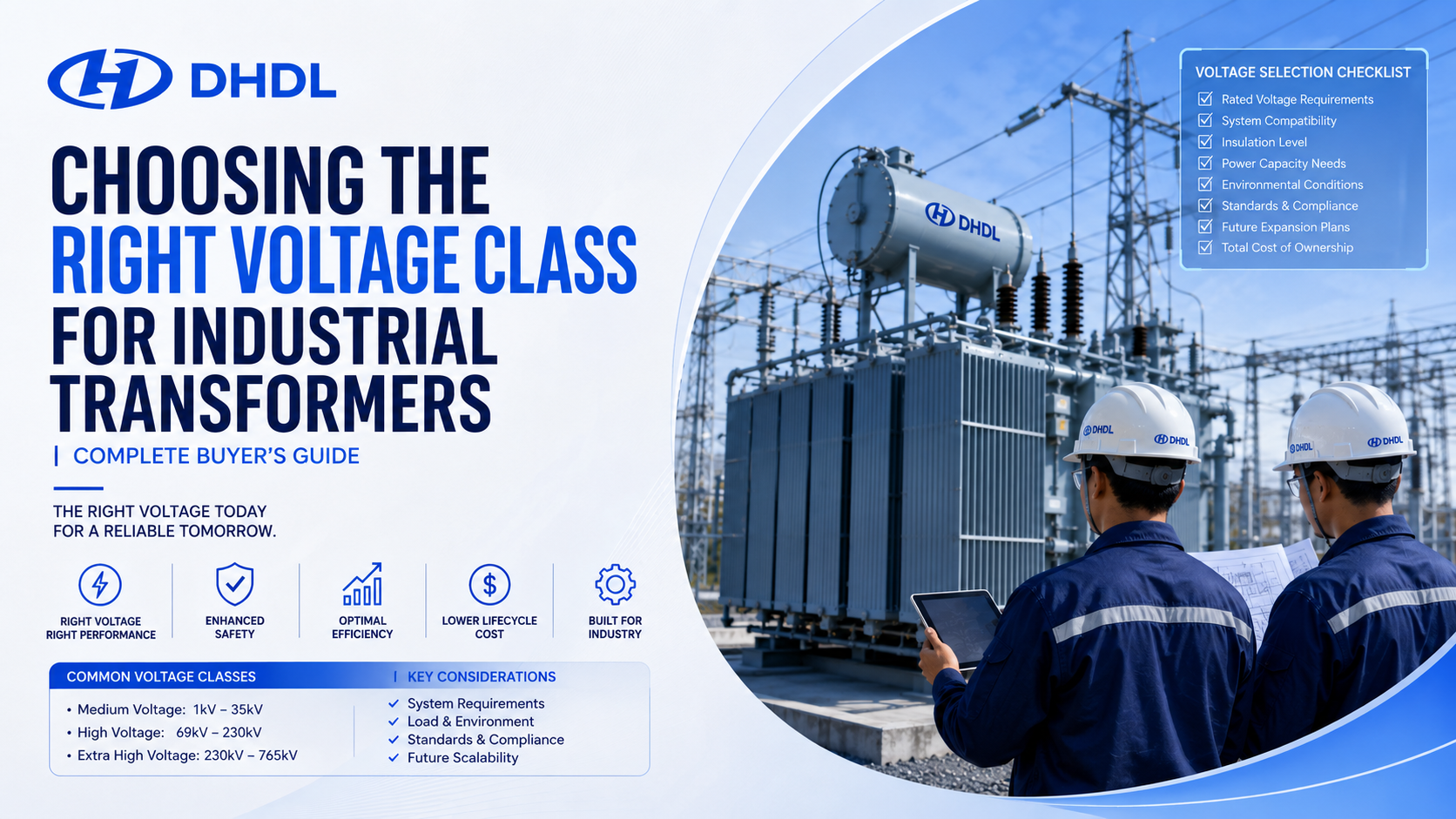
Learn how to choose the right voltage class for industrial transformers. Discover voltage ratings, selection tips, common mistakes, and expert advice from Dinghong Transformer for industrial projects worldwide.
Choosing the Right Voltage Class for Industrial Transformers
Choosing the correct voltage class for an industrial transformer is one of the most important decisions in any commercial or industrial power project.
Whether you’re developing a manufacturing plant in Nigeria, modernizing electrical infrastructure in Ukraine, expanding an industrial park in Ethiopia, building a factory in Vietnam, upgrading commercial facilities in Thailand, or supporting industrial growth in Uzbekistan, selecting the right transformer voltage class directly impacts safety, reliability, energy efficiency, and long-term operating costs.
Many procurement managers focus on transformer capacity (kVA or MVA), but voltage class is equally important. An incorrectly selected voltage class can lead to equipment failures, excessive energy losses, higher maintenance costs, voltage instability, and expensive project delays.
This guide explains how to choose the right industrial transformer voltage class, the key factors to consider, common mistakes to avoid, and why working with an experienced distribution transformer manufacturer like DinghongTransformer helps ensure dependable performance throughout the transformer’s service life.
What Is a Transformer Voltage Class?
A transformer’s voltage class refers to the maximum system voltage the transformer is designed to operate safely and efficiently.
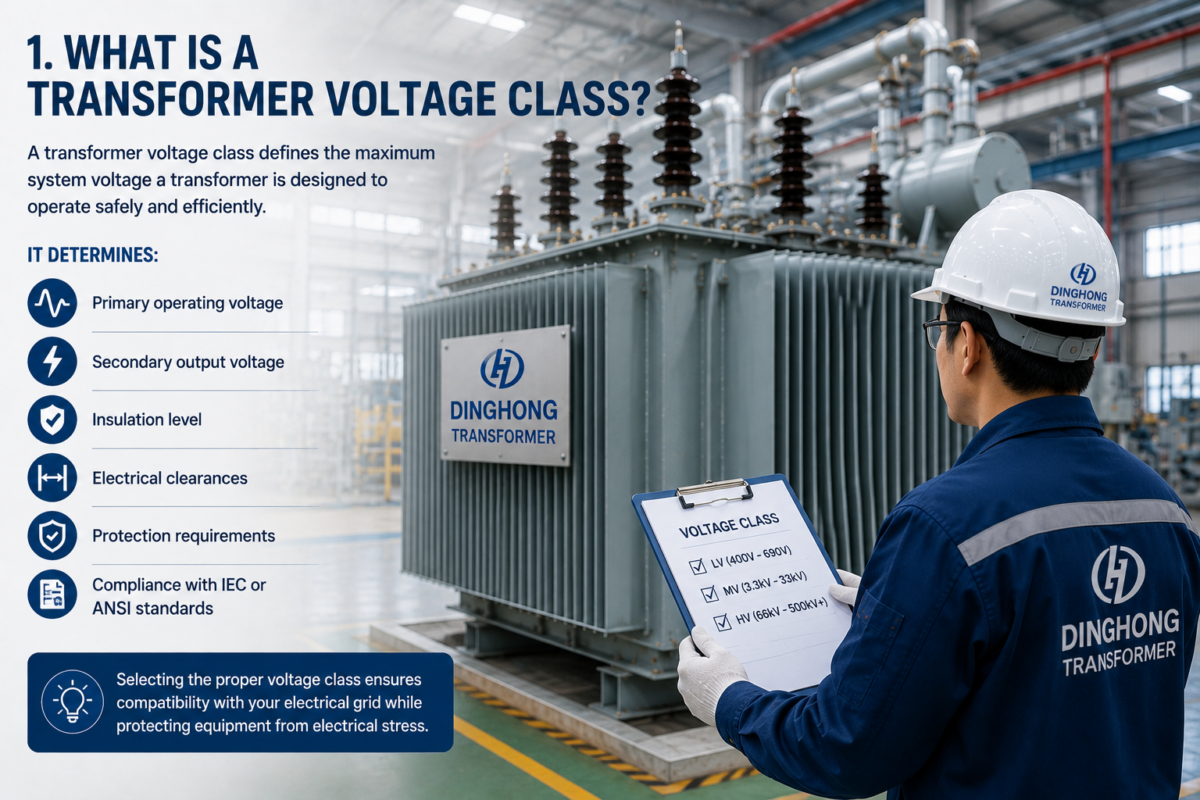
It determines several critical design characteristics, including:
- Primary operating voltage
- Secondary output voltage
- Insulation level
- Electrical clearances
- Protection requirements
- Compliance with IEC or ANSI standards
Selecting the proper voltage class ensures compatibility with your local electrical grid while protecting both the transformer and connected equipment from electrical stress.
Whether you’re planning to buy a distribution transformer for a factory or sourcing a medium voltage transformer for a utility project, voltage class should always be one of the first specifications confirmed.
Common Voltage Classes for Industrial Transformers
Industrial facilities use different voltage classes depending on the local utility network and application.
Common voltage ratings include:
Low Voltage (LV)
- 400V
- 415V
- 480V
- 690V
These are commonly used in commercial buildings and industrial equipment.
Medium Voltage (MV)
- 3.3kV
- 6.6kV
- 10kV
- 11kV
- 13.8kV
- 20kV
- 33kV
Medium voltage transformers are widely used in manufacturing plants, mining operations, industrial parks, renewable energy projects, and utility distribution networks.
High Voltage (HV)
- 66kV
- 110kV
- 132kV and above
High-voltage transformers are typically installed in transmission networks and large utility substations.
A professional transformer manufacturer can help determine the most suitable voltage class based on your project requirements and local utility standards.
Five Factors to Consider When Choosing the Right Voltage Class
1. Local Utility Grid Standards
Every country operates its electrical distribution network differently.
For example:
- Nigeria commonly distributes power through 11kV and 33kV networks.
- Ukraine continues rebuilding and upgrading medium- and high-voltage infrastructure.
- Ethiopia is rapidly expanding industrial parks and utility networks.
- Vietnam relies heavily on medium-voltage distribution to support its growing manufacturing sector.
- Thailand continues investing in commercial and industrial electrical infrastructure.
- Uzbekistan is modernizing power systems to support industrial development.
Before purchasing an industrial transformer, always verify the utility’s incoming voltage.
2. Current and Future Load Requirements
Your transformer should meet today’s electrical demand while allowing room for future expansion.
Consider:
- Connected load
- Peak demand
- Future production increases
- Motor starting current
- Continuous operating load
Choosing a transformer that’s too small can cause overheating, while oversizing unnecessarily increases project costs.
3. Installation Environment
Environmental conditions significantly influence transformer design.
Factors include:
- High ambient temperatures
- Coastal environments
- Dust and pollution
- Mining operations
- Chemical plants
- High-altitude installations
An experienced custom transformer manufacturer can recommend the appropriate insulation system, cooling method, and enclosure protection for your specific application.
4. Industry Application
Different industries require different transformer configurations.
Examples include:
- Manufacturing plants
- Steel mills
- Food processing facilities
- Mining operations
- Hospitals
- Data centers
- Commercial buildings
- Renewable energy projects
- Utility substations
Selecting the correct industrial power transformer improves system reliability and minimizes downtime.
5. Compliance with International Standards
Always verify that your transformer complies with recognized standards such as:
- IEC 60076
- ANSI
- IEEE
- ISO-certified manufacturing processes
Purchasing an IEC-certified transformer ensures your equipment meets internationally accepted safety and performance requirements.
How Voltage Class Affects Energy Efficiency
Choosing the correct voltage class doesn’t only improve compatibility—it also affects the efficiency and operating costs of your electrical system.
When a transformer operates within its designed voltage range, it experiences:
- Lower electrical losses
- Better voltage regulation
- Reduced operating temperatures
- Longer insulation life
- Improved overall efficiency
However, selecting the wrong voltage class can result in:
- Increased energy consumption
- Higher operating temperatures
- Reduced equipment lifespan
- More frequent maintenance
- Greater electricity costs
For factories, industrial plants, and commercial facilities operating continuously, selecting the correct voltage class can significantly reduce lifecycle costs over the transformer’s service life.
Common Mistakes Procurement Teams Make
Many purchasing teams unintentionally make costly mistakes, including:
- Choosing based solely on price
- Ignoring future expansion plans
- Not confirming utility voltage
- Overlooking transformer testing
- Selecting non-standard voltage ratings
- Purchasing from inexperienced suppliers
Working with a reliable transformer supplier helps avoid these issues before production begins.
Real-World Example
Consider two industrial projects.
Manufacturing Plant in Nigeria
A food processing factory in Nigeria receives electricity from a 33kV distribution network but operates production equipment at 415V.
Selecting a properly designed 33kV/415V distribution transformer ensures efficient operation, supports future expansion, and minimizes energy losses.
Electronics Factory in Vietnam
An electronics manufacturer in Vietnam requires stable power for precision equipment connected to an 11kV utility supply.Choosing an 11kV medium voltage transformer with appropriate insulation and cooling improves voltage stability while reducing maintenance requirements.
These examples show why transformer voltage class should always be determined by engineering requirements rather than purchase price alone.
Questions to Ask Before Requesting a Transformer Quotation
Before placing an order, ask your transformer supplier:
- What voltage class best suits my application?
- Does the transformer comply with IEC 60076?
- Can the transformer be customized?
- What routine and factory acceptance tests will be performed?
- Which cooling method is recommended?
- Is future expansion considered?
- What warranty and after-sales support are included?
A reputable distribution transformer manufacturer should provide clear technical guidance and complete testing documentation before shipment.
Why Choose Dinghong Transformer?
Choosing the right voltage class is only one part of a successful transformer purchase. Selecting the right manufacturing partner is equally important.
As a trusted transformer manufacturer and distribution transformer supplier, Dinghong Transformer provides customized power solutions for commercial, industrial, utility, mining, renewable energy, and infrastructure projects around the world.
Every transformer is manufactured using strict quality-control procedures and undergoes comprehensive factory testing to ensure reliable performance in demanding operating environments.
Whether your project is located in Nigeria, Ukraine, Ethiopia, Vietnam, Thailand, Uzbekistan, or any other international market, Dinghong Transformer offers:
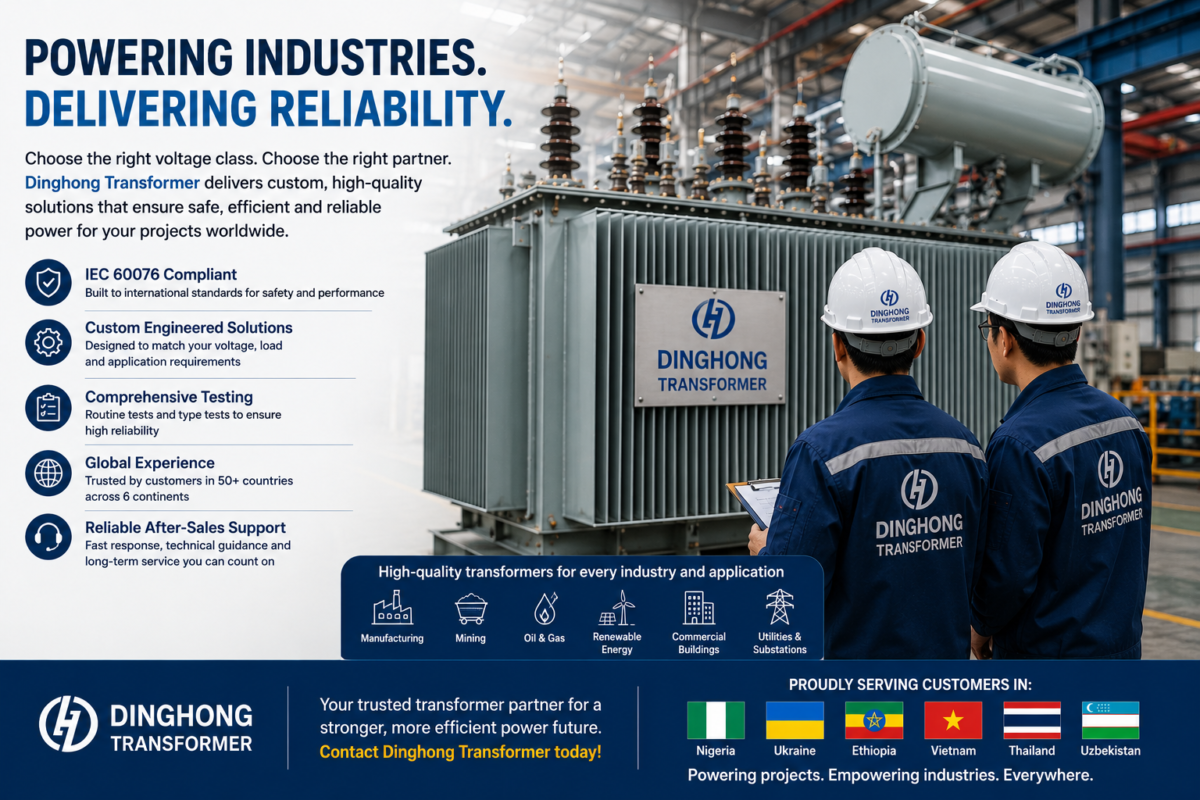
- Custom transformer solutions
- Medium- and high-voltage transformers
- IEC-compliant manufacturing
- Comprehensive factory testing
- Fast global delivery
- Responsive engineering support
- Reliable after-sales service
Our experienced engineering team works closely with customers to recommend the most suitable transformer based on voltage requirements, load profile, installation conditions, and long-term operational goals.
Frequently Asked Questions
Can a transformer operate above its rated voltage class?
No. Operating above the rated voltage places excessive stress on the insulation system, increases overheating risk, and significantly shortens transformer life.
What happens if I choose the wrong voltage class?
The wrong voltage class can lead to equipment damage, poor voltage regulation, higher energy losses, safety risks, and costly modifications after installation.
How do I determine the correct voltage class?
Consult an experienced industrial transformer manufacturer and provide details such as utility supply voltage, required output voltage, connected load, future expansion plans, and installation environment. This ensures the transformer is correctly engineered for your application.
Final Thoughts
Choosing the right voltage class for an industrial transformer is essential for safe, efficient, and reliable power distribution.
By considering utility standards, load requirements, environmental conditions, industry applications, and future expansion, businesses can avoid costly mistakes and maximize the return on their investment.
If you’re looking for a reliable transformer supplier, medium voltage transformer manufacturer, or custom transformer manufacturer, Dinghong Transformer has the engineering expertise, manufacturing capability, and international project experience to deliver dependable transformer solutions for projects across Nigeria, Ukraine, Ethiopia, Vietnam, Thailand, Uzbekistan, and many other global markets.
Contact Dinghong Transformer today to discuss your project requirements and receive a customized transformer quotation tailored to your voltage class, load profile, and application.