330kV–500kV High-Voltage Oil-Immersed Power Transformer: A Buyer’s Guide

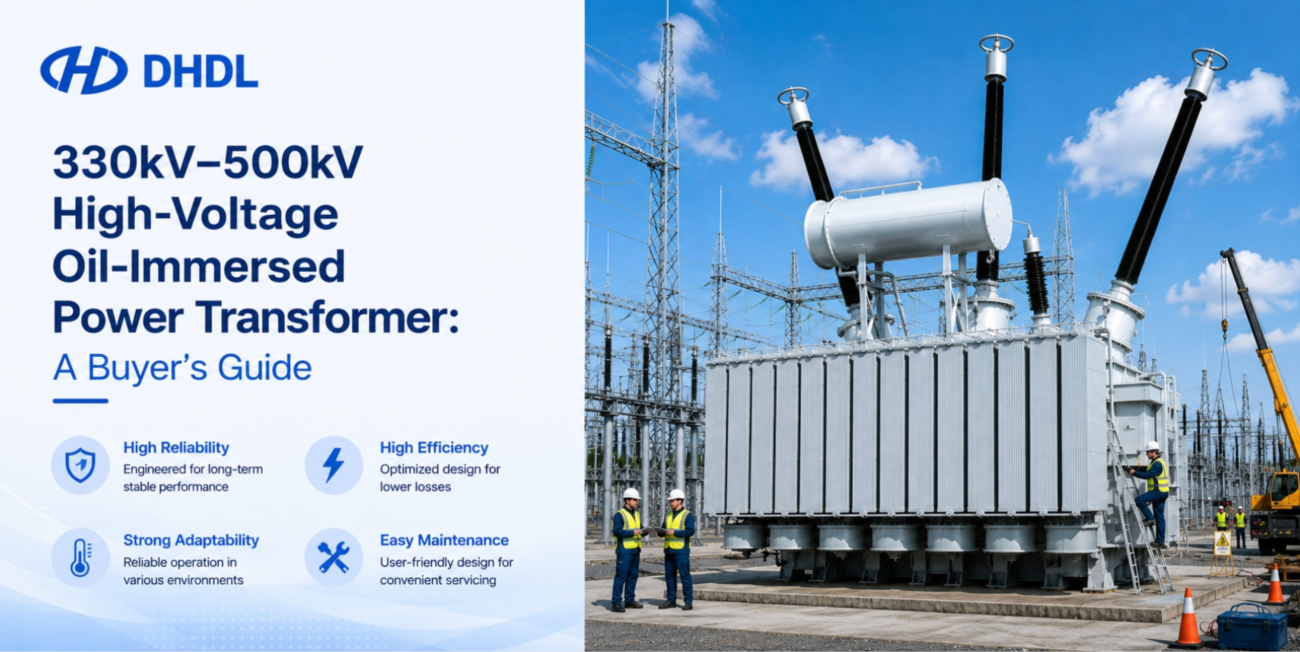
A 330kV or 500kV transformer is not simply a larger version of a distribution transformer.
Instead, it becomes a critical asset in an extra-high-voltage transmission system. Its design can affect power-transfer capacity, substation reliability, grid losses, fault performance, transport planning, installation schedules, and long-term operating costs.
Therefore, utility companies, EPC contractors, renewable energy developers, and substation owners should not select an extra-high-voltage transformer by comparing rated voltage and purchase price alone.
The DHDL 330kV–500kV high-voltage oil-immersed power transformer is designed for extra-high-voltage transmission and substation applications. According to the product page, the series supports voltage classes from 66kV through 500kV, while the featured product range focuses on 330kV–500kV systems.
Moreover, DHDL offers project-based customization covering capacity, voltage ratio, cooling method, impedance, insulation level, accessories, installation environment, and applicable grid standards.
From a user’s perspective, however, customization should not mean adding options after choosing a basic model. Instead, the transformer should be engineered around the actual network, load, site, transportation route, protection scheme, and lifecycle requirements.
This guide explains how to approach that decision.
What Is a 330kV–500kV Oil-Immersed Power Transformer?
A high-voltage oil-immersed power transformer transfers electrical energy between voltage levels in transmission systems, substations, industrial power networks, renewable energy grid connections, and major infrastructure projects.
Transformer oil serves as an insulation and cooling medium. Meanwhile, the tank, core, windings, bushings, cooling system, protection accessories, and insulation structure work together to support high-voltage operation.
DHDL lists the following product information:
| Product item | Published information |
|---|---|
| Product type | High-voltage oil-immersed power transformer |
| Featured voltage range | 330kV–500kV |
| Available series voltage classes | 66kV, 110kV, 220kV, 330kV, and 500kV |
| Rated capacity | Customizable |
| Cooling methods | ONAN, ONAF, or OFAF |
| Installation | Outdoor or substation installation |
| Main application | EHV transmission and substations |
| Other applications | Industrial power systems, renewable energy grid connection, and key infrastructure |
| Customizable items | Voltage, capacity, impedance, cooling, insulation, accessories, and project standards |
| Published warranty | One year |
The product can support voltage step-up or step-down applications. Nevertheless, the final configuration must follow the approved project specification.
Why Buyers Choose Oil-Immersed Technology for EHV Projects
At extra-high-voltage and high-capacity levels, a transformer must manage substantial electrical, mechanical, and thermal stress.
Oil-immersed technology offers a mature structure for these applications. In particular, the insulating oil supports dielectric insulation and transfers heat from the active part to the cooling system.
DHDL highlights several product characteristics:
- Strong insulation performance
- Efficient heat dissipation
- Strong mechanical strength
- Short-circuit withstand capability
- Low-loss design
- Stable operation under high-load conditions
- Custom engineering support
However, buyers should connect each feature to a measurable requirement.
For example, “low loss” should lead to guaranteed no-load and load-loss values. Similarly, “strong insulation” should correspond to the required insulation level and approved test program. Finally, “efficient cooling” should correspond to rated output under defined ambient and cooling conditions.
In this way, marketing claims become verifiable contract requirements.
Is 330kV or 500kV the Right Voltage Class?
The correct voltage level depends on the transmission network, power-transfer requirement, distance, grid architecture, substation role, and utility standard.
DHDL’s product page provides the following application guidance.
| Voltage level | Typical applications | Recommended use |
| 66kV | Urban and township substations, medium industrial power supply, renewable energy grid connection, and infrastructure power supply | Medium-distance transmission, regional distribution, and power supply for cities, towns, and medium-sized industrial users |
| 110kV | Regional substations, industrial high-voltage power supply, urban distribution networks, and renewable energy station grid connection | Large-capacity regional transmission, industrial power supply, and renewable energy grid connection |
| 220kV | Long-distance transmission, large industrial enterprises, regional high-voltage substations, wind farms, and solar power plants | High-capacity transmission, large industrial loads, and large renewable energy grid-connection projects |
| 330kV | Extra-high-voltage transmission lines, major regional substations, centralized renewable energy transmission, and large infrastructure | Long-distance, high-load transmission requiring stable operation and high insulation performance |
| 500kV | Extra-high-voltage transmission lines, major regional or national substations, renewable energy grid connection, high-voltage industrial loads, and critical infrastructure | Bulk power transmission and key grid projects requiring high reliability |
For buyers, this table provides an initial orientation. Nevertheless, it should not replace a network study.
Choose 330kV When the Grid Architecture Requires It
A 330kV transformer may suit regional EHV transmission, large substations, centralized renewable energy transmission, or major infrastructure projects.
However, before specifying the transformer, confirm:
- Existing network voltage
- Planned grid expansion
- Required power-transfer capacity
- Voltage ratio
- Substation bus arrangement
- Neutral and earthing arrangement
- Short-circuit level
- Protection philosophy
- Utility standard
Choose 500kV for Major Bulk Power Transmission
A 500kV transformer may support national or major regional transmission networks, critical substations, and long-distance bulk power transfer.
Because the consequences of a mismatch become more serious at this level, buyers should define the system requirements before requesting a quotation.
In addition, the project should address transportation, site assembly, commissioning, spare strategy, monitoring, and emergency response early in the procurement process.
Start with the Power System, Not the Transformer Catalogue
A reliable transformer selection begins with the power system.
Therefore, the buyer should first define what the transformer must do, where it must operate, and how it will connect to the network.
1. Confirm the Voltage Ratio
Provide every required winding voltage, not only the highest system voltage.
For example, specify:
- High-voltage winding
- Medium-voltage winding, if required
- Low-voltage or tertiary winding
- Neutral arrangement
- Rated frequency
- Permitted voltage variation
- Tap range
- Tap-changer type
If the transformer must connect several system levels, provide the single-line diagram and operating philosophy.
2. Define the Required Capacity
Rated capacity should reflect the real operating plan.
Accordingly, provide:
- Present peak load
- Expected average load
- Future expansion
- N-1 operating requirement
- Emergency loading strategy
- Seasonal load variation
- Renewable generation profile
- Auxiliary or tertiary loads
A transformer selected only for the initial load may restrict future network expansion. Conversely, unnecessary overcapacity may increase procurement cost and no-load losses.
Therefore, capacity selection should balance current requirements, redundancy, and realistic growth.
3. Provide the Network Short-Circuit Data
Short-circuit impedance influences fault current, voltage regulation, system stability, and parallel operation.
Consequently, the manufacturer needs the required impedance and tolerance. The transformer design must also provide the mechanical strength necessary to withstand the specified short-circuit duty.
For this reason, include:
- Maximum system fault level
- Minimum system fault level
- Required impedance
- Impedance tolerance
- Parallel transformer data
- Protection clearing time
- Network configuration
4. Define the Insulation Requirements
At 330kV and 500kV, insulation coordination becomes a central design issue.
Therefore, provide the applicable standard and required insulation levels for:
- Lightning impulse
- Switching impulse
- Power-frequency withstand
- Line terminals
- Neutral terminals
- Tertiary winding
- Bushings
- External clearances
In addition, consider altitude, pollution level, humidity, and site layout because they may influence external insulation requirements.
How to Choose the Cooling Method
DHDL lists ONAN, ONAF, and OFAF as available cooling methods. The final choice should match the rated capacity, load profile, ambient conditions, redundancy strategy, and maintenance plan.
| Cooling method | General operating principle | Buyer consideration |
| ONAN | Oil circulates naturally, while air cools the radiators naturally | Simple operation, but available output depends on the approved thermal design |
| ONAF | Oil circulates naturally, while fans provide forced-air cooling | Can support higher loading stages; however, fans, controls, alarms, and auxiliary power require attention |
| OFAF | Pumps circulate oil, while fans provide forced-air cooling | Supports intensive heat removal, but introduces pumps, controls, additional auxiliary power, and maintenance requirements |
The cooling codes describe general cooling arrangements. Nevertheless, they do not define the transformer’s capacity by themselves.
Therefore, the technical schedule should state:
- Rated capacity for each cooling stage
- Number of fans
- Number of oil pumps, if applicable
- Cooler grouping
- Redundant cooler capacity
- Auxiliary supply voltage
- Automatic starting logic
- Alarm and trip settings
- Noise requirements
- Operation after a fan or pump failure
Do Not Select Cooling Only by Maximum Capacity
A larger cooling system may appear safer. However, it can also increase auxiliary power consumption, maintenance, controls, and spare-parts requirements.
Conversely, insufficient cooling can limit output or increase thermal stress.
Therefore, compare the complete lifecycle effect rather than selecting the most complex cooling method automatically.
Key Technical Parameters Buyers Must Confirm
The product page states that capacity, voltage ratio, impedance, cooling, insulation, losses, dimensions, and accessories can be customized.
Accordingly, the quotation should include a complete technical schedule.
| Parameter | Buyer-side question |
| Rated capacity | Does it cover normal, peak, contingency, and future loading? |
| Voltage ratio | Does it match every connected bus and operating condition? |
| Number of windings | Does the system require two windings, three windings, or a tertiary? |
| Frequency | Does the transformer match the 50Hz or 60Hz network? |
| Vector group | Does it match the earthing, phase displacement, and parallel-operation requirements? |
| Tap range | Can it maintain the required voltage under system variation? |
| Tap changer | Does the project require off-circuit or on-load regulation? |
| Impedance | Does it satisfy fault-current, regulation, and parallel-operation requirements? |
| Insulation level | Does it match the voltage class, altitude, and utility standard? |
| Cooling method | Does it support each required loading stage? |
| No-load loss | Is the guaranteed value included in lifecycle-cost evaluation? |
| Load loss | Is the guaranteed value defined at the required temperature and rating? |
| Noise level | Does it meet site and regulatory requirements? |
| Dimensions and weight | Can the unit be transported and installed at the site? |
| Accessories | Are monitoring, protection, and interface requirements included? |
| Applicable standard | Does it match the utility and destination-country requirements? |
If the supplier has not confirmed a parameter, label it “to be confirmed.” Do not insert an assumed value into the contract schedule.
Why Transformer Losses Matter to the Owner
A high-voltage power transformer may operate for many years. Therefore, a small difference in losses can create a significant lifecycle cost.
DHDL states that its optimized core and winding design helps reduce no-load and load losses.
However, buyers should request guaranteed numerical values.
No-Load Loss
No-load loss continues whenever the transformer remains energized, even when it supplies little load.
Consequently, no-load loss becomes particularly important for transformers that remain energized continuously or operate at a low average load factor.
Load Loss
Load loss changes with transformer current.
Therefore, load loss becomes increasingly important when the transformer operates at high load for long periods.
Compare Evaluated Cost, Not Purchase Price Alone
A lower purchase price does not always produce the lowest lifecycle cost.
Use an evaluated comparison such as:
| Cost factor | Supplier A | Supplier B | Supplier C |
| Purchase price | To be quoted | To be quoted | To be quoted |
| Guaranteed no-load loss | To be confirmed | To be confirmed | To be confirmed |
| Guaranteed load loss | To be confirmed | To be confirmed | To be confirmed |
| Auxiliary cooling power | To be confirmed | To be confirmed | To be confirmed |
| Expected maintenance cost | Buyer evaluation | Buyer evaluation | Buyer evaluation |
| Evaluated lifecycle cost | Buyer calculation | Buyer calculation | Buyer calculation |
In addition, define the loss capitalization method and penalties before comparing bids.
Review the Transformer Drawing Before Production
At EHV voltage levels, physical interfaces can influence the substation design, transport plan, erection schedule, and installation cost.
Therefore, review the general arrangement drawing before approving production.
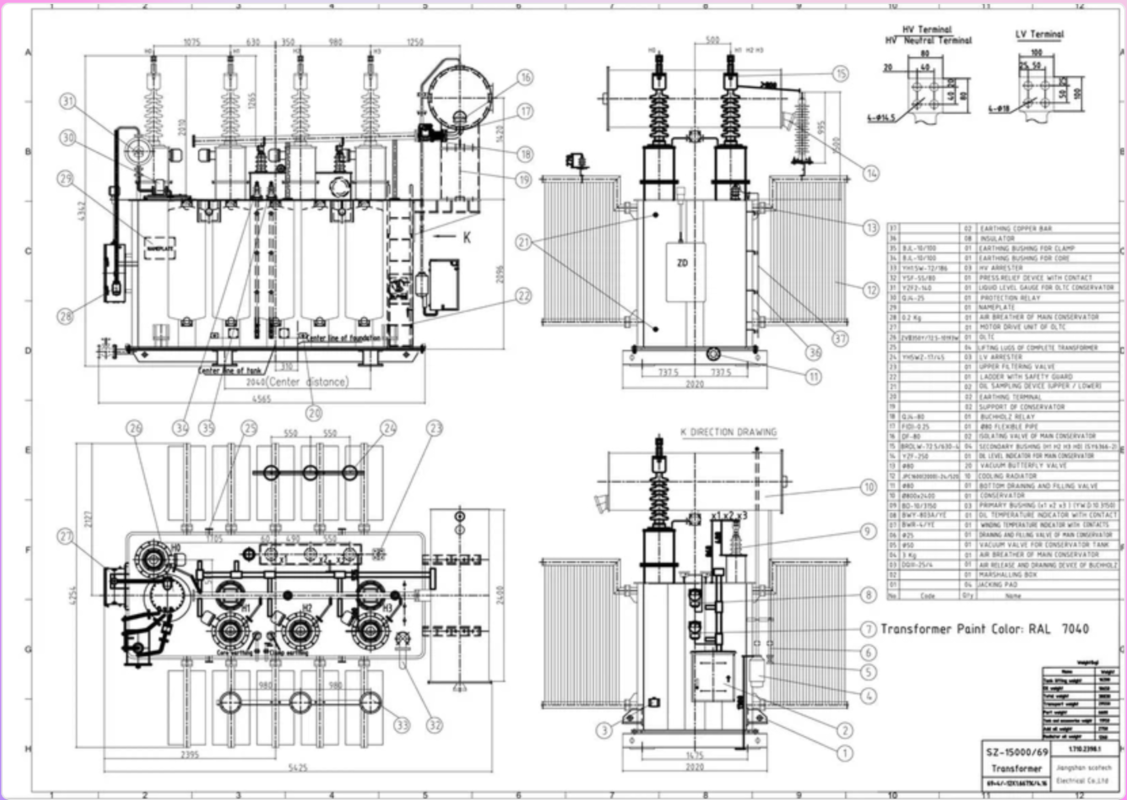
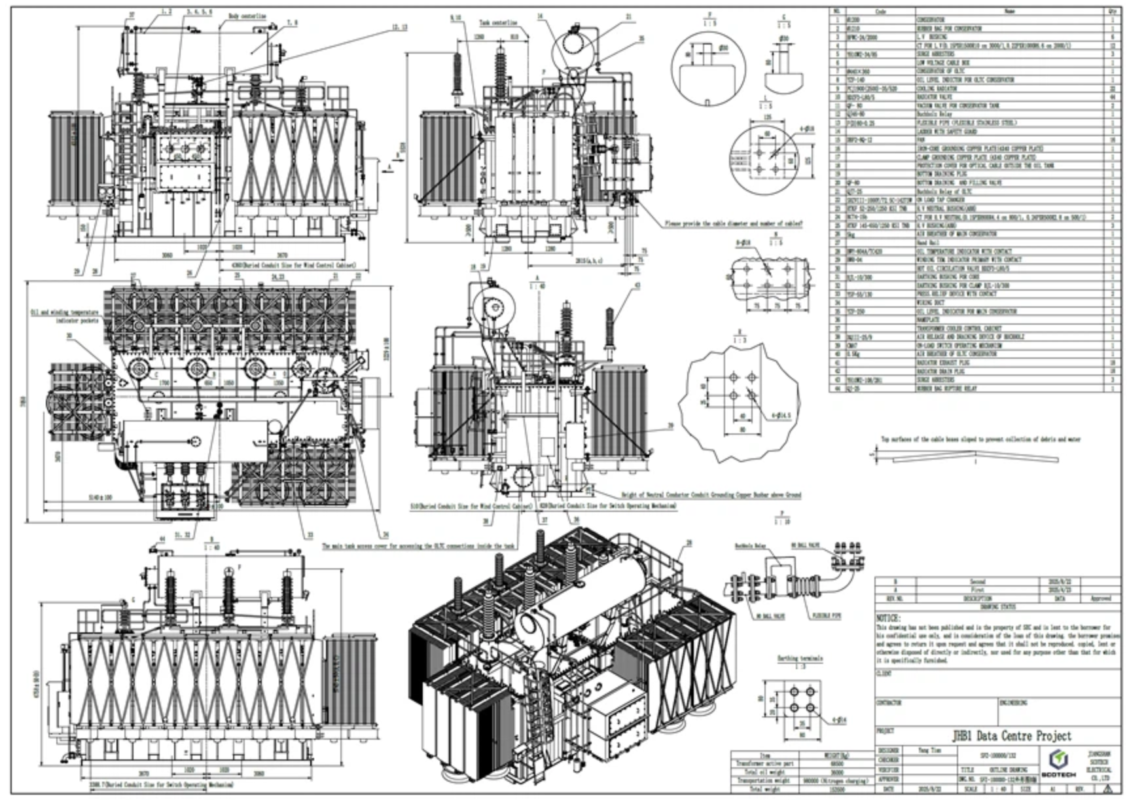
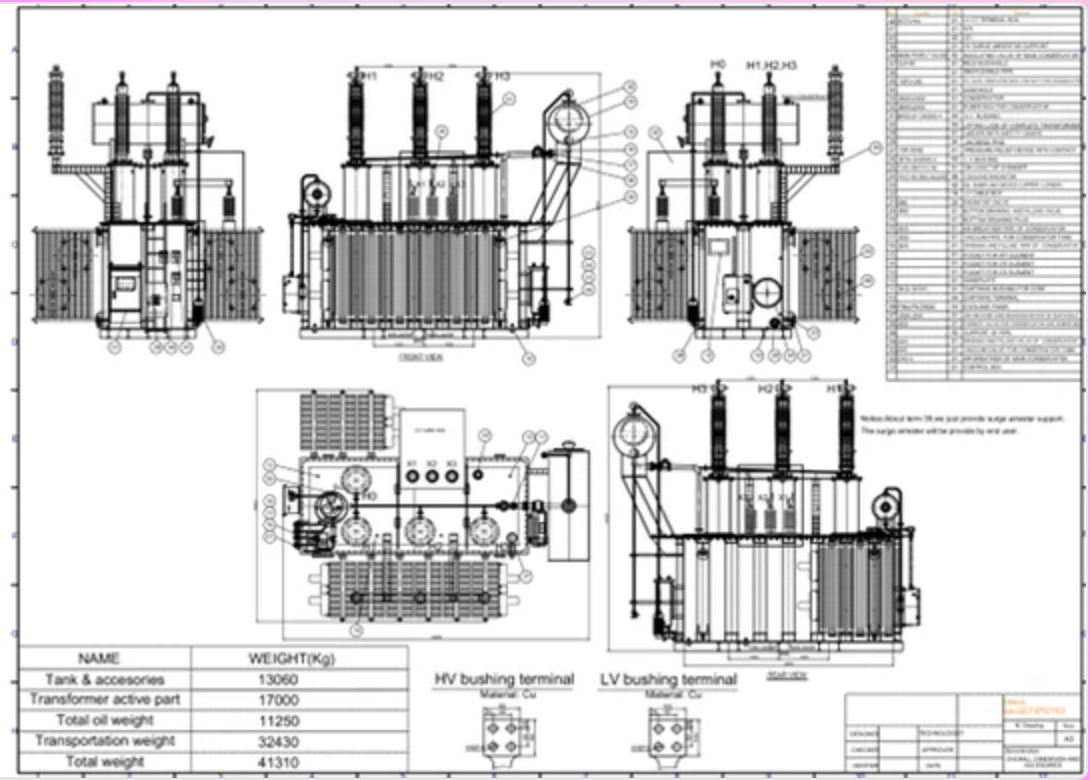
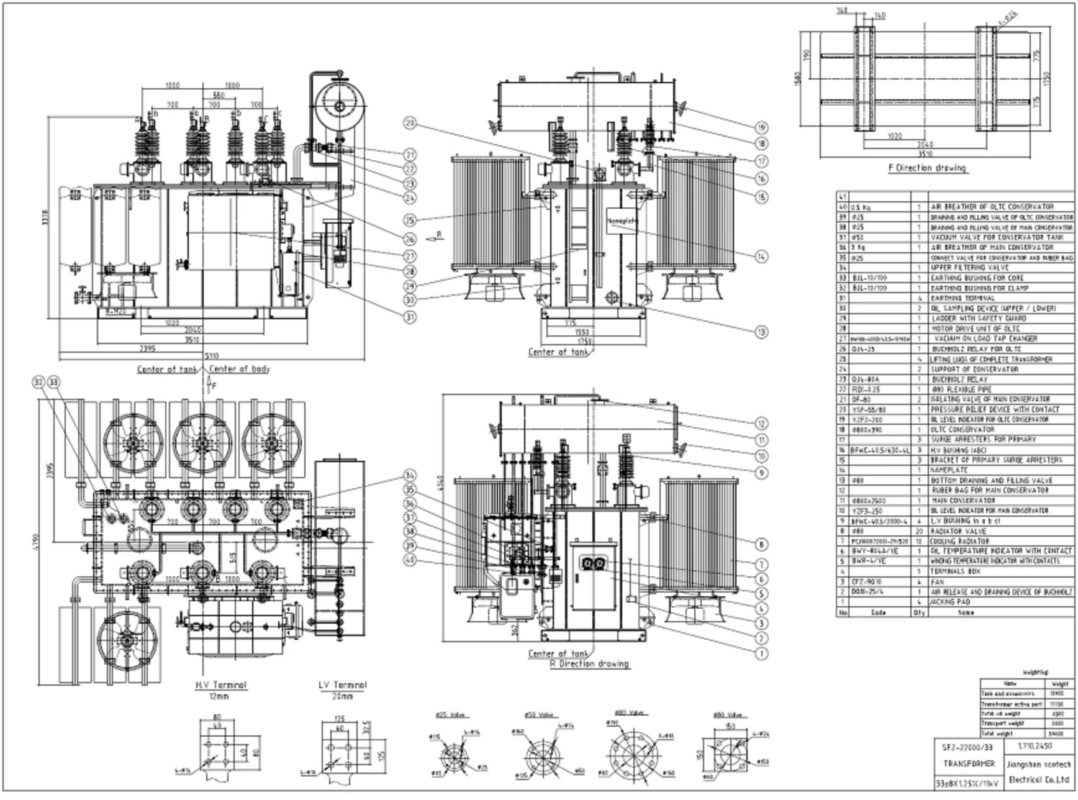
Review the following drawing information:
| Drawing item | Buyer-side verification |
| Overall dimensions | Confirm compatibility with the substation layout and electrical clearances |
| Total weight | Check foundation and lifting capacity |
| Transport dimensions | Confirm road, bridge, port, rail, and site-access restrictions |
| Transport weight | Verify transporter, trailer, crane, and unloading capacity |
| Bushing positions | Match busbar, gantry, and conductor layout |
| Phase spacing | Confirm electrical clearances and substation connection design |
| Cooler arrangement | Reserve airflow, maintenance, and removal space |
| Conservator arrangement | Check clearance, access, and oil-system layout |
| Control cabinet | Confirm cable routing and operator access |
| Foundation loads | Coordinate the civil and seismic design |
| Lifting and jacking points | Confirm erection and maintenance procedures |
| Oil handling connections | Coordinate filling, filtration, sampling, and drainage |
| Fire-protection clearances | Match the substation fire-safety design |
| Maintenance space | Allow access to bushings, radiators, fans, pumps, and monitoring devices |
The drawing shown on the product page should serve as a reference unless DHDL confirms it for the specific order.
Before manufacturing begins, request an order-specific drawing and complete a coordinated review with the electrical, civil, transport, fire-protection, and installation teams.
Transport Planning Should Begin During Technical Design
Transportation is not merely a logistics issue for a 330kV or 500kV transformer. Instead, it can influence the transformer’s mechanical arrangement, detachable components, shipping condition, oil handling, and site assembly.
Therefore, the buyer should provide:
- Delivery port
- Road and bridge limits
- Maximum transport height
- Maximum transport width
- Maximum transport weight
- Minimum turning radius
- Railway limitations, if applicable
- Site slope
- Gate and access dimensions
- Crane capacity
- Foundation position
- Local permit requirements
In addition, confirm which items will be removed for shipment, such as bushings, coolers, conservators, fans, pumps, or accessories.
The supplier should then identify:
- Main-tank shipping dimensions
- Main-tank transport weight
- Total assembled weight
- Number of shipping packages
- Oil shipping arrangement
- Nitrogen or dry-air shipping arrangement, if applicable
- Shock and tilt monitoring requirements
- Site assembly scope
- Required lifting equipment
- Oil filtration and filling requirements
By resolving these issues early, buyers can reduce the risk of redesign, route changes, and project delays.
Factory Tests Listed for the Product
DHDL lists the following routine test items on the product page.
| Factory test item | Published test type |
| Insulation resistance test | Routine test |
| Winding DC resistance test | Routine test |
| Voltage ratio test | Routine test |
| Vector group test | Routine test |
| No-load loss and no-load current test | Routine test |
| Load loss and impedance voltage test | Routine test |
| Power-frequency withstand voltage test | Routine test |
| Induced-withstand-voltage test | Routine test |
| Sealing test | Routine test |
| Transformer oil test | Routine test |
| Appearance and nameplate inspection | Routine test |
| Packing inspection before shipment | Routine test |
These tests provide an important verification baseline. However, an EHV project may require additional tests, calculations, witness points, or third-party inspection according to the applicable standard and contract.
Therefore, buyers should request a project-specific inspection and test plan.
The plan should define:
- Applicable standard
- Routine tests
- Type tests
- Special tests
- Test sequence
- Acceptance criteria
- Witness and hold points
- Test equipment
- Calibration requirements
- Report format
- Third-party participation
- Document submission schedule
Do not assume that every optional test is included in the base price.
Why Manufacturing Control Matters at EHV Voltage Levels
At 330kV and 500kV, final testing alone cannot correct every manufacturing weakness.
Instead, long-term reliability depends on consistent control of materials, core processing, winding, insulation, drying, assembly, oil treatment, sealing, and final testing.
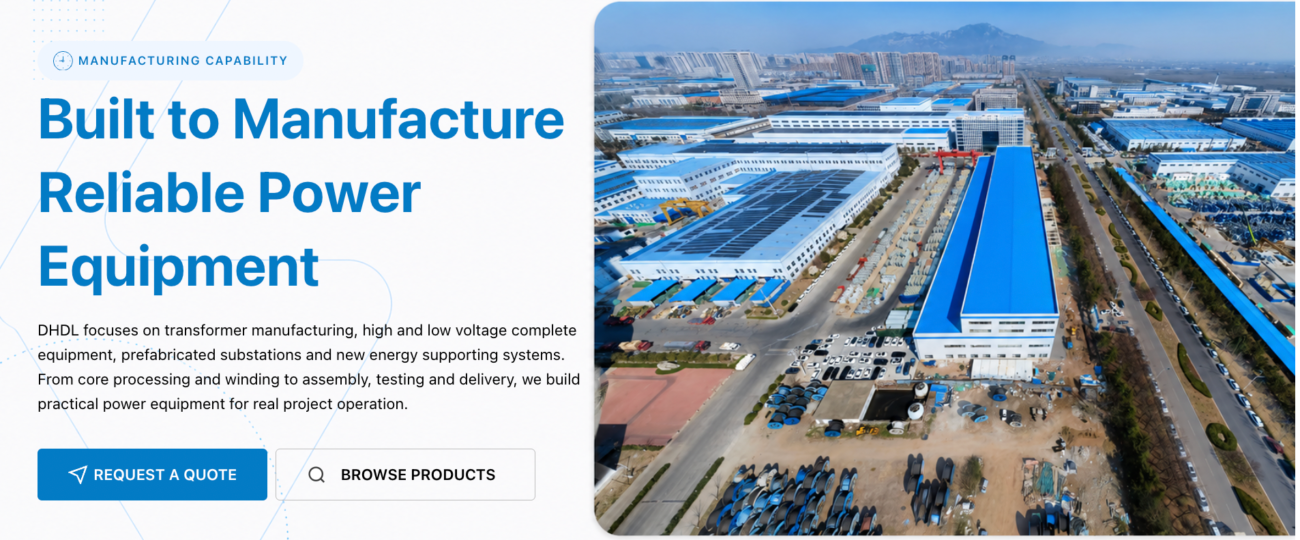
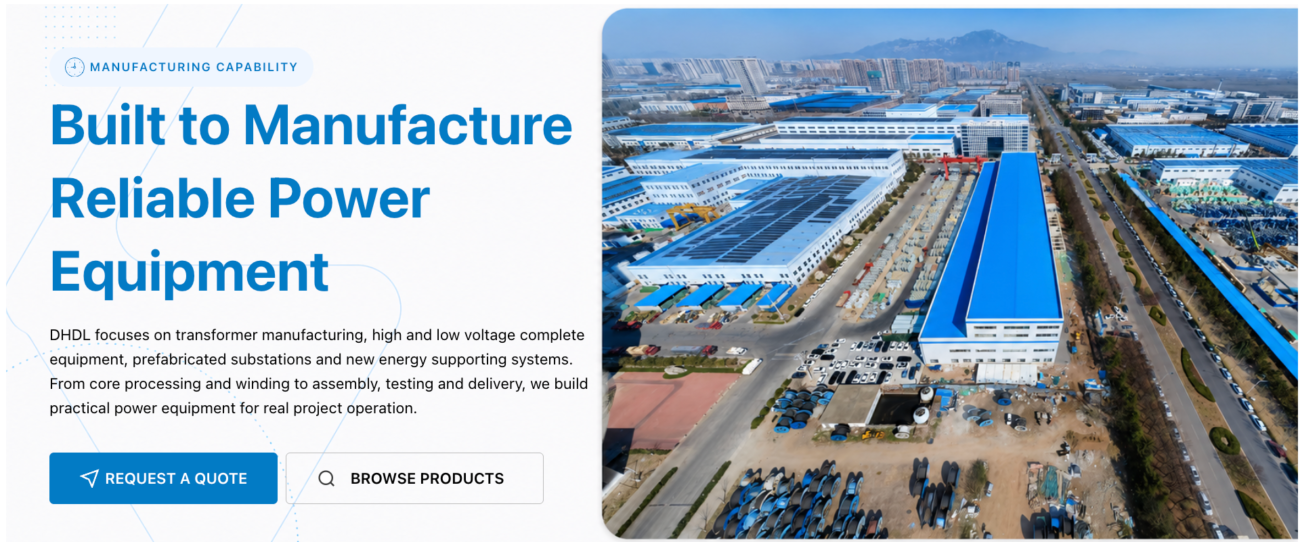
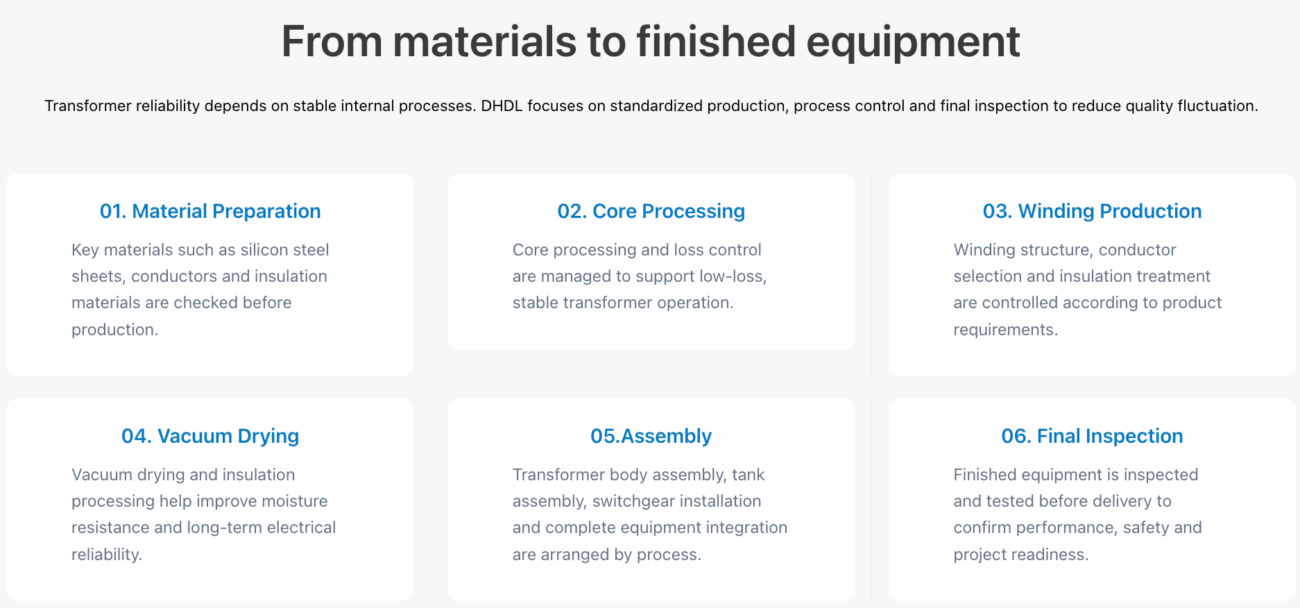
DHDL describes manufacturing support covering:
- Incoming material inspection
- Core processing
- Winding production
- Insulation treatment
- Vacuum drying
- Transformer assembly
- Final inspection
- Routine testing
- Technical-document preparation
- Export packing
For the buyer, however, general capability should become contract-specific quality control.
Therefore, request:
- Quality plan
- Material specification
- Approved supplier list, if required
- Manufacturing schedule
- Process inspection points
- Drying records
- Oil-treatment records
- Test plan
- Nonconformance procedure
- Final test report
- Packing and shipping procedure
You can review DHDL’s published production information on its manufacturing capability page.
Where Can the Transformer Be Used?
According to the product page, the series supports several application categories.
Extra-High-Voltage Transmission and Substations
The featured 330kV–500kV range targets extra-high-voltage transmission lines and major substations.
Therefore, it may support long-distance and bulk power transfer when engineered for the network.
Renewable Energy Grid Connection
Large wind, solar, and other renewable energy projects may require high-capacity grid-connection transformers.
However, renewable output profiles can vary significantly. Consequently, the design should consider expected load variation, network requirements, harmonics where applicable, and grid-code obligations.
Industrial Power Systems
Large industrial facilities may require high-voltage intake or dedicated transmission-level power infrastructure.
In this case, the buyer should define the load profile, motor contribution, fault level, redundancy requirement, and shutdown cost.
Critical Infrastructure
The product page also identifies major infrastructure and critical projects as possible applications.
Because these projects often require high availability, buyers should consider redundancy, monitoring, spare parts, emergency procedures, and lifecycle support alongside transformer performance.
Common Buyer Mistakes to Avoid
Comparing Only Voltage and Capacity
Two transformers with the same voltage and capacity may differ in losses, impedance, insulation, cooling, accessories, materials, tests, and documentation.
Therefore, compare complete technical schedules.
Leaving Transport Review Until After Production
A transformer that cannot reach the site can delay the entire project.
Consequently, approve the transport envelope and route before finalizing the mechanical design.
Treating Cooling Accessories as Minor Items
Fans, pumps, controls, alarms, and auxiliary supplies directly affect cooling availability.
Therefore, define redundancy, automatic control, alarm logic, and spare requirements.
Accepting “Low Loss” Without Guaranteed Values
A descriptive statement cannot support lifecycle-cost evaluation.
Instead, require guaranteed no-load and load-loss values with defined tolerances and reference conditions.
Failing to Coordinate Parallel Operation
If the new transformer will operate in parallel with an existing unit, compare:
- Voltage ratio
- Tap position
- Vector group
- Phase sequence
- Impedance
- Capacity
- Regulation
- Earthing arrangement
Otherwise, unequal load sharing or circulating current may occur.
Approving Accessories Without Interface Details
Monitoring and protection devices require power supplies, signals, communication, alarm logic, and SCADA integration.
Therefore, confirm the complete interface list before production.
Information to Send with Your Inquiry
For a project-specific proposal, provide the following information.
Electrical Requirements
- Rated capacity
- High-, medium-, and low-voltage ratings
- Frequency
- Number of phases
- Vector group
- Tap range
- Tap-changer requirement
- Impedance and tolerance
- Insulation levels
- System fault level
- Earthing arrangement
- Parallel-operation requirements
- Guaranteed loss requirements
- Noise limit
Cooling and Operating Requirements
- Required cooling method
- Capacity at each cooling stage
- Ambient temperature
- Altitude
- Humidity
- Pollution level
- Wind and solar conditions
- Seismic requirements
- Corrosion conditions
- Expected load profile
- Emergency loading requirements
Mechanical and Installation Requirements
- Substation layout
- Maximum dimensions
- Maximum transport weight
- Bushing arrangement
- Cable or busbar connections
- Foundation information
- Fire-protection requirements
- Maintenance clearances
- Transport route
- Site crane capacity
Standards and Documentation
- Destination country
- Applicable IEC, ANSI/IEEE, GB, utility, or project standard
- Inspection and test requirements
- Third-party witness requirements
- Drawing list
- Calculation requirements
- Documentation language
- Spare-parts requirements
- Installation and commissioning scope
Commercial Information
- Quantity
- Required delivery date
- Delivery location
- Trade term
- Packing requirements
- Warranty requirement
- Project schedule
If some parameters remain undecided, send the single-line diagram, grid data, load study, site conditions, and substation layout. DHDL can then identify the remaining technical questions.
Frequently Asked Questions
What voltage classes does this transformer series cover?
The product page lists 66kV, 110kV, 220kV, 330kV, and 500kV voltage classes. The featured product range focuses on 330kV–500kV extra-high-voltage applications.
Is the rated capacity fixed?
No fixed capacity range is stated on the product page. Instead, DHDL identifies the rated capacity as customizable according to project requirements.
Therefore, buyers should provide the required load, contingency plan, future expansion, and network data.
Which cooling methods are available?
DHDL lists ONAN, ONAF, and OFAF. However, the final cooling system and capacity at each cooling stage must be confirmed in the technical schedule.
Can the transformer be installed outdoors?
Yes. The product page identifies outdoor and substation installation.
Nevertheless, the final design should reflect temperature, altitude, humidity, pollution, corrosion, seismic conditions, and other site requirements.
Can DHDL customize impedance and insulation?
The product page states that impedance, insulation level, cooling method, voltage, capacity, accessories, and project standards can be customized.
The buyer should therefore provide the required values and applicable standard during the quotation stage.
How should I compare transformer quotations?
Compare guaranteed parameters rather than product descriptions.
At minimum, review:
- Capacity
- Voltage ratio
- Impedance
- Losses
- Cooling ratings
- Insulation levels
- Materials
- Accessories
- Tests
- Dimensions
- Transport weight
- Documentation
- Warranty
- Delivery scope
What factory tests are listed?
The product page lists insulation resistance, winding DC resistance, voltage ratio, vector group, losses, impedance voltage, withstand voltage, sealing, transformer oil, appearance, nameplate, and packing inspections as routine test items.
The final project test plan should still follow the contract and applicable standard.
What is the published warranty?
The product page displays a one-year warranty. However, the contract should clarify when the warranty begins, what it covers, exclusions, response procedures, and available extended-warranty options.
Make the Technical Decisions Before the Transformer Enters Production
A 330kV–500kV transformer represents a major long-term infrastructure investment.
Therefore, the buyer should resolve the following questions before production:
- Is the voltage class correct for the network?
- Does the capacity cover normal and contingency loading?
- Does the impedance match the fault and parallel-operation studies?
- Are the insulation levels correct?
- Does the cooling system support each required loading stage?
- Are guaranteed losses commercially acceptable?
- Can the transformer travel along the approved route?
- Does the drawing match the substation layout?
- Are accessories fully integrated with protection and SCADA?
- Does the inspection and test plan meet the project standard?
- Are installation, oil handling, and commissioning responsibilities clear?
- Have all technical deviations been closed?
By answering these questions early, utilities and EPC contractors can reduce redesign, transportation problems, interface conflicts, commissioning delays, and lifecycle cost uncertainty.
For a project-specific quotation, send DHDL your capacity, voltage ratio, frequency, impedance, insulation level, cooling stages, site conditions, applicable standard, transportation limits, quantity, and destination country.
Contact DHDLto discuss a customized 330kV–500kV high-voltage oil-immersed power transformer for your transmission or substation project.