
Understanding Transformer Ratings: kVA, Voltage, and Current Explained.

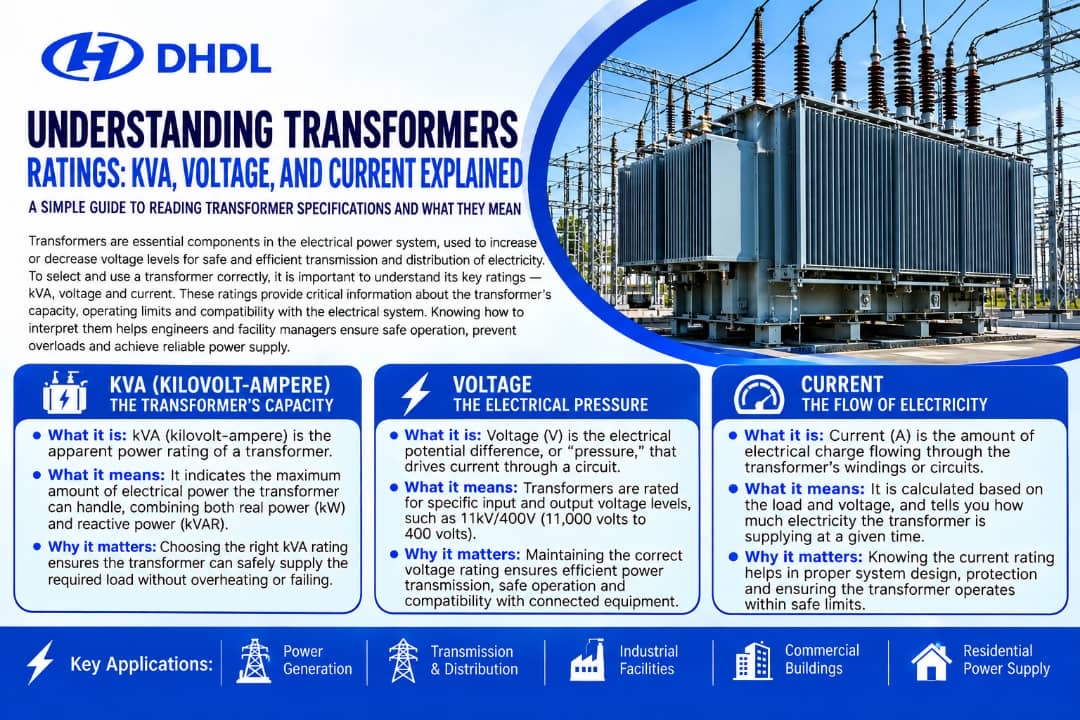
Choosing the right transformer requires more than knowing its physical size or voltage ratio. Every transformer has specific ratings that determine how much electrical power it can handle, the voltage it is designed to operate at, and the amount of current that can safely flow through its windings. Understanding these ratings is essential for electrical engineers, facility managers, contractors, power-system operators, and anyone involved in transformer selection.
The three most important transformer ratings to understand are kVA, voltage, and current. These ratings work together to determine the transformer’s capacity, operating conditions, and suitability for a particular electrical system.
Whether you are selecting a distribution transformer, dry type transformer, single phase transformer, or a larger power transformer, understanding these basic specifications can help prevent overloading, improve efficiency, and extend transformer service life.
What Is a Transformer Rating?
A transformer rating describes the electrical limits and operating characteristics for which the transformer has been designed.
Common information found on a transformer nameplate includes:
- Rated power in kVA or MVA
- Primary voltage
- Secondary voltage
- Rated current
- Frequency
- Phase
- Cooling method
- Impedance
- Insulation level
- Connection configuration
- Temperature rise
These values help users determine whether a transformer is appropriate for a particular electrical application.
The three ratings discussed in this article—kVA, voltage, and current—are especially important because they are directly related to the amount of electrical power a transformer can transfer safely.
What Does kVA Mean on a Transformer?
kVA stands for kilovolt-amperes. It is the apparent power rating of a transformer.
Unlike many electrical loads, transformers are generally rated in kVA rather than kW because the transformer must handle both real power and reactive power associated with the connected electrical system.
The kVA rating indicates the maximum apparent power that the transformer is designed to deliver under specified operating conditions.
For example, a 75 kVA transformer is designed to handle an apparent power of 75 kVA under its specified conditions. Other commonly encountered sizes include 30 kVA, 100 kVA, 500 kVA, 750 kVA, and larger ratings.
The appropriate rating depends on the expected electrical load and operating requirements.
Why Is kVA Important?
Selecting the correct kVA rating is essential because a transformer that is too small may become overloaded.
Overloading can result in:
- Excessive heat
- Higher winding losses
- Insulation deterioration
- Reduced efficiency
- Shorter service life
- Unexpected shutdowns
- Transformer failure
On the other hand, selecting a transformer that is significantly larger than the actual load may increase the initial transformer cost and can result in less efficient operation if the transformer spends most of its time at a very low load.
Proper load analysis is therefore essential before selecting transformer capacity.
How to Calculate Transformer kVA
The calculation depends on whether the transformer is single-phase or three-phase.
Single-Phase Transformer
For a single-phase transformer:
kVA = (Voltage × Current) ÷ 1,000
For example, if a transformer operates at 240 V and supplies 100 A:
kVA = (240 × 100) ÷ 1,000
kVA = 24 kVA
Therefore, the apparent power is 24 kVA.
Three-Phase Transformer
For a three-phase transformer:
kVA = (√3 × Voltage × Current) ÷ 1,000
For example, if a three-phase transformer operates at 400 V and supplies 100 A:
kVA ≈ (1.732 × 400 × 100) ÷ 1,000
kVA ≈ 69.3 kVA
This calculation is useful when estimating the required transformer capacity for a three-phase electrical system.
Understanding Transformer Voltage Ratings
Voltage is another fundamental transformer rating.
A transformer typically has a primary voltage and a secondary voltage.
The primary voltage is the voltage supplied to the transformer input, while the secondary voltage is the voltage available at the transformer’s output.
For example, a transformer might receive a medium-voltage supply on its primary side and provide a lower voltage suitable for commercial or industrial equipment on the secondary side.
This voltage transformation is one of the primary functions of an electrical transformer.
Step-Up and Step-Down Transformers
Transformers can generally be categorized according to whether they increase or decrease voltage.
A step-up transformer increases voltage from the primary side to the secondary side. These transformers are commonly associated with power generation and transmission applications.
A step-down transformer reduces voltage to a lower level suitable for distribution or equipment use.
The voltage ratio is related to the turns ratio of the transformer windings:
V₁ / V₂ = N₁ / N₂
Where:
- V₁ = primary voltage
- V₂ = secondary voltage
- N₁ = primary turns
- N₂ = secondary turns
Understanding voltage ratings is important because connecting a transformer to an incorrect voltage can cause excessive current, overheating, insulation stress, or equipment damage.
Understanding Transformer Current Ratings
Current is the amount of electrical charge flowing through a conductor over time. In a transformer, the rated current indicates the maximum current that the winding is designed to carry under specified conditions.
The transformer’s kVA, voltage, and current ratings are directly related.
For a single-phase transformer:
I = (kVA × 1,000) ÷ V
For a three-phase transformer:
I = (kVA × 1,000) ÷ (√3 × V)
For example, consider a 100 kVA single-phase transformer operating at 240 V:
I = (100 × 1,000) ÷ 240
I ≈ 417 A
This means the rated current on the 240 V side is approximately 417 A under the specified conditions.
For a three-phase transformer, the current calculation will be different because of the √3 factor.
Why Transformer Current Matters
Understanding current ratings is essential for proper system design.
If the current flowing through a winding exceeds its rated value for an extended period, the winding can become excessively hot. Increased temperature accelerates insulation aging and may eventually cause transformer failure.
Current ratings also influence the selection of:
- Conductors
- Circuit breakers
- Fuses
- Switchgear
- Protective relays
- Disconnects
- Busbars
Therefore, transformer current should be considered together with the rest of the electrical system.
kVA, Voltage, and Current Work Together
It is important to understand that kVA, voltage, and current are not independent specifications.
They are mathematically connected.
For a single-phase transformer:
kVA = V × I ÷ 1,000
For a three-phase transformer:
kVA = √3 × V × I ÷ 1,000
If the transformer kVA rating remains constant, increasing the operating voltage generally reduces the corresponding rated current.
This relationship is one reason electrical power systems use higher voltages for efficient transmission and distribution.
Transformer Ratings and Different Transformer Types
Different transformer applications require different ratings.
Dry Type Transformer
A dry type transformer uses air rather than liquid insulation as its primary insulating and cooling medium. These transformers are commonly used in commercial buildings, industrial facilities, and indoor electrical installations.
Their voltage and kVA ratings must be selected according to the connected load and installation conditions.
A single phase transformer is commonly used for single-phase electrical systems and specific residential, commercial, and industrial applications.
Its kVA rating determines the amount of apparent power it can handle, while its voltage and current ratings determine how it integrates into the electrical system.
A distribution transformer reduces voltage to levels suitable for local electricity distribution and end users.
Distribution transformer ratings are particularly important because these units may operate continuously for long periods.
The selected transformer must accommodate expected load demand without excessive overloading.
Power Transformer
A power transformer is generally used in higher-capacity applications such as substations and transmission systems. These transformers may have ratings expressed in MVA rather than kVA.
For example, a power transformer in substation applications may be designed for significantly larger loads than a typical local distribution transformer.
Common Transformer kVA Sizes
The appropriate transformer size depends on the electrical load and application.
Some commonly searched transformer ratings include:
- 5 kVA transformer
- 25 kVA transformer
- 30 kVA transformer
- 75 kVA transformer
- 100 kVA transformer
- 500 kVA transformer
- 750 kVA transformer
- 2500 kVA transformer
However, the highest kVA rating is not automatically the best choice.
Engineers should calculate the actual connected load, consider demand factors and future expansion, and evaluate the operating environment before selecting a transformer.
What Happens If a Transformer Is Undersized?
An undersized transformer may operate close to or above its rated capacity.
This can lead to:
- Overheating
- Increased losses
- Voltage instability
- Insulation aging
- Reduced efficiency
- Shorter service life
- Increased risk of failure
For this reason, transformer sizing should be based on realistic current and future requirements.
What Happens If a Transformer Is Oversized?
Oversizing may reduce the likelihood of overload, but it can have disadvantages.
An unnecessarily large transformer can have a higher purchase cost and may operate at a low load factor for much of its service life. This can make the investment less economical.
For distribution applications, no-load losses can also become an important consideration because the transformer may remain energized even when the connected load is relatively low.
The best approach is to select a transformer with an appropriate capacity for the expected operating conditions.
Transformer Nameplate: What Should You Check?
Before installing or operating a transformer, review its nameplate carefully.
Important information includes:
- kVA or MVA rating
- Primary voltage
- Secondary voltage
- Rated current
- Frequency
- Number of phases
- Connection configuration
- Impedance
- Cooling class
- Temperature rise
These details help ensure that the transformer is correctly integrated into the electrical system.
Transformer Ratings and Safety
Correct transformer ratings are also important for electrical safety.
The transformer should not be operated beyond its specified voltage, current, or thermal limits. Protection equipment should be coordinated with the transformer’s rated characteristics.
Circuit breakers, fuses, protective relays, and other devices should be selected and configured appropriately for the electrical system.
Routine transformer monitoring can also help identify abnormal operating conditions such as excessive temperature, unusual loading, or voltage problems.
External Technical Reference
For additional technical information on power transformers, readers can consult the International Electrotechnical Commission’s IEC 60076 series, which covers power transformers and related requirements.
IEC 60076 — Power Transformers
Conclusion
Understanding transformer ratings is essential when selecting, installing, and operating electrical transformers. The three most important ratings—kVA, voltage, and current—work together to determine the transformer’s capacity and operating limits.
The kVA rating tells you how much apparent power the transformer can handle. The voltage rating specifies the electrical voltage for which the transformer is designed, while the current rating indicates how much current its windings can safely carry under specified conditions.
Whether you are selecting a 75 kVA transformer, 100 kVA transformer, dry type transformer, single phase transformer, distribution transformer, or large power transformer, these ratings should always be evaluated alongside load requirements, installation conditions, efficiency, protection, and future expansion.
Proper transformer sizing helps prevent overloading, reduce unnecessary energy losses, improve reliability, and extend equipment service life. By understanding kVA, voltage, and current, electrical professionals and system operators can make better decisions and select transformers that provide safe, reliable, and efficient performance.
Choose DHDL for Your Transformer Solutions
DHDL is a professional transformer manufacturer specializing indry-type transformers, oil-immersed transformers, power transformers, distribution transformers, and complete power distribution solutions.
We support customized transformer designs based on project voltage, capacity, frequency, installation environment, and international standards.
Whether for industrial facilities, renewable energy projects, data centers, utilities, or infrastructure applications, DHDL delivers reliable, efficient, and customized power solutions worldwide.
Contact DHDL today for professional transformer selection support and a customized quotation.