
How Transformers Improve Electrical Power Distribution.

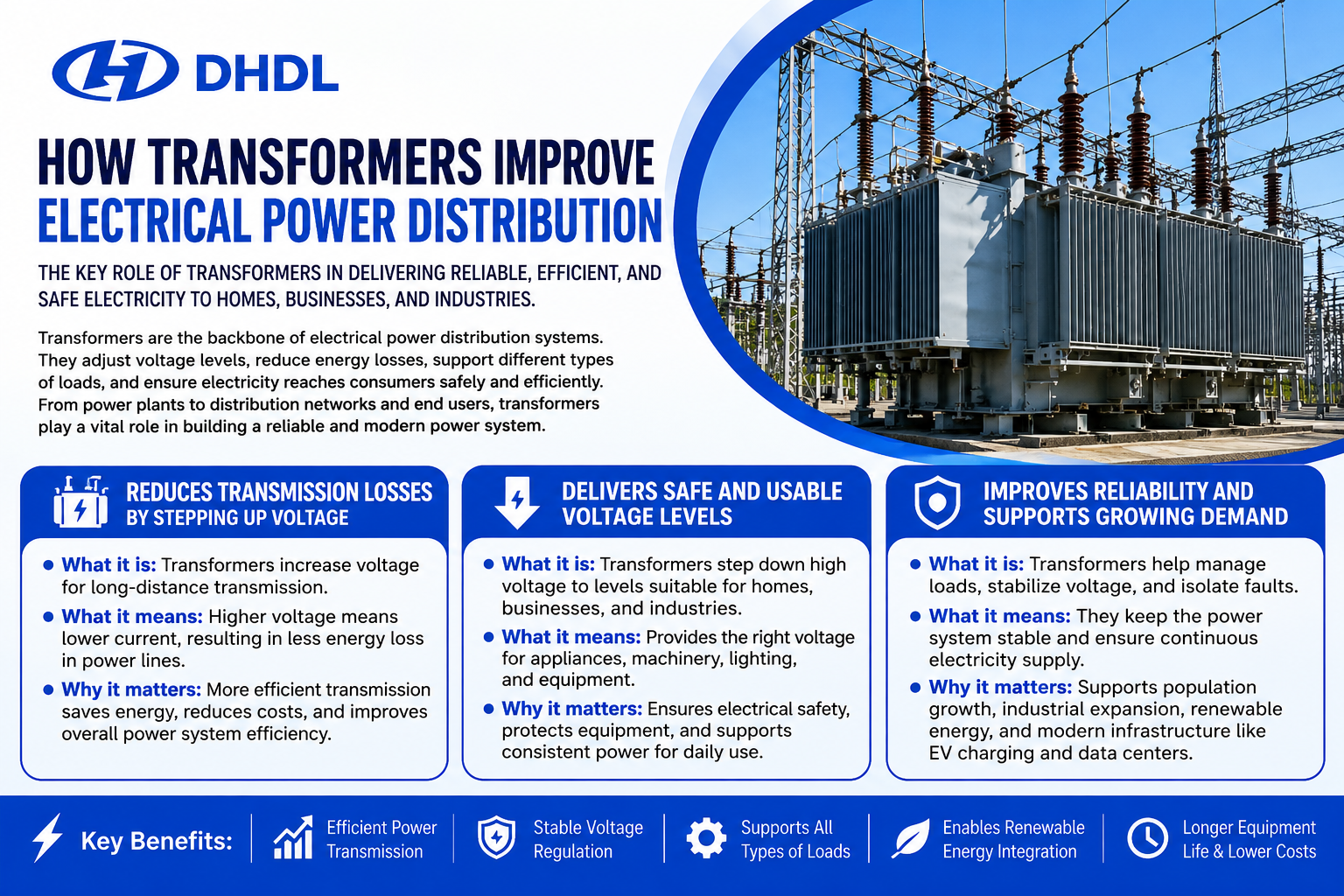
Reliable electricity is essential for homes, businesses, industries, hospitals, data centers, transportation systems, and modern infrastructure. However, electricity cannot be generated, transmitted, and delivered to consumers efficiently at the same voltage level. This is where transformers play a critical role.
Transformers improve electrical power distribution by changing voltage levels, reducing transmission losses, supporting reliable electricity delivery, protecting electrical equipment, and helping utilities meet changing electricity demand. From a power transformer at a substation to a distribution transformer serving homes and businesses, transformers form one of the most important links between electricity generation and the end user.
In this article, we will explain how transformers improve electrical power distribution, the different transformer types used in power systems, and why efficient transformer technology is becoming increasingly important.
What Is an Electrical Transformer?
An electrical transformer is a static electrical device that transfers electrical energy between circuits through electromagnetic induction. Its primary function is to increase or decrease alternating-current voltage while maintaining the frequency.
Transformers can be broadly classified as:
- Step-up transformers
- Step-down transformers
- Distribution transformers
- Power transformers
- Dry-type transformers
- Oil-immersed transformers
- Pole-mounted transformers
- Pad-mounted transformers
- Specialized industrial transformers
Each type is designed for specific applications within the electrical power system.
Why Are Transformers Important in Power Distribution?
Electricity is often generated at a voltage that is not suitable for long-distance transmission or direct use by consumers. Transformers make it possible to change voltage levels at different stages of the electrical network.
For example, electricity can be stepped up to a higher voltage for transmission over long distances and then stepped down through substations and distribution equipment before reaching consumers.
The U.S. Department of Energy describes distribution transformers as essential grid components that reduce voltage to levels suitable for homes and businesses. (The Department of Energy’s Energy.gov)
Without transformers, modern electrical distribution networks would be considerably less practical and efficient.
1. Transformers Reduce Transmission Losses
One of the biggest ways transformers improve electrical power distribution is by enabling electricity to be transmitted at higher voltages.
For a given amount of power, increasing the voltage reduces the current required to transmit that power. Since resistive losses in conductors are related to current squared, reducing current can significantly reduce losses in transmission lines.
A step-up transformer increases voltage before electricity travels over long distances. At the receiving end, a step-down transformer reduces the voltage for subsequent distribution and consumption.
This process helps utilities move electricity over long distances more efficiently.
2. Transformers Deliver Safe Voltage Levels
High transmission voltages are not suitable for direct use by most residential and commercial equipment.
Transformers installed at substations and distribution points progressively reduce voltage to appropriate levels.
A distribution transformer performs an important final-stage function by reducing voltage before electricity reaches consumers.
This makes electrical energy more suitable for:
- Homes
- Offices
- Factories
- Schools
- Hospitals
- Shopping centers
- Data centers
- Commercial buildings
The correct transformer voltage rating is therefore essential for safe and reliable electricity delivery.
3. Transformers Improve Grid Reliability
Transformers help divide electrical networks into different voltage levels and distribution zones. This makes it easier for utilities to manage and control electricity across large networks.
A properly designed distribution system can use multiple transformers to supply different loads. If one section of the network experiences a problem, protection and switching equipment can help isolate the affected section while maintaining service to other areas.
Reliable transformers therefore contribute to overall grid resilience.
Transformer condition monitoring can further improve reliability. A transformer monitoring system can track important operating parameters and help identify abnormal conditions before they develop into serious failures.
4. Distribution Transformers Support Local Electricity Supply
Distribution transformers are located closer to consumers than large transmission transformers.
They reduce medium or higher distribution voltages to levels suitable for local use.
Depending on the network design, utilities may use pole mounted transformers, pad mounted transformers, or other distribution configurations.
A utility distribution transformer can serve residential neighborhoods, commercial facilities, industrial customers, and other local loads.
The correct transformer size is important because an undersized transformer can become overloaded, while an excessively large transformer may increase initial costs and unnecessary no-load losses.
5. Transformers Improve Energy Efficiency
Transformer efficiency has a direct effect on the overall efficiency of electrical power distribution.
Transformers experience two major categories of losses: no-load losses and load losses. The U.S. Department of Energy notes that no-load losses are primarily associated with the transformer core and occur whenever the transformer is energized, while load losses increase with the level of power flowing through the transformer. (The Department of Energy’s Energy.gov)
Modern transformer designs can reduce these losses through improved core materials, winding designs, manufacturing techniques, and cooling systems.
More efficient transformers can therefore reduce wasted electricity over their operating lifetime.
DOE has also highlighted the importance of improving distribution-transformer efficiency because these units can remain in operation continuously for decades. (The Department of Energy’s Energy.gov)
6. Transformers Support Different Types of Electrical Loads
Different consumers have different electrical requirements.
Residential buildings may require relatively small distribution transformers, while factories, data centers, and large commercial facilities may require significantly higher-capacity equipment.
Transformers allow power systems to accommodate these different requirements.
For example:
Industrial Transformers
An industrial transformer can be designed to support demanding manufacturing processes, machinery, and industrial electrical systems.
Data Center Transformers
A data center transformer can support critical computing infrastructure where power reliability and voltage stability are essential.
Solar Transformers
A solar power transformer can transfer electricity generated by photovoltaic systems to a suitable voltage level for connection to the electrical network.
EV Charging Transformers
A transformer for EV charging station applications can support the increased electrical demand associated with electric vehicle charging infrastructure.
These applications demonstrate how transformers are adapting to modern electricity needs.
7. Transformers Support Renewable Energy Integration
The growth of renewable energy has created new requirements for electrical power systems.
Solar and wind generation facilities often produce electricity at voltage levels that need to be transformed before connection to transmission or distribution networks.
A solar transformer can step up voltage from a solar generation facility, while a wind power transformer can perform a similar function for wind generation systems.
Transformers are therefore important for integrating renewable energy into existing electrical grids.
8. Transformers Help Manage Increasing Electricity Demand
Electricity consumption is changing rapidly because of electric vehicles, data centers, industrial expansion, renewable energy, and electrification.
This creates additional demand for transformer capacity.
The U.S. Department of Energy reported that distribution transformers serve homes, businesses, manufacturing facilities, and data centers, while growing demand from areas such as EV charging and renewable generation is increasing the need for transformer infrastructure. (The Department of Energy’s Energy.gov)
Utilities must therefore consider both current and future load requirements when selecting transformers.
9. Transformers Provide Flexibility Through Different Designs
Electrical systems operate in different environments, so one transformer design cannot meet every application.
Dry-Type Transformers
A dry type transformer uses air and solid insulation rather than liquid insulation. These transformers can be suitable for indoor commercial and industrial installations where environmental and fire-safety considerations influence equipment selection.
Oil-Immersed Transformers
An oil immersed transformer uses insulating liquid for electrical insulation and heat transfer. These transformers are widely used in distribution and power applications.
Pad-Mounted Transformers
A pad mounted transformer is installed at ground level and is commonly used in underground distribution systems and commercial developments.
Pole-Mounted Transformers
A pole mounted transformer is installed on utility poles and is commonly used to supply electricity to residential and rural distribution networks.
The availability of different transformer configurations allows electrical engineers and utilities to select equipment based on voltage, capacity, location, safety requirements, and operating conditions.
10. Transformers Improve Power Quality and Voltage Management
Transformers can help electrical systems manage voltage levels more effectively.
In some applications, transformer tap arrangements allow operators to adjust voltage ratios to compensate for variations in supply or load conditions.
Maintaining appropriate voltage is important because excessively high or low voltage can negatively affect electrical equipment.
Proper transformer selection and voltage regulation therefore contribute to stable power delivery.
11. Transformers Support Electrical Protection
Transformers work alongside circuit breakers, fuses, protective relays, surge arresters, grounding systems, and other equipment to protect electrical networks.
When abnormal conditions occur, protection systems can detect faults and disconnect affected equipment.
Proper transformer protection can help limit damage caused by:
- Short circuits
- Overloads
- Electrical surges
- Lightning
- Internal faults
- Overheating
- Abnormal voltage conditions
Regular transformer testing and maintenance help ensure that protective systems continue to operate correctly.
12. Efficient Transformers Reduce Long-Term Operating Costs
The purchase price is only one part of the cost of owning a transformer.
Energy losses occur throughout the transformer’s operating life. Because distribution transformers may remain energized continuously, even small efficiency improvements can accumulate into significant energy savings.
DOE has estimated substantial long-term economic benefits from more efficient distribution transformers, emphasizing that improvements in efficiency can reduce electricity consumption and operating costs. (The Department of Energy’s Energy.gov)
When selecting a transformer, organizations should therefore consider:
- Initial transformer cost
- Energy losses
- Expected load
- Maintenance costs
- Expected service life
- Efficiency
- Installation costs
- Future load growth
This approach provides a better understanding of the transformer’s total cost of ownership.
Choosing the Right Transformer for Power Distribution
Selecting the correct transformer requires careful consideration of the electrical system.
Important factors include:
Transformer Capacity
The transformer’s kVA or MVA rating should match the expected load while allowing appropriate capacity for future growth.
The keyword set used for this article includes common ratings such as 30 kVA transformer, 75 kVA transformer, 100 kVA transformer, 500 kVA transformer, 750 kVA transformer, and 2500 kVA transformer. The appropriate rating depends on the actual application and load requirements.
Voltage
Primary and secondary voltage ratings must match the electrical system.
Phase
Engineers should determine whether a single phase transformer, 3 phase transformer, or another configuration is required.
Installation Environment
Indoor, outdoor, underground, industrial, and utility applications may require different transformer designs.
Cooling Method
Cooling requirements depend on transformer capacity, design, load, and environmental conditions.
Maintenance Requirements
The availability of inspection, testing, monitoring, and maintenance resources should also be considered.
External Resource for Further Reading
For additional technical and regulatory information about distribution transformers and energy conservation standards, the U.S. Department of Energy provides a useful reference:
U.S. Department of Energy — Distribution Transformers
Conclusion
Transformers are fundamental to efficient and reliable electrical power distribution. They make it possible to increase voltage for efficient long-distance transmission, reduce voltage for safe consumer use, distribute electricity to different types of loads, support renewable energy integration, and improve overall grid reliability.
From a power transformer in a substation to a local power distribution transformer, every transformer performs an important role in moving electricity from where it is generated to where it is needed.
Efficient transformer selection is especially important because transformers can operate continuously for many years. Choosing equipment with appropriate capacity, voltage, efficiency, cooling, and protection can reduce energy losses and operating costs while improving system reliability.
As electricity demand continues to grow through industrial development, EV charging, renewable energy, data centers, and electrification, transformers will become even more important to modern power infrastructure.
For utilities, industries, and commercial organizations, investing in reliable and efficient transformer technology is not simply about transferring voltage—it is about building a safer, more efficient, resilient, and sustainable electrical power distribution system.