
Transformer Cooling System: Types, Methods, and Importance

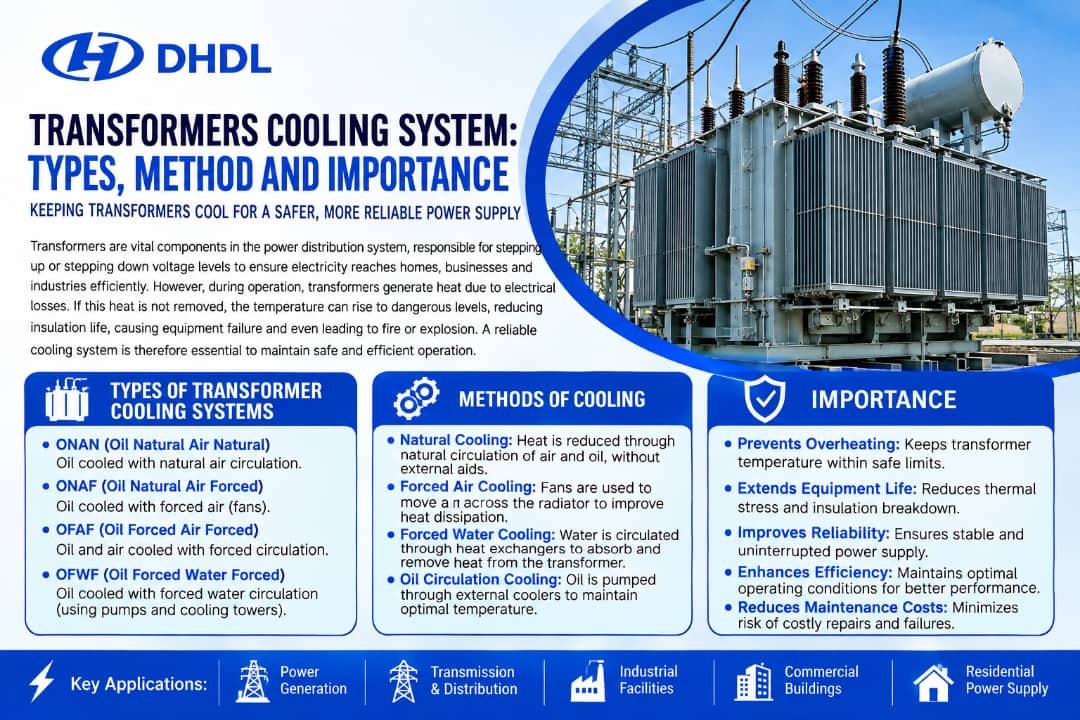
Transformers are essential components of modern electrical power systems. They are used to increase or decrease voltage levels for efficient electricity transmission, distribution, and utilization. However, while a transformer transfers electrical energy, it also produces heat during operation. If this heat is not effectively removed, excessive temperature can damage insulation, reduce efficiency, accelerate aging, and eventually cause transformer failure.
This is why a transformer cooling system is an essential part of transformer design and operation.
A properly selected and maintained cooling method helps control transformer temperature, improve reliability, support continuous operation, and extend service life. The International Electrotechnical Commission’s IEC 60076-2 specifically addresses temperature rise for liquid-immersed transformers, including cooling methods, temperature-rise limits, and temperature-rise testing. (IEC Webstore)
In this article, we will explore the importance of transformer cooling, the major types and methods used, how cooling systems work, and how proper maintenance can improve transformer performance.
What Is a Transformer Cooling System?
A transformer cooling system is the arrangement used to remove heat generated inside a transformer during normal operation.
Electrical energy losses occur in transformer components such as the core and windings. These losses are converted into heat. As the transformer load increases, heat generation generally increases as well.
If the heat cannot be dissipated effectively, the transformer’s internal temperature may rise beyond acceptable limits.
A cooling system transfers this heat away from the active parts of the transformer and releases it into the surrounding air or another cooling medium.
The cooling method depends on factors such as:
- Transformer capacity
- Transformer design
- Voltage level
- Installation environment
- Load requirements
- Insulation system
- Cooling medium
- Indoor or outdoor installation
- Required operating temperature
Why Is Transformer Cooling Important?
1. Prevents Overheating
The primary purpose of transformer cooling is to prevent excessive temperature.
Overheating can accelerate insulation deterioration and reduce the transformer’s expected service life. It can also affect oil condition, winding performance, and other components.
A properly designed cooling system keeps operating temperatures within acceptable limits.
2. Extends Transformer Service Life
Transformer insulation is highly sensitive to temperature. Consistently high operating temperatures can accelerate insulation aging.
By efficiently removing heat, a cooling system helps protect the insulation system and other internal components.
This is particularly important for transformers that operate continuously, such as a distribution transformer in an electrical distribution network.
3. Improves Reliability
A transformer that operates at appropriate temperatures is less likely to experience heat-related problems.
Reliable cooling therefore contributes to stable transformer operation and helps reduce the risk of unexpected shutdowns.
This is especially important for industrial facilities, substations, renewable energy installations, and other applications where power interruptions can be costly.
4. Supports Higher Transformer Capacity
Effective cooling can allow a transformer to manage its designed load more effectively.
Larger transformers and transformers serving demanding applications may require more advanced cooling arrangements to remove the greater amount of heat generated during operation.
Main Types of Transformer Cooling Methods
Transformer cooling methods generally depend on whether the transformer is liquid-immersed or dry type.
1. Air Natural Cooling
Air natural cooling is commonly associated with dry type transformers.
In this arrangement, heat generated by the transformer is transferred to the surrounding air naturally without relying on powered fans.
The heated air rises while cooler air moves toward the transformer, creating natural air circulation.
This method is relatively simple and requires fewer mechanical components.
It can be suitable for applications where transformer capacity and heat generation are within the limits of natural air cooling.
2. Air Forced Cooling
Air forced cooling uses fans to increase airflow around the transformer.
Fans move air across heat-producing components, increasing the rate at which heat is transferred away from the transformer.
This method can provide greater cooling capacity than natural air circulation.
For example, a dry type transformer operating under higher loads may use forced-air cooling to improve heat dissipation.
Fan-based cooling systems should be regularly inspected because fan failure can result in a rapid increase in operating temperature.
3. Oil Natural Air Natural Cooling
For many oil immersed transformers, insulating oil performs an important role in transferring heat away from the windings and core.
As the oil becomes warmer, it naturally circulates through the transformer and radiators because of differences in density. The radiators then transfer heat from the oil to the surrounding air.
This method does not require pumps or fans for oil circulation.
It is relatively simple and reliable, making it suitable for many transformer applications.
4. Oil Natural Air Forced Cooling
In this arrangement, oil circulates naturally inside the transformer, while fans are used to force air across the radiators.
Adding fans increases the heat-transfer capability of the radiator system.
This can be useful when the transformer needs additional cooling during periods of higher load.
Automatic controls may be used to switch fans on when temperature or load reaches a specified level.
5. Oil Forced Air Forced Cooling
Oil forced air forced cooling uses pumps to circulate transformer oil and fans to force air through cooling equipment.
The pump improves the movement of heated oil through the cooling circuit, while the fans increase heat transfer from the oil to the surrounding air.
This type of system is commonly associated with larger power transformers where substantial heat must be removed.
IEC 60076-22-6 covers electric fans used in cooling circuits of liquid-immersed power transformers and reactors, including fans used with liquid-to-air coolers and radiators.
6. Oil Forced Water Forced Cooling
Some large transformers use water-cooled heat exchangers to remove heat from the insulating liquid.
In this system, pumps circulate the transformer oil through a heat exchanger while water removes heat from the oil.
This arrangement can provide high cooling capacity but requires careful monitoring of pumps, heat exchangers, water circuits, and insulating liquid.
It may be appropriate for certain high-capacity or specialized installations where conventional air cooling is insufficient or impractical.
Transformer Cooling System Components
A transformer cooling system can contain several components depending on its design.
Radiators
Radiators provide additional surface area for transferring heat from transformer oil to the surrounding air.
They are particularly common on oil-immersed transformers.
Blocked or damaged radiators can reduce cooling performance.
Fans
Fans increase airflow across radiators or transformer surfaces.
Fan operation should be checked regularly for mechanical damage, electrical faults, excessive vibration, and dust accumulation.
Pumps
Pumps are used in some large transformers to force insulating liquid through the cooling circuit.
Pump failure can significantly reduce cooling performance and may require immediate attention.
IEC 60076-22-5 addresses electric pumps used in cooling circuits of power transformers and reactors.
Heat Exchangers
Heat exchangers transfer heat from transformer oil to another cooling medium, such as air or water.
IEC 60076-22-3 covers insulating-liquid-to-air heat exchangers using forced-air and forced-liquid circuits for liquid-immersed power transformers and reactors.
Temperature Sensors
Temperature sensors help monitor transformer operating conditions.
They can provide information about oil temperature, winding temperature, or other relevant thermal conditions.
Modern installations may integrate these sensors with a transformer monitoring system to provide continuous operating information.
How Transformer Cooling Relates to Transformer Efficiency
Transformer cooling and efficiency are closely connected.
Every transformer experiences losses, including core and winding losses. These losses produce heat.
An effective cooling system does not eliminate the losses themselves, but it removes the resulting heat and helps maintain acceptable operating temperatures.
When a transformer operates within its intended thermal limits, it can perform more reliably and maintain the expected performance of its insulation and components.
This makes cooling an important consideration when evaluating the overall performance of an electrical transformer.
Cooling Systems for Dry Type Transformers
A dry type transformer does not use liquid insulation for its primary cooling arrangement. Instead, heat is transferred through solid insulation materials and air.
Natural air cooling can be sufficient for many applications, but larger or heavily loaded dry-type transformers may use fans to increase airflow.
Proper ventilation is especially important for indoor installations.
The area around a dry-type transformer should remain free from dust, debris, and obstructions that could restrict airflow.
Cooling Systems for Oil-Immersed Transformers
An oil immersed transformer uses insulating liquid to provide both electrical insulation and heat transfer.
The oil carries heat away from the core and windings toward radiators or other cooling equipment.
Maintaining the condition of the insulating oil is therefore essential.
Regular transformer oil testing and transformer oil analysis can help identify moisture, contamination, aging, and other conditions that may affect transformer performance.
Where appropriate, a transformer oil purification system may be used to treat contaminated or degraded oil according to the transformer’s condition and applicable procedures.
Common Transformer Cooling Problems
Even a well-designed cooling system can experience problems.
Common issues include:
- Fan failure
- Pump failure
- Blocked radiators
- Low oil level
- Poor ventilation
- Damaged heat exchangers
- Faulty temperature sensors
- Excessive dust accumulation
- High ambient temperature
- Transformer overloading
These issues can cause transformer temperature to rise and should be investigated promptly.
How to Maintain a Transformer Cooling System
Proper maintenance can help ensure that cooling equipment remains effective.
Inspect Fans and Pumps
Fans and pumps should be inspected regularly for abnormal noise, vibration, overheating, electrical faults, or mechanical damage.
Keep Radiators Clean
Dirt and debris can reduce airflow across radiator surfaces. Keeping radiators clean can help maintain effective heat transfer.
Monitor Temperature
Temperature readings should be recorded and compared with normal operating conditions.
Sudden or gradual temperature increases can indicate developing problems.
Check Oil Levels
For oil-filled transformers, oil levels should be monitored according to the manufacturer’s requirements.
Low oil levels may affect both insulation and cooling performance.
Use Transformer Monitoring Systems
A transformer monitoring system can provide continuous information about temperature, load, and other operating parameters.
For critical installations, an online transformer monitoring system can help operators identify abnormal thermal conditions before they develop into serious failures.
Choosing the Right Transformer Cooling Method
The appropriate cooling system depends on the transformer’s application.
Before selecting a transformer, engineers should evaluate:
- Transformer rating
- Expected load
- Ambient temperature
- Installation location
- Indoor or outdoor conditions
- Required reliability
- Available ventilation
- Maintenance requirements
- Future load growth
- Transformer size
- Cooling infrastructure
For example, a small indoor dry type transformer may require a very different cooling arrangement from a large power transformer in substation applications.
The cooling method should therefore be selected as part of the overall transformer design rather than treated as an afterthought.
Conclusion
A transformer cooling system is essential for safe, reliable, and long-term transformer operation. By removing heat generated during electrical operation, cooling systems help prevent overheating, protect insulation, improve reliability, and extend transformer service life.
Common cooling methods include natural air cooling, forced air cooling, natural oil circulation with natural or forced air, forced oil circulation, and oil-to-water cooling systems.
Radiators, fans, pumps, heat exchangers, temperature sensors, and monitoring systems all play important roles depending on the transformer design.
Proper maintenance is equally important. Regular inspections, temperature monitoring, radiator cleaning, fan and pump checks, oil assessment, and condition monitoring can help ensure that the cooling system continues to perform effectively.