
Standard Transformer Sizes for Commercial and Distribution Projects

Choosing the right transformer size is one of the most important decisions in a commercial or electrical distribution project.
A transformer that is too small can experience overloading, overheating, voltage instability, and premature insulation aging, while an unnecessarily large transformer can increase project cost and no-load losses.
For commercial buildings, factories, infrastructure projects, renewable energy systems, and distribution networks, standard transformer sizes provide a useful starting point.
However, the final transformer rating should always be determined from the actual load, voltage, operating conditions, future expansion, and applicable standards.
What Are Standard Transformer Sizes?
Transformer capacity is normally expressed in kVA (kilovolt-amperes) for distribution and smaller commercial applications, while larger power transformers are often rated in MVA.
Common transformer sizes include:
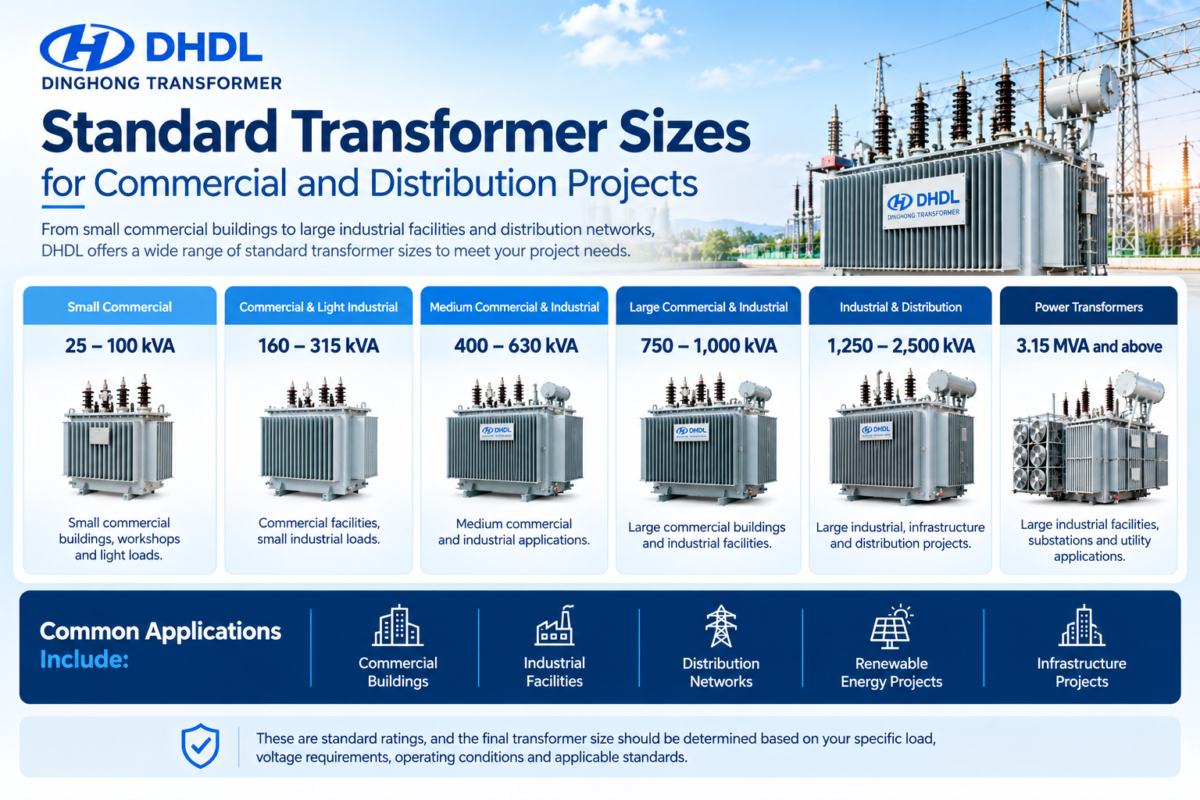
| Transformer Size | Typical Application |
| 25–100 kVA | Small commercial buildings, workshops and light loads |
| 160–315 kVA | Commercial facilities, small industrial loads |
| 400–630 kVA | Medium commercial and industrial applications |
| 750–1,000 kVA | Large commercial buildings and industrial facilities |
| 1,250–2,500 kVA | Large industrial, infrastructure and distribution projects |
| 3.15 MVA and above | Large industrial facilities, substations and utility applications |
These ratings are examples rather than universal standards.
Transformer manufacturers can provide customized ratings and specifications according to the requirements of a particular electrical system.
For example, Dinghong’s medium-voltage oil-immersed distribution transformer range covers approximately 30 kVA to 2,500 kVA, depending on configuration and project requirements.
How Do You Choose the Right Transformer Size?
Transformer selection should begin with a proper load assessment rather than simply choosing the nearest standard kVA rating.
For a three-phase transformer, the basic apparent-power calculation is:kVA = √3 × Voltage × Current ÷ 1,000For example, a three-phase system operating at 400 V and carrying 500 A has an apparent load of approximately 346 kVA.
The next available transformer size may therefore be considered, but the final selection should also account for demand factors, power factor, starting currents, environmental conditions, and planned expansion.
1. Calculate the Connected and Maximum Demand Load
List the major electrical loads connected to the transformer, including:
- Lighting
- HVAC systems
- Motors
- Pumps
- Elevators
- Production equipment
- Office equipment
- EV charging equipment
- Data-center equipment
- Renewable-energy systems
Do not automatically size the transformer based on the total connected load. The project’s maximum demand and diversity should also be evaluated.
2. Allow for Future Expansion
A commercial or industrial facility may increase its electrical demand after several years.For example, a factory currently requiring approximately 700 kVA may eventually add production machinery, larger motors, or additional production lines.
Selecting a transformer with reasonable expansion capacity can prevent an expensive replacement later.
However, excessive oversizing should also be avoided.
A transformer operating significantly below its intended load may increase the initial investment and make the project less economical.
3. Consider Primary and Secondary Voltage
Transformer size cannot be separated from voltage requirements.
Common project configurations may include:
- 11 kV / 0.4 kV
- 22 kV / 0.4 kV
- 33 kV / 0.4 kV
- 13.8 kV / 480 V
- 6.6 kV / 0.4 kV
The correct voltage combination depends on the local utility network and project electrical design.For international projects, buyers should clearly specify the primary voltage, secondary voltage, frequency, phase, vector group, tap range, and applicable standard when requesting a quotation.
Dinghong’s RFQ guidance recommends providing these details because two transformers with the same kVA rating can have substantially different specifications and prices.
Standard Transformer Sizes for Commercial Buildings
Commercial buildings often require transformers to supply lighting, HVAC, elevators, pumps, offices, retail equipment and other building services.
Typical ratings may include 100 kVA, 160 kVA, 250 kVA, 315 kVA, 500 kVA, 630 kVA, 800 kVA and 1,000 kVA.
For indoor commercial installations, a dry-type transformer may be appropriate where fire safety, indoor installation and reduced maintenance are important.
Dry-type transformers are commonly used in commercial buildings, factories, schools, hospitals, airports and data centers.
For outdoor substations or applications requiring strong heat dissipation and continuous operation, an oil-immersed distribution transformer may be more suitable.
Standard Transformer Sizes for Distribution Projects
Distribution networks require transformers that can reliably reduce medium voltage to a level suitable for local consumers and electrical equipment.
Common distribution transformer ratings include:100 kVA → 160 kVA → 250 kVA → 315 kVA → 400 kVA → 500 kVA → 630 kVA → 800 kVA → 1,000 kVA → 1,250 kVA → 1,600 kVA → 2,000 kVA → 2,500 kVA
The actual available rating series can vary according to manufacturer, utility requirements and applicable standards.
For larger distribution systems, multiple transformers may be installed rather than using one very large unit.
This can provide operational flexibility and support maintenance or future capacity expansion.
Transformer Size Is Not the Only Specification That Matters
Two 1,000 kVA transformers are not necessarily equivalent.
A Buyers should also compare:
| Specification | Why It Matters |
| Primary voltage | Must match the incoming network |
| Secondary voltage | Must match the downstream system |
| Frequency | 50 Hz or 60 Hz requirements |
| Vector group | Determines phase relationship |
| Impedance | Influences fault current and voltage regulation |
| Winding material | Copper or aluminum affects design and performance |
| No-load loss | Important for continuously energized transformers |
| Load loss | Affects operating efficiency |
| Cooling method | Determines thermal performance |
| Insulation level | Important for system protection |
| Tap range | Helps accommodate voltage variation |
| Installation | Indoor or outdoor requirements |
| Applicable standard | IEC, ANSI/IEEE, GB or project-specific requirements |
This is why procurement teams should avoid comparing transformer quotations based only on price and kVA rating.
Why Correct Transformer Sizing Matters
An undersized transformer may operate close to or above its rated capacity.
Over time, this can cause:
- Excessive temperature rise
- Increased electrical losses
- Voltage instability
- Accelerated insulation aging
- Reduced transformer life
- Unexpected downtime
- Higher maintenance costs
On the other hand, oversizing can increase capital expenditure and may result in inefficient operation at very low load levels.
The goal is therefore not to choose the largest transformer, but to choose the transformer that provides the right balance between capacity, efficiency, reliability, expansion requirements and total lifecycle cost.
How DinghongTransformer Can Help
Selecting a transformer for a commercial or distribution project involves more than choosing a standard kVA number.
Dinghong Transformer provides customized transformer solutions based on project requirements such as voltage, capacity, frequency, installation environment, winding material and applicable standards.
Its transformer solutions include oil-immersed distribution transformers, dry-type transformers and larger power transformer solutions.
When preparing an RFQ, buyers should provide the transformer type, required capacity, primary and secondary voltage, frequency, phase, vector group, tap range, impedance, installation environment, applicable standard, quantity and destination whenever possible.
This gives the manufacturer enough information to develop a more accurate technical and commercial proposal.
FAQs
What transformer sizes does Dinghong Transformer offer?
Dinghong supports a range of transformer capacities for commercial, industrial and distribution applications.
Its medium-voltage oil-immersed distribution transformer range includes approximately 30 kVA to 2,500 kVA, with project-specific configurations available.
Can Dinghong Transformer customize transformer sizes?
Yes.
Transformer specifications can be customized according to project requirements, including voltage, capacity, frequency, winding material, environmental conditions and applicable standards.
Does Dinghong Transformer manufacture both oil-immersed and dry-type transformers?
Yes. Dinghong provides both oil-immersed distribution transformers and dry-type transformer solutions, allowing customers to select equipment according to installation environment and electrical requirements.
Can Dinghong Transformer supply transformers for international projects?
Dinghong’s published project and standards content addresses international requirements, including IEC and ANSI/IEEE applications.
Buyers should provide the destination country, local grid requirements and applicable project standards when requesting a quotation.
What information should I provide when requesting a transformer quotation?
Provide the required transformer type, kVA/MVA rating, primary and secondary voltage, frequency, phase, vector group, tap range, impedance, winding material, installation conditions, applicable standard, quantity and project destination. Providing complete information helps manufacturers prepare a more accurate quotation.
Can DinghongTransformer help me select the correct transformer capacity?
Yes. Buyers can provide their load information, voltage requirements, application, operating conditions and future expansion plans so the engineering team can evaluate the appropriate transformer configuration.
Need Help Selecting a Transformer?
Tell DinghongTransformer your required capacity, voltage, application, quantity and project location. Its engineering team can help recommend a suitable transformer configuration for your commercial, industrial or distribution project.
Request a Transformer Quote from Dinghong Transformer today.