
High-Voltage Transformer Price and Lead-Time Factors

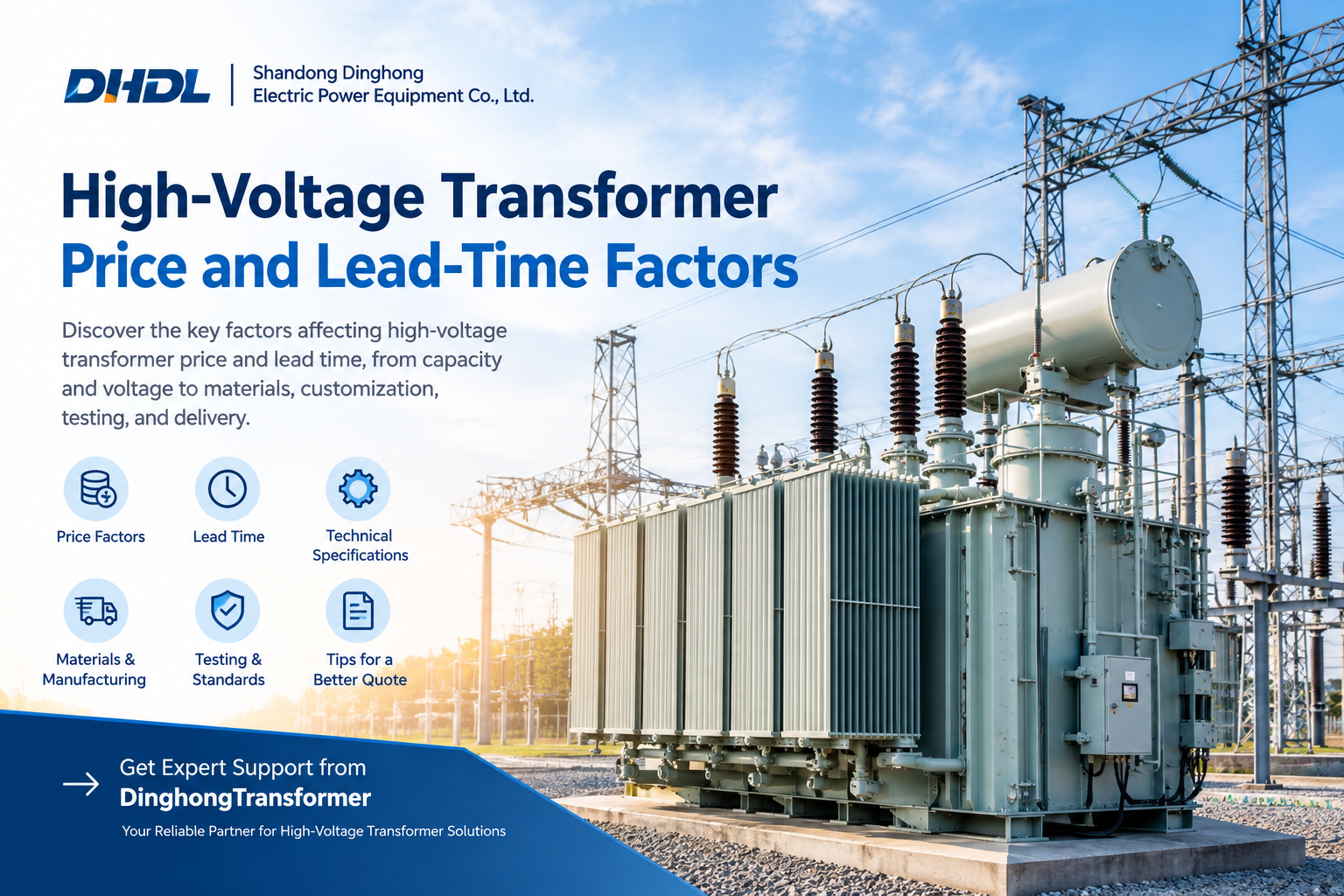
When planning a power infrastructure project, understanding high-voltage transformer price and lead-time factors is essential for controlling costs, managing procurement schedules, and avoiding unexpected project delays.
A high-voltage transformer is a major investment, and its final price depends on much more than its rated capacity.
Voltage level, transformer type, materials, Cooling Methods, technical specifications, testing requirements, accessories, and delivery location can all influence the total cost.
At the same time, lead time can vary significantly depending on the complexity of the transformer, manufacturing capacity, component availability, inspection requirements, and order quantity.
This guide explains the key factors that affect high-voltage transformer cost and delivery time, helping buyers prepare a more accurate request for quotation (RFQ) and make better purchasing decisions.
What Determines the Price of a High-Voltage Transformer?
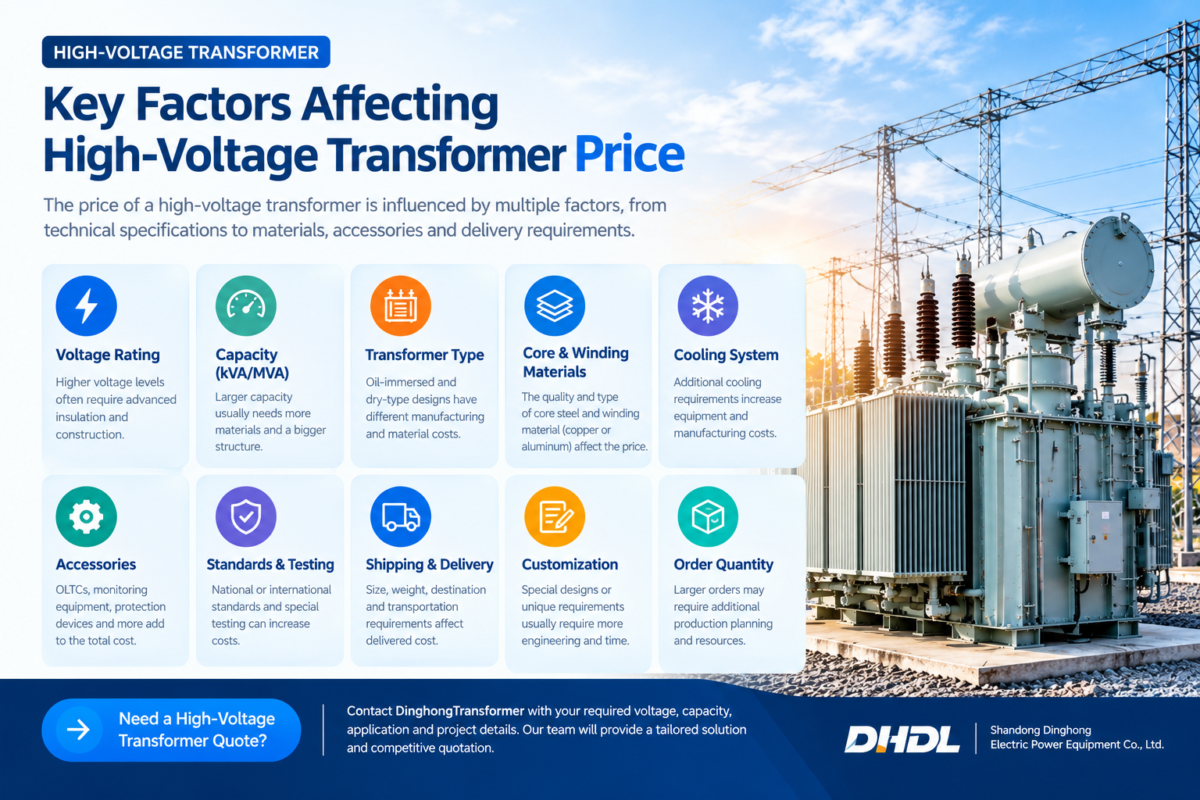
There is no single standard price for a high-voltage transformer because every project may require a different configuration.The following are some of the most important factors.
| Price Factor | How It Affects Transformer Cost |
| Voltage rating | Higher voltage levels generally require more sophisticated insulation and construction |
| Capacity (kVA/MVA) | Larger capacity usually requires more active materials and a larger physical structure |
| Transformer type | Oil-immersed and dry-type designs have different manufacturing and material costs |
| Core material | Core design and steel quality affect efficiency, performance, and cost |
| Winding material | Copper and aluminum winding options can significantly affect the price |
| Cooling system | Additional cooling requirements can increase equipment and manufacturing costs |
| Accessories | OLTCs, monitoring equipment, protection devices, and other accessories add to the total cost |
| Standards | Required national or international standards may affect engineering, testing, and certification |
| Testing | Special factory or third-party testing can increase the overall project cost |
| Shipping | Transformer size, weight, destination, and transportation requirements affect delivered cost |
1. Voltage Rating
The transformer’s voltage level is one of the fundamental factors in determining its design and price.
A transformer designed for an 11kV system may have substantially different insulation, construction, and testing requirements from a transformer designed for a 33kV or higher-voltage application.
As voltage increases, the transformer may require more advanced insulation systems, greater clearances, and additional engineering considerations.
Therefore, buyers should always provide both the high-voltage and low-voltage ratings when requesting a quotation.
2. Transformer Capacity
Transformer capacity is commonly specified in kVA or MVA.A higher-capacity transformer generally requires more core and winding materials and may have a larger tank, cooling system, and supporting structure.
For example, a 500kVA transformer and a 2500kVA transformer can have very different material, manufacturing, transportation, and installation requirements.
Selecting the correct capacity is therefore important—not simply choosing the largest available transformer.
3. Transformer Type and Design
The choice between an oil-immersed transformer and a dry-type transformer can affect both purchase price and application suitability.
Oil-immersed transformers are widely used in utility, industrial, commercial, and distribution applications.
Dry type transformer may be preferred in certain indoor or environments where liquid insulation is undesirable.
The appropriate choice depends on factors such as installation environment, available space, safety requirements, maintenance expectations, and project specifications.
What Affects High-Voltage Transformer Lead Time?
Price is only one part of transformer procurement.
Lead time can be equally important.
A transformer may be technically suitable and competitively priced, but a delayed delivery can affect installation schedules, commissioning, and the overall project timeline.Several factors can influence manufacturing and delivery time.
Manufacturing Complexity
A standard transformer configuration is generally easier to manufacture than a highly customized unit.Special voltage ratios, unusual impedance requirements, advanced cooling systems, special enclosures, additional monitoring equipment, or customized accessories can increase engineering and production time.
Material Availability
Transformers depend on major materials and components such as electrical steel, winding conductors, insulation materials, transformer oil, bushings, tap changers, and other accessories.If a required component has a long procurement cycle, it can affect the entire production schedule.
Testing and Inspection Requirements
Buyers may require specific factory acceptance tests (FAT), routine tests, type tests, or third-party inspections.These requirements should be established during the quotation stage because additional testing can affect both cost and lead time.
Order Quantity
Large projects involving multiple transformers may require additional production planning.Manufacturers need to coordinate materials, production capacity, testing schedules, and packaging for the complete order.For this reason, buyers should discuss the expected quantity and required delivery schedule with the manufacturer as early as possible.
How to Reduce Transformer Procurement Delays
One of the simplest ways to avoid unnecessary delays is to provide complete technical information during the RFQ stage.An incomplete specification can lead to repeated communication between the buyer and manufacturer, slowing down quotation, engineering approval, and production.
Important information may include:
- Required transformer capacity
- High-voltage rating
- Low-voltage rating
- Frequency
- Phase
- Transformer type
- Cooling method
- Tap changer requirements
- Impedance
- Applicable standards
- Installation environment
- Quantity required
- Required accessories
- Testing requirements
- Destination and project location
- Expected delivery schedule
Providing these details allows the manufacturer to evaluate the project more accurately and prepare a quotation based on the actual requirements.
Price vs. Lead Time: What Should Buyers Prioritize?
The lowest transformer price is not always the lowest overall project cost.For example, selecting a cheaper transformer with a significantly longer delivery period could create additional costs through project delays, storage changes, installation rescheduling, or delayed commissioning.Buyers should therefore evaluate suppliers based on several factors:Price + Technical Compliance + Quality + Lead Time + After-Sales SupportA reliable supplier should be able to explain what is included in the quotation, what technical assumptions have been made, the expected production schedule, and what factors could affect delivery.
How to Get a More Accurate High-Voltage Transformer Quote
The best way to obtain an accurate quotation is to provide a complete RFQ specification rather than simply asking, “How much does a high-voltage transformer cost?”
A good RFQ gives the manufacturer enough information to determine the required design, materials, testing, accessories, and delivery requirements.
This can also make supplier comparisons easier because different manufacturers can quote against the same technical requirements.
For more information, buyers can also review a transformer RFQ checklist and related guides covering transformer capacity, voltage selection, specifications, testing, and delivery.
FAQ
1. How much does a high-voltage transformer cost?
The price of a high-voltage transformer depends on its voltage rating, capacity, transformer type, winding material, cooling method, insulation requirements, accessories, applicable standards, testing requirements, and delivery location.
Because configurations are customized for different projects, buyers should provide complete technical specifications to receive an accurate quotation.
2. What factors affect high-voltage transformer prices?
The main factors include rated capacity, voltage level, core and winding materials, cooling system, insulation level, impedance, tap changer requirements, accessories, testing requirements, applicable standards, quantity, and transportation costs.
3. How long does it take to manufacture a high-voltage transformer?
Lead time depends on the transformer design, capacity, voltage level, customization, material availability, order quantity, testing requirements, and production schedule. DinghongTransformer states a typical 15–25 day lead time for its core distribution range, while larger or highly customized high-voltage transformers may require a project-specific schedule.
4. Can DinghongTransformer customize high-voltage transformers?
Yes. DinghongTransformer provides customized transformer solutions based on requirements such as voltage level, rated capacity, voltage ratio, cooling method, impedance, insulation level, accessories, installation environment, and applicable standards.
5. What information is needed to get a high-voltage transformer quotation?
For a more accurate quotation, buyers should provide the required capacity in kVA or MVA, high-voltage and low-voltage ratings, frequency, connection group, impedance, applicable standard, application, installation environment, quantity, and project location. Additional information may be required for specialized projects.
6. Does a higher voltage rating always mean a higher transformer price?
Not necessarily. Voltage rating is an important cost factor, but the final price also depends on capacity, design, materials, insulation requirements, cooling system, accessories, testing, and customization. Two transformers with the same voltage rating can have significantly different prices because of different project specifications.
7. What is the difference between a standard and customized transformer?
A standard transformer follows an established configuration, while a customized transformer is designed around specific project requirements. Customized transformers may require additional engineering, special components, testing, or production time, which can affect both price and lead time.
8. How can I reduce high-voltage transformer procurement delays?
Provide complete technical specifications at the RFQ stage, clearly state the required delivery date, confirm applicable standards and testing requirements, and communicate the project location and installation conditions early. This helps the manufacturer evaluate the design and production schedule before the order is finalized.
Need a High-Voltage Transformer Quote?
If you are planning a substation, industrial power project, renewable energy project, or transmission application, DinghongTransformer can help you determine the appropriate transformer configuration.
Send your required capacity, voltage combination, frequency, standard, application, quantity, and project location to DinghongTransformer for a project-specific recommendation and quotation.