American-Style Energy Storage Pad-Mounted Transformer: A Buyer’s Guide

An energy storage project needs more than batteries and a power conversion system. It also needs electrical equipment that can transform voltage, distribute power, coordinate protection, and connect the storage system to the required electrical network.
The DHDL American-Style Energy Storage Pad-Mounted Transformer combines an oil-immersed transformer unit, high-voltage protection, a low-voltage connection compartment, and a weather-resistant enclosure in one factory-assembled outdoor unit. Therefore, it gives project developers a compact power transformation and distribution solution for commercial, industrial, renewable-energy, distributed-power, and community energy projects.
However, buyers should not select this equipment from a product name alone. The final design depends on the project voltage, system capacity, protection scheme, cable arrangement, installation environment, and approved drawings. This guide explains the published configuration, buyer benefits, selection criteria, application fit, and information DHDL needs to prepare a technical proposal.
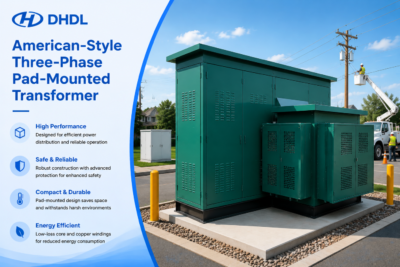
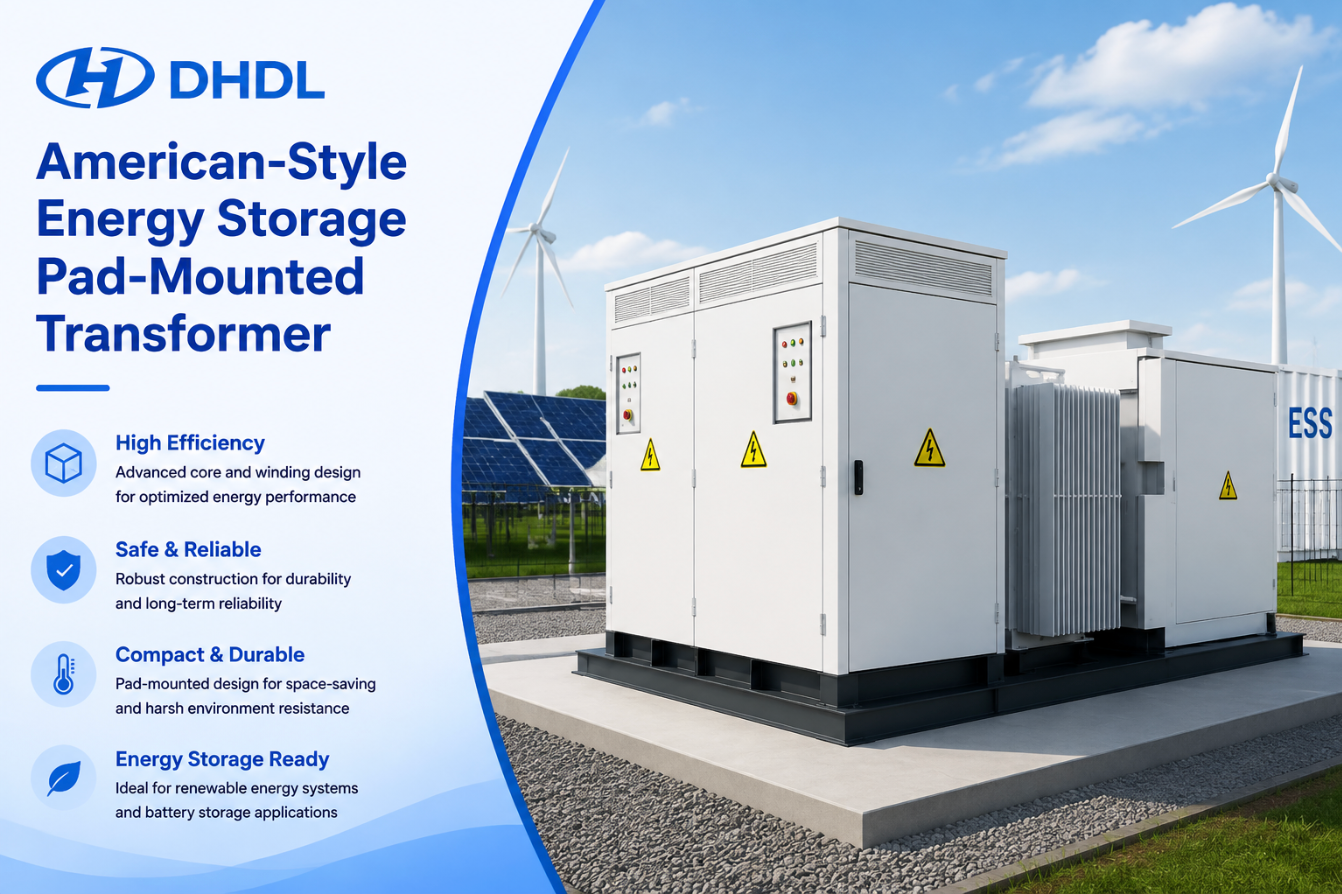
DHDL American-style energy storage pad-mounted transformer with an integrated oil-immersed transformer, protection system, connection compartment, and outdoor enclosure.
What Is an American-Style Energy Storage Pad-Mounted Transformer?
An American-style energy storage pad-mounted transformer is a compact, outdoor-installed power transformation and distribution unit. DHDL developed this product for renewable-energy and distributed energy storage projects.
Its integrated structure includes four core sections:
- Oil-immersed transformer unit
- High-voltage protection system
- Low-voltage connection compartment
- Weather-resistant outdoor enclosure
Instead of installing these primary functions as several loosely arranged pieces of equipment, DHDL combines them in a factory-assembled unit. As a result, the design can reduce the required installation area and simplify transportation, positioning, cable connection, and on-site commissioning.
The equipment does not include one universal voltage or capacity configuration. Instead, DHDL configures these values according to the power system, system load, protection requirements, installation conditions, and project drawings.
How Does the Transformer Fit into an Energy Storage System?
A battery energy storage system stores electrical energy, while the power conversion system manages the conversion between direct current and alternating current. The transformer then adapts the system voltage to the required distribution or grid-connection level.
Within this process, the DHDL unit performs two main functions:
- Power transformation
- Power distribution
Moreover, its integrated high-voltage protection system supports the project’s required protection arrangement. The dedicated low-voltage compartment provides the connection interface for the low-voltage side, while DHDL can customize the outgoing configuration according to the project.
The exact system interface still requires engineering confirmation. Buyers should provide the power conversion system output data, required transformer voltage ratio, system capacity, cable arrangement, protection philosophy, and point-of-connection requirements before finalizing the transformer.
Published Technical Specifications
DHDL publishes the following general specifications for the American-style energy storage pad-mounted transformer.
| Item | Published product information |
|---|---|
| Product type | American-Style Energy Storage Pad-Mounted Transformer |
| Transformer structure | Compact oil-immersed pad-mounted design |
| System function | Power transformation and distribution for energy storage and renewable-energy systems |
| Voltage level | Customizable according to the project power system |
| Rated capacity | Customizable according to system load requirements |
| Insulation and cooling | Oil-immersed insulation with efficient natural heat dissipation |
| High-voltage protection | Integrated high-voltage protection configured according to project requirements |
| Low-voltage connection | Dedicated low-voltage connection compartment with customizable outgoing configuration |
| Enclosure design | Compact outdoor enclosure designed for rain, wind, dust, and sand resistance |
| Installation method | Pad-mounted installation with simplified site positioning and cable connection |
| Operating characteristics | Stable heat dissipation, low operating noise, and reliable continuous operation |
| Typical applications | Commercial and industrial energy storage, renewable energy, distributed power, and community energy projects |
| Customization options | Voltage level, rated capacity, protection configuration, terminal arrangement, enclosure layout, and auxiliary systems |
These specifications describe the available product framework. Nevertheless, DHDL determines the final technical configuration from the project’s voltage, capacity, protection scheme, installation environment, cable arrangement, and approved drawings.
Buyers should therefore treat a project-specific datasheet and approved drawing as the final technical reference.
Why Consider This Design for an Energy Storage Project?
Compact Integration Can Reduce Site Complexity
Energy storage sites often need to fit battery equipment, power conversion systems, transformers, protection devices, cables, access routes, and safety clearances into a limited area.
DHDL’s compact pad-mounted structure integrates several transformer-side functions in one outdoor unit. Consequently, project designers can reduce the number of separately positioned transformer components and simplify the general equipment arrangement.
This advantage may prove useful when:
- The project has limited usable land
- The electrical equipment must stay close to the battery or PCS area
- The buyer wants a factory-assembled outdoor unit
- The site requires a clear and compact equipment layout
- The project team wants to simplify positioning and cable connection
However, compact construction does not remove the need for layout engineering. The buyer still needs to confirm foundation dimensions, cable trenches, operating access, maintenance clearances, fire-safety distances, lifting access, and equipment interfaces.
Oil-Immersed Construction Supports Heat Dissipation
The transformer uses oil-immersed insulation and natural heat dissipation. According to DHDL, efficient oil circulation and heat dissipation support stable operation under continuous-load conditions.
In addition, DHDL identifies low operating noise as one of the product’s operating characteristics. This feature can matter in commercial, industrial, and community energy storage applications where electrical equipment may sit closer to occupied or working areas.
Still, buyers should request the project-specific noise data if their tender sets a numerical noise limit. The product page describes low-noise operation but does not publish a fixed sound-pressure value for every configuration.
Integrated High-Voltage Protection Simplifies Coordination
DHDL integrates the high-voltage protection system into the unit and configures it according to project requirements. Therefore, buyers can coordinate the transformer and its high-voltage protection as part of the same technical design.
However, the manufacturer still needs accurate system data. The protection configuration may depend on:
- System voltage
- Transformer rated capacity
- Fault level
- Earthing method
- Upstream protection
- Downstream equipment
- Required operating sequence
- Local grid-connection requirements
For this reason, buyers should submit a single-line diagram and protection requirements early. DHDL can then review the transformer and high-voltage protection configuration together.
A Dedicated Low-Voltage Compartment Supports Project-Specific Connections
The unit includes a dedicated low-voltage connection compartment. Moreover, DHDL can customize the outgoing configuration to match the project.
This flexibility can help the equipment connect with the selected power conversion system or other low-voltage-side equipment. Nevertheless, the buyer must confirm the outgoing quantity, terminal arrangement, cable size and number, entry direction, phase sequence, neutral requirements, and interface location.
A technically correct cable interface reduces the risk of expensive site modifications. Therefore, both parties should approve the terminal drawings before production.
The Outdoor Enclosure Addresses Challenging Site Conditions
DHDL designs the sealed outdoor enclosure to resist heavy rain, strong wind, dust, and sand exposure. Consequently, the unit can serve outdoor projects where the enclosure must protect internal equipment from difficult environmental conditions.
Still, terms such as “outdoor” and “weather-resistant” do not define every site condition. Buyers should specify:
- Maximum and minimum ambient temperatures
- Relative humidity
- Installation altitude
- Rainfall and flooding risk
- Wind conditions
- Dust and sand exposure
- Salt mist or coastal corrosion exposure
- Seismic requirements
- Solar radiation
- Required enclosure protection level
DHDL can then evaluate the enclosure, layout, auxiliary systems, and project-specific protection measures.
Where Can Buyers Use the Transformer?
Commercial and Industrial Energy Storage
Commercial and industrial facilities may use energy storage to support load management, renewable-energy integration, or site power strategies. In these projects, the transformer provides the required voltage transformation and distribution interface.
Its compact outdoor structure may suit factories, industrial parks, logistics facilities, commercial campuses, and other sites that need an integrated transformer-side arrangement.
However, every facility has a different load profile. Buyers should provide the system’s charge and discharge power, duty cycle, expected continuous load, power conversion equipment data, and required voltage levels.
Solar and Wind Energy Projects
Renewable-energy projects often combine generation, conversion equipment, energy storage, and a medium-voltage collection or distribution system. Therefore, the transformer must match both the power conversion equipment and the point of connection.
DHDL can customize the voltage level, rated capacity, protection configuration, terminal arrangement, and auxiliary systems for the project. In addition, buyers who need broader energy-storage equipment can review DHDL’s energy storage cabinet categories.
Distributed-Energy Projects
Distributed projects usually place electrical equipment closer to the load or generation source. As a result, equipment footprint, transportation, installation, and outdoor adaptability can become major selection factors.
The American-style pad-mounted design offers a highly integrated structure for these conditions. Nevertheless, buyers should verify transport limitations, unloading arrangements, foundation preparation, access roads, cable routing, and local operating requirements.
Community Energy Storage
Community energy projects may require outdoor equipment near residential or mixed-use areas. Therefore, buyers often need to consider space, noise, physical security, visual arrangement, and maintenance access together.
DHDL describes the product as compact and low-noise. However, the project owner should request configuration-specific dimensional and noise data whenever the approval process requires numerical limits.
American-Style vs. European-Style Energy Storage Solutions
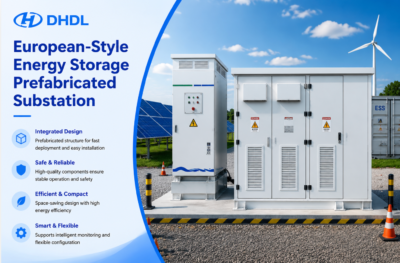
DHDL also offers a European-Style Energy Storage Prefabricated Substation. The two products address energy-storage projects, but their published structures and functions emphasize different buyer priorities.
| Selection factor | American-style energy storage pad-mounted transformer | European-style energy storage prefabricated substation |
| Central product role | Power transformation and distribution | Power conversion, distribution, energy-storage integration, and intelligent system management |
| Core structure | Compact oil-immersed transformer, high-voltage protection, low-voltage connection, and outdoor enclosure | Modular enclosure with electrical equipment, battery interface, cooling, monitoring, and energy-management integration |
| Main design emphasis | High integration, compact installation, simplified positioning, and transformer-side protection | Modular system compatibility, system integration, intelligent control, and future expansion |
| Capacity basis | DHDL customizes rated transformer capacity according to the system load | DHDL customizes system capacity according to energy demand and load requirements |
| Cooling information | Oil-immersed insulation with natural heat dissipation | Project-specific cooling design for integrated equipment |
| Expansion information | The product page does not publish a modular expansion claim | Modular configuration supports future system expansion |
| Typical fit | Projects that need a compact transformer and power-distribution unit | Projects that need broader energy-storage equipment and management integration |
| Final selection basis | Voltage, load, protection, cable arrangement, environment, and drawings | Voltage, storage capacity, battery solution, energy-management platform, environment, and drawings |
The American-style unit remains the more focused choice when the project primarily needs an integrated pad-mounted transformer and its associated connections and protection. In contrast, the European-style solution covers a broader system-integration scope according to its product page.
Neither design automatically fits every project. Therefore, buyers should compare the single-line diagram, equipment boundaries, system interfaces, expansion plan, available space, and operating strategy before selecting a structure.
What Can DHDL Customize?
DHDL can configure the American-style energy storage pad-mounted transformer around the approved project requirements.
Electrical Configuration
Available electrical customization includes:
- Voltage level
- Rated capacity
- High-voltage protection configuration
- Low-voltage outgoing configuration
- Terminal arrangement
These items must match the energy storage system and site distribution network. In particular, DHDL needs the PCS output and grid-side requirements to determine the correct transformer interface.
Mechanical Configuration
DHDL can customize:
- Enclosure layout
- Terminal positions
- Cable arrangement
- Internal compartment arrangement
- Project-specific structural details shown in the approved drawings
As a result, buyers can coordinate the unit with the site foundation and cable routing before production.
Auxiliary Systems
The product page also lists auxiliary systems as customizable. Buyers should describe every required auxiliary function in the inquiry rather than assume that the base configuration includes it.
For example, the project specification should identify required monitoring, indication, heating, ventilation, lighting, control-power, alarm, or communication functions. DHDL can then confirm which auxiliary systems apply to the proposed configuration.
Important Buyer Checks Before Ordering
Confirm the Transformer and PCS Match
The transformer must match the power conversion system electrically. Otherwise, the project may face interface problems, design revisions, or delays during commissioning.
Buyers should confirm:
- PCS rated output voltage
- PCS rated power
- Maximum operating current
- Operating frequency
- Required transformer ratio
- Winding and grounding requirements
- Expected load cycle
- Harmonic information when relevant
- Grid-side voltage
- Grid-connection requirements
DHDL should verify these details against the proposed transformer design.
Confirm Protection Coordination
Integrated high-voltage protection offers a compact arrangement. However, the protection devices must coordinate with the transformer, upstream network, and downstream equipment.
Therefore, submit the single-line diagram, fault-current data, earthing arrangement, relay philosophy, and required operating sequence with the inquiry.
Confirm the Physical Interfaces
A technically suitable transformer can still create site problems if the physical interfaces do not match. For example, cable entry direction, termination space, foundation size, or lifting access may conflict with the site arrangement.
Accordingly, buyers should approve:
- General arrangement drawing
- Foundation drawing
- Cable entry drawing
- Terminal arrangement
- Equipment dimensions
- Transport dimensions
- Lifting and positioning instructions
- Required operating and maintenance clearances
Confirm Environmental Conditions
The enclosure addresses rain, wind, dust, and sand exposure. Nevertheless, DHDL needs measurable site conditions to finalize the configuration.
Country names alone do not provide enough engineering information. Instead, the manufacturer needs exact project-site data.
Information to Confirm in DHDL Target Markets
DHDL’s target markets include Ukraine, Ethiopia, Vietnam, Thailand, Myanmar, Uzbekistan, Russia, and Nigeria. These markets contain very different climates and project conditions, so buyers should avoid selecting equipment from regional assumptions alone.
| Target market | Information the buyer should prioritize |
| Ukraine | Minimum temperature, snow and wind conditions, site heating provisions, grid voltage, and local documentation requirements |
| Ethiopia | Altitude, maximum temperature, dust exposure, road transport conditions, and grid interface |
| Vietnam | Humidity, condensation, rainfall, flooding risk, coastal exposure where applicable, and local grid requirements |
| Thailand | High-temperature and high-humidity conditions, rainfall, drainage, condensation control, and cable arrangement |
| Myanmar | Temperature, monsoon conditions, site access, grid characteristics, and maintenance resources |
| Uzbekistan | Seasonal temperature range, dust and sand exposure, altitude, transport route, and local technical requirements |
| Russia | Minimum temperature, heating provisions, snow and wind conditions, grid standards, and documentation requirements |
| Nigeria | Temperature, humidity, rainfall, dust exposure, grid stability, fault level, and site security requirements |
For example, a coastal project in Vietnam may need a different enclosure treatment from a dry inland project in Uzbekistan. Similarly, a high-altitude installation in Ethiopia requires different technical review inputs from a low-altitude industrial site.
Therefore, buyers should provide precise site data rather than rely only on the destination country.
What Information Should You Send for a Quotation?
A complete RFQ helps DHDL prepare a more accurate transformer configuration, drawing, and commercial proposal.
| RFQ information | Why it matters |
| Project location | Establishes environmental, transport, and documentation requirements |
| Application | Clarifies whether the unit supports C&I storage, renewable energy, distributed power, or a community project |
| Single-line diagram | Defines the electrical arrangement and equipment interfaces |
| High- and low-side voltages | Establishes the required voltage transformation |
| Rated system power | Supports transformer-capacity selection |
| PCS technical data | Helps verify the low-voltage interface and operating requirements |
| Grid-connection requirements | Defines the network-side conditions |
| Protection scheme | Supports high-voltage protection selection and coordination |
| Cable data | Determines terminal and cable-compartment arrangements |
| Installation environment | Supports enclosure and auxiliary-system design |
| Foundation and space limits | Helps DHDL prepare a suitable physical layout |
| Applicable standards | Establishes the technical and documentation basis |
| Required drawings and test documents | Clarifies the approval and delivery package |
| Delivery destination and schedule | Supports transport and production planning |
If some values remain uncertain, send the available single-line diagram and project brief first. DHDL can identify which technical items still need confirmation.
Frequently Asked Questions
Does DHDL publish a fixed voltage range for this transformer?
No fixed voltage range appears on the product page. DHDL customizes the voltage level according to the project power system. Therefore, buyers should submit the required high- and low-side voltages for confirmation.
Does the product have a fixed rated capacity?
DHDL does not publish one standard rated capacity for every project. Instead, it configures the capacity according to the system load requirements.
What does the integrated structure include?
The published core configuration includes an oil-immersed transformer unit, high-voltage protection system, low-voltage connection compartment, and weather-resistant outdoor enclosure.
Can DHDL customize the cable connections?
Yes. The product page lists terminal arrangement, low-voltage outgoing configuration, enclosure layout, and cable arrangement among the project-specific design factors.
Is the unit suitable for outdoor installation?
Yes. DHDL designed it as a pad-mounted outdoor unit with an enclosure that addresses rain, wind, dust, and sand. However, buyers should still submit exact site conditions so DHDL can confirm the final configuration.
Does “low operating noise” mean the same numerical value for every unit?
The product page identifies low operating noise as a characteristic but does not publish one universal numerical limit. Therefore, buyers with a specified noise requirement should request configuration-specific confirmation.
Can the transformer support continuous energy-storage operation?
DHDL states that its oil circulation and heat-dissipation design supports stable operation under continuous-load conditions. Nevertheless, the final transformer capacity and operating design must match the project’s actual duty cycle and load data.
Plan the Transformer Around the Complete Energy Storage System
The American-style energy storage pad-mounted transformer gives buyers a compact outdoor solution that combines power transformation, high-voltage protection, low-voltage connection, and enclosure functions.
Moreover, its oil-immersed construction supports insulation and natural heat dissipation, while the configurable electrical and mechanical design allows DHDL to adapt the unit to different energy storage projects.
Still, successful selection begins with accurate system data. Buyers should confirm the voltage ratio, rated capacity, PCS interface, protection scheme, terminal arrangement, cable routing, installation environment, standards, and required drawings before approving production.
To request a project-specific proposal, send DHDL your single-line diagram, PCS datasheet, required voltage levels, system capacity, protection requirements, site conditions, cable arrangement, and delivery destination through the DHDL contact page. DHDL can then review the interfaces and prepare a configuration based on your actual energy storage project.