SF6 Gas Insulated Switchgear: A Compact MV Distribution Solution

Choosing medium-voltage switchgear involves more than comparing voltage and current ratings. As a buyer, you also need to consider the installation footprint, environmental conditions, protection scheme, maintenance workload, operating safety, and compatibility with the rest of the distribution system.
DHDL’s SF6 gas insulated switchgear provides switching, protection, isolation, control, and power distribution functions in a sealed and compact structure. It uses SF6 gas as its primary insulation and arc-extinguishing medium. Therefore, the equipment can support stable medium-voltage operation while reducing its exposure to dust, humidity, and other external conditions.
However, a successful switchgear project still depends on correct selection. Buyers should define the system voltage, rated current, short-circuit requirements, circuit configuration, protection functions, cable arrangement, operating environment, and applicable standards before placing an order.
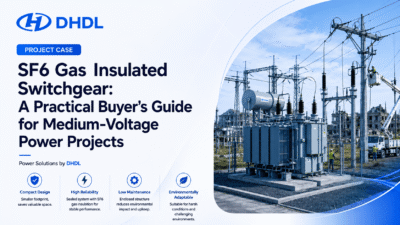
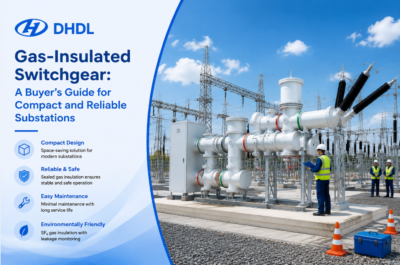
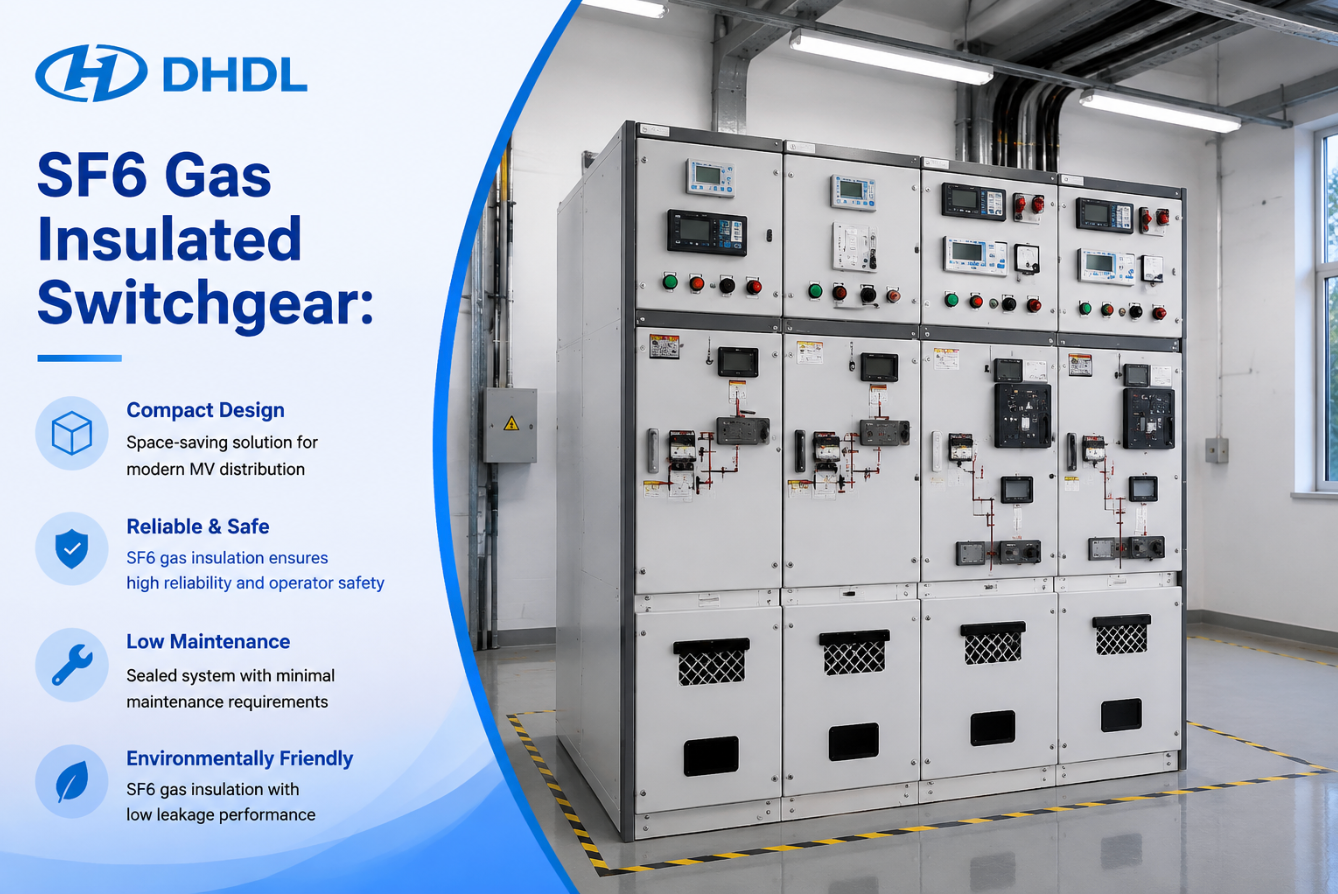
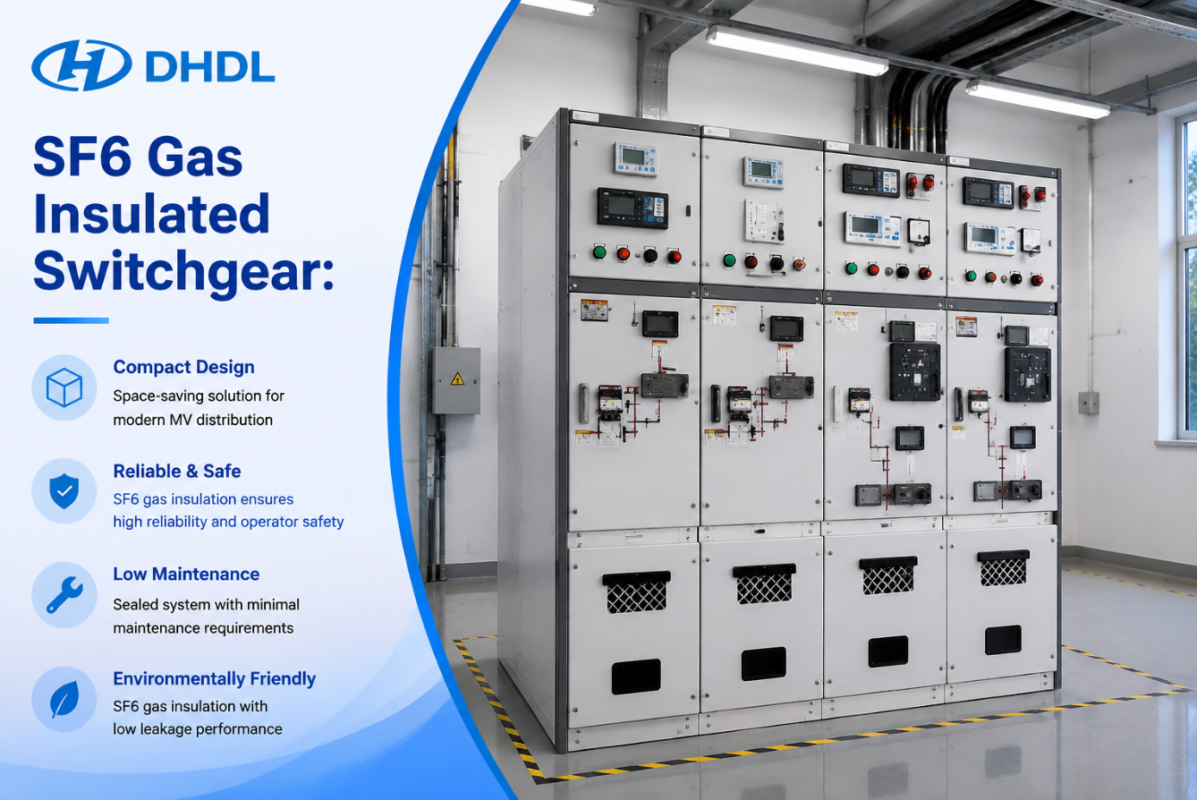
DHDL SF6 gas insulated switchgear with a sealed and compact structure for medium-voltage distribution systems.
What Is SF6 Gas Insulated Switchgear?
SF6 gas insulated switchgear is medium-voltage distribution equipment that uses sulfur hexafluoride gas as its insulation and arc-extinguishing medium. The sealed structure houses the functional components within a compact assembly and reduces their direct exposure to the surrounding environment.
In a distribution system, the switchgear can perform several essential functions:
- Power distribution
- Circuit switching
- Electrical protection
- Circuit isolation
- System control
Consequently, one switchgear lineup can help operators manage incoming power, outgoing feeders, transformer circuits, and other distribution branches according to the approved single-line diagram.
DHDL designs its SF6 switchgear for substations, ring main networks, industrial facilities, and urban power systems. Moreover, the manufacturer can customize the equipment according to the required voltage level, rated current, circuit configuration, protection requirements, installation environment, and applicable standards.
Why Do Buyers Choose a Sealed Gas-Insulated Structure?
The insulation medium alone should not determine your purchasing decision. Instead, you should evaluate how the complete design responds to your project’s space, environment, safety, and maintenance requirements.
1. Compact Installation
The sealed gas-insulated design reduces the equipment size and supports compact installation in substations and distribution rooms.
This advantage becomes particularly important when:
- The electrical room has limited floor space
- The project requires several feeders within a restricted area
- The switchgear must fit into a prefabricated substation
- Building expansion limits the available electrical space
- The project requires a compact ring main distribution arrangement
Therefore, buyers should provide the available room dimensions, access route, installation clearances, cable trench arrangement, and planned cabinet lineup during the technical review.
2. Stable Insulation and Arc-Extinguishing Performance
DHDL uses SF6 gas as the insulation and arc-extinguishing medium. This design supports stable insulation and reliable switching performance in medium-voltage applications.
Nevertheless, buyers should not select equipment based only on its nominal voltage. The technical team must also review the rated current, required short-circuit breaking capacity, insulation coordination, circuit function, and protection arrangement.
3. Reduced Exposure to External Conditions
A fully enclosed structure limits the internal components’ exposure to dust, humidity, and other environmental conditions. As a result, the equipment can reduce part of the maintenance workload associated with environmental contamination.
This feature can benefit projects in humid, dusty, industrial, or coastal locations. However, buyers should still provide exact site conditions. For example, a coastal site may require a different cabinet treatment from an indoor urban substation, even when both systems operate at the same nominal voltage.
4. Safe and Stable Operation
Reliable switching, protection, and interlocking systems help improve operational safety and distribution stability.
In practice, the correct interlocking logic can help prevent unsafe operating sequences. Meanwhile, the selected protection unit can help identify abnormal electrical conditions and initiate the required switching action.
For this reason, buyers should submit the intended operating sequence, protection philosophy, control power supply, communication requirements, and interface signals before DHDL finalizes the design.
5. Lower Routine Maintenance Requirements
Because the design encloses key components, it reduces their exposure to the surrounding environment. Consequently, operators may spend less time addressing dust and humidity contamination than they would with equipment whose insulation system remains more exposed.
Still, “low maintenance” does not mean “no maintenance.” The project owner should follow the approved operating and maintenance instructions, inspect accessible mechanisms and indicators, verify interlocks, and manage the insulating gas according to applicable project procedures and local requirements.
DHDL SF6 Gas Insulated Switchgear Specifications
The following table summarizes the information published on the official product page.
| Item | Published specification |
|---|---|
| Product type | SF6 Gas Insulated Switchgear |
| Insulation medium | SF6 gas insulation and arc-extinguishing medium |
| Main application | Medium-voltage distribution systems, substations, ring main networks, industrial facilities, and urban power systems |
| Structure | Sealed compact switchgear structure with reliable insulation performance |
| Main functions | Power distribution, switching, protection, isolation, and control |
| Supported voltage levels | 6kV, 10kV, 12kV, 24kV, 40.5kV, and other project-specific voltage levels |
| Customization | Voltage level, rated current, circuit configuration, protection unit, cabinet layout, and applicable standards |
| Further configurable items | Breaking capacity, cable entry and exit method, communication function, and cabinet size |
| Referenced standard | IEC 62271 series and other relevant international standards |
| Documentation | Type-test reports and certification documents can be provided according to project requirements |
These details establish the product’s general scope. However, they do not replace a project-specific technical proposal. The final configuration must follow the single-line diagram and confirmed operating conditions.
Which Projects Can Use SF6 Switchgear?
Utility Distribution Networks
Utility networks require equipment that can switch, isolate, protect, and control distribution circuits. Accordingly, SF6 switchgear can serve urban and regional substations, feeder arrangements, and ring main networks where compact installation and reliable operation are important.
For utility procurement, buyers should clearly specify the number of incoming and outgoing circuits, bus arrangement, transformer feeder requirements, protection functions, metering interfaces, and remote-control needs.
Industrial Facilities
Factories, workshops, mining sites, and production facilities often operate motors, transformers, process equipment, and critical auxiliary loads. Therefore, their switchgear must match both normal operating current and fault-level requirements.
In addition, industrial buyers should consider:
- Load criticality
- Operating continuity
- Planned maintenance intervals
- Protection coordination
- Cable entry direction
- Expansion requirements
- Integration with transformers and downstream distribution equipment
If the project also requires medium-voltage transformers, buyers can coordinate the switchgear with a 6–37kV dry-type distribution transformer or a 6–38.5kV oil-immersed distribution transformer, depending on the installation environment and system design.
Commercial Buildings and Infrastructure
Commercial complexes, transportation facilities, campuses, and large public buildings often need compact medium-voltage distribution equipment. Since electrical-room space may be limited, a sealed gas-insulated structure can help project designers use the available area more efficiently.
However, the engineering team should also evaluate access routes, ventilation, cable trenches, operating clearances, emergency procedures, and future expansion before approving the final layout.
Renewable-Energy and Energy-Storage Projects
Solar power plants, wind farms, energy-storage stations, and microgrids use medium-voltage equipment to collect, switch, protect, and distribute electrical power.
For these projects, buyers should provide the generation or storage capacity, system voltage, number of feeders, transformer arrangement, grid connection requirements, protection scheme, communication protocol, and environmental data.
Data-Center Power Infrastructure
Data-center campuses require stable medium-voltage intake and distribution systems. Therefore, switchgear selection should support the project’s required redundancy concept, protection coordination, operating sequence, and monitoring architecture.
Moreover, buyers should explain whether the system uses single or multiple utility feeds, standby generation, sectionalized buses, automatic transfer logic, or future expansion circuits. DHDL can then review the required circuit and control configuration.
SF6 Gas Insulated Switchgear vs. KYN28 Air-Insulated Switchgear
Both products can serve medium-voltage distribution projects. Nevertheless, their structures and selection priorities differ.
| Comparison point | SF6 gas insulated switchgear | KYN28 metal-clad withdrawable switchgear |
| Insulation approach | Uses SF6 gas as the primary insulation and arc-extinguishing medium | Uses an air-insulated metal-clad structure |
| Installation characteristic | Sealed and compact design | Compartmentalized cabinet design with withdrawable functional units |
| Environmental exposure | Sealed structure reduces internal exposure to dust and humidity | Site conditions and maintenance access require careful consideration |
| Typical buyer priority | Compact footprint, environmental adaptability, and reduced routine maintenance | Withdrawable configuration, compartmentalization, and accessible equipment arrangement |
| Configuration basis | Voltage, current, breaking capacity, circuit scheme, protection, cable arrangement, and environment | Also depends on system voltage, current, short-circuit level, circuit scheme, protection, and layout |
| Best selection method | Confirm through the single-line diagram and project conditions | Confirm through the single-line diagram and project conditions |
The table does not mean that one design suits every project better. Instead, the correct choice depends on the electrical system, installation space, maintenance strategy, environmental conditions, operating procedures, and budget.
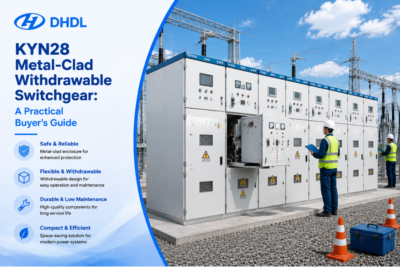
Buyers who are comparing both options can also review DHDL’s KYN28 metal-clad withdrawable switchgear and discuss the differences with the engineering team.
What Can DHDL Customize?
DHDL can customize the SF6 gas insulated switchgear according to project requirements. Published customization options include:
- Voltage level
- Rated current
- Circuit configuration
- Protection unit
- Cabinet layout
- Breaking capacity
- Cable entry and exit method
- Communication function
- Cabinet size
- Applicable standards
As a result, buyers can align the switchgear with the project’s electrical design instead of selecting only from a fixed general configuration.
However, customization requires accurate input data. If the single-line diagram or short-circuit information changes after design approval, the change may affect the protection units, switching devices, bus arrangement, cabinet quantity, cable interfaces, and overall dimensions.
Therefore, the buyer, consultant, and manufacturer should confirm the essential design information early in the project.
Information Buyers Should Provide for a Technical Proposal
A clear request for quotation helps DHDL prepare a more relevant configuration and avoid unnecessary revisions.
| Required information | Why DHDL needs it |
| System voltage | Determines the applicable insulation and equipment class |
| Single-line diagram | Defines incoming, outgoing, transformer, coupling, and other circuits |
| Rated current | Supports the selection of busbars and switching components |
| Short-circuit breaking capacity | Determines the required fault-interruption capability |
| Number of circuits | Establishes the cabinet lineup and functional arrangement |
| Protection requirements | Defines relay and protection-unit functions |
| Cable entry and exit method | Affects the internal and external connection arrangement |
| Communication requirements | Defines monitoring, control, and data interfaces |
| Installation environment | Supports the review of temperature, humidity, dust, altitude, and corrosion risks |
| Room layout and dimensions | Helps confirm the cabinet arrangement and access requirements |
| Applicable standards | Establishes the design and documentation basis |
| Required test documents | Clarifies the expected type-test reports, certificates, and inspection records |
| Project schedule | Supports production and delivery planning |
In addition, buyers should identify any special requirements for metering, auxiliary power, remote control, spare circuits, mechanical interlocking, labeling, packaging, or inspection.
Considerations for DHDL’s Target Markets
Country-level information alone cannot determine a switchgear configuration. Nevertheless, regional conditions can guide the questions that buyers should answer.
| Target market | Project information buyers should confirm |
| Ukraine | Minimum and maximum indoor temperatures, building heating conditions, local technical requirements, documentation language, and grid parameters |
| Ethiopia | Installation altitude, ambient temperature, dust exposure, humidity, and transport conditions |
| Vietnam | Humidity, condensation risk, coastal exposure where applicable, room ventilation, and local utility requirements |
| Thailand | High-temperature and high-humidity conditions, condensation control, installation location, and protection requirements |
| Myanmar | Ambient temperature, humidity, seasonal conditions, transport access, and site maintenance capability |
| Uzbekistan | Seasonal temperature range, dust conditions, altitude, local standards, and indoor-room conditions |
| Russia | Minimum site temperature, heating provisions, technical standards, documentation requirements, and operating environment |
| Nigeria | Ambient temperature, humidity, dust, grid conditions, short-circuit data, and site access |
For example, a humid coastal project and a dry inland project may require different external cabinet treatments even if they use the same voltage level. Similarly, an elevated site in Ethiopia may require additional technical evaluation compared with a low-altitude installation.
Therefore, DHDL recommends providing exact site data rather than relying only on the project country.
Standards, Testing, and Documentation
According to the product page, DHDL designs and manufactures the switchgear in accordance with the IEC 62271 series and other relevant international standards. Furthermore, type-test reports and certification documents can be made available according to project requirements.
Buyers should state the required standards and documents in the inquiry. In particular, the procurement specification should identify:
- Applicable standard and edition
- Required routine-test records
- Required type-test reports
- Certification requirements
- Inspection and witness-test requirements
- Drawing and document language
- Nameplate and labeling requirements
- Final documentation format
DHDL also lists material inspection, manufacturing-process control, routine testing, and final inspection before delivery within its quality-control process. For additional factory information, buyers can review DHDL’s manufacturing capability.
Frequently Asked Questions
What applications are SF6 gas insulated switchgear cabinets suitable for?
They are suitable for urban distribution networks, industrial parks, commercial buildings, renewable-energy power stations, rail transit systems, substations, ring main networks, and other projects that require reliable medium-voltage distribution and compact installation.
Which voltage levels can DHDL supply?
The product page lists 6kV, 10kV, 12kV, 24kV, and 40.5kV. DHDL can also review other voltage requirements according to the project.
Can DHDL customize the circuit scheme?
Yes. DHDL can customize the circuit scheme, rated current, breaking capacity, protection configuration, cable entry and exit arrangement, communication functions, cabinet size, and applicable standards.
Does a sealed structure eliminate maintenance?
No. The sealed structure reduces exposure to dust, humidity, and external environmental conditions, which can lower part of the maintenance workload. However, operators must still follow the approved inspection, operation, maintenance, and insulating-gas management procedures.
What information does DHDL need for a quotation?
DHDL requests the system voltage, single-line diagram, rated current, short-circuit breaking capacity, number of circuits, installation environment, and project requirements. Providing protection, communication, cable, room-layout, standard, and documentation requirements will also improve quotation accuracy.
Can buyers request test reports?
Yes. According to the product page, DHDL can provide type-test reports and certification documents according to project requirements. Buyers should identify the required documents during the quotation stage.
Build the Switchgear Around Your Actual Project
SF6 gas insulated switchgear can provide compact installation, reliable insulation, switching and protection functions, strong environmental adaptability, and reduced maintenance requirements. However, the equipment delivers these advantages only when the manufacturer configures it for the actual electrical system and operating environment.
Therefore, start with the single-line diagram and verified project data. Confirm the voltage level, rated current, breaking capacity, circuit quantity, protection philosophy, cable arrangement, communication functions, installation conditions, standards, and documentation requirements.
DHDL can then prepare a project-specific SF6 switchgear proposal instead of offering only a general cabinet configuration.
For a technical solution and quotation, send your project specifications through the DHDL contact page. If available, attach the single-line diagram, switchgear schedule, room layout, technical specification, and required delivery date so that the engineering team can review the project efficiently.