
How to Choose the Right Transformer for an Industrial Project: A Practical Buyer’s Guide

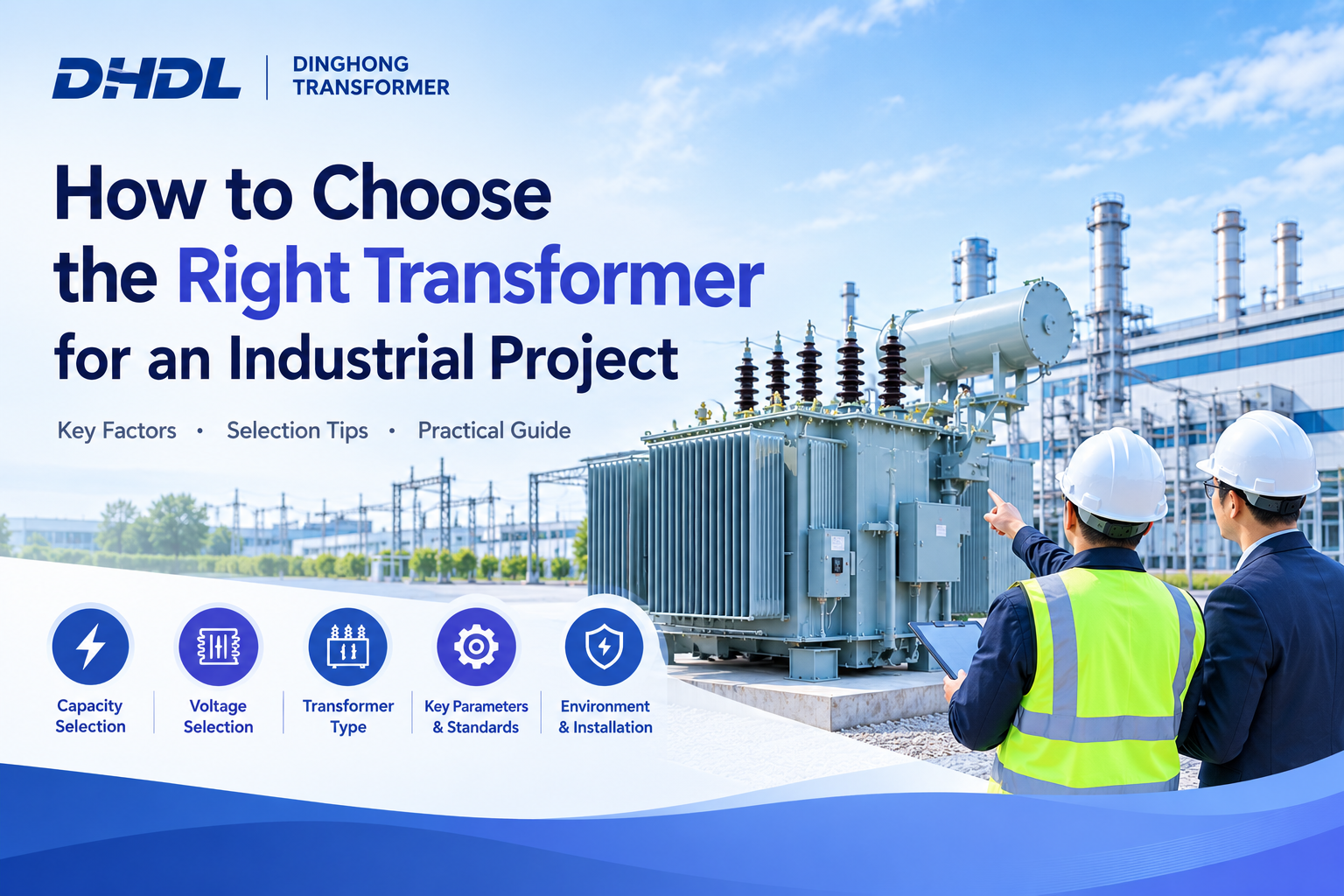
Choosing a transformer for an industrial project is not simply a matter of selecting a kVA rating and comparing prices.
The wrong transformer can create overheating, excessive losses, voltage problems, protection issues, installation difficulties, or costly modifications after delivery.
The correct selection depends on the electrical load, voltage levels, operating environment, cooling requirements, applicable standards, and future expansion plans.
For industrial facilities, EPC contractors, electrical engineers, and procurement teams, the better approach is to select the transformer around the complete electrical system, not around one specification.
This guide explains the key factors to evaluate before requesting a transformer quotation.
1. Start With the Industrial Application
The first question is not “How many kVA do I need?”It is:What will the transformer actually supply?A transformer supplying a factory with motors and variable-frequency drives may have different requirements from one supplying lighting, office buildings, data-center equipment, furnaces, solar inverters, or general distribution loads.
Consider:
- Total connected load
- Maximum demand
- Motor loads
- Motor-starting requirements
- Variable-frequency drives
- Rectifiers and converters
- Furnaces
- Solar or renewable-energy equipment
- UPS systems
- Harmonic-producing equipment
- Expected future expansion
DHDL’s transformer portfolio covers oil-immersed, dry-type, power, and special transformer solutions for different industrial and power-distribution applications.
2. Select the Correct Transformer Capacity
Transformer capacity is normally specified in kVA or MVA.However, selecting capacity based only on today’s connected load can create problems later.
For example, suppose an industrial facility currently requires approximately 750 kVA but plans to add additional production lines over the next three years.
A 750 kVA transformer may technically satisfy the present load but leave little room for expansion.Before selecting capacity, review:
Before selecting capacity, review:
| Selection Factor | Why it matters |
| Connected load | Establishes the total installed electrical demand |
| Maximum demand | Shows the expected operating requirement |
| Power factor | Influences the required apparent power |
| Motor starting | Large motors can create temporary high demand |
Load profile | Determines whether loading is continuous or variable |
| Harmonics | Can increase heating and affect transformer selection |
| Future expansion | Prevents premature capacity limitations |
| Ambient temperature | Can affect allowable loading and thermal performance |
| Redundancy | May require additional capacity or multiple transformers |
Do not automatically choose the largest available transformer either. Oversizing can increase capital cost and may result in inefficient operation at very light loads.The objective is to select a rating appropriate for the actual load profile and project growth plan.
3. Confirm Primary and Secondary Voltage
The transformer must match both sides of the electrical system.
Typical industrial configurations may include:
| Application | Example Voltage |
| Medium-voltage distribution | 11 kV / 0.4 kV |
| Industrial distribution | 33 kV / 0.4 kV |
| Medium-voltage systems | 13.8 kV / 0.4 kV |
| Higher-voltage substation | 66 kV / lower-voltage system performance |
| High-voltage transmission | 330–500 kV applications |
The actual voltage should always be confirmed from the project’s electrical drawings and utility requirements.For example, DHDL’s published 6–38.5 kV oil-immersed distribution transformer range supports rated capacities from 30 to 2500 kVA, with a 0.4 kV low-voltage option and project-specific vector-group and tap configurations.
When requesting a quotation, specify:
- Primary voltage
- Secondary voltage
- Frequency
- Phase
- Required voltage tolerance
- Tap range
- System grounding arrangement
Do not assume that a transformer designed for one voltage level can simply be substituted for another because the capacity is identical.
4. Choose Oil-Immersed or Dry-Type Construction
The installation environment and application should influence the transformer type.
Oil-immersed transformers
Oil-immersed transformers are widely used for outdoor substations, industrial power distribution, utility systems, and higher-capacity applications. Transformer oil provides insulation and helps transfer heat from the core and windings to the cooling system.
Dry-type transformers
Dry-type transformers use solid insulation and air-based cooling.
They are often considered for buildings, indoor load centers, factories, hospitals, schools, data centers, and applications where fire-safety or indoor installation requirements are important.
A simple comparison:
| Factor | Oil-immersed | Dry-type |
| Typical installation | Outdoor/substation | Indoor/load center |
| Cooling | Insulating liquid + cooling systemAir-based | Air-based |
| Fire considerations | Requires project-specific review | No insulating-oil leakage risk |
| Common applications | Utilities, industry, substations | Buildings, factories, critical facilities |
| Maintenance | Includes oil-related | No transformer-oil maintenance |
| Capacity range | Broad, including large projects | Broad, depending on design |
The final choice should be based on the project’s technical specification rather than assuming one technology is always better.
5. Check the Transformer’s Electrical Parameters
Capacity and voltage are only the beginning.
Important parameters include:
| Parameter | What the buyer should confirm |
| Frequency | 50 Hz or 60 Hz |
| Phase | Single-phase or three-phase |
| Vector group | Required connection and phase displacement |
| Impedance | System fault and voltage-drop requirements |
| Tap range | Voltage-regulation requirements |
| Cooling | ONAN, ONAF or required dry-type cooling |
| Winding material | Copper or aluminum |
| Insulation level | Based on system voltage and applicable standard |
| No-load loss | Important for continuous energy consumption |
| Load loss | Important for operating efficiency |
| Temperature rise | Must match project requirements |
| Noise level | Important for buildings and sensitive sites |
For example, DHDL’s published distribution transformer specifications include vector groups such as Dyn11 and Yyn0, tap ranges such as ±5% and ±2×2.5%, and ONAN-related configurations.
6. Consider the Industrial Environment
A transformer installed inside a clean electrical room does not face the same conditions as one installed outdoors at a dusty industrial plant.
Provide the manufacturer with:
- Maximum ambient temperature
- Minimum ambient temperature
- Installation altitude
- Relative humidity
- Dust exposure
- Salt or corrosive atmosphere
- Rainfall
- Ventilation
- Indoor or outdoor installation
- Seismic conditions
- Flood risk
- Available installation space
This is particularly important for industrial projects in hot, humid, dusty, coastal, or high-altitude environments.A transformer design suitable for one site may require modifications for another.
7. Check Harmonics and Nonlinear Loads
Modern industrial facilities increasingly use variable-frequency drives, rectifiers, UPS systems, converters, EV chargers, and other nonlinear loads.
These loads can introduce harmonics into the electrical system.
If the facility has significant nonlinear loads, provide the transformer manufacturer with available harmonic information and load characteristics.
Ignoring harmonics can lead to inappropriate transformer selection, increased heating, and reduced operating reliability.This is especially important when the transformer will supply:
- Motor drives
- Welding equipment
- Furnaces
- Data centers
- Solar inverters
- Battery systems
- Rectifiers
- Large UPS systems
8. Consider Impedance and Parallel Operation
Transformer impedance affects voltage regulation, fault current, and system coordination.If a new transformer will operate in parallel with an existing transformer, do not select impedance independently.
Provide the existing transformer’s:
- Rated capacity
- Voltage ratio
- Vector group
- Impedance
- Tap configuration
- Nameplate information
- Relevant test data
Transformers intended for parallel operation must be technically compatible.DHDL’s RFQ guidance specifically identifies impedance, vector group, tap range, and existing system information as important inputs when defining a transformer solution.
9. Don’t Compare Transformer Quotations by Price Alone
Two suppliers may quote the same capacity and voltage while offering substantially different technical designs
Before choosing the lowest quotation, compare:
| Comparison point | Questions to ask |
| Capacity | Is the rating identical? |
| Voltage | Are HV and LV ratings identical? |
| Winding | Copper or aluminum? |
| Losses | What are the guaranteed losses? |
| Impedance | Is the value suitable for the system? |
| Cooling | Is the cooling configuration equivalent? |
| Accessories | Are all required accessories included? |
| Testing | What tests are included? |
| Standards | Does the design meet the project standard? |
| Warranty | What warranty is provided? |
| Delivery | Does the schedule meet the project requirement? |
A lower purchase price does not necessarily mean a lower total project cost.Efficiency, losses, maintenance, reliability, installation requirements, and service support can affect the transformer’s lifecycle cost.
10. Give the Manufacturer a Complete RFQ
One of the biggest mistakes industrial buyers make is sending an inquiry such as:
“Please quote one 1000 kVA transformer.”
That information is not enough for a final technical proposal.
A stronger RFQ should include:
| Required information | Example |
| Application | Industrial factory |
| Capacity | 1000 kVA |
| Primary voltage | 11 kV |
| Secondary voltage | 0.4 kV |
| Frequency | 50 Hz |
| Phase | Three-phase |
| Vector group | Project specified |
| Impedance | Project specified |
| Tap range | Project specified |
| Winding | Copper/aluminum |
| Installation | Indoor/outdoor |
| Ambient temperature | Project value |
| Altitude | Project value |
| Standard | IEC/project specific |
| Quantity | Number of units |
| Destination | City/country |
| Delivery | Required date |
DHDL’s published RFQ checklist recommends providing electrical data, site conditions, load characteristics, standards, accessories, testing requirements, quantity, destination, and delivery information to improve quotation accuracy.
Common Transformer Selection Mistakes
Avoid these common purchasing mistakes:
- Selecting capacity from connected load alone
- Ignoring future expansion
- Choosing voltage without checking the utility requirement
- Ignoring harmonics
- Failing to specify the installation environment
- Leaving vector group and impedance undefined
- Comparing quotations with different technical scopes
- Ignoring applicable IEC, ANSI/IEEE, GB, or project standards
- Waiting until after production to clarify accessories and drawings
These mistakes can result in redesign, additional costs, delivery delays, or installation problems.
Practical Example: Selecting a Transformer for a Growing Factory
Consider a manufacturing facility with:
- 650 kVA current demand
- Large motor loads
- Several variable-frequency drives
- Planned production expansion
- Outdoor transformer installation
- 11 kV incoming supply
- 0.4 kV plant distribution
The buyer should not simply order a 650 kVA transformer.
The engineering team should review the future load, motor starting, harmonic conditions, ambient temperature, required voltage regulation, transformer type, and expansion strategy.
If an oil-immersed distribution transformer is appropriate, the buyer could review DHDL’s 6–38.5 kV oil-immersed distribution transformer range and provide the complete project information for technical confirmation.
The final capacity and configuration should be confirmed by the project’s qualified electrical engineer and transformer manufacturer based on the actual load study.
Transformer Selection Checklist
Before placing an order, confirm:
- Application and load type
- ☐ Required kVA/MVA
- ☐ Primary voltage
- ☐ Secondary voltage
- ☐ Frequency
- ☐ Phase
- ☐ Vector group
- ☐ Impedance
- ☐ Tap range
- ☐ Cooling method
- ☐ Winding material
- ☐ Ambient temperature
- ☐ Altitude
- ☐ Humidity and dust conditions
- ☐ Harmonic requirements
- ☐ Applicable standard
- ☐ Protection requirements
- ☐ Accessories
- ☐ Factory testing requirements
- ☐ Quantity
- ☐ Delivery destination
- ☐ Required delivery date
A complete checklist helps turn a general transformer request into a technically useful specification.
FAQ
What is the most important factor when choosing a transformer?
There is no single factor. Capacity, voltage, load characteristics, environment, cooling, impedance, standards, and future expansion must be evaluated together.
How do I calculate the required transformer capacity?
Start with the project’s demand load and power factor, then consider motor starting, load profile, harmonics, ambient conditions, redundancy, and future expansion. Final sizing should be confirmed by a qualified electrical engineer.
Should I choose an oil-immersed or dry-type transformer?
Oil-immersed transformers are commonly used for outdoor and industrial distribution applications, while dry-type transformers are often suitable for indoor installations and applications with specific fire-safety requirements. The project specification should determine the final choice.
Is a 1000 kVA transformer always suitable for a 1000 kVA load?
No. The actual operating conditions, load profile, power factor, ambient temperature, harmonics, motor starting, and future expansion must be considered.
What information should I send when requesting a transformer quotation?
At minimum, provide the application, capacity, primary and secondary voltage, frequency, phase, installation environment, quantity, and destination. For an accurate proposal, also provide vector group, impedance, tap requirements, winding material, standards, load data, and site conditions.
Why does the same transformer capacity have different prices?
Different quotations may use different winding materials, loss targets, insulation levels, cooling systems, accessories, testing requirements, standards, and construction specifications. Always compare technically equivalent quotations.
Need Help Selecting a Transformer?
Tell us your required voltage, capacity, application, load characteristics, installation environment, and project location. Our engineering team can help review the requirements and recommend an appropriate transformer configuration.
Request a Transformer Quote
Ready to specify a transformer for your industrial project?
Send DHDL your:
- Required capacity
- Primary and secondary voltage
- FrequencyApplication
- Installation conditions
- QuantityDestination
- Technical specification or single-line diagram
A complete project brief allows the manufacturer to provide a more accurate technical proposal and quotation.
Contact DHDL — Dinghong Transformer for a Customised transformer.