
How Transformer Efficiency Changes at Different Load Levels

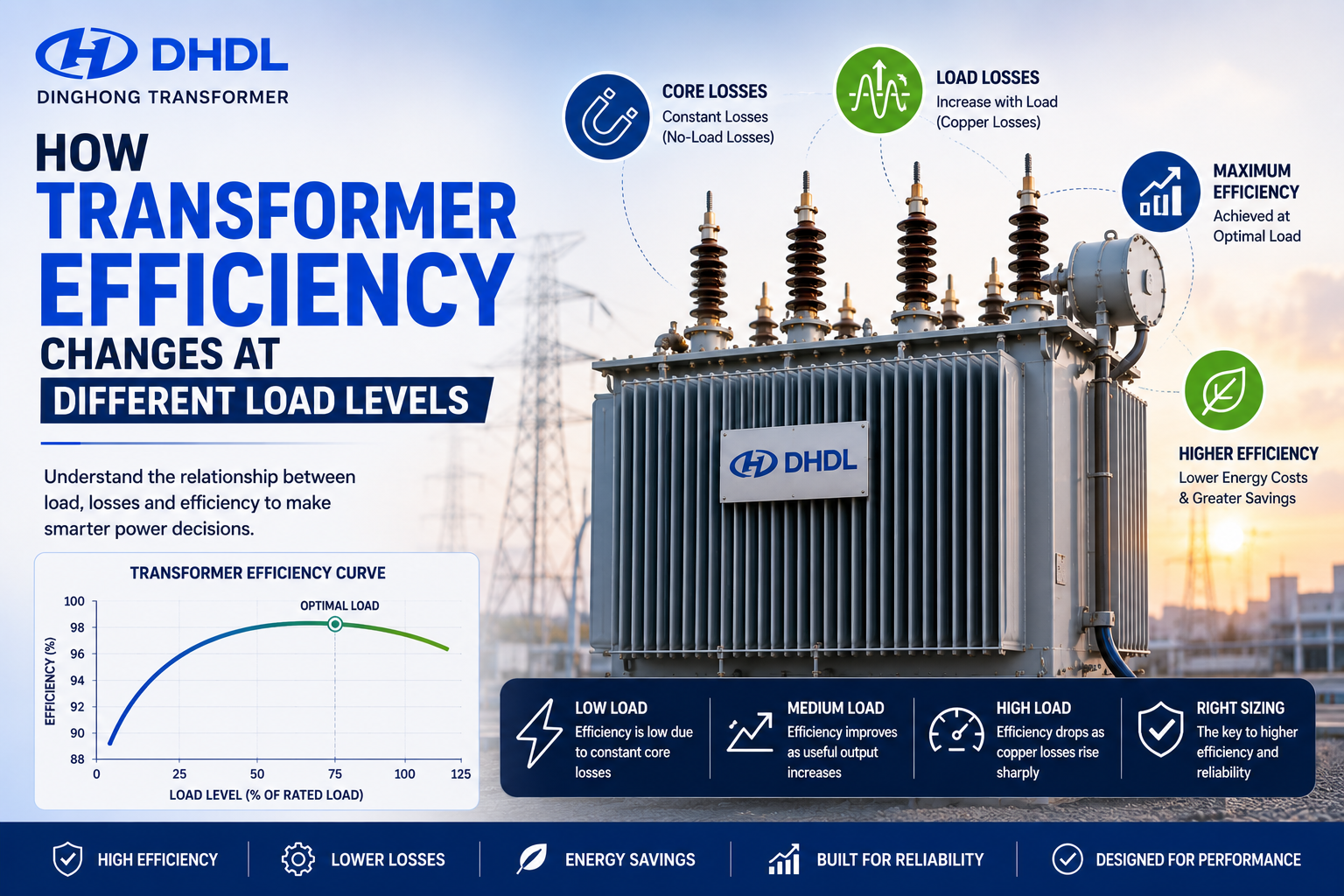
Transformer efficiency is one of the most important factors when evaluating the operating cost and long-term performance of a power transformer.
A transformer may be highly efficient at its rated load, but its efficiency does not remain constant as loading changes.
For industrial facilities, substations, commercial buildings, and renewable-energy projects, understanding transformer efficiency at different load levels helps engineers select the right transformer capacity, estimate energy losses, and avoid unnecessary operating costs.
What Is Transformer Efficiency?
Transformer efficiency describes how effectively a transformer converts electrical input power into useful output power.
It is commonly expressed as the ratio of output power to input power, usually as a percentage.Some energy is always lost during transformer operation.
The major losses are core losses and load losses.
Because these losses behave differently as transformer loading changes, efficiency also changes with load.
Core Losses and Load Losses
Core losses, also called no-load losses, occur whenever the transformer is energized, even when it is supplying little or no external load.
They are primarily associated with magnetization of the transformer core and include hysteresis and eddy-current losses.Load losses, on the other hand, increase as transformer current increases.
Copper losses in the windings are particularly important because they are approximately proportional to the square of the load current.
This difference explains why transformer efficiency varies considerably across the load range.
What Happens at Low Transformer Loads?
When a transformer operates at a very low load, core losses can represent a relatively large portion of the total input power.
The transformer may consume energy simply because it remains energized, even though it is delivering comparatively little useful power.
As a result, operating a significantly oversized transformer at low loading can reduce its practical energy efficiency.
This does not mean that every transformer should operate close to full capacity. Engineers must also consider starting currents, future expansion, reliability, temperature, redundancy, and expected demand.
How Efficiency Improves as Load Increases
As transformer loading increases from a very low level, useful output power increases faster than the relatively stable core losses.
Consequently, transformer efficiency generally improves.
This improvement continues until the increasing load losses begin to offset the benefit of putting more useful power through the transformer.
The exact efficiency curve depends on transformer design, rated capacity, voltage, winding resistance, core material, cooling method, and operating conditions.
What Happens Near Full Load?
As loading approaches the transformer’s rated capacity, load losses increase significantly because winding current is higher.
Since resistive losses rise approximately with the square of current, a relatively small increase in load can produce a disproportionately larger increase in load-related losses.
Temperature also rises as losses increase.
If the transformer operates continuously at high loading, thermal stress can accelerate insulation aging and affect service life.
At Overload Conditions
Operating a transformer above its rated capacity can create additional thermal and electrical stress. Temporary overload may be permissible under specific conditions and manufacturer or standard guidance, but continuous overloading can increase losses and temperature substantially.Before planning overload operation, engineers should evaluate ambient temperature, previous loading, cooling capability, insulation aging, and transformer design.
Why Transformer Sizing Affects Efficiency
Transformer sizing has a direct relationship with efficiency.
An excessively large transformer may spend much of its operating life at light load, making its fixed core losses more significant relative to useful output.
An Undersized transformer may operate near its thermal limits, increasing load losses and temperature.
The goal is not simply to choose the largest transformer available or the smallest unit that can carry the present load.
The better approach is to evaluate the facility’s load profile, expected growth, diversity, operating schedule, and required reserve.
Dinghong Transformer for Efficient Industrial Power Systems
DinghongTransformer (DHDL) manufactures power transformers and distribution transformers for industrial, utility, infrastructure, and renewable-energy applications.
Transformer design involves balancing efficiency, capacity, reliability, voltage requirements, cooling, insulation, impedance, installation conditions, and expected loading.
For a project with variable demand, DinghongTransformer can develop transformer specifications around the application’s operating requirements rather than relying only on a basic nameplate rating.