
What Happens If a Transformer Is Undersized? Real Consequences for Industrial Loads

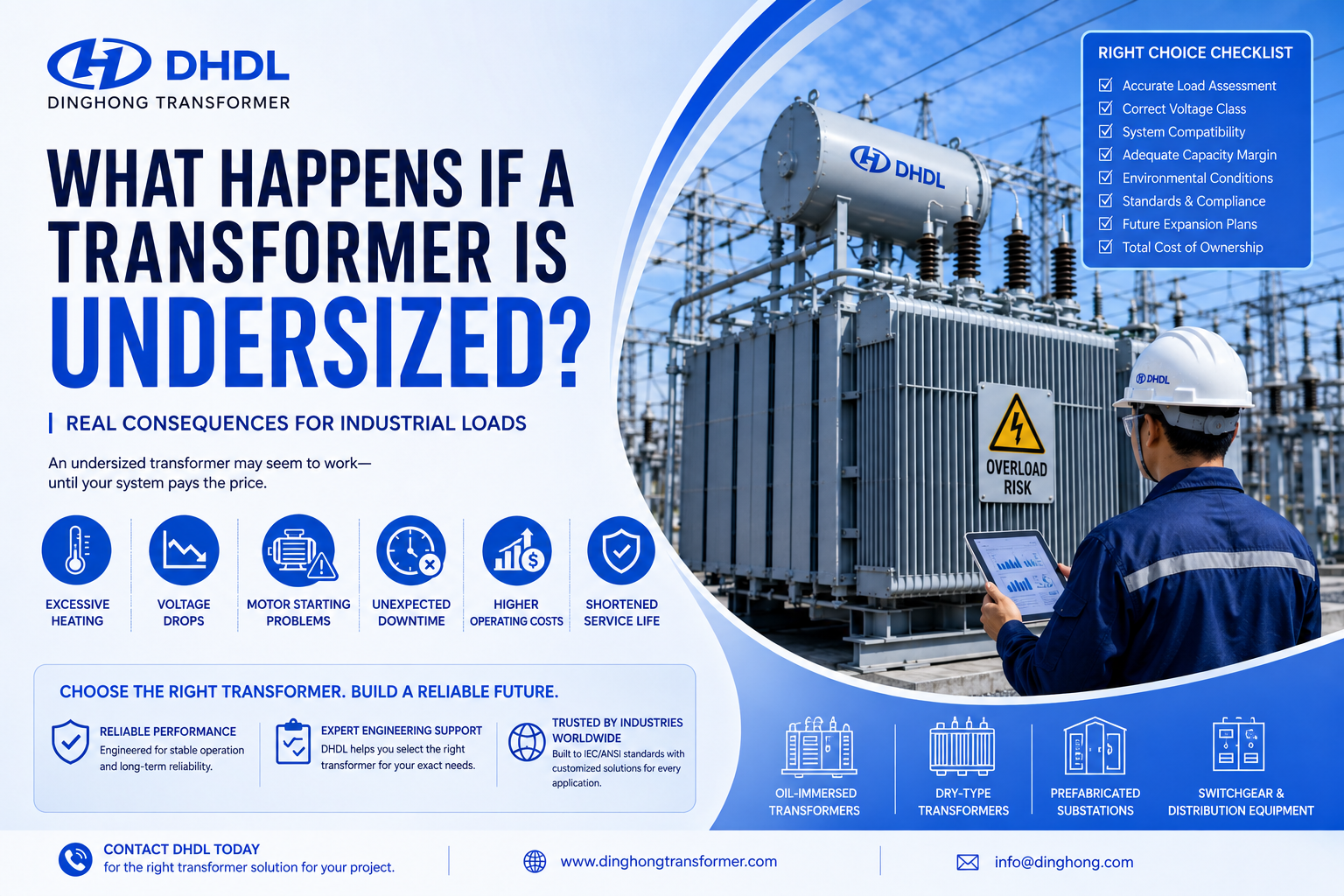
Choosing the correct transformer capacity is one of the most important decisions when designing an industrial power distribution system.
An undersized transformer may initially appear to work normally, but when production increases or multiple heavy electrical loads operate simultaneously, the transformer can become overloaded. The consequences can include excessive heat, voltage instability, equipment damage, unexpected downtime, higher operating costs, and premature transformer failure.
For factories, industrial parks, commercial facilities, renewable energy projects, and infrastructure developments, selecting the right industrial power transformer is therefore much more than choosing a convenient kVA rating.
It is about ensuring that the transformer can reliably support today’s load while providing sufficient capacity for future expansion.
What Is an Undersized Transformer?
A transformer is undersized when its rated capacity is insufficient for the electrical load it is expected to supply.
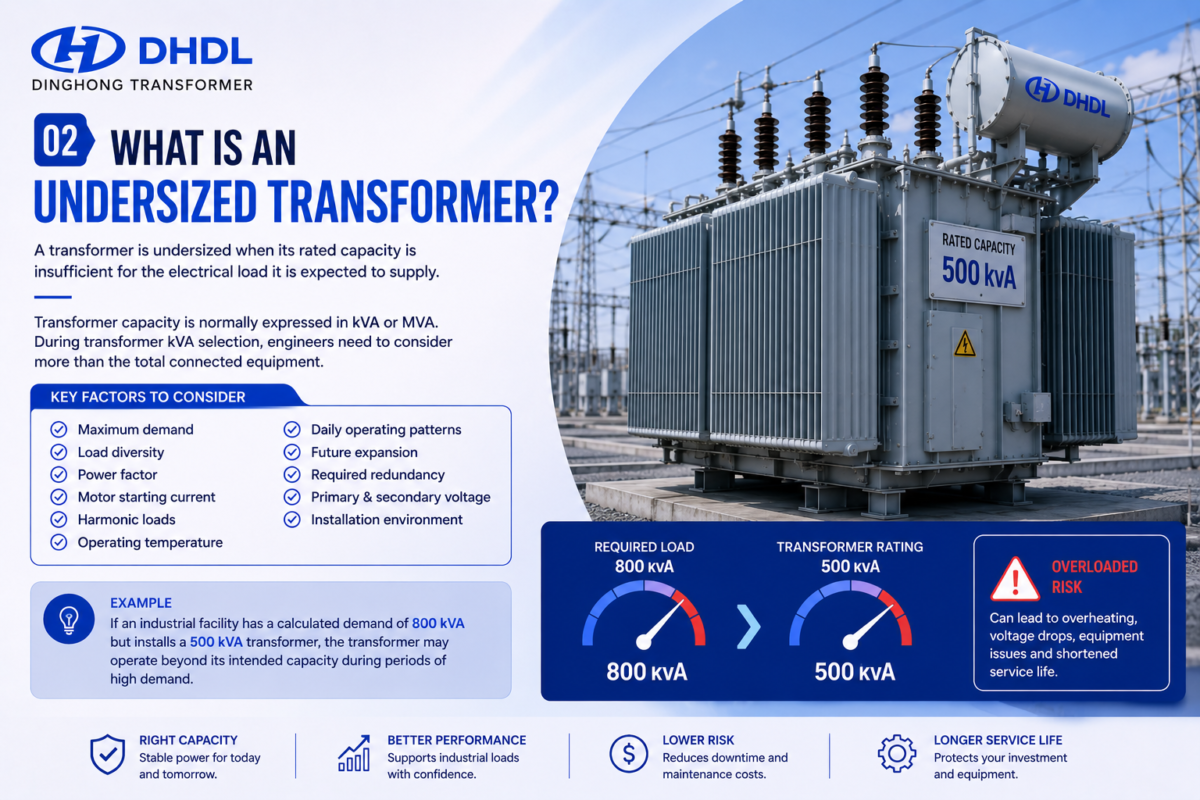
Transformer capacity is normally expressed in kVA or MVA. During transformer kVA selection, engineers need to consider more than the total connected equipment.
Important factors include:
- Maximum demand
- Load diversity
- Power factor
- Motor starting current
- Harmonic loads
- Operating temperature
- Daily operating patterns
- Future expansion
- Required redundancy
- Primary and secondary voltage
- Installation environment
For example, if an industrial facility has a calculated demand of 800 kVA but installs a 500 kVA transformer, the transformer may operate beyond its intended capacity during periods of high demand.
That can create problems throughout the facility’s electrical distribution system.
1. An Undersized Transformer Can Overheat
One of the most immediate consequences of transformer overloading is excessive heat.As electrical current increases, transformer losses also increase.
The additional losses generate heat inside the transformer.When the transformer operates beyond its rated capacity for extended periods, its cooling system may struggle to maintain an acceptable operating temperature.
Continuous overheating places additional stress on insulation, windings and other internal components.
For an industrial facility operating around the clock, repeated thermal stress can gradually reduce transformer reliability and service life.
This is why selecting the correct power distribution transformer requires consideration of both the expected load and the environmental conditions where the transformer will operate.
2. Voltage Drops Can Disrupt Production Equipment
Industrial machinery requires a stable electrical supply.
An undersized transformer may contribute to voltage drops, especially when large motors, compressors, pumps or other high-power equipment start or operate simultaneously.
Voltage instability can affect:
- Electric motors
- Variable-frequency drives
- Automation systems
- PLCs and control equipment
- HVAC systems
- Industrial machinery
- Sensitive electronic equipment
In a manufacturing environment, an electrical disturbance can quickly become a production problem.
A properly engineered transformer and power-distribution system helps reduce these risks by providing adequate capacity for the facility’s actual operating requirements.
3. Transformer Insulation Can Age Faster
Transformer insulation is affected by operating temperature.
When an undersized transformer is continuously overloaded, increased temperature can accelerate insulation aging.Over time, this can reduce the transformer’s expected service life and increase the probability of insulation-related failures.
This creates an important distinction between initial transformer cost and total cost of ownership.A smaller transformer may cost less to purchase, but if it operates under excessive thermal stress and needs replacement years earlier than expected, the apparent initial saving can disappear.
For industrial projects, reliability and lifecycle cost should therefore be considered alongside the purchase price.
4. Motor Starting Problems Can Become More Frequent
Large industrial motors can draw significantly more current during startup than during normal operation.
Factories may have dozens or even hundreds of motors powering:
- Pumps
- Compressors
- Conveyors
- Fans
- Crushers
- Production machinery
- Cooling systems
If the transformer does not have sufficient capacity, starting a large motor can cause a temporary voltage drop.
In severe situations, the motor may have difficulty accelerating, while other equipment connected to the same distribution system can experience voltage disturbances.
This is one reason engineers should not determine transformer capacity simply by adding equipment nameplate ratings.The actual operating profile of the facility must be evaluated.
5. Production Downtime Can Become the Real Cost
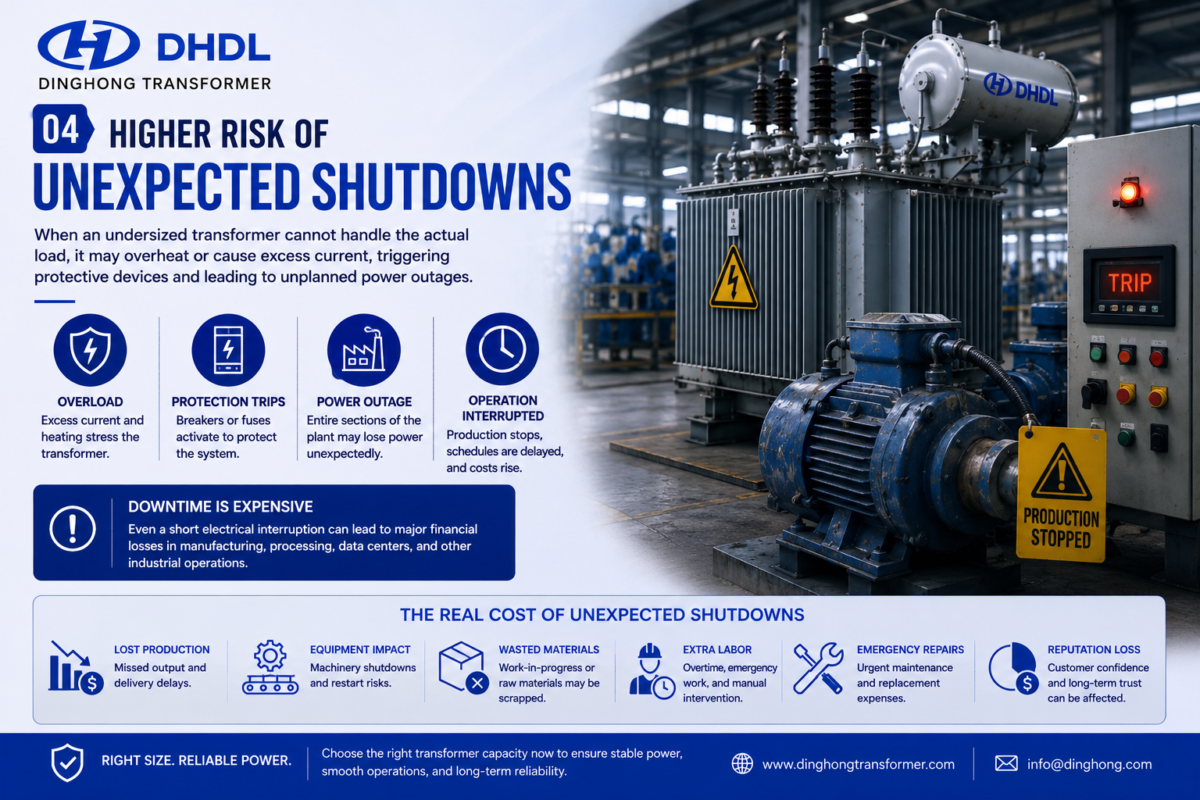
Transformer problems don’t always end with the transformer.If an overloaded transformer causes protective devices to operate or power quality problems to occur, production equipment may shut down.
For an industrial operation, downtime can be much more expensive than the transformer itself.
A production interruption can result in:
- Lost production
- Wasted raw materials
- Delayed deliveries
- Equipment restart costs
- Emergency maintenance
- Additional labor costs
- Customer dissatisfaction
For this reason, selecting an appropriately sized transformer is an important part of industrial risk management.
6. Future Expansion Becomes More Difficult
Industrial facilities rarely operate at exactly the same load throughout their entire lifespan.
A factory may eventually add another production line, larger motors, additional HVAC equipment, automated machinery, EV charging infrastructure or renewable energy systems.
If the original transformer was selected with almost no spare capacity, expansion can become expensive.
The facility may eventually need:
- A larger transformer
- Additional switchgear
- New cables
- Structural modifications
- Additional protection equipment
- Planned shutdowns
Considering future load growth during the original transformer kVA selection process can reduce the likelihood of major electrical upgrades later.
How Can You Tell If Your Transformer Is Undersized?
Several warning signs may indicate that a transformer is operating too close to its limits.
These include:
- Persistent transformer overheating
- Voltage fluctuations during peak demand
- Frequent protective trips
- Motor-starting difficulties
- Unexpected production interruptions
- Increasing electrical losses
- Transformer loading consistently approaching its rated capacity
- New equipment being added without reassessing transformer capacity
However, these symptoms do not automatically mean that the transformer needs to be replaced.A qualified electrical engineer should evaluate the complete power system and operating conditions.
Transformer monitoring and regular transformer testing can also help identify developing problems before they become major failures.
How Should Industrial Transformer Capacity Be Selected?
A reliable transformer selection process should begin with the project’s actual electrical requirements.
Engineers should evaluate:
1. Current electrical demand
Determine the facility’s actual maximum demand rather than relying only on connected load.
2. Load characteristics
Motors, welding equipment, variable-frequency drives, data-processing equipment and other loads can have different electrical characteristics.
3. Future expansion
Consider how much additional capacity the facility may require over its expected operating life.
4. Environmental conditions
Temperature, humidity, dust, altitude and outdoor exposure can influence transformer design requirements.
5. Voltage and frequency
The transformer must match the project’s primary and secondary voltage, frequency and connection requirements.
6. Required standards
International projects may require IEC, ANSI/IEEE, GB or project-specific technical requirements.
7. Transformer type
Depending on the application, the project may require an oil-immersed transformer, dry-type transformer or specialized transformer.
Why Choose Dinghong Transformer for Industrial Projects?
When an industrial transformer needs to be replaced, upgraded or specified for a new project, working with an experienced manufacturer can make the selection process significantly easier.
Dinghong Transformer (DHDL) manufactures transformers and complete power-distribution equipment for industrial, utility, infrastructure and renewable-energy applications.
Its product portfolio includes oil-immersed transformers, dry-type transformers and special transformers, alongside switchgear and prefabricated substations.
DHDL can customize transformer solutions according to project requirements, including voltage level, rated capacity, voltage ratio, impedance, cooling method, insulation requirements, accessories and applicable standards.Its medium-voltage oil-immersed distribution transformer range, for example, covers 6–38.5 kV and 30–2500 kVA, with customization available for different project conditions.
For larger projects, DHDL also manufactures high-voltage oil-immersed power transformers for applications including industrial power systems, substations and renewable-energy grid connections. Its published range includes voltage levels up to 500 kV, with customizable rated capacity and cooling configurations.
More Than Just a Transformer Supplier
Dinghong Transformer approaches industrial projects as complete power-distribution requirements rather than treating the transformer as an isolated component.
DHDL manufactures transformers, high- and low-voltage distribution cabinets, prefabricated substations, energy storage equipment and EV charging equipment.
The company also highlights integration between transformers and switchgear, IEC/ANSI standard adaptation, climate-specific design and export technical documentation.
This can be particularly valuable for overseas EPC contractors, distributors and industrial project developers that need equipment matched to a specific project specification.
DHDL states that its manufacturing process covers material preparation, winding, vacuum drying, assembly and routine testing, with factory testing including ratio, DC resistance, insulation, withstand-voltage and loss tests.
Don’t Size a Transformer Only for Today’s Load
An undersized transformer can create a chain reaction.What begins as excessive loading can lead to overheating.
Overheating can accelerate insulation aging.
Voltage drops can affect motors and control systems. Equipment interruptions can reduce production.
Eventually, the facility may face an expensive transformer replacement or electrical-system upgrade.
The solution is not necessarily to install the biggest transformer available.Instead, the transformer should be properly engineered around the facility’s current demand, operating conditions, expected expansion and reliability requirements.
For industrial facilities planning a new installation, expansion or transformer replacement, Dinghong Transformer can help match transformer capacity and configuration to the project’s electrical requirements.
Provide the required kVA/MVA, HV and LV voltage, frequency, connection group, applicable standard, application, installation environment and quantity, and DHDL can evaluate the appropriate transformer or complete power-distribution solution for the project.Need the right transformer for your industrial project?
Need the right transformer for your industrial project?
Contact Dinghong Transformer today .
Conclusion
An undersized transformer is not simply an equipment-sizing mistake. It can become a long-term reliability, maintenance and production problem.
The right transformer capacity helps provide stable power, accommodate industrial loads, support future expansion and reduce unnecessary operating stress.Whether you need an industrial power transformer, distribution transformer, dry-type transformer, oil-immersed transformer or complete power distribution system, selecting the right manufacturer and specification from the beginning can make a significant difference.
Dinghong Transformer combines transformer manufacturing with switchgear, substations and other power equipment to support complete industrial and energy projects.
For a transformer that is designed around your actual project requirements rather than a generic capacity rating, work with an experienced transformer manufacturer from the specification stage.