
Transformer Factory Acceptance Testing: What Buyers Should Expect Before Shipment

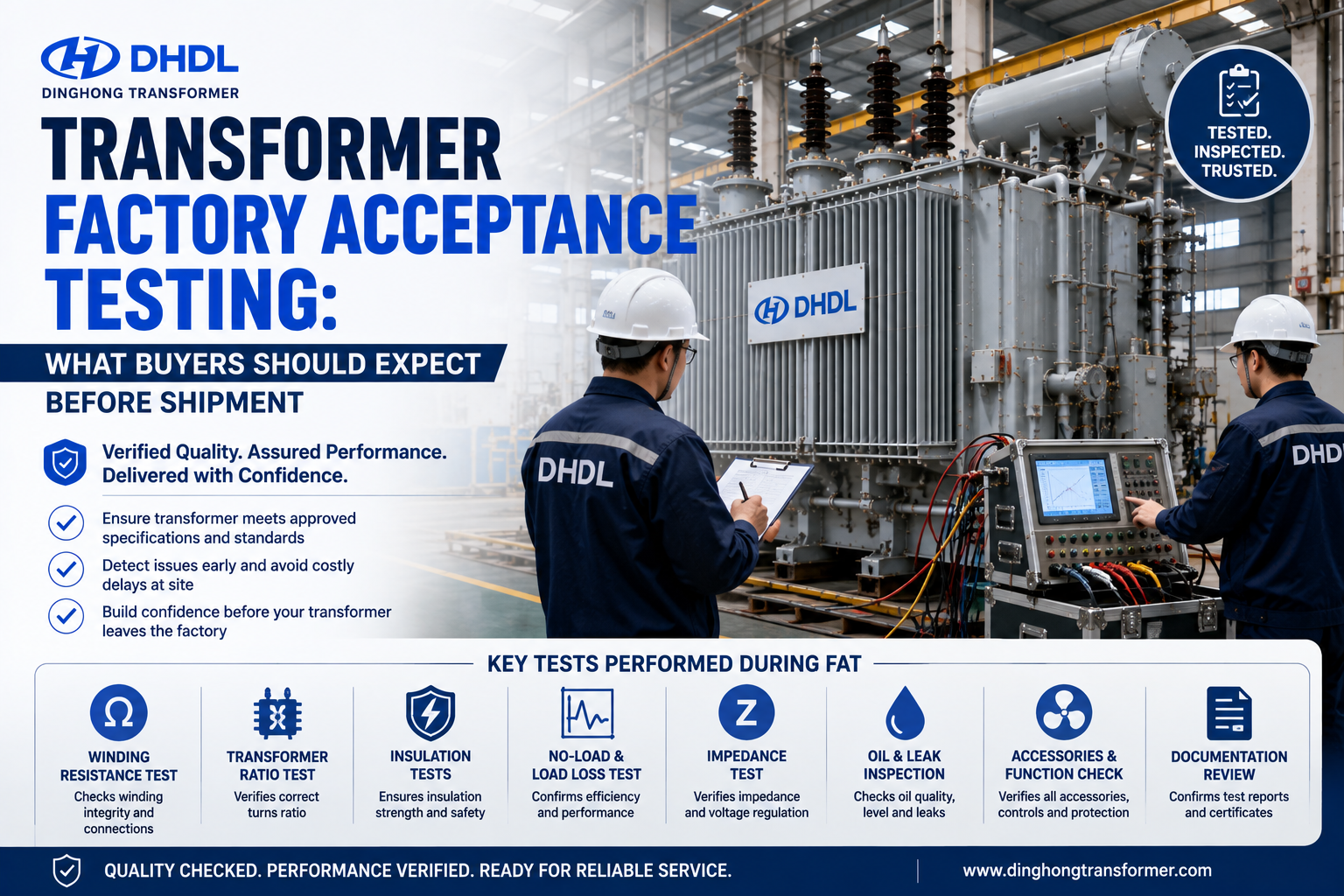
Buying a power transformer is a major investment, especially for industrial plants, substations, utilities, and renewable-energy projects.
Before a transformer leaves the factory, buyers need confidence that it meets the agreed electrical, mechanical, and performance requirements.
This is where transformer factory acceptance testing, commonly called FAT, becomes essential.
What Is Transformer Factory Acceptance Testing?
Factory acceptance testing is a series of inspections and electrical tests performed on a transformer before shipment.
The purpose is to verify that the transformer conforms to approved drawings, specifications, contractual requirements, and applicable standards.
Depending on the transformer and project specification, FAT can involve routine, type or special tests, dimensional inspections, accessory checks, and documentation reviews.
Buyers may witness selected tests before approving shipment.
Why Is Transformer FAT Important?
A transformer can be difficult and expensive to repair after it reaches the project site.
Problems discovered during installation or commissioning can cause delays and unexpected project expenses.
Factory acceptance testing moves verification to the manufacturing facility, where engineers can investigate and correct issues before delivery.
For buyers, this provides an important quality-control checkpoint.
1. Review the Transformer Design
Before testing begins, buyers should confirm that the transformer matches the approved design.Important details include rated power, voltage, frequency, phase configuration, vector group, impedance, insulation level, cooling method, tap-changer arrangement, and accessories.
The nameplate information should also correspond with the approved technical documentation.
2. Winding Resistance Test
A winding resistance test measures the resistance of transformer windings using direct current. The results can help identify poor connections, winding problems, or abnormal differences between phases.For transformers with tap changers, measurements may be taken at different tap positions.
3. Transformer Ratio Test
The transformer turns ratio test verifies that the relationship between high-voltage and low-voltage windings matches the specified ratio.An unexpected ratio can indicate winding or connection issues.
4. Insulation Resistance and Dielectric Tests
Insulation testing evaluates the condition and electrical strength of the transformer insulation system.
Depending on the transformer design and applicable standards, factory testing may include insulation resistance measurements and dielectric withstand tests.
5. No-Load and Load-Related Performance Tests
Transformer losses are an important consideration for long-term operating costs.
Factory testing can measure no-load losses and load losses according to the applicable test requirements.These results allow buyers to compare delivered performance with guaranteed values in the purchase agreement.
6. Impedance and Short-Circuit Verification
Transformer impedance affects voltage regulation, fault current, and parallel operation. Where required, impedance and load-loss measurements are verified during factory testing.
7. Insulating Oil and Leak Inspection
For oil-immersed transformers, buyers should expect checks related to insulating oil, sealing, and leakage.
The transformer tank, valves, radiators, conservator, bushings, and other oil-containing components should be inspected for leaks or visible defects.
8. Inspect Bushings, Cooling Equipment and Accessories
FAT should not focus only on transformer windings.
External components also need inspection.
Buyers should verify Bushing, radiators, cooling fans, pumps, tap changers, control cabinets, protection devices, gauges, terminals, and monitoring equipment against approved drawings and specifications.
9. Documentation and Test Certificates
Test results are an important part of transformer acceptance. Buyers should receive appropriate factory test reports and certificates showing the actual measured values.Documentation may include routine test results, inspection records, drawings, nameplate information, oil-test results, calibration information, and other agreed quality documents.
These checks also give project teams a documented baseline for commissioning, future maintenance, warranty discussions, and long-term transformer performance monitoring programs.
Dinghong Transformer: Quality Before Shipment
DinghongTransformer(DHDL) manufactures power transformers and distribution transformers for industrial, utility, infrastructure, and renewable-energy applications.
For every transformer project, factory testing should be aligned with the equipment’s technical requirements and intended operating environment.
Dinghong Transformer can develop transformer solutions around voltage, capacity, cooling requirements, insulation systems, impedance, installation conditions, and applicable standards.
A structured factory acceptance process helps ensure that the equipment delivered to the customer reflects the agreed design and performance requirements.
What Should Buyers Do During FAT?
Buyers should review the approved specifications before attending factory acceptance testing.
They should understand which tests are routine, which are witnessed, and which results are guaranteed.
During the inspection, record actual test results rather than relying only on pass/fail statements. Compare measurements with approved requirements and investigate unexplained deviations.
Buyers should also confirm that the transformer is properly prepared for shipment after testing. Accessories should be identified and packaged correctly, documentation should be complete, and transportation requirements should be communicated clearly.
Final Thoughts
Transformer factory acceptance testing gives buyers an opportunity to verify quality before a valuable piece of electrical equipment leaves the manufacturing facility.
From winding resistance and transformer ratio tests to insulation, losses, impedance, oil, accessories, and documentation, each inspection contributes to a clearer understanding of transformer condition and compliance.
A successful FAT does not replace proper installation, commissioning, and maintenance, but it provides an important foundation for them.
For industrial and utility projects, working with a manufacturer such as Dinghong Transformer and establishing clear FAT requirements before production can reduce uncertainty, prevent avoidable delays, and provide greater confidence that the transformer is ready for shipment and reliable service.