
Transformer Lifecycle Cost: How to Compare Price, Losses, Maintenance and Reliabilityy

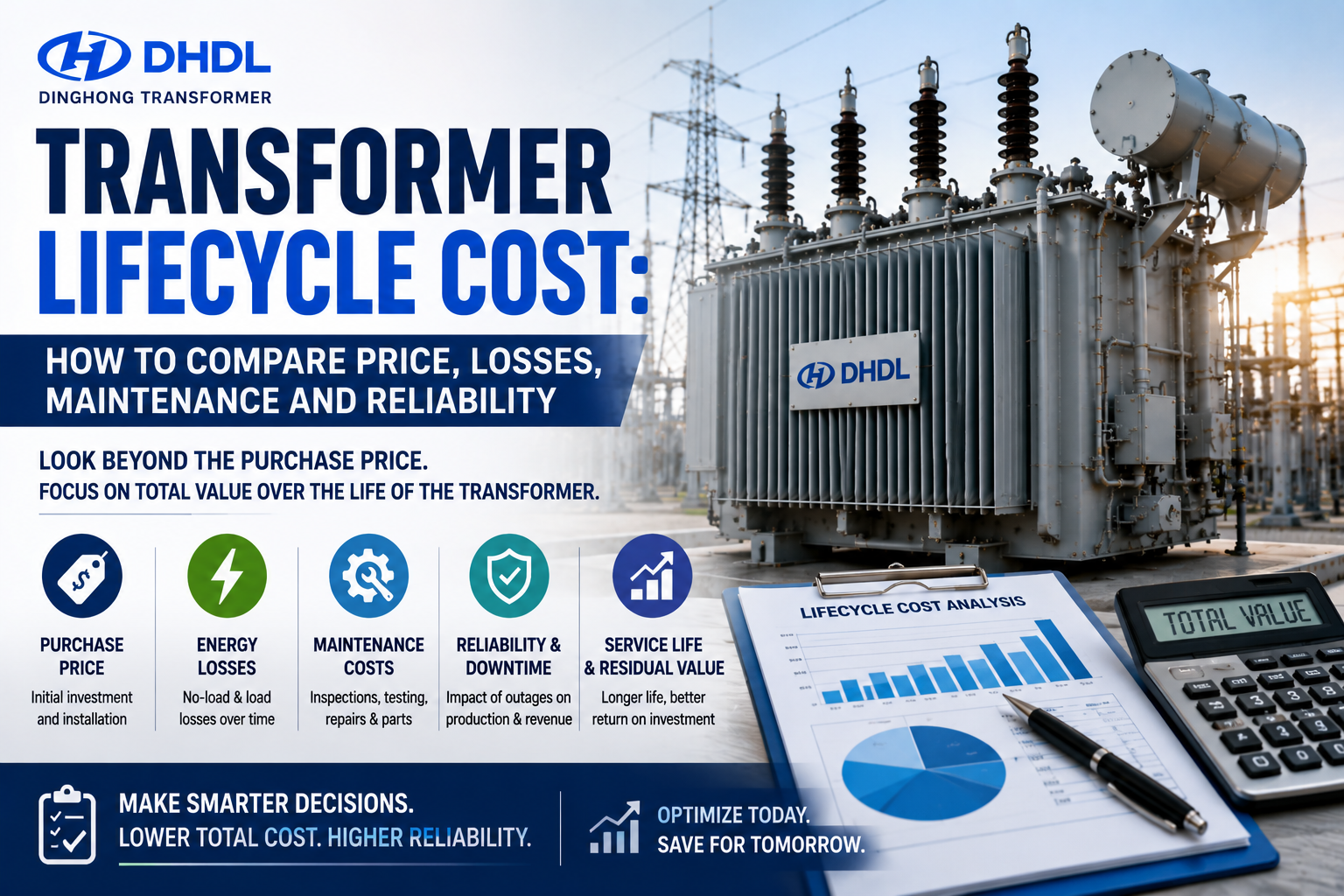
When purchasing a power transformer, the lowest initial price is not always the lowest overall cost.
A transformer can operate for decades, and its purchase price is only one part of what an industrial facility, utility, or infrastructure project ultimately spends.
Energy losses, maintenance, downtime, repairs, and expected service life can have a major impact on the total investment.Understanding transformer lifecycle cost helps engineers and procurement teams compare equipment based on long-term value rather than purchase price alone.
What Is Transformer Lifecycle Cost?
Transformer lifecycle cost is the total cost associated with owning and operating a transformer throughout its useful service life.
It can include the initial purchase price, transportation, installation, energy losses, inspections, maintenance, repairs, replacement components, and costs associated with unplanned outages.
This approach is also called total cost of ownership. Instead of asking, “Which transformer is cheapest?” buyers can ask, “Which transformer provides the best long-term value for this application?”
1. Start With the Purchase Price
Two transformers with similar ratings can have different prices because of differences in core materials, winding design, cooling systems, insulation, accessories, monitoring equipment, manufacturing quality, and customization.
A lower-cost transformer may appear attractive initially but could have higher operating losses or maintenance requirements.
A higher-efficiency transformer may require greater upfront investment while reducing operating costs over many years.
2. Calculate Transformer Energy Losses
Transformer losses are one of the most important components of lifecycle cost. The two primary categories are no-load losses and load losses.
No-load losses occur whenever the transformer is energized, even when it is supplying little load.
Load losses increase as current increases and are strongly influenced by transformer loading.When comparing transformers, engineers should evaluate expected loading patterns rather than relying only on rated efficiency.
3. Consider the Actual Load Profile
A transformer rarely operates at exactly the same load throughout its entire life. Industrial facilities may experience changing production schedules, seasonal demand, startup loads, and future capacity requirements.
A lifecycle cost analysis should therefore consider how many hours the transformer is expected to operate at different load levels.An efficient transformer at the facility’s typical operating point may provide more value than a transformer optimized only for full-load conditions.
4. Include Maintenance Costs
Maintenance is another important part of transformer lifecycle cost.
Oil immersed transformerss may require oil testing, inspections, cleaning, connection checks, and condition monitoring.
Other maintenance requirements depend on the transformer design and operating environment.
Engineers should consider the availability and cost of replacement components, inspection requirements, testing intervals, and specialist services.
A transformer designed for maintainability can reduce maintenance complexity and help keep operating costs predictable.
5. Account for Reliability and Downtime
The financial impact of transformer failure can be much greater than the repair bill.An unexpected transformer outage may interrupt production, affect downstream equipment, delay deliveries, and create additional labor or emergency replacement costs.
For critical facilities, reliability should therefore be included in the economic comparison. Features such as appropriate thermal design, insulation quality, protection, monitoring, and manufacturing controls can contribute to dependable operation.
6. Evaluate Service Life
A transformer with a long service life can spread its initial investment and installation costs across many years of operation.
Service life depends on design, insulation aging, operating temperature, loading, maintenance, environmental conditions, and other factors.
Operating a transformer consistently above its thermal limits can accelerate insulation aging. Selecting appropriate capacity and cooling can therefore support both reliability and long-term value.
7. Compare the Total Cost of Ownership
A practical transformer lifecycle cost model can combine:
- Initial transformer purchase price
- Transportation and installation
- No-load energy losses
- Load energy losses
- Maintenance and testing
- Spare parts
- Repairs
- Monitoring equipment
- Expected downtime costs
- End-of-life replacement costs
Dinghong Transformer and Long-Term Value
DinghongTransformer (DHDL) manufactures power transformers and distribution transformers for industrial, utility, infrastructure, and renewable-energy applications.
For transformer projects, the objective should be more than meeting a basic capacity and voltage requirement.
Transformer design can be developed around expected loading, cooling requirements, insulation systems, environmental conditions, efficiency targets, and applicable standards.
By considering these factors early, customers can select equipment that balances upfront investment with operating efficiency, reliability, and maintenance requirements.
Why Lifecycle Cost Matters in Transformer Selection
A transformer is a long-term infrastructure investment.
Choosing equipment solely according to the lowest quotation can overlook costs that accumulate throughout years of operation.
A lifecycle cost comparison provides a broader view.
It helps engineers understand whether paying more for lower losses, stronger reliability, better monitoring, or easier maintenance could produce measurable savings over time.
Final Thoughts
Transformer lifecycle cost provides a better framework for comparing transformer options than purchase price alone. Initial cost, energy losses, maintenance, reliability, downtime, and service life all contribute to the real cost of ownership.
The best transformer is not necessarily the cheapest transformer to buy.
It is the transformer that delivers the right combination of efficiency, reliability, maintainability, capacity, and long-term operating value.
By analyzing total cost of ownership before procurement, engineers and facility owners can make more informed decisions, reduce avoidable expenses, and build a more reliable power system.