
75kVA 3 Phase Transformer: Specifications, Applications & Buyer’s Guide

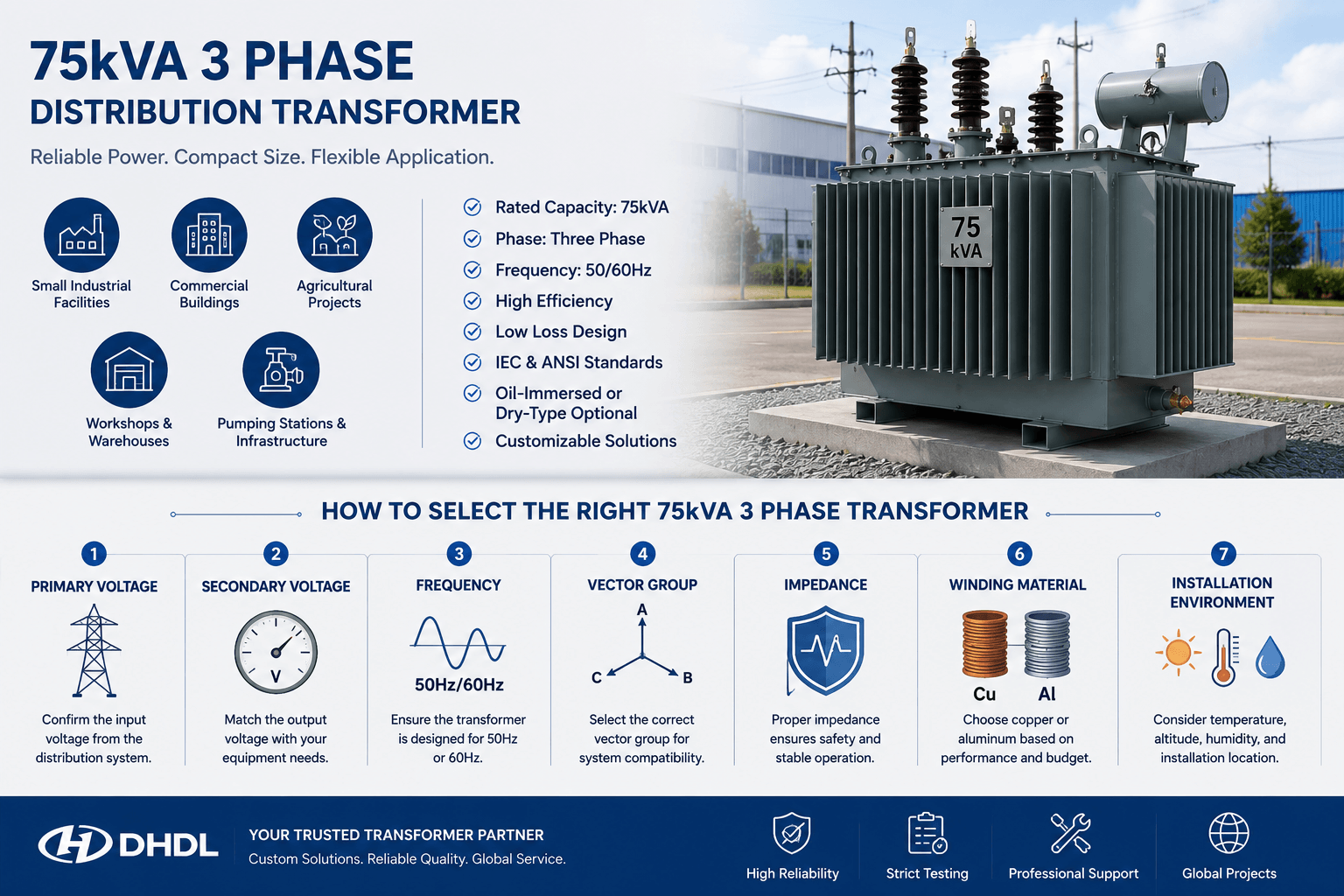
A 75kVA 3 phase transformer is a practical choice for small and medium-sized commercial, industrial, agricultural, and infrastructure power distribution systems. It provides enough capacity for many three-phase loads while remaining more compact and economical than larger distribution transformers.
But selecting a 75kVA transformer is not simply a matter of finding a unit marked “75kVA.”
Two transformers with the same capacity can have completely different primary voltages, secondary voltages, vector groups, impedance values, winding materials, insulation systems, cooling methods, and efficiency levels.
For buyers, EPC contractors, electrical distributors, and project engineers, these details determine whether the transformer will actually work correctly after installation.
This guide explains what a 75kVA three-phase transformer is, how much load it can support, common voltage configurations, applications, and the specifications buyers should confirm before ordering.
What Is a 75kVA 3 Phase Transformer?
A 75kVA three-phase transformer is an electrical transformer with an apparent power rating of 75 kilovolt-amperes (kVA) designed for a three-phase AC electrical system.
Its primary purpose is to change voltage while transferring electrical energy between three-phase circuits.
Depending on the project, it may be used to:
- Step medium voltage down to utilization voltage
- Convert one low-voltage level to another
- Supply three-phase industrial equipment
- Support commercial facilities
- Supply pumps, motors and HVAC equipment
- Serve small distributed loads
A 75kVA transformer is significantly smaller than the multi-MVA units used in major substations, but that does not make specification accuracy less important. In smaller projects, choosing the wrong voltage or connection can still prevent commissioning completely.
How Many Amps Does a 75kVA 3 Phase Transformer Provide?
This is one of the most common questions buyers search before purchasing a transformer.
For a three-phase transformer, the line current depends on the rated kVA and system voltage.
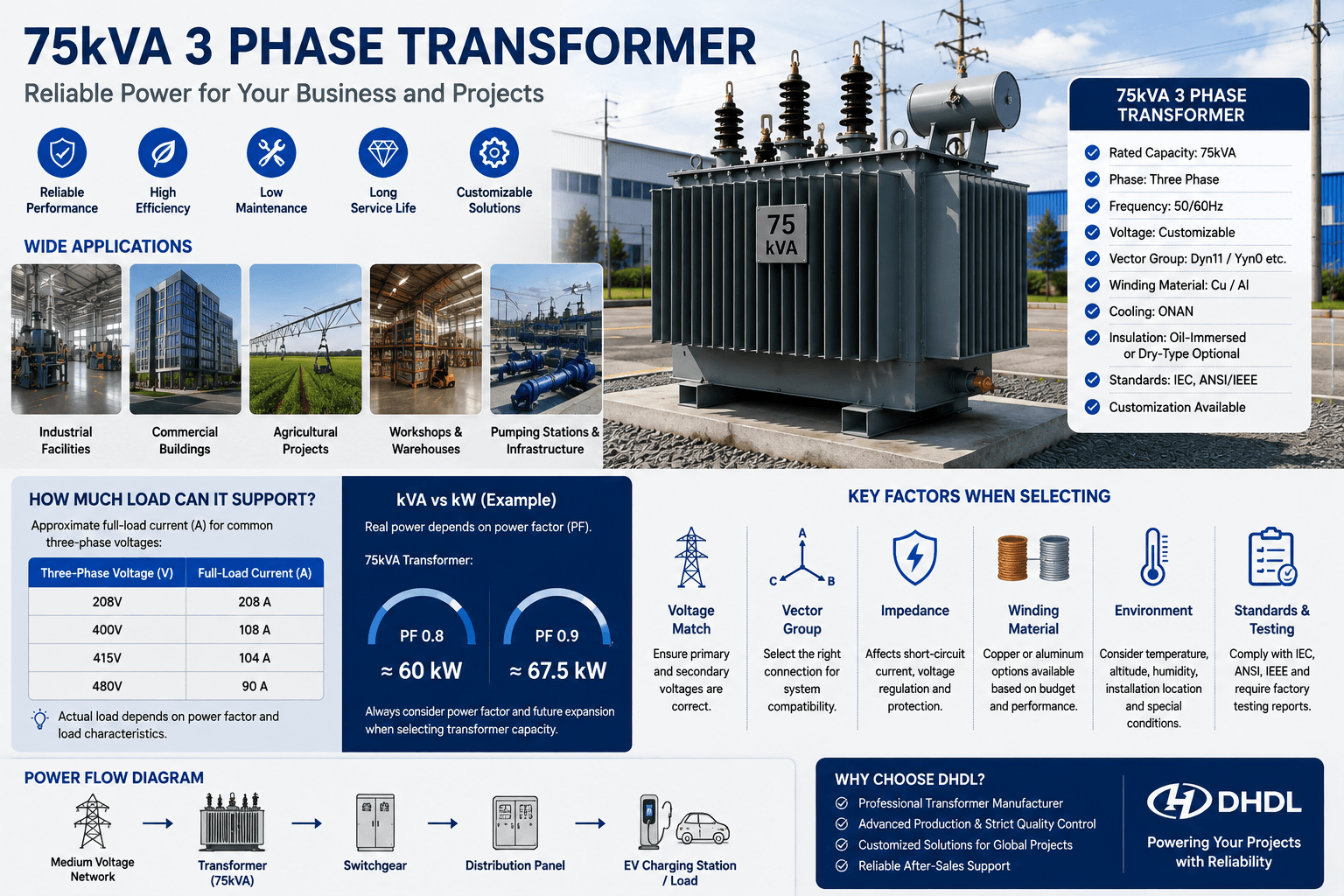
For example, a 75kVA transformer provides approximately:
| Three-Phase Voltage | Approx. Full-Load Current |
|---|---|
| 208V | 208A |
| 400V | 108A |
| 415V | 104A |
| 480V | 90A |
These values are useful for preliminary planning, but transformer selection should not be based on current alone.
Actual project design must also consider load characteristics, power factor, starting current, harmonics, ambient temperature, altitude, future expansion, and applicable electrical standards.
75kVA Does Not Mean 75kW
This is an important distinction that buyers sometimes overlook.
Transformers are normally rated in kVA, while many loads are described in kW.
A 75kVA transformer does not automatically mean that it can continuously supply 75kW of real power.
For example, at a power factor of 0.8:
75kVA × 0.8 = 60kW
At a power factor of 0.9:
75kVA × 0.9 = 67.5kW
Therefore, if your connected equipment requires around 70–75kW continuously, selecting a 75kVA transformer without checking the actual power factor and load profile may leave insufficient capacity.
This becomes especially important for motors, compressors, pumps, welding equipment and other loads with high starting or fluctuating demand.
Common Applications of a 75kVA Three-Phase Transformer
1. Small Industrial Facilities
A 75kVA transformer can supply groups of relatively small three-phase machines, production equipment, pumps, compressors, ventilation systems and auxiliary loads.
2. Commercial Buildings
Commercial facilities may use a three-phase transformer for lighting, HVAC, elevators, refrigeration systems and general electrical distribution.
3. Agricultural Projects
Farms and agricultural processing facilities often require three-phase electricity for irrigation pumps, ventilation systems, grain handling equipment and processing machinery.
4. Workshops and Warehouses
A 75kVA unit can be suitable for workshops and warehouses where the electrical demand is moderate but three-phase equipment is required.
5. Infrastructure and Distributed Loads
The transformer may also be used for remote facilities, utility distribution, small pumping stations and other decentralized electrical loads.
The correct application depends on the actual load calculation rather than the facility name alone.
Oil-Immersed or Dry-Type: Which Is Better for 75kVA?
Both designs can be appropriate depending on installation conditions.
Oil-Immersed Transformer
Oil-immersed transformers use insulating oil for electrical insulation and heat dissipation.
They are commonly selected for outdoor distribution because they offer:
- Effective heat dissipation
- Reliable continuous operation
- Compact design
- Good environmental adaptability
- Competitive lifecycle cost
DHDL’s oil-immersed distribution transformer platform covers 30–2500kVA and 6–38.5kV, with configurations adapted to project requirements.
Dry-Type Transformer
Dry-type transformers use solid insulation and air-based cooling instead of transformer oil.
They are often preferred for:
- Indoor electrical rooms
- Commercial buildings
- Hospitals
- Schools
- Data centers
- Locations with stricter fire-safety requirements
The decision should therefore be based on installation environment, fire requirements, maintenance conditions and total project cost, rather than assuming one technology is universally better.
7 Specifications to Confirm Before Buying a 75kVA Transformer
1. Primary Voltage
Never send an RFQ that says only:
“Need 75kVA 3 phase transformer.”
The manufacturer first needs to know the incoming voltage.
Depending on the project, this could be a medium-voltage distribution supply or another low-voltage system.
The exact grid voltage must be confirmed before design.
2. Secondary Voltage
The secondary voltage must match the equipment or downstream distribution system.
Typical three-phase utilization voltages vary significantly between countries and applications.
Do not assume that “standard voltage” means the same thing in every market.
3. Frequency
Confirm whether the electrical system operates at:
- 50Hz
- 60Hz
Frequency affects transformer design and must be specified when ordering.
4. Vector Group
The vector group defines how the high-voltage and low-voltage windings are connected and their phase displacement.
Common transformer configurations may include Dyn11, Yyn0 or other project-specific arrangements.
The correct vector group must match the electrical system design.
5. Impedance
Transformer impedance affects:
- Short-circuit current
- Voltage regulation
- Protection coordination
- Parallel operation
Do not simply copy an impedance value from another transformer specification without checking the system requirements.
6. Copper or Aluminum Windings
Both copper and aluminum can be used when the transformer is correctly engineered.
Copper generally provides higher conductivity and allows compact winding designs, while aluminum can offer economic advantages.
Instead of asking only which material is “better,” compare:
- Loss performance
- Temperature rise
- Mechanical design
- Transformer dimensions
- Project budget
7. Installation Environment
Tell the manufacturer where the transformer will operate.
Important information includes:
- Indoor or outdoor
- Maximum ambient temperature
- Minimum ambient temperature
- Altitude
- Humidity
- Dust
- Corrosive atmosphere
- Coastal environment
DHDL supports transformer adaptation for high temperature, high humidity, high altitude, dusty areas, corrosion and outdoor operating conditions.
A Hidden Cost: Transformer Losses Matter Even at 75kVA
For smaller transformers, buyers sometimes assume efficiency differences are too small to matter.
That can be an expensive assumption.
A distribution transformer may remain energized 24 hours a day, even when the connected equipment is operating at only partial load.
Two losses should therefore be checked:
No-load loss occurs whenever the transformer is energized.
Load loss increases as the transformer supplies current.
Over years of operation, a cheaper transformer with higher losses can consume enough additional electricity to offset part—or even all—of the initial purchase-price saving.
For projects purchasing dozens or hundreds of distribution transformers, this difference becomes even more important.
Should You Oversize a 75kVA Transformer?
Not automatically.
Buying a much larger transformer “just to be safe” can increase:
- Initial equipment cost
- Physical size
- Installation cost
- No-load energy losses
But selecting a transformer too close to the maximum continuous load can create overheating and limit future expansion.
A better approach is to evaluate:
- Maximum demand
- Continuous load
- Motor starting current
- Load diversity
- Power factor
- Harmonic loads
- Future expansion
If the calculated requirement is already close to 75kVA under normal operating conditions, the next transformer capacity should be evaluated rather than automatically specifying 75kVA.
What Should Be Included in a 75kVA Transformer RFQ?
For a faster and more accurate quotation, provide:
- Rated capacity: 75kVA
- Phase: Three phase
- Primary voltage
- Secondary voltage
- Frequency: 50Hz or 60Hz
- Vector group
- Impedance requirement
- Copper or aluminum winding preference
- Oil-immersed or dry-type design
- Indoor or outdoor installation
- Ambient temperature
- Altitude
- Applicable standard
- Quantity
- Destination country
- Required accessories
If you have a single-line diagram (SLD) or project technical specification, send it with the inquiry. It can eliminate multiple rounds of technical clarification.
Factory Testing Should Be Part of the Purchase Decision
A transformer should not be evaluated only from its nameplate.
Manufacturing consistency and factory testing directly affect long-term reliability.
DHDL controls key manufacturing processes including material preparation, winding, drying, assembly and final testing. Routine testing includes transformer ratio, DC resistance, insulation, withstand voltage and loss verification.
For overseas projects, technical drawings, test reports, manuals and export documentation can also be prepared according to project requirements.
FAQ
1. How many amps can a 75kVA three-phase transformer handle?
It depends on the secondary voltage. Approximate full-load current is about 208A at 208V, 108A at 400V, 104A at 415V and 90A at 480V.
2. How many kW is a 75kVA transformer?
The real power depends on power factor. At 0.8 power factor, 75kVA corresponds to approximately 60kW; at 0.9 power factor, approximately 67.5kW.
3. Is a 75kVA transformer suitable for motors?
It can be, but motor starting current must be considered. Large motors can draw several times their normal operating current during startup, so a load and starting analysis should be performed before selecting transformer capacity.
4. Should I choose an oil-immersed or dry-type 75kVA transformer?
Oil-immersed units are commonly used for outdoor distribution and provide effective cooling. Dry-type transformers are often preferred indoors or where fire and oil-leakage requirements are more restrictive.
5. Can a 75kVA transformer be customized for 50Hz or 60Hz?
Yes. Transformer frequency must match the power system, and DHDL supports both 50Hz and 60Hz project requirements.
6. Can I order a 75kVA transformer with copper or aluminum windings?
Yes. DHDL supports copper and aluminum winding options depending on project specifications, performance requirements and budget.
7. What information should I send for a 75kVA transformer quotation?
Send the primary and secondary voltage, frequency, vector group, impedance, transformer type, winding material, installation conditions, standard, quantity and destination country.
Choose DHDL for Your Transformer Solution
DHDL is a professional transformer and power distribution equipment manufacturer serving utility, industrial, commercial and renewable-energy projects.
Our transformer solutions can be customized according to project capacity, voltage combination, frequency, winding material, installation environment and IEC or ANSI/IEEE requirements.
Whether you need a 75kVA three-phase transformer or a complete transformer and switchgear solution, providing complete electrical specifications at the RFQ stage helps our engineering team confirm a more accurate configuration.
Need a 75kVA transformer quotation? Send us your primary voltage, secondary voltage, frequency, application, standard, quantity and destination country.
💬WeChat/WhatsApp:+8613355383777
📩 Email:service@dinghongtransformer.com
🌐web:https://dinghongtransformer.com/