
How Does a Transformer work? Understanding the Basic Principles.

Introduction
Transformers are among the most important components used in modern electrical and electronic systems. From power generation and transmission to household appliances, industrial equipment, telecommunications, and electronic devices, transformers help electrical systems operate safely and efficiently.
But how does a transformer work? At its most basic level, a transformer is a static electrical device that transfers alternating electrical energy from one circuit to another through electromagnetic induction. It can increase or decrease voltage depending on the design and the number of turns in its windings. (Schneider Electric)
Understanding the basic principles of transformers is useful for engineers, technicians, manufacturers, students, and anyone working with electrical or electronic equipment. In this article, we will explain how transformers work, the role of their major components, the relationship between voltage and winding turns, different types of transformers, common applications, and what to consider when selecting a transformer.
What Is a Transformer?
A transformer is an electrical device designed to transfer electrical energy between circuits through a changing magnetic field. Unlike motors and generators, transformers normally have no moving mechanical parts. Their operation depends primarily on electromagnetic induction.
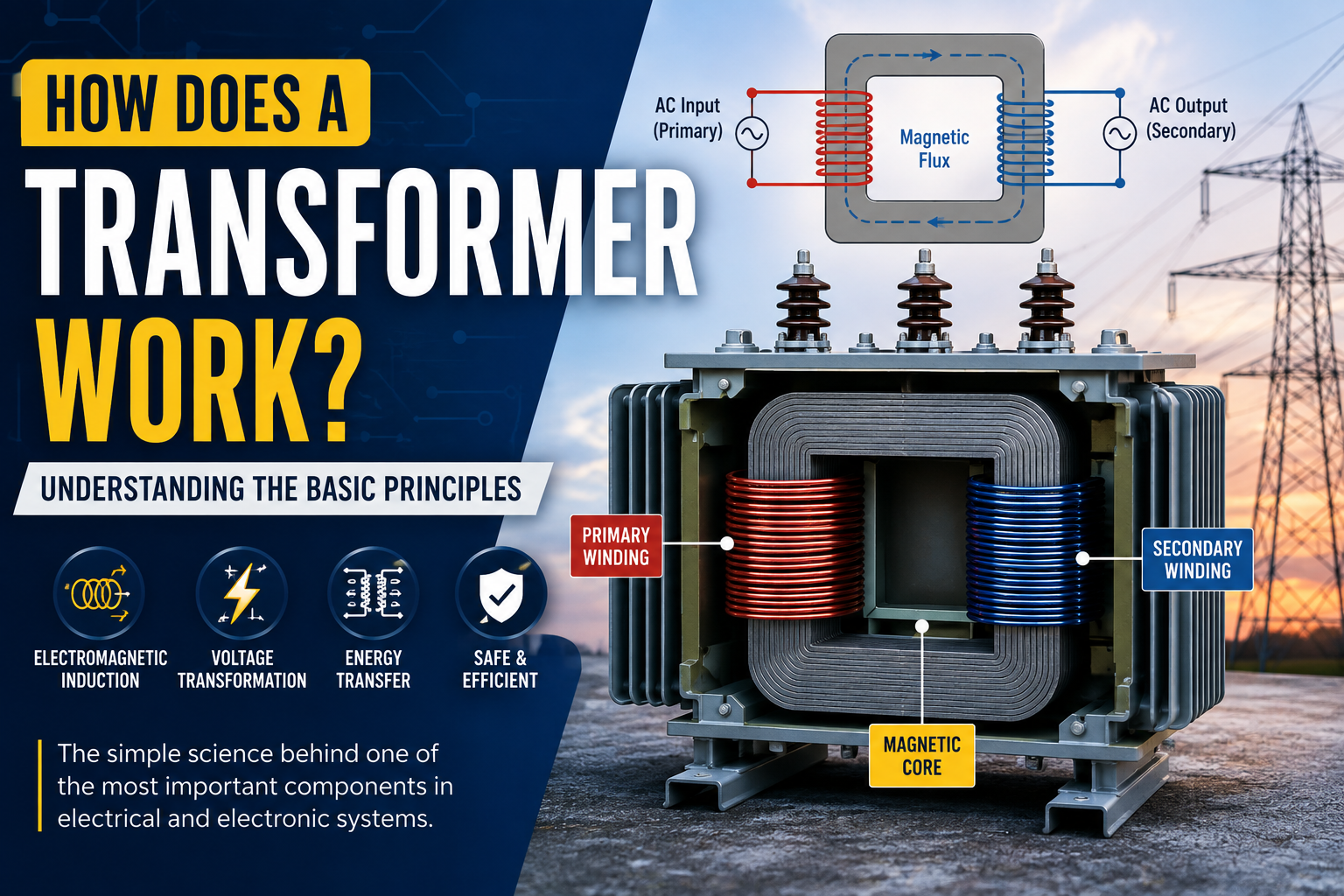
A basic transformer consists of three major elements:
- A magnetic core
- A primary winding
- A secondary winding
The primary winding is connected to the input electrical supply, while the secondary winding delivers the transformed electrical output to a load. The two windings are electrically insulated from each other, while the magnetic core provides a path that helps couple the magnetic flux between them. (Schneider Electric)
The main purpose of a transformer is not necessarily to create more electrical power. Instead, it changes the voltage and current characteristics of an AC electrical supply while transferring energy from one circuit to another.
How Does a Transformer Work?
The working principle of a transformer is based on Faraday’s law of electromagnetic induction and mutual induction.
Here is the basic process:
- An AC voltage is applied to the primary winding.
- Alternating current flows through the primary winding.
- The current produces a changing magnetic field.
- The magnetic field creates changing magnetic flux within the core.
- The changing flux links with the secondary winding.
- An electromotive force (EMF), or voltage, is induced in the secondary winding.
- When a load is connected to the secondary, current flows through the load.
This process allows electrical energy to be transferred between the primary and secondary circuits without a direct electrical connection between the two windings. (GeeksforGeeks)
In simple terms, you can think of the transformer as converting electrical energy into a changing magnetic field and then converting that magnetic energy back into electrical energy at another voltage level.
The Role of Electromagnetic Induction
Electromagnetic induction is the foundation of transformer operation.
When alternating current passes through the primary winding, it produces a magnetic field that continuously changes direction and magnitude. The transformer core concentrates and guides much of this changing magnetic flux toward the secondary winding.
According to Faraday’s law, a changing magnetic flux through a coil induces an electromotive force in that coil. Therefore, as the magnetic flux changes, voltage is induced in the secondary winding. (GeeksforGeeks)
This is why conventional transformers require alternating current for normal transformer action. A steady DC supply does not continuously create the changing magnetic flux required to induce a sustained voltage in the secondary winding.
Understanding the Transformer Core
The transformer core plays a critical role in the operation of many transformers. It provides a magnetic path for the flux generated by the primary winding and helps improve magnetic coupling between the primary and secondary windings.
Many power-frequency transformers use laminated electrical steel cores. The laminations help reduce eddy-current losses that would otherwise occur within the core. (IEEE Technology Navigator)
Different applications require different core materials and shapes. For example, high-frequency transformers used in switching power supplies may use ferrite materials because of their suitable magnetic characteristics at higher frequencies.
The choice of core material can affect transformer efficiency, size, temperature performance, frequency response, and overall reliability.
Primary and Secondary Windings
The two main coils in a transformer are called the primary winding and secondary winding.
Primary Winding
The primary winding receives electrical energy from the input source. When AC voltage is applied, current flows through this winding and produces the alternating magnetic flux required for transformer operation.
Secondary Winding
The secondary winding receives energy through electromagnetic induction. The changing magnetic flux generated by the primary winding induces a voltage across the secondary winding.
The number of turns in each winding determines the voltage relationship between the input and output.
Understanding the Transformer Turns Ratio
One of the most important concepts in understanding how a transformer works is the turns ratio.
For an ideal transformer:
V₁ / V₂ = N₁ / N₂
Where:
- V₁ = primary voltage
- V₂ = secondary voltage
- N₁ = number of turns on the primary winding
- N₂ = number of turns on the secondary winding
This means that the output voltage depends on the ratio between the number of turns in the primary and secondary windings. (GeeksforGeeks)
For example, suppose a transformer has 1,000 turns on its primary winding and 500 turns on its secondary winding. If 240 V AC is applied to the primary, the ideal secondary voltage would be approximately 120 V.
The same principle works in reverse. If the secondary has more turns than the primary, the transformer can increase the voltage.
Step-Up and Step-Down Transformers
Transformers can generally be categorized according to whether they increase or decrease voltage.
Step-Up Transformer
A step-up transformer increases the output voltage compared with the input voltage.
It has more turns on the secondary winding than on the primary winding.
Step-up transformers are commonly used in electrical power systems because high transmission voltages can reduce current for a given power level and therefore help reduce resistive losses in transmission lines.
Step-Down Transformer
A step-down transformer reduces the output voltage compared with the input voltage.
It has fewer turns on the secondary winding than on the primary winding.
Step-down transformers are widely used in power distribution and electronic equipment where a lower voltage is required for safe or suitable operation.
What Happens to Current in a Transformer?
When transformer voltage changes, current changes in the opposite direction under ideal conditions.
The approximate relationship is:
V₁I₁ ≈ V₂I₂
This means that if a transformer increases voltage, the available current decreases proportionally, assuming ideal power transfer. In a practical transformer, some energy is lost through resistance, core losses, leakage flux, and other effects, so the output power is slightly lower than the input power.
This relationship is important when designing or selecting a transformer because voltage rating alone is not enough. The required current and power rating must also be considered.
Main Types of Transformers
Different transformer designs are produced for different applications. Some common types include:
Power transformers are designed for electrical power systems and are commonly used at generating stations and substations.
Distribution transformers reduce voltage to levels suitable for consumers and local electrical networks.
3. Isolation Transformers
Isolation transformers provide electrical separation between circuits while maintaining a similar voltage ratio, depending on the design.
4. Current Transformers
Current transformers are used for measuring and monitoring electrical current and are commonly found in protection and metering systems.
5. High-Frequency Transformers
High-frequency transformers are widely used in switching power supplies, chargers, adapters, telecommunications equipment, and other electronic applications.
6. Audio Transformers
Audio transformers are designed for applications involving audio signals, impedance matching, isolation, and signal transfer.
For manufacturers and electronic equipment designers, selecting the right transformer design is essential for achieving the required electrical performance and reliability.
Common Applications of Transformers
Transformers are found in numerous industries because electrical systems often require different voltage levels.
Common applications include:
- Electrical power transmission
- Power distribution
- Industrial machinery
- Battery chargers
- Power adapters
- Switching power supplies
- Consumer electronics
- Telecommunications equipment
- Audio equipment
- Control systems
- Renewable energy systems
- Automation equipment
- Measuring and protection systems
Transformers are particularly important in power transmission because electrical energy may be transformed to higher voltages for efficient long-distance transmission and later reduced to suitable distribution levels. (IEEE Technology Navigator)
Why Are Transformers Important?
The importance of transformers extends beyond simply changing voltage. They help electrical systems operate at appropriate voltage and current levels, support efficient energy transmission, and provide electrical isolation in many applications.
Without transformers, it would be significantly more difficult to design practical AC power networks that efficiently transmit electricity over long distances and deliver suitable voltage levels to different users.
Transformers also allow electronic devices to receive the voltage levels required by their individual circuits. This makes them essential components in everything from industrial control equipment to consumer electronics.
Factors to Consider When Choosing a Transformer
Choosing the correct transformer requires more than simply looking at its physical size. Several technical specifications should be evaluated.
Input Voltage
Determine the voltage available from the power source and ensure that the transformer’s primary winding is designed for that voltage.
Output Voltage
The secondary voltage should match the requirements of the equipment or circuit being powered.
Power Rating
Transformer power ratings are commonly expressed in volt-amperes (VA) or kilovolt-amperes (kVA). The transformer should have sufficient capacity for the intended load.
Operating Frequency
The transformer must be designed for the operating frequency of the application. Transformers intended for low-frequency power applications are not necessarily suitable for high-frequency switching circuits.
Insulation and Safety
Adequate insulation between windings is essential, particularly when there is a significant difference between primary and secondary voltages.
Efficiency
A good transformer should minimize unnecessary energy losses and excessive heat generation.
Size and Installation Requirements
Available installation space, cooling requirements, mounting method, and environmental conditions should also be considered.
For manufacturers, working with a reliable supplier can help ensure that the transformer design matches the electrical and mechanical requirements of the final application.
Common Transformer Losses
Although an ideal transformer would transfer power without losses, real transformers experience some energy losses.
Common losses include:
- Copper losses: Caused by resistance in the winding conductors.
- Core losses: Associated with hysteresis and eddy currents in the magnetic core.
- Leakage flux: Some magnetic flux does not link both windings.
- Heat losses: Energy lost within the transformer eventually appears as heat.
Transformer design aims to minimize these losses while maintaining reliable operation.
How to Improve Transformer Performance
Manufacturers can improve transformer performance through appropriate material selection, winding design, core construction, insulation systems, thermal management, and quality control.
Using suitable magnetic materials can reduce core losses, while properly sized conductors can help minimize winding resistance. Good insulation and manufacturing practices also contribute to transformer safety and service life.
For high-frequency applications, the design becomes even more important because factors such as leakage inductance, parasitic capacitance, switching frequency, and core characteristics can significantly influence performance.
Conclusion
So, how does a transformer work? The answer begins with electromagnetic induction. When alternating voltage is applied to the primary winding, it produces a changing magnetic flux in the transformer core. This changing flux links with the secondary winding and induces a voltage. The number of turns in the primary and secondary windings determines whether the transformer increases or decreases the voltage.
Transformers are essential components in modern electrical and electronic systems because they allow voltage and current levels to be adapted to different applications. From power transmission and distribution to electronic devices, industrial equipment, chargers, and control systems, transformer technology supports the efficient and reliable transfer of electrical energy.
When choosing a transformer, it is important to consider input and output voltage, power rating, operating frequency, efficiency, insulation, size, thermal requirements, and the specific application. Selecting a properly designed transformer can improve system performance, safety, reliability, and energy efficiency.
If you are looking for transformer components for an electronic or electrical application, explore the relevant [Transformer Products] available on your website to compare suitable options based on your application’s requirements.
Choose DHDL for Your Transformer Solutions
DHDL is a professional transformer manufacturer specializing indry-type transformers, oil-immersed transformers, power transformers, distribution transformers, and complete power distribution solutions.
We support customized transformer designs based on project voltage, capacity, frequency, installation environment, and international standards.
Whether for industrial facilities, renewable energy projects, data centers, utilities, or infrastructure applications, DHDL delivers reliable, efficient, and customized power solutions worldwide.
Contact DHDL today for professional transformer selection support and a customized quotation.