
Understanding Partial Discharge in Power Transformers

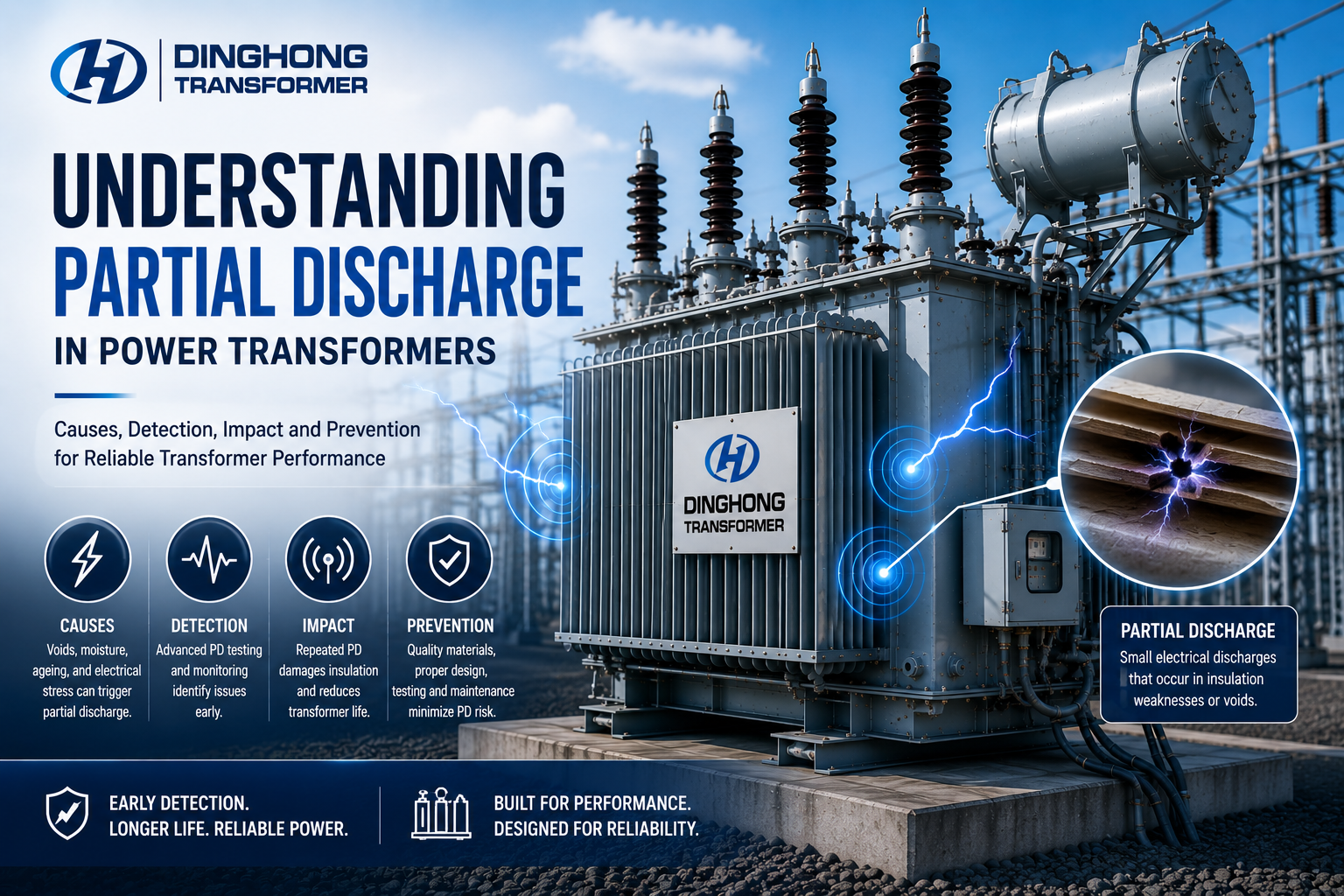
Power transformers are critical components of modern electrical networks, and their insulation systems must withstand high electrical, thermal, and mechanical stresses throughout their service life.
One of the most important insulation-related problems engineers monitor is partial discharge (PD).Although partial discharge may initially involve very small electrical discharges, repeated activity can gradually damage transformer insulation.
If left undetected, this deterioration can eventually contribute to insulation failure, unexpected outages, and costly transformer repairs.Understanding partial discharge in power transformers, what causes it, how it is detected, and how it can be prevented is therefore essential for transformer manufacturers, utilities, industrial facilities, and maintenance teams.
What Is Partial Discharge?
Partial discharge is a localized electrical discharge that only partially bridges the insulation between conductors or between a conductor and ground.
Unlike a complete electrical breakdown, partial discharge does not immediately create a continuous conductive path through the entire insulation system.
Instead, small discharges occur within weak points, voids, cracks, or other defects in the insulation.
Each individual discharge may release relatively little energy, but repeated activity can gradually deteriorate the surrounding insulation.
Each individual discharge may release relatively little energy, but repeated activity can gradually deteriorate the surrounding insulation.
Over time, this can lead to:
- Insulation erosion
- Carbonization
- Cracks and cavities
- Increased electrical stress
- Reduced dielectric strength
- Eventual insulation breakdown
For high-voltage power transformers, detecting PD early is therefore an important part of condition assessment and preventive maintenance.
What Causes Partial Discharge in Transformers?
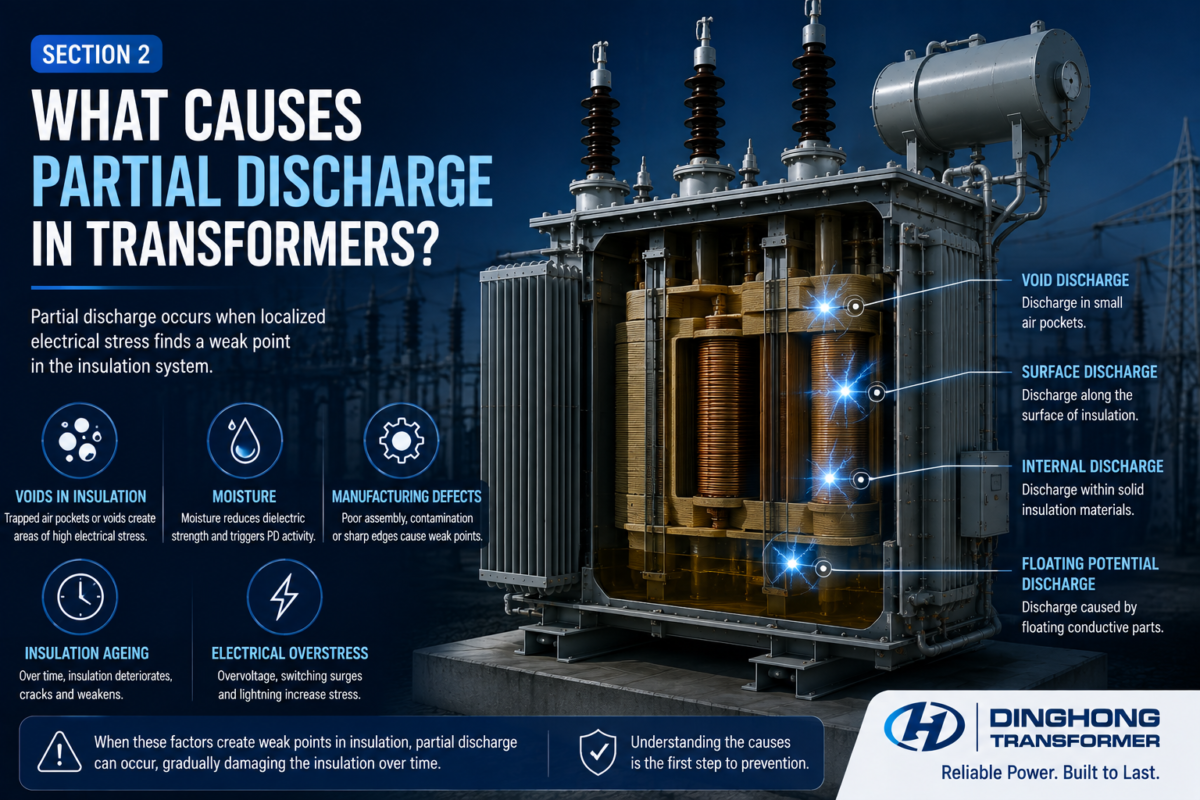
Partial discharge can develop because of manufacturing defects, insulation ageing, contamination, mechanical damage, or excessive electrical stress.
1. Voids in Solid Insulation
Small air pockets or voids inside paper, pressboard, resin, or other insulating materials can create areas of concentrated electrical stress.Because the dielectric properties of a void differ from the surrounding insulation, localized discharge can occur when the electric field becomes sufficiently strong.
2. Poor Manufacturing or Assembly
Improper insulation installation, inadequate drying, contamination, sharp edges, or poor connections can create localized weaknesses.This is why strict manufacturing quality control is essential when producing high-voltage transformers.
3. Moisture
Moisture is one of the major threats to transformer insulation.
It can reduce dielectric strength and contribute to insulation degradation, increasing the risk of partial discharge.Proper transformer vacuum drying and moisture control are therefore important manufacturing processes.
4. Insulation Ageing
Over years of operation, transformer insulation is exposed to electrical, thermal, and mechanical stress. Ageing can create cracks, weakened areas, and other defects that become sources of partial discharge.
5. Electrical Overstress
Overvoltage, switching events, lightning impulses, and abnormal operating conditions can place excessive stress on transformer insulation.If the insulation system has an existing weakness, these events can accelerate PD activity.
Why Is Partial Discharge Dangerous?
Partial discharge is often considered an early warning sign of insulation deterioration.
Repeated discharge gradually damages the insulation surrounding the discharge location.
As deterioration progresses, the affected area may become larger, allowing further discharge activity.
This can create a cycle:Electrical stress → partial discharge → insulation damage → increased electrical stress → greater partial discharge.
Eventually, the deterioration can develop into a serious insulation fault.
For high-value power transformers, early detection can therefore help maintenance teams intervene before a major failure occurs.
How Is Partial Discharge Detected?
Several methods can be used to detect and evaluate partial discharge activity.
Electrical PD Testing
Electrical measurement techniques detect the pulses generated by partial discharge and help engineers assess the magnitude and characteristics of the activity.
These tests can be performed during factory testing or as part of specialized condition assessments.
Acoustic Detection
Partial discharge generates small mechanical and acoustic signals. Sensors can detect these signals and help engineers identify the approximate location of a discharge source.
UHF Detection
Ultra-high-frequency methods can detect electromagnetic signals generated by partial discharge inside transformer equipment.UHF monitoring can be particularly useful for identifying internal PD activity without relying solely on conventional electrical measurements.
Dissolved Gas Analysis
For oil-immersed transformers, dissolved gas analysis (DGA) can provide valuable information about electrical and thermal faults occurring inside the transformer.
Although DGA does not directly measure every partial discharge event, certain gas patterns can provide indications of electrical activity and insulation problems.
How Can Partial Discharge Be Prevented?
Preventing partial discharge begins with good transformer design and manufacturing.Important measures include:
High-Quality Insulation Materials
Using properly selected insulation materials helps provide the dielectric strength required for the transformer’s operating voltage.
Effective Moisture Control
Insulation should be properly dried and protected from moisture during manufacturing, transportation, installation, and operation.
Accurate Manufacturing
Precise winding, insulation placement, core assembly, and connection processes help reduce defects that can become sources of electrical discharge.
Proper Electrical Clearances
Adequate insulation distances and carefully designed electric-field distribution help prevent excessive localized electrical stress.
Factory Testing
Comprehensive factory testing can help identify insulation problems before a transformer leaves the manufacturing facility.
Partial Discharge Testing During Transformer Manufacturing
For high-voltage and specialized transformer applications, partial discharge testing can provide valuable information about insulation quality.
Testing requirements depend on the transformer type, voltage level, applicable specifications, and relevant industry standards.
When purchasing a power transformer, buyers should discuss testing requirements with the manufacturer before production begins.
This is particularly important for transformers intended for:
- Utility substations
- Industrial power systems
- Renewable energy projects
- High-voltage transmission networks
- Large manufacturing facilities
- Critical infrastructure
Partial Discharge and Transformer Maintenance
PD monitoring can also form part of a broader transformer condition-monitoring program.
Regular assessment can help identify changes in insulation condition before they develop into major failures.
Depending on the transformer and application, maintenance programs may combine PD testing with oil analysis, thermal monitoring, insulation measurements, and visual inspections.
A condition-based approach can help asset owners make better maintenance decisions and reduce the risk of unexpected transformer outages.
Choose an Experienced Transformer Manufacturer
Partial discharge performance is strongly influenced by transformer design, insulation quality, manufacturing precision, drying procedures, and factory testing.
Dinghong Transformer manufactures power transformers, distribution transformers, oil-immersed transformers, dry type transformer, and customized transformer solutions for commercial, industrial, utility, and renewable energy applications.
Dinghong Transformer focuses on controlled manufacturing processes, quality materials, insulation treatment, assembly, and testing to help deliver reliable transformer products for demanding electrical applications.
For projects with specific insulation or partial-discharge requirements, customers can work with the manufacturer to define appropriate technical specifications and testing requirements before production.
Conclusion
Partial discharge is an important indicator of insulation health in high-voltage power transformers. While individual discharge events may be small, repeated activity can gradually deteriorate insulation and eventually contribute to serious electrical failure.Voids, moisture, manufacturing defects, insulation ageing, and electrical overstress are among the factors that can contribute to partial discharge.
Early detection through electrical testing, acoustic methods, UHF monitoring, and supporting techniques such as dissolved gas analysis can help identify potential problems before they become major failures.
For transformer buyers, preventing partial discharge starts with selecting a manufacturer that places strong emphasis on insulation design, moisture control, manufacturing quality, and testing.
By partnering with an experienced manufacturer such as Dinghong Transformer, project owners can obtain transformer solutions designed to deliver reliable insulation performance, long service life, and dependable operation in demanding power systems.