
Transformer Impedance Explained: Why It Matters for Fault Current and System Design

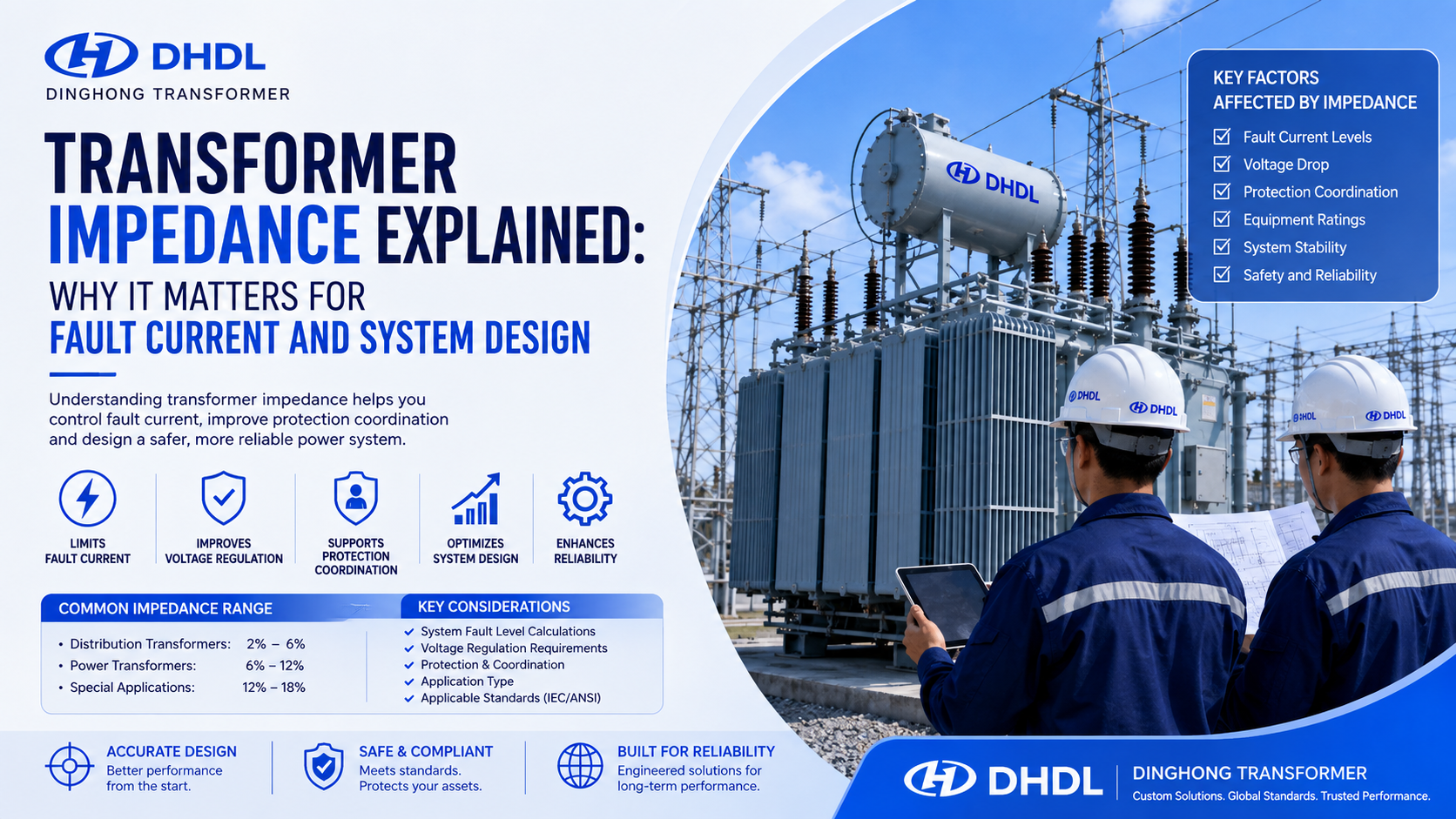
Transformer impedance is one of the most important technical specifications on a transformer nameplate, yet it is often overlooked during procurement. For industrial facilities and power distribution networks, impedance affects fault current, voltage drop, protection coordination, equipment ratings, and transformer performance.
What Is Transformer Impedance?
Transformer impedance is the opposition a transformer presents to current flow, mainly through leakage reactance and winding resistance. It is commonly expressed as percentage impedance, written as %Z.
In practical terms, percentage impedance indicates how much voltage must be applied to one winding to produce rated current when the other winding is short-circuited. IEC 60076-1 defines requirements for specifying and measuring transformer impedance, while IEC 60076-5 addresses short-circuit withstand and fault-current calculations.
It influences how the transformer behaves during normal loading and fault conditions.
How Does Transformer Impedance Affect Fault Current?
One of the biggest reasons engineers pay attention to transformer impedance is its effect on short-circuit current.
Generally, a lower transformer impedance allows higher fault current to flow, while a higher impedance limits available fault current. IEC 60076-5 specifies that short-circuit calculations consider the measured transformer impedance together with system impedance
For a simplified transformer-only calculation:Fault current ≈ Full-load current × 100 / % impedanceFor example, if a transformer has 5% impedance, its theoretical fault current at the transformer terminals is approximately 20 times its full-load current when upstream system impedance is neglected.
The actual fault level must be calculated using the complete network, including source impedance, cables, busbars, and other equipment.
Low vs High Transformer Impedance
Choosing transformer impedance involves a design trade-off.
A lower impedance transformer generally provides better voltage regulation and less voltage drop under load.
However, it can produce higher short-circuit current, potentially requiring higher-rated switchgear and protection equipment.
A higher impedance transformer can reduce available fault current, which may simplify fault-level management.
However, it can increase voltage drop and may affect motor starting and other demanding loads.IEC 60076-1 recognizes this trade-off between limiting voltage drop and limiting overcurrent under system fault conditions
Therefore, there is no universally best transformer impedance. The correct value depends on the electrical system.
Why Transformer Impedance Matters for Industrial Loads
If transformer impedance is poorly matched to the application, voltage performance and fault protection can become more difficult to manage.
Excessive voltage drop during heavy loading may affect motor performance, while an unexpectedly high fault level can exceed the interrupting capacity of downstream equipment.
This is why transformer impedance should be considered during system design rather than after the transformer has been ordered.
Transformer Impedance and Protection Coordination
Protection systems depend on accurate fault-current calculations.
Engineers use transformer impedance together with upstream network impedance to estimate prospective fault levels.
These calculations help determine breaker ratings, relay settings, fuse characteristics, and protection zones.
If transformer impedance differs significantly from the value used during system studies, the protection design may need to be reassessed.
For this reason, project specifications should clearly state the required impedance, tolerances, tapping conditions, and applicable standards.
Transformer Impedance and Parallel Operation
Transformer impedance is also important when two or more transformers operate in parallel.
Transformers intended to share load should have compatible electrical characteristics, including suitable impedance.
Significant differences can cause unequal load sharing, meaning one transformer may carry more current than another.
This can lead to overheating, reduced capacity utilization, or protection issues.
Before connecting transformers in parallel, engineers should verify impedance, voltage ratio, vector group, phase sequence, and other relevant parameters.
What Should Buyers Specify?
When requesting an industrial power transformer or power distribution transformer, buyers should provide more than kVA and voltage.
A technical specification should consider:
- Rated power
- Primary and secondary voltage
- Frequency
- Percentage impedance
- Vector group
- Tap range and tap type
- Cooling method
- Insulation requirements
- Applicable standards
- Installation environment
- Required short-circuit withstand capability
Providing these details allows the manufacturer to recommend equipment compatible with the intended power system.
Why Choose Dinghong Transformer?
Dinghong Transformer(DHDL) manufactures transformers and power-distribution equipment for industrial, utility, infrastructure, and renewable-energy applications.
DHDL’s transformer solutions can be configured around project requirements, including rated capacity, voltage, vector group, impedance, cooling method, and applicable standards.
Its product range includes oil immersed , dry type transformer, distribution transformers, power transformers, and related power-distribution equipment.
For projects where fault level, voltage regulation, or parallel operation is important, specifying impedance early allows Dinghong’s engineering team to evaluate the transformer against broader system requirements.
Final Thoughts
Transformer impedance is a small specification with a major influence on power system performance.
It affects fault current, voltage drop, protection coordination, switchgear ratings, motor performance, and parallel transformer operation.
Choosing the wrong value can create problems that are expensive to correct after installation.The right approach is to evaluate transformer impedance as part of the complete electrical system—not as an isolated number.
When selecting an industrial power transformer, provide the manufacturer with accurate system information and clearly define the required impedance and applicable standards.
A specified transformer does more than deliver power.
It becomes a reliable part of the protection, performance, and long-term stability of the entire electrical system.