
Transformer Neutral Loading: Why Neutral Current Matters in Three-Phase Systems

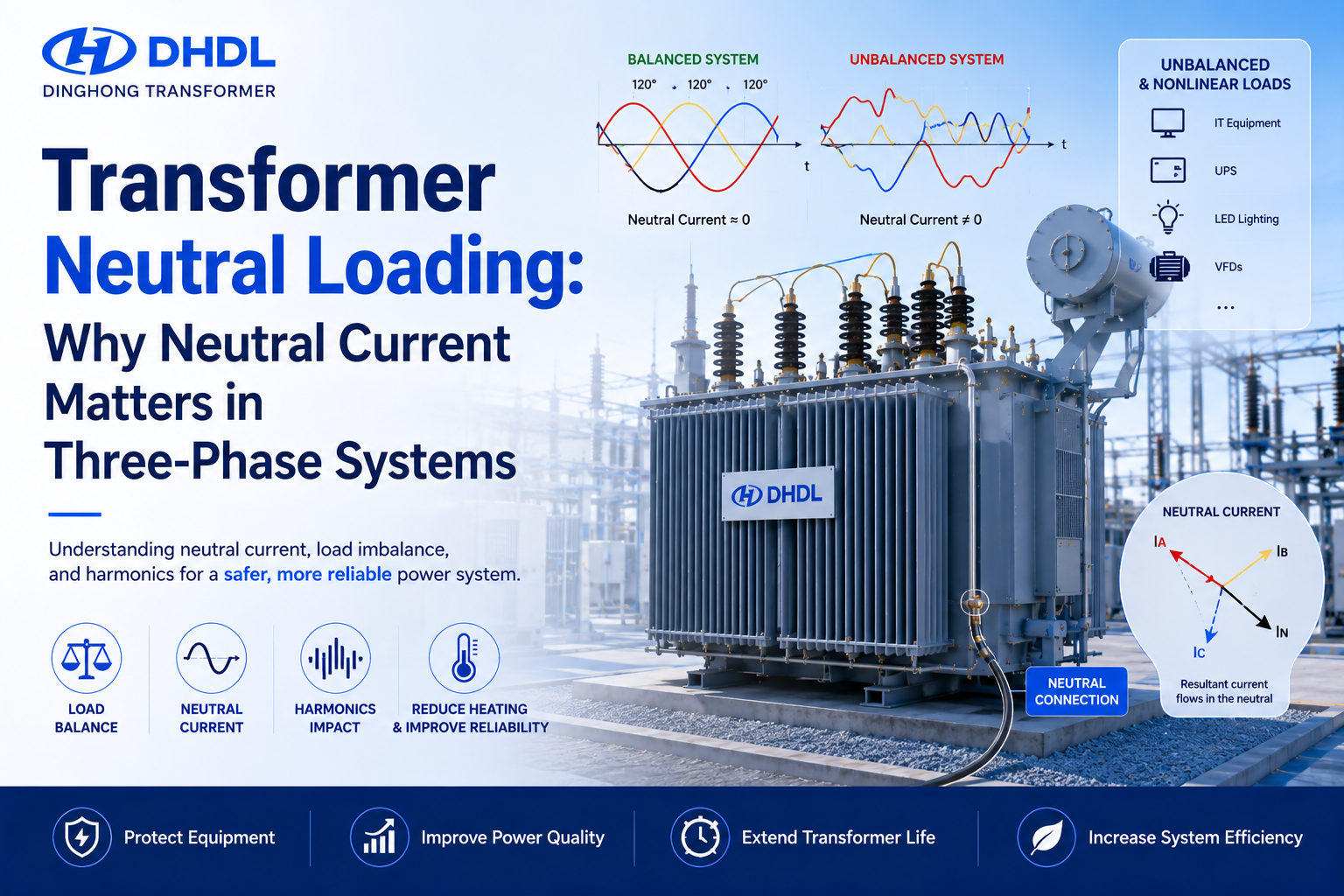
Three-phase power systems are widely used in factories, commercial buildings, data centers, processing plants, and utility networks because they deliver power efficiently to large electrical loads. However, when single-phase and nonlinear loads are connected to a three-phase transformer, neutral current can become an important design consideration.
Understanding transformer neutral loading helps engineers prevent overheating, voltage imbalance, equipment stress, and power-quality problems.
It is especially important when selecting a distribution transformer for facilities with computers, LED lighting, UPS systems, variable-speed equipment, and other electronic loads.
What Is Neutral Current?
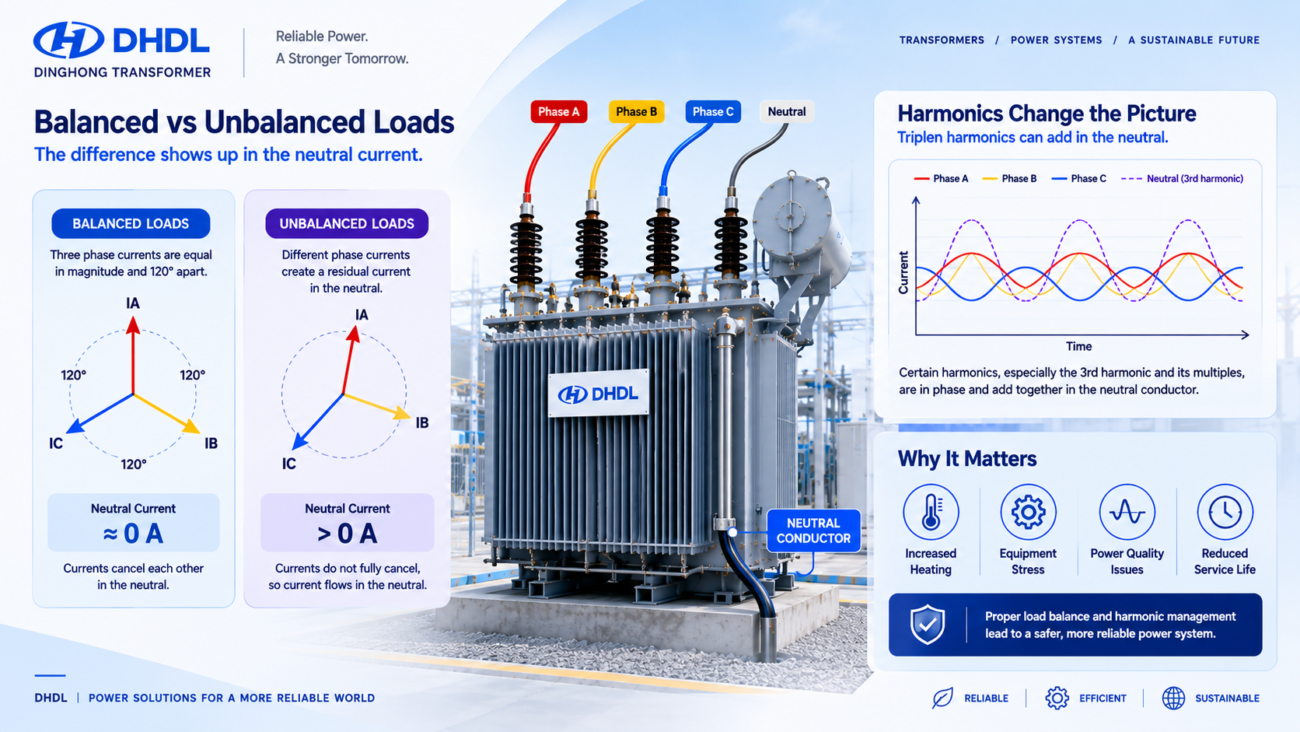
In a balanced three-phase system supplying equal linear loads, the currents in the three phases are separated by 120 degrees and their vector sum is approximately zero.
Under these conditions, little or no current flows through the neutral conductor.
When single-phase loads are distributed unevenly across the three phases, the phase currents no longer cancel completely.
The remaining current flows through the neutral conductor.
Therefore, neutral current results from current imbalance and certain harmonic currents within the electrical system.
Why Does Transformer Neutral Loading Matter?
Neutral loading matters because the neutral path is part of the overall electrical system. If neutral current becomes excessive, the neutral conductor, transformer connections, and associated equipment can experience additional thermal stress.
In a transformer supplying many single-phase loads, engineers should consider both the magnitude and characteristics of neutral current.
How Unbalanced Loads Increase Neutral Current
A three-phase transformer may supply different types of loads across phases. This creates phase imbalance.
An unbalanced system can produce neutral current because the three phase currents do not cancel each other completely.
Excessive imbalance may also contribute to voltage imbalance, which can negatively affect sensitive equipment and three-phase motors.
Good load distribution is therefore an important part of transformer and electrical system design.
The Special Problem of Harmonic Currents
Nonlinear loads create another challenge.
Equipment such as computers, UPS systems, LED drivers, battery chargers, and variable frequency drives can produce harmonic currents.
Some triplen harmonics, particularly the third harmonic and its multiples, can add together in the neutral conductor rather than canceling as fundamental phase currents do.
As a result, a system can experience significant neutral current even when the fundamental phase loads appear reasonably balanced.
Can High Neutral Current Overheat a Transformer?
Excessive neutral current can contribute to additional heating in conductors and transformer components.
Increased heating can accelerate insulation aging and reduce equipment reliability.
The actual impact depends on transformer construction, winding configuration, harmonic content, loading level, cooling, and installation conditions.
Engineers should therefore evaluate expected neutral and harmonic currents.
How Can Neutral Loading Be Managed?
Effective neutral management begins with accurate load assessment.
During planning, engineers should identify where single-phase loads are connected and estimate the expected current on each phase.
Measurements after commissioning can then confirm whether the real system matches the design assumptions.
For facilities, periodic power-quality measurements can also reveal changes caused by new equipment, expansion, or operating schedules.
Balance Single-Phase Loads
Distribute single-phase loads evenly among the three phases. This reduces fundamental current imbalance and can improve voltage balance.
Evaluate Nonlinear Loads
Identify equipment that produces harmonic currents and estimate its contribution to the neutral.
Select Appropriate Transformer Designs
Transformer design and winding configuration can influence how zero-sequence and harmonic currents behave.
The transformer should be specified according to the actual load profile.
Monitor the Electrical System
Power-quality monitoring can help identify phase imbalance, excessive neutral current, voltage distortion, and changing load conditions.
Transformer Neutral Loading and Transformer Selection
When purchasing an industrial or distribution transformer, buyers should provide the manufacturer with detailed information about the intended loads.
Important information can include:
- Three-phase and single-phase load quantities
- Expected load imbalance
- Nonlinear equipment
- Harmonic spectrum
- Rated transformer capacity
- Primary and secondary voltage
- Neutral connection requirements
- Earthing arrangement
- Expected operating conditions
This helps ensure that the transformer configuration matches the electrical system.
Why Choose Dinghong Transformer?
Dinghong Transformer (DHDL) manufactures transformers and power-distribution equipment for industrial, utility, infrastructure, and renewable-energy applications.
Its transformer solutions can be developed around project-specific electrical requirements, including capacity, voltage, winding configuration, cooling method, impedance, installation environment, and applicable standards.
For facilities with substantial single-phase or nonlinear loads, discussing neutral loading can help ensure the selected transformer is appropriate.
DinghongTransformer can support projects requiring oil immersed transformer, dry type transformer, distribution transformers, and power transformer.
Final Thoughts
Transformer neutral loading is an important consideration in three-phase power system design, particularly when a facility contains substantial single-phase or nonlinear loads.
An overloaded neutral can increase conductor heating, contribute to voltage-quality problems, and place additional stress on electrical equipment.
Harmonic currents make the issue even more important because certain harmonics can accumulate in the neutral instead of canceling.
The best approach is to evaluate phase balance, harmonic content, neutral current, and expected operating conditions before selecting the transformer.
For industrial projects, the transformer should be specified around the real characteristics of the electrical load—not simply its total kVA rating.
By addressing neutral loading during design and working with an experienced transformer manufacturer such as DinghongTransformer, facility owners and engineers can build a more reliable, efficient, and resilient three-phase power system.