Transformer Selection for Hot and Dusty Environments: What Should Be Customized?

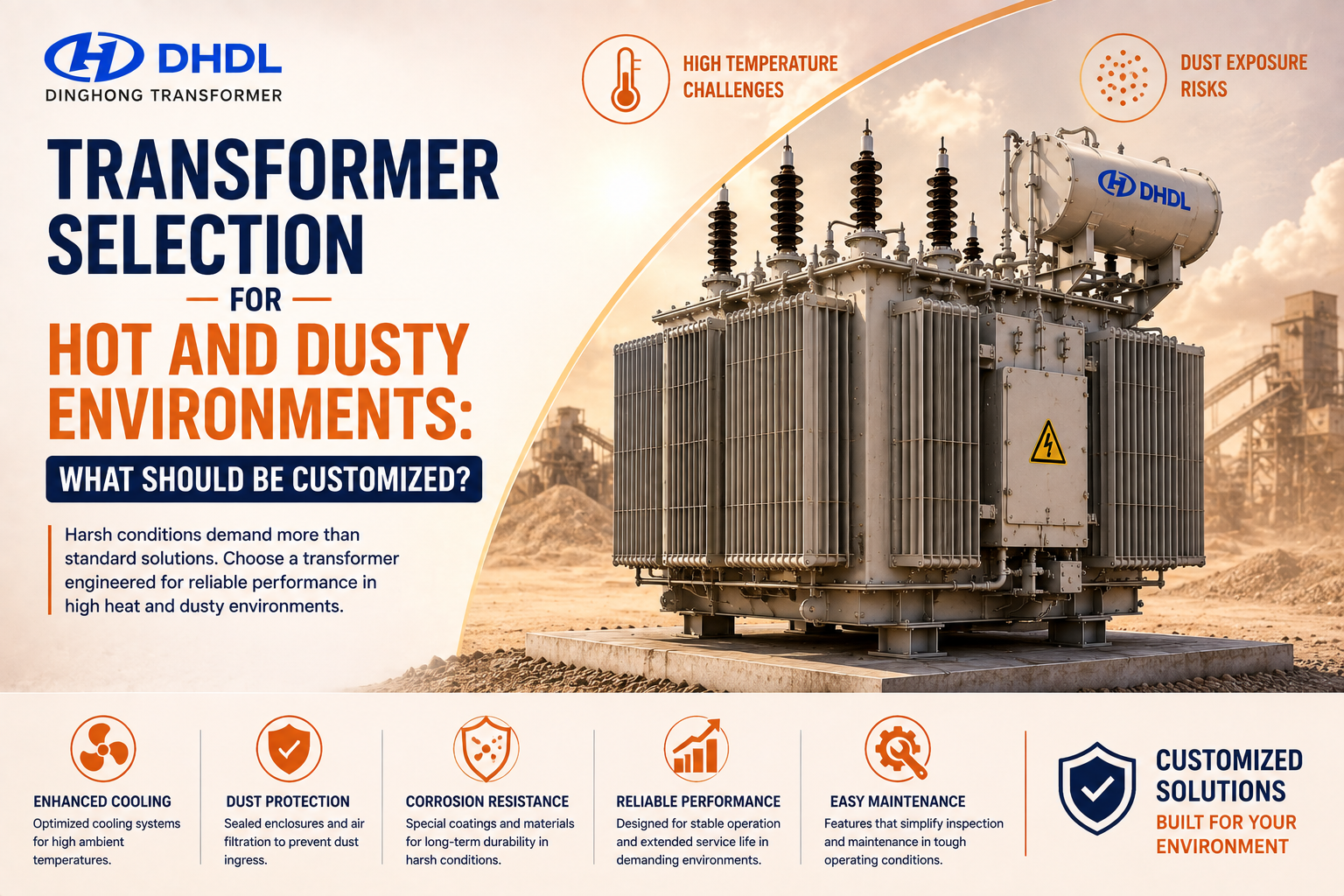
Industrial transformers operating in hot and dusty environments face conditions that can reduce cooling efficiency, increase maintenance requirements, and accelerate equipment aging.
A transformer that performs reliably in a clean, temperate environment may require additional engineering when installed in a factory, mining site, power plant, construction project, or outdoor substation.
For project owners, EPC contractors, and electrical engineers, transformer selection should consider the complete installation environment—not only voltage and kVA rating.
Why Are Hot and Dusty Environments Challenging?
Heat and dust create related challenges.
High ambient temperature reduces the temperature difference available for heat dissipation, making it harder for the transformer to release heat generated during operation.
Dust can accumulate on surfaces, cooling equipment, ventilation openings, and accessories.When these conditions occur together, thermal performance and maintenance become especially important.
1. Transformer Cooling Configuration
Cooling is one of the first areas to evaluate for a high-temperature installation.Transformer losses naturally produce heat.
In a hot environment, the surrounding air is already warm, so the transformer has less opportunity to transfer heat to its surroundings.
Engineers may therefore need to evaluate radiator capacity, airflow, fans, ventilation, and the selected cooling method.
For an oil immersed transformer, the cooling system and radiator arrangement are important considerations.
For a dry type transformer, airflow and room ventilation can have a major effect on heat dissipation.
2. Enclosure and Dust Protection
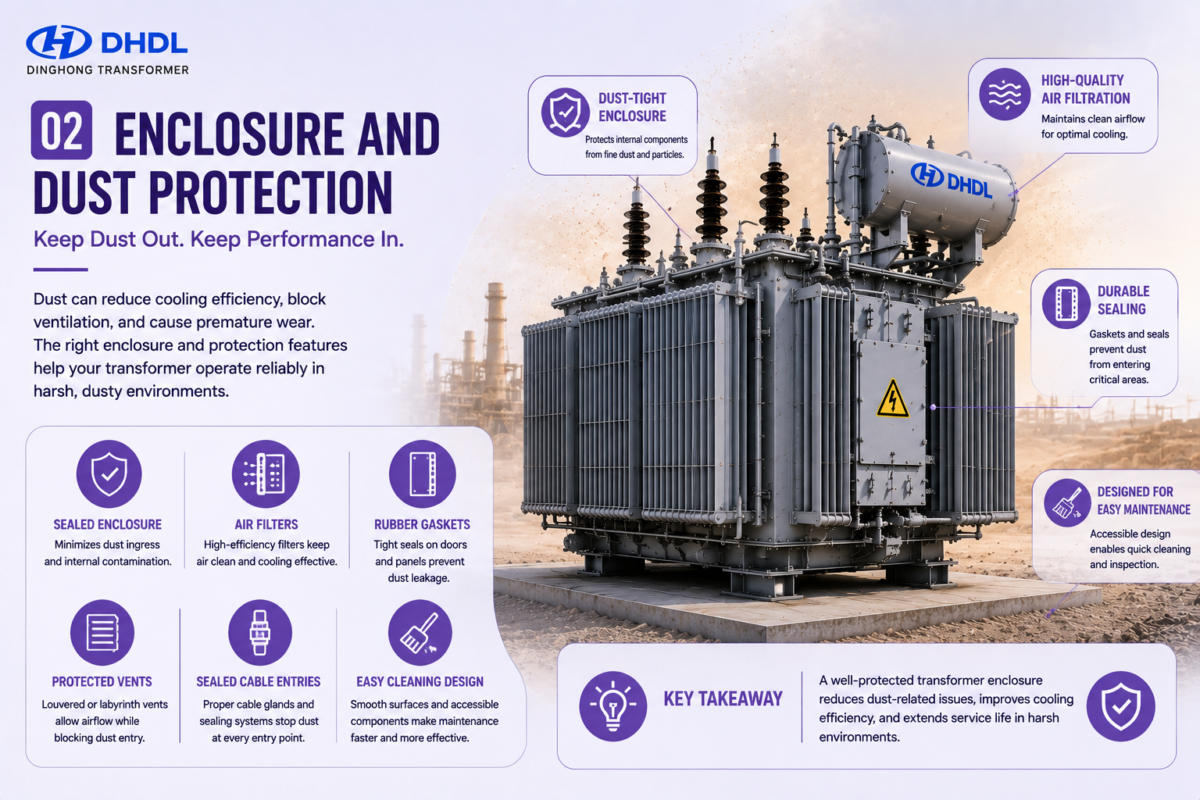
Dust protection becomes important when a transformer is installed near mining operations, cement plants, manufacturing facilities, construction sites, deserts, or other areas with airborne particles.The required enclosure and protection depend on whether the transformer is installed indoors or outdoors and on the type and concentration of contaminants.
For dry type transformers, ventilation must be balanced with protection against dust entering sensitive areas.
For outdoor equipment, the enclosure, cable entries, accessories, and exposed surfaces should be evaluated as part of the transformer specification.
3. Material and Corrosion Protection
Hot and dusty locations can be harsh on external transformer components.If the installation is exposed to moisture, chemicals, salt, or industrial pollutants in addition to dust, corrosion protection may become an important customization.
Surface preparation, coating systems, hardware selection, and enclosure materials should be matched to environmental conditions.
This matters for outdoor substations and industrial power distribution systems.
4. Temperature and Load Requirements
Transformer kVA selection should account for actual operating conditions.A transformer should not be selected solely from connected load.
Engineers should evaluate maximum demand, power factor, motor starting requirements, operating schedule, future expansion, and ambient temperature.
When high ambient temperatures are expected, thermal performance becomes even more important. An industrial power transformer should provide sufficient capacity while staying within specified temperature limits.
5. Installation Location Matters
The same transformer can experience different conditions depending on where it is installed.A transformer inside a well-ventilated electrical room may have different requirements from one installed outdoors under direct sunlight.
Before finalizing the design, project teams should communicate whether the transformer will be indoors or outdoors, near heavy machinery, in a mining or dusty industrial area, in a desert climate, or near chemical pollutants.
This information helps the manufacturer recommend an appropriate configuration.
6. Transformer Monitoring and Maintenance
Harsh environments make condition monitoring and preventive maintenance particularly valuable. Operators can monitor transformer loading and temperature to identify abnormal conditions early. Maintenance plans should also consider dust accumulation, ventilation, cooling equipment, external surfaces, connections, and accessories.
7. Choosing the Right Transformer Type
Oil immersed and dry type transformers can both serve demanding applications. The correct choice depends on voltage, capacity, load characteristics, installation conditions, regulations, space, and project objectives.
Why Customized Transformer Design Matters
Standard transformer specifications may not always address the conditions of a specific industrial site.
Customization allows the manufacturer to consider environmental and electrical requirements before production.
A project may require customized cooling, enclosure protection, corrosion protection, voltage configuration, or documentation.
This reduces the risk of selecting equipment that is poorly matched to its operating environment.
Why Choose Dinghong Transformer?
DinghongTransformer (DHDL) manufactures transformers and power distribution equipment for industrial, infrastructure, utility, and renewable energy applications.Its product range includes oil immersed transformers, dry type transformers, power transformers, distribution transformers, prefabricated substations, and switchgear.
For hot and dusty projects, DHDL can evaluate rated capacity, voltage, cooling method, installation environment, applicable standards, and customization needs.
Before requesting a quotation, provide the kVA or MVA rating, voltage levels, frequency, location, maximum ambient temperature, dust exposure, cooling requirements, and applicable standards.
Conclusion
Selecting a transformer for a hot and dusty environment requires more than choosing voltage and capacity. Cooling, enclosure protection, materials, corrosion resistance, loading, monitoring, and maintenance should be considered during design.
A properly customized industrial transformer can be better prepared for demanding conditions and long-term power distribution.
Whether you need an oil immersed transformer, dry type transformer , power transformer, or complete substation solution, Dinghong Transformer can develop equipment around your electrical and environmental requirements.
The goal is simple: select a transformer designed for both the electrical load and the environment.