
Transformer RFQ Checklist: 15 Specifications Buyers Must Provide for an Accurate Quote

A request that says only “Please quote a 1,000 kVA transformer” is not enough for a reliable technical and commercial proposal.
Two transformers with the same capacity can have very different prices, dimensions, losses, accessories and delivery schedules. The final design depends on voltage, frequency, vector group, impedance, installation environment, applicable standards and many other project conditions.
Missing information usually leads to additional emails, delayed quotations or a proposal based on assumptions. More seriously, an incorrectly specified transformer may not match the local grid, protection system or connected load.
Use the following transformer RFQ checklist before sending your inquiry to a manufacturer.
Quick Transformer RFQ Checklist
At minimum, provide the following information:
| Required information | Example |
|---|---|
| Transformer type | Oil-immersed distribution transformer |
| Rated capacity | 1,000 kVA |
| Primary voltage | 11 kV |
| Secondary voltage | 0.4 kV |
| Frequency | 50 Hz |
| Phase | Three-phase |
| Vector group | Dyn11 |
| Tap range | ±2 × 2.5% |
| Short-circuit impedance | 6% |
| Cooling method | ONAN |
| Winding material | Copper |
| Installation | Outdoor |
| Applicable standard | IEC or project specification |
| Quantity | 6 units |
| Destination | Manila, Philippines |
This information is enough for an initial quotation in many standard projects. However, buyers should provide the following details when available.
We have provided some articles related to RFQs:
Transformer RFQ Checklist: Specifications Buyers Must Provide for an Accurate Quote
Transformer RFQ Checklist: 15 Specifications Buyers Must Provide for an Accurate Quote
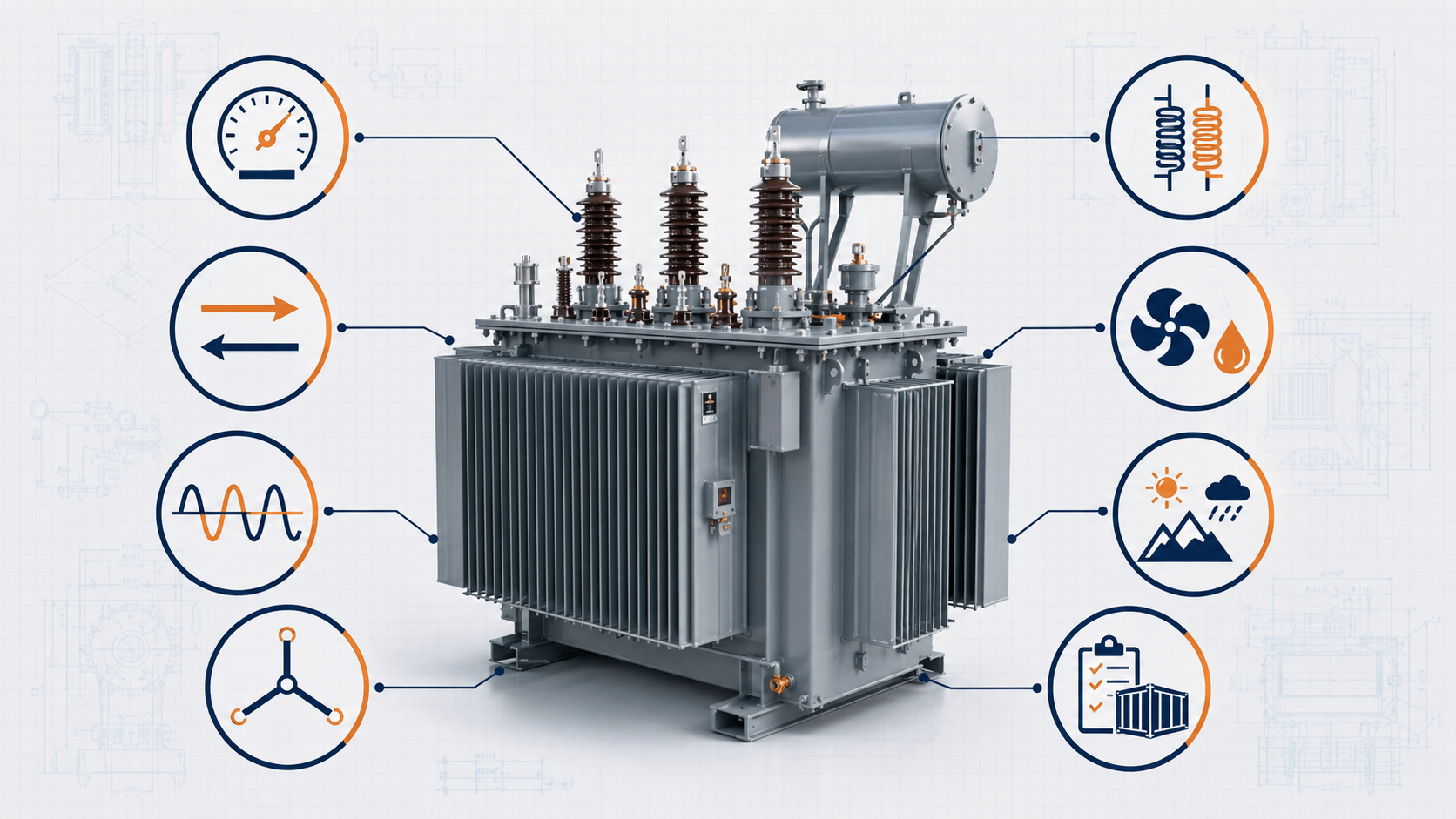
1. Transformer Type and Application
Start by identifying the required transformer and its actual use.
Common types include:
- Oil-immersed distribution transformer
- Dry-type transformer
- Power transformer
- Pole-mounted transformer
- Pad-mounted transformer
- Furnace or rectifier transformer
- Renewable energy step-up transformer
The application is equally important. A transformer for a commercial building does not have the same operating profile as one serving motors, furnaces, data centers, solar inverters or EV charging equipment.
Do not write only “for industrial use.” State the connected load and operating scenario.
2. Rated Capacity
Provide the required capacity in kVA or MVA.
If the final size has not been confirmed, send:
- Total connected load
- Estimated demand load
- Power factor
- Largest motor or starting load
- Expected future expansion
- Normal and peak load profiles
A manufacturer can review these inputs, but the final capacity should also be confirmed by the project’s qualified electrical engineer.
A common hidden mistake is selecting capacity from the present load only. Future expansion, motor starting current, harmonics and ambient temperature may affect the appropriate rating.
3. Primary and Secondary Voltage
State both nominal primary and secondary voltage.
For example:
- 11/0.4 kV
- 33/0.415 kV
- 13.2 kV/240–480 V
- 110/35/10 kV
Do not assume that “low voltage” means the same value in every country. Also clarify whether the requested secondary voltage is the transformer’s no-load rated voltage or the required system voltage under operating conditions.
If the grid voltage fluctuates significantly, provide the normal operating range.
4. Frequency and Phase
Confirm whether the system uses 50 Hz or 60 Hz and whether it is single-phase or three-phase.
Frequency affects the transformer’s electromagnetic design. It should never be left for the supplier to guess based only on the destination country, especially for industrial plants with independent power systems.
5. Vector Group and Neutral Requirements
For three-phase transformers, provide the required vector group, such as Dyn11, Yyn0 or another project-specific arrangement.
The vector group affects phase displacement, grounding, neutral availability and parallel operation. If the new transformer will operate in parallel with an existing unit, provide the existing transformer’s nameplate and test data.
Also clarify:
- Whether a neutral terminal is required
- Expected neutral loading
- Grounding method
- Whether the neutral must be fully rated
This is frequently missed in RFQs for data centers, nonlinear loads and commercial facilities.
6. Tap Changer Requirements
State the required tap range and tap changer type.
Examples include:
- Off-circuit tap changer: ±5%
- Off-circuit taps: ±2 × 2.5%
- On-load tap changer with a project-defined regulation range
If an on-load tap changer is required, include the number of positions, step voltage, control method and any automatic voltage regulation requirement.
7. Short-Circuit Impedance
Impedance is not a minor nameplate value. It affects fault current, voltage drop, protection coordination and parallel operation.
Provide the specified impedance and tolerance if these have already been calculated. For replacement or parallel transformers, send the existing unit’s impedance rather than requesting “standard impedance.”
Changing impedance to reduce the purchase price may create additional costs elsewhere in the electrical system.
8. Cooling Method and Temperature-Rise Limits
Specify the required cooling method, such as:
- ONAN
- ONAF
- OFAF
- Air natural cooling
- Forced-air cooling
Also provide the required temperature-rise limits if stated in the project specification.
For transformers with multiple cooling stages, list the capacity available at each stage. For example, the ONAN and ONAF ratings should be clearly separated.
9. Winding Material
Confirm whether the project requires copper or aluminum windings.
Do not compare quotations based on total price until the conductor material is confirmed. Buyers should also compare:
- Guaranteed no-load loss
- Guaranteed load loss
- Transformer weight
- Temperature rise
- Short-circuit strength
- Total operating cost
If either material is acceptable, ask the supplier to provide two technically comparable options instead of quoting two designs with different loss targets.
10. Installation Environment
Site conditions can change the insulation, cooling and enclosure design. Provide:
- Indoor or outdoor installation
- Maximum and minimum ambient temperature
- Altitude above sea level
- Relative humidity
- Dust, salt, sand or corrosive conditions
- Seismic requirements
- Flood risk
- Available ventilation
- Required enclosure or IP rating
High altitude and high ambient temperature are often discovered too late. They may require design adjustments and can affect transformer dimensions and cost.
11. Applicable Standards
Identify the required standard system and edition, such as IEC, ANSI/IEEE, GB or a utility-specific specification.
Attach the complete technical specification when possible. Do not state only “international standard,” because test requirements, insulation levels, efficiency rules and accessories vary between markets.
If the project has mandatory local certification or utility approval requirements, mention them at the RFQ stage.
12. Load Characteristics
Describe what the transformer will supply.
Important information includes:
- Motor loads and starting method
- Variable-frequency drives
- Rectifiers or furnaces
- Solar or wind inverters
- EV chargers
- UPS systems
- Data center loads
- Harmonic spectrum or total harmonic distortion
- Frequent overload or cyclic loading
A standard distribution transformer may not be suitable for severe harmonics, rapid load changes or repeated impact loads.
13. Required Accessories and Interfaces
Accessories can create a large difference between quotations. Specify requirements such as:
- Temperature indicators or controllers
- Pressure relief device
- Oil level indicator
- Buchholz relay
- Winding temperature indicator
- Fans and control cabinet
- Surge arresters
- Cable boxes or busbar connections
- Current transformers
- Monitoring communication
- Terminal material and orientation
Include cable entry direction, terminal position and available installation space. A technically correct transformer can still create site problems if its interfaces do not match the civil and electrical layout.
14. Tests, Documents and Witness Requirements
List the required routine, type and special tests. State whether the buyer or a third-party inspector will witness testing.
Typical document requirements may include:
- General arrangement drawing
- Nameplate drawing
- Technical data sheet
- Test reports
- Wiring diagrams
- Foundation plan
- Packing list
- Operation and maintenance manual
DHDL’s manufacturing process includes material inspection, winding, vacuum drying, assembly and final testing. Required tests and documents should still be agreed before order confirmation.
15. Quantity, Delivery and Commercial Information
An accurate quotation also requires:
- Order quantity
- Required delivery date
- Destination city and country
- Preferred Incoterm
- Shipping method
- Site unloading limitations
- Maximum transport dimensions or weight
- Spare parts requirements
- Warranty requirement
For large power transformers, route restrictions and transport dimensions should be reviewed during design—not after production.
The Most Common RFQ Mistakes
Before sending your inquiry, check that you have not:
- Requested price using capacity alone
- Omitted frequency or phase
- Assumed the supplier will select the vector group
- Ignored altitude, temperature or harmonics
- Compared copper and aluminum designs as if they were identical
- Requested parallel operation without existing nameplate data
- Forgotten cable entry, terminal orientation or accessories
- Asked for “IEC standard” without attaching the project specification
- Requested delivery without providing destination and inspection requirements
These details may look small, but they often determine whether a quotation is useful or merely preliminary.
Send a Complete Transformer Inquiry
A complete RFQ helps the manufacturer prepare a faster and more technically comparable proposal. It also reduces redesign, commercial variation and installation risk later in the project.
DHDL supplies transformers and power distribution equipment for utility, industrial, commercial and renewable energy projects, with support for different voltage levels, frequencies, winding materials, standards and operating environments.
When contacting DHDL, send your specification, single-line diagram, load information, quantity, destination and required delivery schedule. If some parameters have not yet been confirmed, identify them clearly instead of leaving them blank.
FAQ
What is the minimum information needed for a transformer quotation?
Provide transformer type, capacity, primary and secondary voltage, frequency, phase, quantity, application and destination. More detailed information will produce a more accurate quotation.
Can I request a quote if the transformer capacity is not confirmed?
Yes. Provide the connected load, demand factor, power factor, largest motor, load profile and future expansion plan for preliminary review. Final sizing should be confirmed by the project engineer.
Why does the supplier need the vector group?
The vector group affects phase displacement, grounding, neutral configuration and parallel operation. An incorrect vector group may prevent the transformer from matching the power system.
What documents should I attach to the RFQ?
Attach the technical specification, single-line diagram, load schedule, existing transformer nameplate, site conditions and required test or documentation list when available.
Why do quotations for the same kVA rating differ significantly?
The designs may use different winding materials, loss levels, insulation requirements, impedance, cooling systems, accessories, standards or test scopes. Compare technical compliance before comparing total price.
Choose DHDL for Your Transformer Solutions
DHDL is a professional transformer manufacturer specializing in dry-type transformers, oil-immersed transformers, power transformers, distribution transformers, and complete power distribution solutions.
We support customized transformer designs based on project voltage, capacity, frequency, installation environment, and international standards.
Whether for industrial facilities, renewable energy projects, data centers, utilities, or infrastructure applications, DHDL delivers reliable, efficient, and customized power solutions worldwide.
Contact DHDL today for professional transformer selection support and a customized quotation.
💬WeChat/WhatsApp:+8613355383777
📩 Email:service@dinghongtransformer.com
🌐web:https://dinghongtransformer.com/