
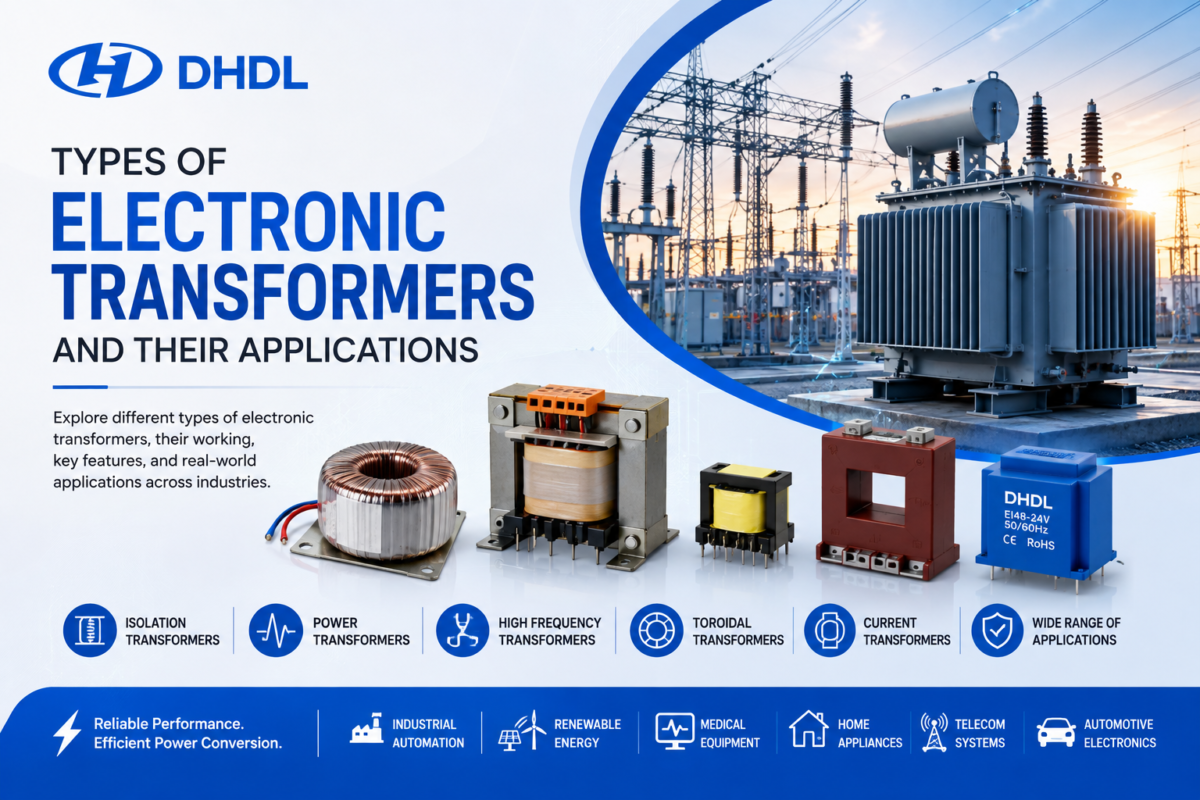
Types of Electronic Transformers and their Applications.

Electrical transformers are among the most important components in modern power systems. From power generation and transmission to industrial machinery, renewable energy systems, consumer electronics, and residential buildings, transformers help ensure that electrical energy is delivered at the right voltage for safe and efficient use.
A transformer works by transferring electrical energy between circuits through electromagnetic induction. Depending on their design, voltage requirements, capacity, and intended application, transformers are manufactured in different types and configurations. Choosing the right type of electrical transformer is essential for improving energy efficiency, protecting electrical equipment, and maintaining reliable power distribution.
In this article, we explore the major types of electrical transformers, their functions, and the applications where each type is commonly used.
What Is an Electrical Transformer?
An electrical transformer is a static electrical device designed to transfer alternating-current (AC) electrical energy from one circuit to another while changing the voltage and current levels.
Transformers generally consist of a magnetic core and one or more windings. The winding connected to the incoming electrical supply is called the primary winding, while the winding connected to the load is known as the secondary winding.
Depending on the number of turns in the primary and secondary windings, a transformer can either increase or decrease voltage.
For example, a step-up transformer increases voltage for efficient long-distance power transmission, while a step-down transformer reduces voltage so electricity can be safely used by homes, businesses, and electrical equipment.
Major Types of Electrical Transformers
1. Step-Up Transformer
A step-up transformer is designed to increase the voltage from the primary side to the secondary side. It has more turns of wire on its secondary winding than on its primary winding.
Step-up transformers are particularly important in electrical power generation and transmission. Electricity generated at power plants is typically increased to a much higher voltage before being transmitted over long distances. Higher transmission voltages help reduce current and minimize energy losses in transmission lines.
Applications of Step-Up Transformers
Step-up transformers are commonly used in:
- Power generation stations
- Electrical transmission networks
- Renewable energy systems
- Industrial power systems
- High-voltage electrical equipment
They are especially useful wherever electricity needs to travel long distances efficiently.
2. Step-Down Transformer
A step-down transformer performs the opposite function of a step-up transformer. It reduces a higher input voltage to a lower output voltage.
Step-down transformers are widely used in electrical distribution systems because the voltage transmitted over power networks is too high for direct use by most homes, offices, and electrical appliances.
For example, distribution transformers reduce medium-voltage electricity to a level suitable for residential and commercial consumers.
Applications of Step-Down Transformers
Common applications include:
- Residential power distribution
- Commercial buildings
- Industrial equipment
- Battery chargers
- Control systems
- Electronic devices
- Power supply units
If your project requires a compact transformer for reducing voltage in electronic equipment, explore the relevant [step-down transformer products] on the manufacturer’s product page.
3. Distribution Transformer
A distribution transformer is used to deliver electrical power from the distribution network to consumers at a usable voltage.
These transformers are normally installed close to homes, offices, factories, commercial buildings, and other electricity users. Their main purpose is to reduce distribution-line voltage to a level appropriate for end users.
Distribution transformers can be oil-immersed or dry-type depending on the installation environment and design requirements.
Applications of Distribution Transformers
Distribution transformers are commonly found in:
- Residential neighborhoods
- Shopping centers
- Office buildings
- Factories
- Schools
- Hospitals
- Commercial facilities
Their reliable operation is essential for maintaining stable electricity supplies.
4. Power Transformer
Power transformers are generally designed for high-voltage applications within electrical power generation and transmission systems. They handle large amounts of electrical power and are engineered for high efficiency and long-term operation.
Power transformers are typically installed at generating stations and substations. They can be used to increase voltage for transmission or decrease voltage between different stages of the power network.
Applications of Power Transformers
Power transformers are used in:
- Power generation plants
- Transmission substations
- Electrical grids
- Large industrial facilities
- Utility infrastructure
Because they operate at high power levels, their insulation, cooling systems, core construction, and protection systems are critical to overall performance.
5. Isolation Transformer
An isolation transformer provides electrical separation between the input and output circuits while maintaining the required voltage relationship.
Unlike conventional transformers that are primarily used to change voltage, isolation transformers are often selected for electrical safety, noise reduction, and protection against certain types of electrical disturbances.
The primary and secondary windings are electrically isolated from each other.
Applications of Isolation Transformers
Isolation transformers are commonly used in:
- Medical equipment
- Laboratory equipment
- Industrial control systems
- Sensitive electronic equipment
- Testing facilities
- Audio and communication equipment
They can help provide an additional layer of protection when sensitive equipment needs to be electrically separated from the main power supply.
6. Autotransformer
An autotransformer uses a single continuous winding with portions of the winding serving as both primary and secondary circuits.
Compared with a conventional two-winding transformer of similar capacity, an autotransformer can be smaller, lighter, and more economical in certain applications.
However, unlike an isolation transformer, an autotransformer does not provide complete electrical isolation between its input and output.
Applications of Autotransformers
Autotransformers are commonly used for:
- Voltage regulation
- Motor starting
- Industrial equipment
- Laboratory variable-voltage supplies
- Electrical distribution systems
- Voltage adjustment applications
They are particularly useful when the required voltage transformation ratio is relatively small.
7. Current Transformer (CT)
A current transformer, commonly called a CT, is designed to reduce high electrical currents to lower, standardized values that can safely be measured by meters and protection equipment.
Current transformers are important components in electrical protection and measurement systems. They allow high currents in power systems to be monitored without connecting measuring instruments directly to high-current conductors.
Applications of Current Transformers
Current transformers are widely used in:
- Electrical meters
- Circuit protection systems
- Switchgear
- Power substations
- Industrial electrical systems
- Energy monitoring equipment
CTs are particularly important in systems where accurate current measurement and protective relay operation are required.
8. Voltage Transformer
A voltage transformer, sometimes called a potential transformer (PT), reduces high voltage to a lower, measurable voltage.
This allows monitoring and protection equipment to safely measure voltage levels in high-voltage electrical systems.
Applications of Voltage Transformers
Voltage transformers are commonly used in:
- High-voltage substations
- Electrical measurement systems
- Protection systems
- Power monitoring equipment
- Industrial electrical installations
For projects requiring voltage measurement or monitoring, choosing a transformer with the correct voltage ratio and insulation rating is essential.
9. Toroidal Transformer
A toroidal transformer has a ring-shaped magnetic core around which the windings are wrapped. Its design can provide a compact form factor and, depending on the application, low electromagnetic radiation and efficient operation.
Toroidal transformers are popular in applications where space, weight, and electrical performance are important.
Applications of Toroidal Transformers
They can be found in:
- Audio equipment
- Medical devices
- Industrial electronics
- Control systems
- Power supplies
- Instrumentation equipment
Their compact design makes them particularly useful in equipment where installation space is limited.
10. Dry-Type Transformer
Dry-type transformers use air or another solid insulation system rather than liquid insulation. Because they do not rely on transformer oil for insulation and cooling, they are often suitable for indoor installations and locations where fire-safety considerations are important.
Some dry-type transformers use resin encapsulation to provide additional protection for the windings.
Applications of Dry-Type Transformers
Dry-type transformers are frequently used in:
- Commercial buildings
- Industrial plants
- Hospitals
- Schools
- Data centers
- Renewable energy installations
- Indoor substations
For customers looking for this category, a relevant internal-link keyword would be [dry-type transformer products].
11. Oil-Immersed Transformer
Oil-immersed transformers use insulating oil to provide electrical insulation and help transfer heat away from the transformer windings and core.
They are widely used in medium- and high-power electrical systems, especially in outdoor installations and utility applications.
Applications of Oil-Immersed Transformers
Oil-immersed transformers are commonly used in:
- Electrical substations
- Power transmission systems
- Distribution networks
- Industrial facilities
- Utility infrastructure
- Large renewable energy projects
Proper maintenance and monitoring are important for maintaining the reliability and service life of oil-immersed transformers.
How to Choose the Right Electrical Transformer
Selecting the appropriate transformer depends on several factors. Before purchasing a transformer, consider the following:
Voltage Requirements
Determine the required input and output voltage. A transformer must have a voltage rating that matches the electrical system.
Power Rating
Transformer capacity is normally expressed in VA or kVA. Select a transformer that can safely handle the expected electrical load.
Frequency
The transformer should be designed for the operating frequency of the electrical system, such as 50 Hz or 60 Hz.
Installation Environment
Consider whether the transformer will be installed indoors or outdoors. Temperature, humidity, ventilation, dust, and other environmental conditions can affect the appropriate transformer design.
Cooling Method
Transformers can use different cooling methods depending on their size and application. Larger transformers require effective heat-management systems to maintain reliable operation.
Safety and Insulation
Insulation quality and the transformer’s rated voltage are particularly important in high-voltage applications. The transformer should be designed and tested according to the relevant standards for its intended use.
Efficiency
Energy efficiency is another important consideration. A transformer with lower losses can reduce energy consumption and operating costs over its service life.
Why Electrical Transformers Are Important
Transformers play a critical role in making modern electricity systems practical and efficient. Electricity often needs to be transmitted at high voltage and then reduced to safer levels before reaching consumers.
Without transformers, it would be much more difficult to efficiently distribute electricity over long distances and provide suitable voltage levels for different types of equipment.
Transformers are also essential in renewable energy systems. Solar farms, wind power installations, battery energy-storage systems, and other energy technologies require appropriate voltage conversion and electrical integration.
As demand for electricity continues to grow, the need for reliable, efficient, and application-specific transformer technology is also increasing.
Conclusion
Understanding the types of electrical transformers and their applications is important when designing, upgrading, or maintaining an electrical system. From step-up and step-down transformers to power transformers, distribution transformers, current transformers, voltage transformers, isolation transformers, toroidal transformers, dry-type transformers, and oil-immersed transformers, each type is designed to perform a specific role.
The right transformer depends on factors such as voltage, power capacity, frequency, installation environment, cooling requirements, insulation, safety, and efficiency. Choosing the appropriate transformer can improve electrical system performance, enhance safety, reduce energy losses, and support reliable long-term operation.
Whether you are working on an industrial project, commercial building, renewable energy installation, electronic device, or electrical distribution system, selecting a suitable transformer is an important engineering decision. Businesses and engineers should therefore evaluate the technical requirements carefully and work with qualified transformer manufacturers or suppliers when selecting electrical transformer products.