
On-Load vs Off-Circuit Tap Changer: What Is the Difference?

Voltage stability is critical in industrial facilities, substations, renewable-energy projects, and electrical distribution networks.
As system loads change, transformer output voltage can fluctuate. Transformer tap changers provide a way to adjust the transformer’s turns ratio and help maintain the required voltage level.However, not all tap changers work in the same way.
The two main types are on-load tap changers (OLTCs) and off-circuit tap changers (OCTCs), also called de-energized tap changers.
Understanding the difference is important when selecting a power transformer or distribution transformer for a new project.
What Is a Transformer Tap Changer?
A transformer tap changer changes the effective number of turns in one transformer winding. Changing the turns ratio changes the relationship between the transformer’s input and output voltage.
For example, if the incoming system voltage changes because of variations in grid conditions or electrical loading, adjusting the transformer tap can help keep the secondary voltage within the required range.
The major difference between tap changer types is whether the transformer can remain energized while the tap is changed.
That distinction affects operation, equipment cost, maintenance, and application.
What Is an On-Load Tap Changer?
An on-load tap changer, commonly abbreviated as OLTC, allows transformer taps to be changed while the transformer remains energized and supplying its load.
This means the transformer does not normally need to be disconnected from the power system before the voltage adjustment is made.
OLTCs are commonly used where continuous voltage regulation is important, particularly in substations, transmission systems, industrial power networks, and large power transformers.
An OLTC typically incorporates switching equipment designed to transfer current from one tap position to another while controlling or limiting the transition current.
How Does an OLTC Work?
When the system voltage needs adjustment, the tap changer moves from one winding tap to another.
Because the transformer is carrying load, the transition between taps must be carefully controlled.
Modern OLTC designs use diverter switches, selector switches, resistors, reactors, or combinations of these components to prevent dangerous interruptions or short circuits between adjacent taps.The tap changer can be operated manually or automatically.
In an automatic voltage-regulation system, a controller monitors the transformer voltage and commands the OLTC to change taps when the measured voltage moves outside a defined range.
This allows the transformer to respond to changing system conditions without interrupting the power supply.
What Is an Off-Circuit Tap Changer?
An off-circuit tap changer, also known as a de-energized tap changer, can only be adjusted when the transformer is disconnected from the electrical supply and is not carrying a load.
This design is simpler than an OLTC because it does not have to transfer current between taps while energized.
An off-circuit tap changer is therefore suitable for applications where the required transformer voltage ratio is relatively stable and frequent voltage adjustment is unnecessary.
Once the appropriate tap has been selected, the transformer is energized again.
On-Load vs Off-Circuit Tap Changer
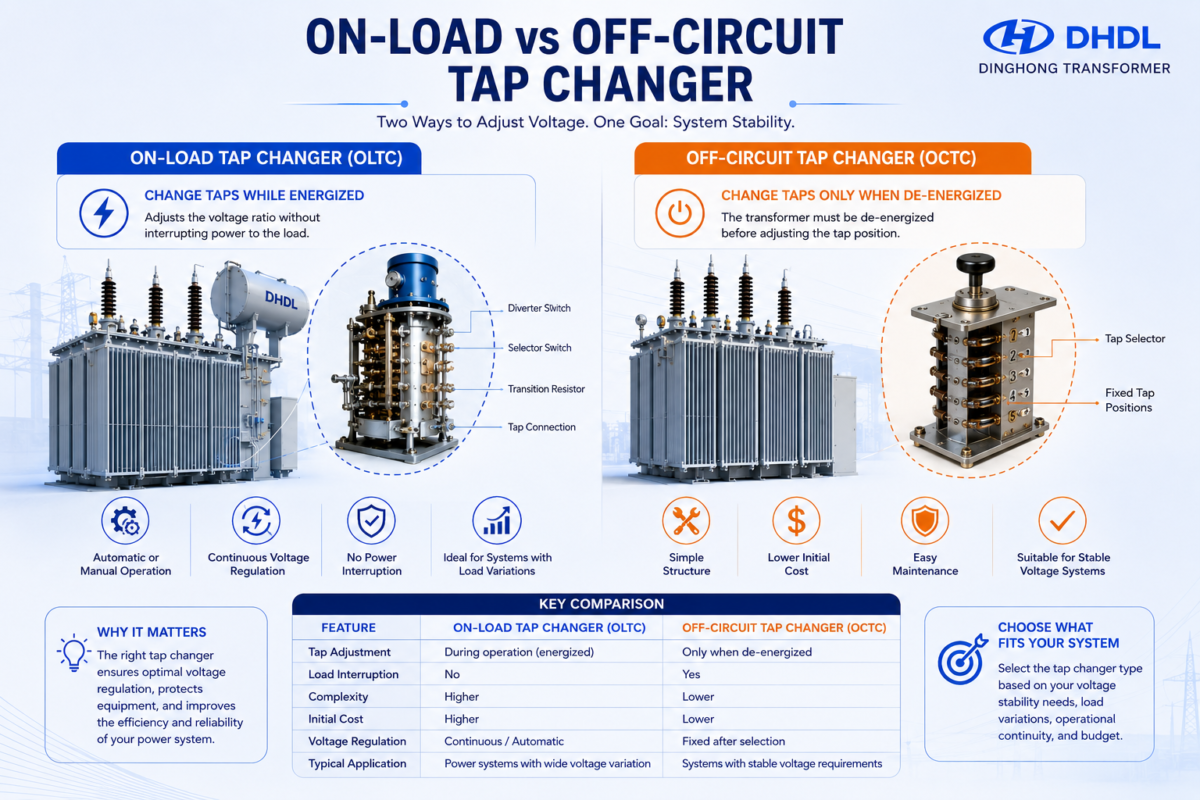
The fundamental difference is straightforward:
On-load tap changer: Tap position can be changed while the transformer is energized and supplying power.
Off-circuit tap changer: Transformer must be de-energized before the tap position can be changed.
This difference has significant implications for system operation.
| FEATURE | On-Load Tap Changer | Off-Circuit Tap Changer |
| Tap adjustment | During operation | Only when de-energized |
| Load interruption | Normally avoided | Required |
| Design complexity | Higher | Lower |
| Initial cost | Generally higher | Generally lower |
| Voltage regulation | Continuous/automatic possible | Fixed after selection |
| Maintenance | More specialized | Generally simpler |
| Typical application | Grid, substations, large industrial systems | Distribution and stable-load applications |
When Should You Choose an On-Load Tap Changer?
An OLTC may be appropriate when the electrical system experiences significant voltage variation or when maintaining voltage within a narrow range is important.
Potential applications include:
- Utility substations
- Large industrial facilities
- Transmission and distribution networks
- Renewable-energy grid connections
- Large power transformers
- Systems with significant load variation
For example, an industrial facility may experience substantial changes between daytime production and nighttime operation.
An OLTC can help regulate transformer output voltage as system conditions change.
When Is an Off-Circuit Tap Changer Better?
An off-circuit tap changer can be a practical solution when voltage conditions are relatively stable and adjustments are only occasionally required.
It is commonly appropriate for applications where the transformer can safely be disconnected during maintenance or voltage adjustment.
Because the design is generally simpler, an OCTC can also provide a cost-effective solution where continuous voltage regulation is unnecessary.
For many distribution transformer applications, selecting an off-circuit tap changer can provide the required voltage adjustment without the additional complexity of an OLTC.
What Are the Advantages of an OLTC?
The biggest advantage is voltage regulation without interrupting the load.Other benefits can include:
- Improved voltage stability
- Automatic voltage regulation
- Reduced need for manual intervention
- Better adaptation to changing loads
- Continuous operation during tap adjustment
However, OLTC systems contain additional mechanical and electrical components, which can increase equipment cost and maintenance requirements.
What Are the Advantages of an Off-Circuit Tap Changer?
The main advantage of an OCTC is simplicity.
Because it does not switch taps under load, its construction and operating mechanism can be less complex.
Benefits may include:
- Lower initial cost
- Simpler construction
- Easier maintenance
- Suitable for stable voltage systems
- Fewer moving components
The trade-off is that the transformer must be de-energized before changing the tap position.
How Should You Select the Right Tap Changer?
Tap changer selection should be based on the actual electrical requirements of the project.
Engineers should consider:
- Grid voltage variation
- Transformer capacity
- Load variation
- Required voltage regulation
- Operating continuity
- Maintenance requirements
- Project budget
- System protection
- Applicable technical standards
The decision should be made during the transformer specification stage rather than after manufacturing has started.
Choosing Dinghong Transformer
DinghongTransformer (DHDL) manufactures customized transformers and power-distribution equipment for industrial, utility, infrastructure, and renewable-energy applications.
Depending on the project requirements, transformer specifications can be developed around factors such as rated capacity, voltage, tap range, cooling method, vector group, impedance, installation environment, and applicable standards.
For projects requiring frequent voltage regulation, an on-load tap changer transformer may provide the required operational flexibility.
Where voltage conditions are stable and adjustments are infrequent, an off-circuit tap changer may be the more practical solution.
The correct choice ultimately depends on the project’s electrical system rather than simply selecting the more advanced option.
Final Thoughts
The difference between an on-load tap changer and an off-circuit tap changer comes down primarily to how and when the transformer voltage ratio can be adjusted.An OLTC allows tap changes while the transformer remains energized, making it suitable for systems requiring continuous voltage regulation.
An OCTC requires the transformer to be de-energized, but its simpler design can make it appropriate for systems where voltage adjustments are infrequent.
Neither option is universally better.
The right choice depends on voltage stability, load characteristics, operational requirements, transformer capacity, maintenance strategy, and project budget.
By defining these requirements early, project owners and engineers can select a transformer and tap-changing system that provides reliable voltage control throughout the equipment’s service life.
For a customized power transformer or distribution transformer, DinghongTransformer can evaluate the project’s electrical requirements and develop a configuration suited to the intended application.