
The Importance of Transformer Efficiency in Power Distribution

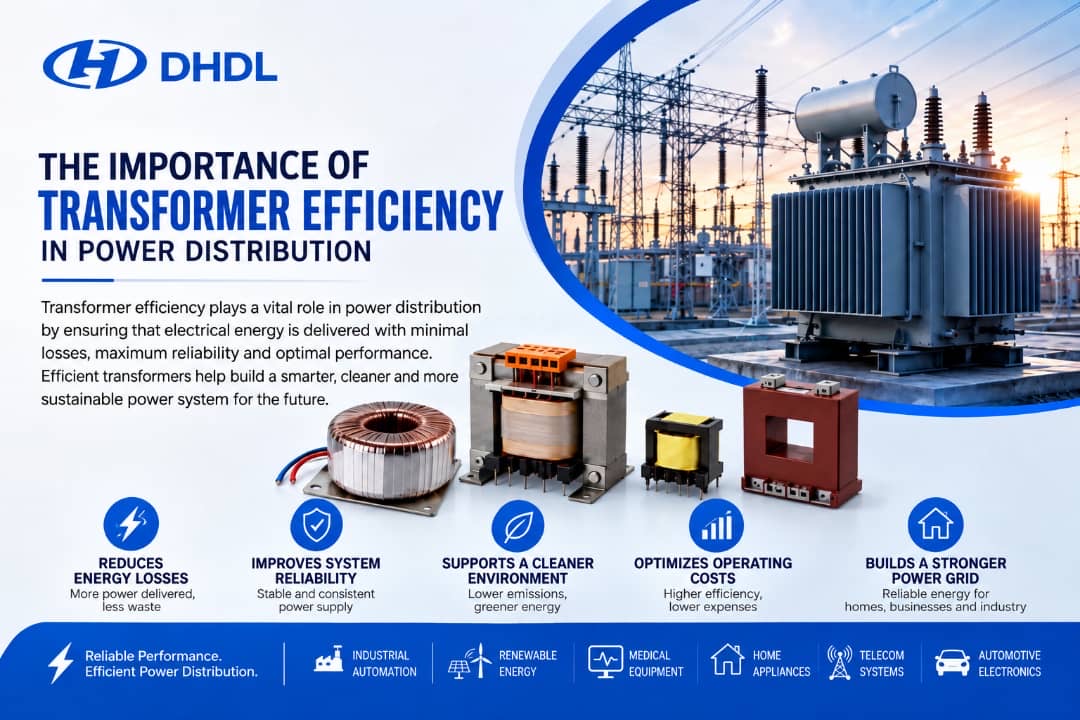
Transformers are among the most important components in modern electrical power systems. They make it possible to transmit electricity at appropriate voltage levels and safely distribute power to homes, commercial buildings, industrial facilities, and other users. However, the performance of a transformer is not determined only by its voltage rating or capacity. Transformer efficiency is equally important because even small energy losses can become significant when transformers operate continuously for many years.
In a power distribution network, improving transformer efficiency helps reduce energy waste, operating costs, equipment stress, and environmental impact while supporting reliable electricity delivery. The U.S. Department of Energy (DOE) notes that distribution transformers operate continuously and that even relatively small improvements in efficiency can produce significant energy savings. (The Department of Energy’s Energy.gov)
What Is Transformer Efficiency?
Transformer efficiency refers to how effectively a transformer converts electrical power from its input side to useful electrical power at its output side.
It can generally be expressed as:
Transformer Efficiency = (Output Power ÷ Input Power) × 100
No transformer operates at 100% efficiency because some electrical energy is lost during operation. These losses mainly occur in the transformer core and windings.
According to the U.S. Department of Energy, distribution transformer losses are generally divided into no-load losses and load losses. No-load losses occur whenever the transformer is energized, while load losses increase as the transformer load increases.
Understanding these losses is essential when selecting an electrical transformer, especially for applications where the transformer will operate continuously.
Why Is Transformer Efficiency Important in Power Distribution?
1. Reduces Energy Losses
One of the biggest benefits of an efficient transformer is the reduction of wasted electrical energy. During voltage transformation, energy is lost primarily through core losses and winding losses.
Core or no-load losses occur even when the transformer has little or no connected load. Load losses, on the other hand, increase as the transformer supplies more current. DOE explains that load losses increase approximately with the square of the percentage loading. (The Department of Energy’s Energy.gov)
Using a high-efficiency distribution transformer can therefore help utilities and businesses reduce unnecessary energy losses throughout the distribution network.
2. Lowers Operating Costs
Transformer losses represent energy that must still be generated and supplied even though it does not reach the end user as useful output.
For utilities operating thousands of transformers, small efficiency improvements across individual units can result in substantial savings. The DOE’s updated distribution-transformer efficiency standards were developed specifically to reduce wasted energy and improve the efficiency of the electrical grid.
For businesses and industrial facilities, selecting efficient transformers can also contribute to lower long-term electricity and operating costs.
3. Improves Power Distribution Reliability
Efficiency and reliability are closely connected. Excessive energy losses produce heat, and excessive heat can accelerate insulation aging and place additional stress on transformer components.
A properly designed and efficiently operated transformer can manage losses more effectively, helping maintain stable operating temperatures and dependable performance.
This is particularly important for transformers serving critical loads such as industrial facilities, commercial buildings, data centers, healthcare facilities, and infrastructure projects.
4. Extends Transformer Service Life
Temperature has a major influence on transformer insulation and component aging. When losses produce excessive heat, the insulation system can deteriorate more rapidly.
Improving transformer efficiency reduces unnecessary losses and helps control operating temperatures. Combined with appropriate cooling, maintenance, monitoring, and loading practices, this can contribute to a longer service life.
This is one reason transformer selection should consider not only the initial purchase price but also total ownership cost over the equipment’s operating lifetime.
5. Supports Grid Modernization
Modern electricity networks are becoming more complex as electricity demand increases and technologies such as renewable energy, electric vehicles, battery storage, and smart-grid systems expand.
Efficient transformers are an important part of this transition. The DOE identifies distribution transformers as critical components of the electrical grid and highlights efficiency improvements as a way to conserve energy and strengthen grid performance. (The Department of Energy’s Energy.gov)
For modern distribution systems, transformer efficiency should therefore be considered alongside capacity, voltage regulation, monitoring, protection, and system reliability.
Understanding No-Load and Load Losses
To improve transformer efficiency, it is important to understand the two major categories of losses.
No-Load Losses
No-load losses, sometimes called core losses, occur whenever a transformer is energized. They are primarily associated with the magnetic core.
Because a distribution transformer may remain energized around the clock, no-load losses can accumulate significantly over its lifetime.
Better core materials and optimized magnetic designs can help reduce these losses. The ENERGY STAR transformer buyer’s guide explains that core losses can be reduced through factors such as thinner laminations, improved magnetic orientation, and advanced core materials such as amorphous steel.
Load Losses
Load losses are primarily associated with the transformer windings and electrical resistance. They increase as the transformer supplies more current.
This means that a transformer operating close to its rated capacity can experience considerably higher load losses than one operating at a lighter load.
For this reason, selecting the correct transformer capacity is essential. Oversizing and undersizing can both create undesirable economic or operational consequences.
Factors That Affect Transformer Efficiency
Several factors should be considered when evaluating transformer efficiency:
- Transformer design: Core and winding design directly influence losses.
- Core material: High-quality magnetic materials can reduce no-load losses.
- Loading level: Load losses increase significantly as current increases.
- Cooling system: Effective cooling helps manage heat generated during operation.
- Operating temperature: Excessive temperature can affect performance and service life.
- Maintenance: Proper maintenance helps keep transformers operating within their intended conditions.
- Voltage regulation: Appropriate voltage control supports stable power delivery.
- Transformer sizing: Correct capacity helps ensure efficient operation under expected loads.
The IEC has also developed technical guidance specifically addressing transformer energy efficiency. IEC TS 60076-20:2017 covers power transformers and proposes methods for defining energy-efficiency indexes and evaluating transformer energy performance. (IEC Webstore)
How to Improve Transformer Efficiency
Utilities and businesses can take several steps to improve transformer efficiency.
First, select transformers according to actual and expected electrical loads. Second, compare no-load and load losses rather than looking only at the purchase price. Third, maintain appropriate cooling and ventilation systems. Fourth, conduct regular transformer testing and monitoring to identify developing problems.
Transformer monitoring can also provide useful information about temperature, loading, insulation condition, and other operating parameters. Early detection of abnormal conditions can help prevent failures and maintain reliable power distribution.
For large installations, it is also useful to evaluate the total cost of ownership. A transformer with a higher initial purchase price may provide better long-term value if it delivers lower energy losses throughout its service life.
Efficient Transformers and Sustainable Power Distribution
Energy efficiency is increasingly important as countries and industries seek to reduce energy waste and improve sustainability.
Because distribution transformers can remain energized continuously, their losses accumulate over thousands of operating hours. Improving their efficiency can therefore reduce the amount of electricity that must be generated simply to compensate for transformer losses.
The DOE’s 2024 final rule on distribution transformer efficiency projected significant long-term energy savings from improved standards, demonstrating the scale of impact that transformer efficiency can have across an electrical system. (The Department of Energy’s Energy.gov)
Choosing the Right Transformer
Choosing the right transformer requires more than selecting a suitable voltage and kVA rating. Engineers and buyers should evaluate efficiency, no-load losses, load losses, installation environment, cooling requirements, insulation, applicable standards, maintenance requirements, and expected load profile.
Depending on the application, options may include dry type transformers, oil immersed transformers, distribution transformers, power transformers, pole mounted transformers, and pad mounted transformers.
The right choice should balance technical requirements, efficiency, reliability, safety, and long-term operating costs.
Conclusion
Transformer efficiency in power distribution is essential for reducing energy losses, lowering operating costs, improving reliability, supporting longer equipment life, and building more sustainable electrical networks.
Efficient transformers help ensure that more of the electricity generated reaches consumers as useful power instead of being lost as heat. For utilities, industries, commercial facilities, and infrastructure developers, investing in high-efficiency transformer technology can provide value throughout the equipment’s operating life.
As electricity demand continues to grow and modern technologies place new demands on power networks, the importance of efficient and reliable transformers will only increase. Selecting the right transformer, maintaining it properly, monitoring its performance, and considering both no-load and load losses are therefore essential steps toward a more efficient power distribution system.