
Electric Vehicle Charging Station Manufacturers: How to Choose the Right EV Charging Solution Provider

The global transition toward electric mobility is accelerating. As electric vehicles (EVs become more popular, the demand for reliable charging infrastructure is growing rapidly across residential areas, commercial buildings, highways, industrial parks, and public transportation networks.
Behind every efficient EV charging network is a complete power supply system. EV charging stations are not only about charging piles — they require reliable electrical equipment, power conversion systems, protection devices, and stable energy distribution solutions.
Choosing the right electric vehicle charging station manufacturer is therefore critical for project success.
A professional EV charging solution provider should not only supply charging equipment but also understand:
- Power distribution requirements
- Transformer selection
- Grid connection challenges
- Safety standards
- Energy management needs
- Long-term operation and maintenance
This guide explains what EV charging station manufacturers provide, how EV charging systems work, key factors when selecting suppliers, and why integrated power solutions are becoming increasingly important.
1. What Is an Electric Vehicle Charging Station?
An electric vehicle charging station is a power supply system designed to deliver electrical energy from the grid to electric vehicle batteries.
Similar to traditional fuel stations, EV charging stations provide energy refueling services, but instead of gasoline or diesel, they deliver electricity through charging equipment.
A complete EV charging system usually includes:
- EV charging piles
- Power distribution equipment
- Transformers
- Switchgear
- Protection devices
- Energy management systems
- Communication systems
Depending on application requirements, EV charging stations can be designed for:
- Residential charging
- Commercial parking areas
- Highway charging stations
- Bus charging depots
- Fleet charging centers
- Industrial facilities
2. How Does an EV Charging Station Work?
The charging process involves several stages:
1. Grid Power Input
Electricity is supplied from the utility grid at medium or low voltage.
For large charging projects, the incoming voltage may require a dedicated transformer and distribution system.
2. Power Conversion
Charging stations convert grid electricity into a suitable form for EV batteries.
Depending on charging type:
AC Charging
AC chargers supply alternating current directly to the vehicle’s onboard charger.
Advantages:
- Lower installation cost
- Suitable for long parking periods
- Common for homes and workplaces
DC Fast Charging
DC chargers convert AC power into direct current before delivering it directly to the battery.
Advantages:
- Faster charging speed
- Suitable for highways and commercial charging stations
- Supports high-power charging requirements
3. Battery Charging Management
Modern charging stations monitor:
- Charging voltage
- Current level
- Battery status
- Temperature
- Energy consumption
This improves charging safety and efficiency.
3. Why Do EV Charging Projects Need Professional Power Equipment?
Many people focus only on charging piles, but the electrical infrastructure behind them is equally important.
Large-scale charging stations require:
Reliable Transformers
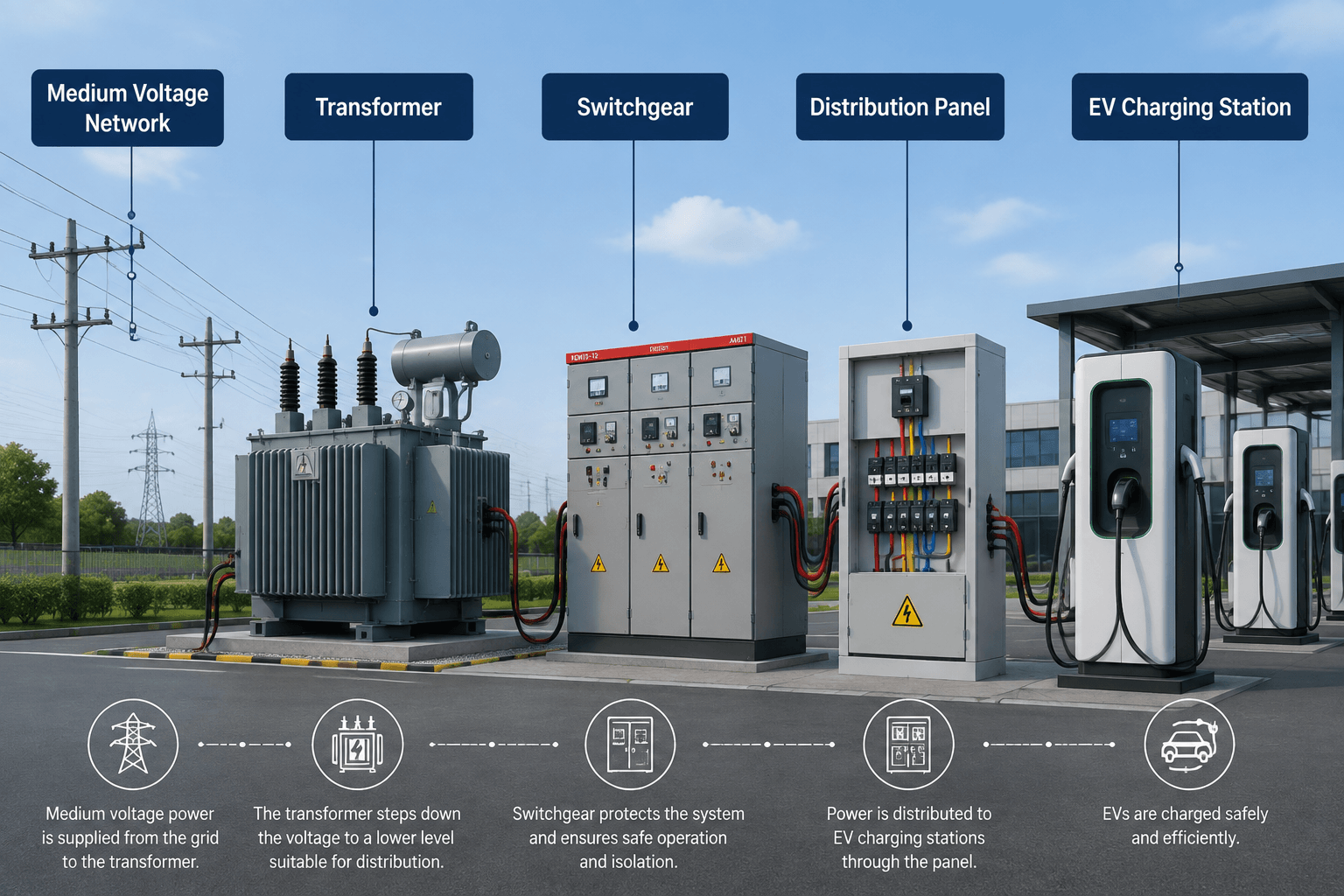
Transformers provide the required voltage conversion between the utility grid and charging equipment.
For example:
- Medium voltage grid → Transformer → Low voltage charging system
A properly selected transformer ensures:
- Stable voltage output
- Lower energy losses
- Reliable operation
High Voltage Switchgear
Switchgear protects electrical equipment from:
- Short circuits
- Overcurrent
- Voltage abnormalities
It also allows safe maintenance and system control.
Energy Management Systems
Smart energy management helps operators:
- Monitor electricity usage
- Control charging loads
- Reduce peak demand costs
- Improve system efficiency
4. Types of EV Charging Stations
1. Residential EV Chargers
Designed for individual users.
Applications:
- Homes
- Apartments
- Private parking spaces
Features:
- Low power output
- Simple installation
- Overnight charging
2. Commercial Charging Stations
Used in:
- Shopping centers
- Office buildings
- Hotels
- Parking facilities
Requirements:
- Multiple charging points
- Reliable power distribution
- User management systems
3. Public Fast Charging Stations
Common locations:
- Highways
- Service areas
- Transportation hubs
These projects require:
- High-power charging equipment
- Dedicated transformers
- Advanced protection systems
4. Fleet Charging Stations
Used by:
- Electric buses
- Logistics companies
- Delivery fleets
Key requirements:
- High charging capacity
- Continuous operation
- Intelligent scheduling
5. How to Choose the Right EV Charging Station Manufacturer?
Selecting a manufacturer requires evaluating more than product price.
1. Complete Power Solution Capability
A reliable manufacturer should understand the entire electrical system.
Important capabilities include:
- Transformer solutions
- Switchgear integration
- Charging equipment supply
- System design support
Manufacturers with complete power experience can reduce project complexity.
2. Charging Equipment Compatibility
Before purchasing, confirm compatibility with:
- Vehicle models
- Charging standards
- Communication protocols
- Local regulations
Common standards include:
- CCS
- CHAdeMO
- GB/T
- Type 2
3. Power Capacity Design
Incorrect power planning can cause:
- Grid overload
- Charging delays
- Higher operating costs
Professional suppliers evaluate:
- Number of chargers
- Charging power
- Peak demand
- Future expansion
4. Safety and Protection Features
EV charging systems must include protection against:
- Overvoltage
- Overcurrent
- Leakage current
- Short circuits
- Temperature problems
Safety design directly affects equipment reliability.
5. International Standards
Global projects may require compliance with:
- IEC standards
- CE certification
- UL requirements
- Local electrical regulations
A professional manufacturer should support different market requirements.
6. Hidden Costs Many EV Charging Projects Ignore
1. Transformer Capacity Planning
Many projects underestimate future charging demand.
As EV adoption increases, charging requirements may grow significantly.
A properly designed power system should consider:
- Future vehicle growth
- Additional chargers
- Increased electricity demand
2. Installation Environment
Outdoor charging stations must consider:
- Weather protection
- Temperature conditions
- Humidity
- Dust
- Corrosion
Poor environmental adaptation can reduce equipment lifetime.
3. Total Lifecycle Cost
The lowest equipment price does not always mean the lowest project cost.
Consider:
- Initial investment
- Energy efficiency
- Maintenance requirements
- Service life
- Downtime risk
Reliable equipment can provide better long-term returns.
7. Why Choose DHDL for EV Charging Power Solutions?
DHDL is a professional power equipment manufacturer providing integrated electrical solutions for global energy projects.
DHDL products include:
- Distribution transformers
- Dry-type transformers
- Oil-immersed transformers
- High voltage equipment
- Switchgear systems
- EV charging power solutions
With experience in power distribution systems, DHDL supports EV charging infrastructure projects by providing reliable electrical equipment designed for different applications.
DHDL solutions can be customized according to:
- Grid voltage requirements
- Charging capacity
- Installation environment
- International standards
- Project specifications
From electrical design to manufacturing and testing, DHDL helps customers build stable and efficient EV charging networks.
8. Conclusion
The growth of electric vehicles requires more than charging piles. Behind every successful EV charging project is a reliable electrical infrastructure system.
Choosing the right electric vehicle charging station manufacturer means selecting a partner with experience in power distribution, transformer technology, safety design, and long-term project support.
Whether for commercial charging stations, highway fast-charging networks, industrial fleets, or renewable energy projects, professional power solutions are essential for reliable EV charging performance.
DHDL provides customized power equipment solutions for global EV charging infrastructure projects, helping customers create safer, smarter, and more efficient energy systems.
FAQ
1. What does an electric vehicle charging station manufacturer provide?
A professional EV charging station manufacturer provides charging equipment, power solutions, system integration, technical support, and customized charging infrastructure solutions.
2. What equipment is required for an EV charging station?
A complete EV charging station may include:
- Charging piles
- Transformers
- Switchgear
- Protection devices
- Energy management systems
- Communication systems
3. What is the difference between AC charging and DC fast charging?
AC charging uses the vehicle’s onboard charger and is suitable for slower charging. DC fast charging converts power directly for faster battery charging.
4. Why are transformers important for EV charging stations?
Transformers adjust grid voltage levels to match charging equipment requirements and ensure stable, safe power supply.
5. How do I select an EV charging station manufacturer?
Consider:
- Technical experience
- Power system capability
- Product quality
- Safety standards
- Customization ability
- After-sales support
6. Can EV charging systems be customized?
Yes. Professional manufacturers can customize charging solutions based on charging capacity, voltage requirements, location, and application scenarios.
7. What standards should EV charging stations meet?
Depending on the market, EV charging systems may need to comply with IEC, CE, UL, GB/T, or other local standards.
Choose DHDL for Your Transformer Solutions
DHDL is a professional transformer manufacturer specializing in dry-type transformers, oil-immersed transformers, power transformers, distribution transformers, and complete power distribution solutions.
We support customized transformer designs based on project voltage, capacity, frequency, installation environment, and international standards.
Whether for industrial facilities, renewable energy projects, data centers, utilities, or infrastructure applications, DHDL delivers reliable, efficient, and customized power solutions worldwide.
Contact DHDL today for professional transformer selection support and a customized quotation.
💬WeChat/WhatsApp:+8613355383777
📩 Email:service@dinghongtransformer.com
🌐web:https://dinghongtransformer.com/