
How to Specify a Data Center Transformer: Sizing, Redundancy & RFQ Checklist for Global Projects

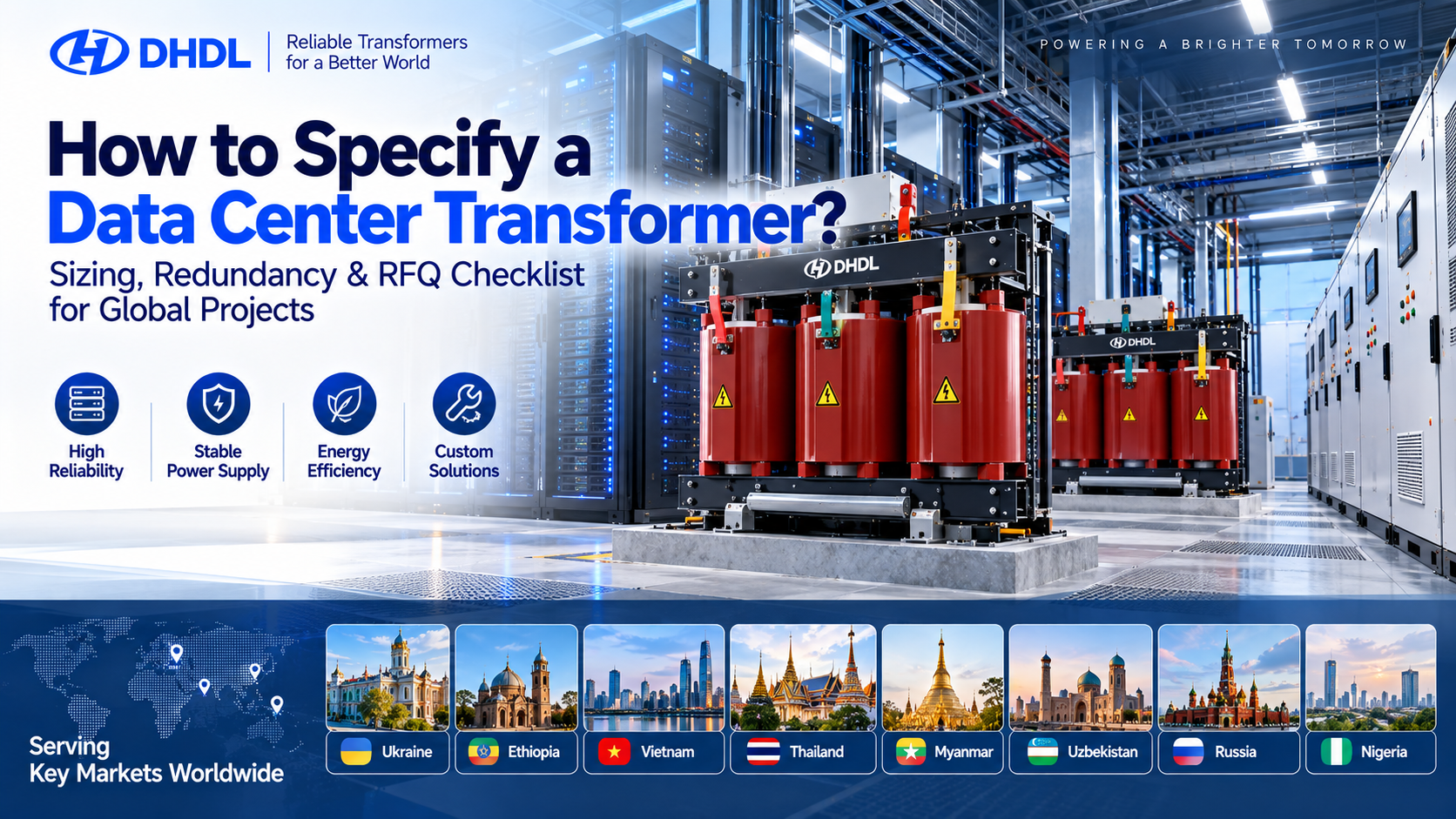
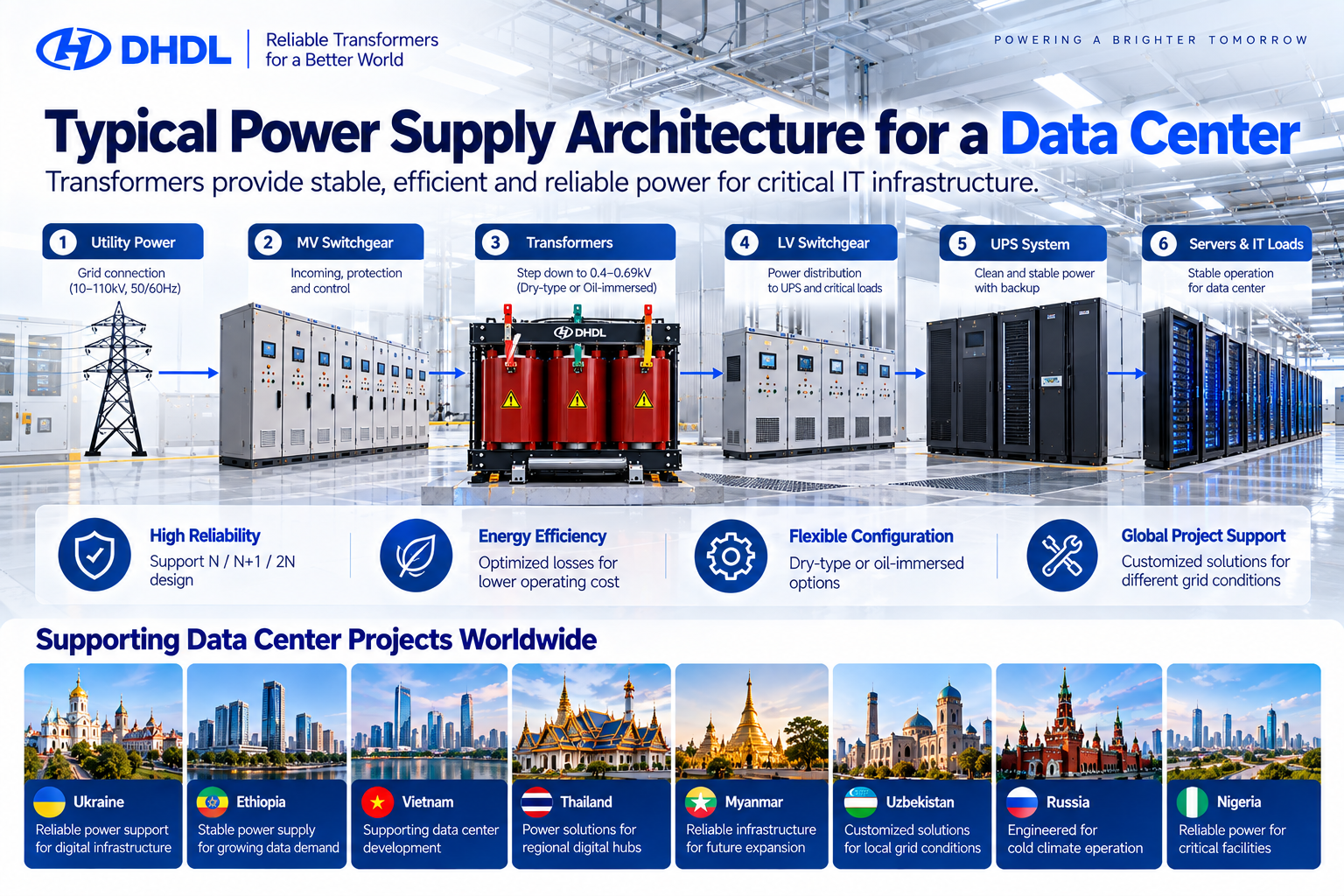
A data center transformer does more than reduce medium voltage to a usable distribution voltage. It supports a power system where electrical reliability, efficiency, cooling, protection, and future capacity all affect operating costs and service continuity.
For data center projects in Ukraine, Éthiopie, Vietnam, Thaïlande, Myanmar, Ouzbékistan, Russia, and Nigeria, transformer specifications must also reflect local grid conditions, ambient temperatures, installation environments, and project-specific electrical standards.
A transformer that performs well in a climate-controlled electrical room in Vietnam may require different environmental provisions from one installed in a cold region of Russia or Uzbekistan.
The same applies to facilities operating under unstable grid conditions in parts of Nigeria, Ethiopia, or Myanmar.
So, how do you specify the right transformer for a data center?
Start with the actual electrical design—not simply the transformer price or the number of server racks.
1. Calculate Transformer Capacity from the Actual Data Center Load
One of the most common procurement mistakes is selecting transformer capacity based only on IT equipment power.
A data center also consumes electricity through cooling systems, UPS losses, lighting, auxiliary equipment, and electrical distribution infrastructure.
A practical transformer sizing assessment should consider:
- IT equipment load (kW)
- Cooling and HVAC load
- UPS losses and operating mode
- Auxiliary electrical loads
- Power factor
- Expected demand and diversity
- Future capacity expansion
- Transformer redundancy arrangement
Example: Transformer Sizing for a 1MW IT Load
Assume a proposed data center has:
| Parameter | Illustrative Value |
|---|---|
| IT Load | 1,000kW |
| Design PUE | 1.40 |
| Total Facility Power | 1,400kW |
| Assumed Power Factor | 0.95 |
| Apparent Power | 1,474kVA |
| Illustrative Design Allowance | 20% |
| Calculated Capacity | 1,768kVA |
The simplified calculation is:
\[ S=\frac{1{,}000\times1.40}{0.95}\times1.20\approx1{,}768\text{ kVA} \]
A standard 2,000kVA transformer might therefore be considered for this illustrative load.
However, final selection depends on the load allocation, redundancy design, UPS characteristics, cooling demand, transformer temperature rise, and expansion plan. The PUE calculation must also be applied consistently to avoid counting the same auxiliary loads twice.
Hidden procurement risk: A 2,000kVA transformer does not automatically mean the facility has 2,000kVA of usable IT capacity.
2. Choose Between Dry-Type and Oil-Immersed Transformers
Both dry-type and oil-immersed transformers can be used in data center electrical infrastructure.
The correct choice depends on the installation location, fire-safety requirements, cooling arrangements, maintenance access, and local regulations.
| Selection Factor | Transformateur de type sec | Transformateur immergé dans l'huile |
|---|---|---|
| Insulation | Solid insulation, commonly cast resin | Insulating liquid |
| Typical Installation | Indoor electrical rooms | Outdoor substations or designated transformer areas |
| Fire Considerations | No insulating oil; still requires fire assessment | Oil containment and fire protection may be required |
| Cooling | Air cooling, natural or forced | Oil and air cooling arrangements |
| Maintenance | Inspection, cleaning, connections, ventilation | Oil condition, sealing, cooling and electrical inspection |
| Common Data Center Role | Building distribution | Utility intake and main distribution |
| Main Procurement Concern | Temperature rise, ventilation, noise | Fire separation, oil containment, cooling and access |
For an indoor data center electrical room in Vietnam or Thailand, a cast-resin dry-type transformer may be a suitable option where building requirements and thermal design permit.
For a large data center campus in Uzbekistan, Ethiopia, or Nigeria, an outdoor oil-immersed transformer may be considered for the main power intake, with dry-type transformers serving downstream electrical rooms.
DHDL supplies both dry-type distribution transformers and oil-immersed distribution transformers for project-specific applications.
3. Specify Voltage, Frequency, Vector Group and Impedance
A data center transformer RFQ must clearly identify the electrical characteristics of the facility.
Do not request only a “2,500kVA data center transformer.”
At minimum, confirm the following parameters.
| Technical Parameter | Example Specification |
|---|---|
| Rated Capacity | 2,500kVA |
| Primary Voltage | 10kV / 11kV / Project Specific |
| Secondary Voltage | 400V / 415V / Project Specific |
| Fréquence | 50Hz |
| Phase | Three-Phase |
| Vector Group | Dyn11, subject to system design |
| Short-Circuit Impedance | Project Specific |
| Tap Range | ±2 × 2.5%, if required |
| Winding Material | Copper / Aluminum |
| Cooling | AN / AF or ONAN, as applicable |
| Insulation and Temperature Rise | According to design and applicable standards |
| Applicable Standards | IEC / Local Utility / Project Requirements |
These values are illustrative RFQ fields, not a universal DHDL data center model specification.
Why Impedance Matters
Transformer impedance affects short-circuit current, voltage regulation, and load sharing when transformers operate in parallel.
For example, a 2,500kVA transformer with a 400V secondary has a rated current of approximately:
\[ I=\frac{2{,}500{,}000}{\sqrt{3}\times400}\approx3{,}608\text{ A} \]
With an illustrative impedance of 6%, the transformer-limited initial symmetrical short-circuit current at its terminals is approximately 60kA, assuming an ideal upstream source and neglecting additional impedance.
That figure is not a substitute for a complete short-circuit study, but it demonstrates why transformer impedance must be coordinated with low-voltage switchgear ratings.
For data center projects in Ukraine, Russia, and Uzbekistan, existing utility and substation configurations should be reviewed before confirming voltage ratio, vector group, and impedance.
4. Design for Redundancy, Not Just Installed Capacity
A data center may use N, N+1, 2N, or another engineered redundancy arrangement.
The transformer procurement specification must reflect the intended power architecture.
For example, installing two 2,500kVA transformers does not automatically create a fully redundant 5,000kVA power system.
If one transformer is unavailable, the remaining transformer must be capable of carrying the required transferred load—or the system must have an approved load-shedding arrangement.
Buyers should confirm:
- Normal operating load per transformer
- Maximum permitted loading
- Required capacity after one transformer fails
- Automatic transfer requirements
- Parallel operation requirements
- Bus coupler and switchgear arrangement
- Protection coordination
- Planned maintenance strategy
For new data center developments in Thailand, Vietnam, and Nigeria, these decisions should be made during the electrical design stage, not after transformer manufacturing begins.
5. Check UPS Harmonics, Losses and Cooling Requirements
Data center transformers often supply electrical systems containing UPS rectifiers, variable-frequency drives, and other nonlinear loads.
These loads can produce harmonic currents, increasing transformer losses and temperature rise.
Before ordering, request information about:
- UPS topology and input harmonic characteristics
- Total harmonic current distortion (THDi) at the relevant operating point
- Expected transformer loading
- Neutral conductor requirements
- Harmonic filtering arrangements
- Transformer winding temperature rise
- Cooling and ventilation conditions
A low-harmonic UPS design may not require the same transformer provisions as a system with significant harmonic distortion.
Hidden procurement risk: Do not automatically specify a K-rated transformer or an oversized transformer without evaluating the actual harmonic spectrum and applicable design standard.
Why Transformer Losses Matter
Data center transformers can remain energized continuously, even when IT load is relatively low.
The procurement team should compare guaranteed no-load and load losses, not just initial purchase price.
For an illustrative transformer with 3kW of no-load loss:
\[ 3 \times 8{,}760 = 26{,}280\text{ kWh/year} \]
At an illustrative electricity price of $0.10/kWh, this represents approximately $2,628 annually in no-load energy cost alone.
Actual annual costs also depend on loading, load losses, electricity tariffs, and operating hours.
For continuously operated data centers in Vietnam, Thailand, Nigeria, and Ethiopia, lifecycle loss evaluation can reveal cost differences that are not obvious in the original quotation.
6. Real Project Case: DHDL Harbin Intelligent Computing Center
A relevant example comes from DHDL’s Harbin Intelligent Computing Center Phase I power distribution project in China.
The published project involved an expansion supporting approximately 18MW of additional IT load and around 1,800 server cabinets.
Published DHDL project information.
| Project Parameter | Published Information |
|---|---|
| Location | Harbin, China |
| Application | AI Computing / Data Center |
| Additional IT Load | Approx. 18MW |
| Additional Server Cabinets | Approx. 1,800 |
| Power Architecture | Dual Supply + Double Busbar |
| Redundancy | N+1 |
| Main Transformers | 2 × 31.5MVA, 110/10.5kV |
| Distribution Transformers | 26 × 2,500kVA dry-type |
| Medium-Voltage Switchgear | 32 KYN28A-12 Panels |
| Low-Voltage Switchgear | 156 MNS Panels |
| Delivery | Within 58 Days |
The project required coordinated transformers, switchgear, UPS infrastructure, backup generation, and protection systems.
Harbin’s winter temperatures can approach −30°C, making low-temperature design and anti-condensation measures important for the project.
DHDL reports that the equipment arrived within 58 days, eight days ahead of the planned schedule.
This project demonstrates three important purchasing lessons.
First, a data center transformer should be specified as part of the complete electrical distribution architecture.
Second, redundancy depends on transformer capacity, switching arrangements, and the loads that must remain energized during an outage.
Third, environmental conditions and delivery schedules must be confirmed before production.
For data center developments in Russia, Ukraine, and Uzbekistan, the cold-weather engineering considerations illustrated by this project are particularly relevant, although the actual temperature design must be based on the destination site.
Source note: DHDL’s published project pages contain differing distribution-transformer counts. This article uses the dedicated project page’s 26-unit figure; confirm the final project equipment schedule before using that quantity in promotional claims.
7. Country-Specific Transformer Requirements for Data Centers
Transformer specifications should reflect the actual project location.
The following table provides engineering considerations for DHDL’s eight target markets. These are planning considerations, not verified countrywide grid specifications. Utility voltage, frequency, local codes, and approval requirements must be confirmed for each project.
| Target Market | Key Considerations for Data Center Procurement |
|---|---|
| Ukraine | Existing grid connections, backup power, cold-weather performance, protection coordination |
| Éthiopie | Utility voltage, ambient temperature, altitude, grid reliability and backup strategy |
| Vietnam | High humidity, cooling ventilation, electrical-room conditions, utility compatibility |
| Thaïlande | High ambient temperatures, humidity, transformer cooling and outdoor installation |
| Myanmar | Grid reliability, backup generation, voltage variation and protection coordination |
| Ouzbékistan | Temperature extremes, dust, substation integration and insulation requirements |
| Russia | Low-temperature design, local standards, documentation and winter operating conditions |
| Nigeria | Grid voltage quality, backup power, heat, dust and site maintenance requirements |
Southeast Asia: Vietnam, Thaïlande and Myanmar
For data centers in Vietnam, Thailand, and Myanmar, buyers should carefully review temperature, humidity, ventilation, and moisture protection.
Indoor dry-type transformers require adequate airflow and heat removal. Outdoor installations require an enclosure and protection system appropriate to the site.
Where backup generators are used, transformer energization, transfer sequences, and protection coordination should be included in the design review.
Africa: Ethiopia and Nigeria
For Ethiopia and Nigeria, procurement teams should focus on actual utility connection conditions, required backup capacity, site temperature, and maintainability.
High-altitude locations in Ethiopia may require a review of insulation coordination and cooling performance.
For Nigerian facilities using generators and UPS systems, the electrical design should consider source transfer, voltage quality, fault levels, and critical-load continuity.
Eastern Europe and Central Asia: Ukraine, Russia and Uzbekistan
For projects in Ukraine, Russia, and Uzbekistan, the transformer specification may need additional consideration of low-temperature operation, condensation, storage conditions, and utility-interface requirements.
Outdoor oil-immersed transformers may require appropriate oil, sealing, and accessory specifications for the minimum site temperature.
For indoor dry-type transformers, the building’s actual heating, ventilation, and humidity-control conditions remain important.
Buyers should also confirm applicable local technical regulations, certification requirements, and trade or import restrictions before procurement.
8. Data Center Transformer RFQ Checklist
Before requesting a quotation, send the transformer manufacturer a complete technical specification.
| RFQ Item | Buyer Input |
|---|---|
| Destination Country | Ukraine / Ethiopia / Vietnam / Thailand / Myanmar / Uzbekistan / Russia / Nigeria |
| Application | Data Center / AI Computing Center |
| IT Load | _____ MW |
| Total Facility Load | _____ kW |
| Transformer Capacity | _____ kVA / MVA |
| Quantity | _____ Units |
| Primary Voltage | _____ kV |
| Secondary Voltage | _____ V / kV |
| Fréquence | _____ Hz |
| Vector Group | _____ |
| Short-Circuit Impedance | _____ % |
| Tap Range | _____ |
| Transformer Type | Dry-Type / Oil-Immersed |
| Cooling Method | AN / AF / ONAN / Other |
| Winding Material | Copper / Aluminum |
| No-Load / Load Losses | Guaranteed Values |
| UPS Harmonic Requirements | THDi / Harmonic Spectrum |
| Redundancy | N / N+1 / 2N / Other |
| Maximum Ambient Temperature | _____ °C |
| Minimum Ambient Temperature | _____ °C |
| Altitude | _____ m |
| Applicable Standards | IEC / Local / Project-Specific |
| Factory Testing | Routine Tests / Additional FAT |
| Delivery Destination | _____ |
| Required Site Delivery Date | _____ |
Recommended RFQ Attachments
- Single-Line Diagram (SLD)
- Data center electrical load schedule
- IT and cooling load calculations
- UPS technical specifications
- Generator and automatic transfer scheme
- Short-circuit study
- Protection coordination study
- Transformer loss requirements
- Electrical-room ventilation design
- Site environmental conditions
- Required test reports and certifications
- Project construction schedule
For projects in Vietnam, Thailand, Ethiopia, Nigeria, Ukraine, Myanmar, Uzbekistan, and Russia, include the exact destination city and installation conditions rather than relying on general national climate assumptions.
DHDL’s inquiry guidance recommends providing transformer capacity, voltage, vector group, impedance, standards, installation environment, and project documents for technical review.
9. What Should Buyers Compare Before Selecting a Manufacturer?
A low transformer quotation does not necessarily mean the lowest project cost.
For data center procurement, compare suppliers using the following criteria:
| Evaluation Item | What to Verify |
|---|---|
| Technical Compatibility | Voltage, capacity, vector group and impedance |
| Energy Efficiency | Guaranteed no-load and load losses |
| Thermal Performance | Temperature rise and cooling design |
| Reliability | Insulation design and factory testing |
| Redundancy | Compatibility with the electrical architecture |
| Documentation | Drawings, reports, manuals and certificates |
| Customization | Environmental and local standard requirements |
| Delivery | Production milestones and shipping schedule |
| Support | Installation and commissioning coordination |
One commonly overlooked cost is the need to redesign low-voltage switchgear after changing transformer impedance or capacity.
Another is insufficient electrical-room ventilation, which may require costly site modifications.
Confirming these requirements before placing the order can reduce technical changes, delivery delays, and installation costs.
Data Center Transformer Solutions from DHDL
DHDL supplies dry-type transformers, oil-immersed transformers, power transformers, low-voltage distribution cabinets, medium-voltage switchgear, and prefabricated substations for industrial and critical-power applications.
Its published Harbin computing-center project demonstrates experience supplying transformers and distribution equipment for a data center with dual power supplies and redundant electrical infrastructure.
For data center projects in Ukraine, Ethiopia, Vietnam, Thailand, Myanmar, Uzbekistan, Russia, and Nigeria, DHDL can review project-specific requirements for transformer capacity, voltage, cooling, winding material, environmental conditions, and applicable standards.
To request a technical proposal, provide:
IT Load + Total Facility Load + HV/LV Voltage + Redundancy Design + UPS Requirements + Site Conditions + Destination Country + Quantity
A complete transformer specification helps buyers compare technically equivalent offers and reduces the risk of costly design changes.
DHDL — Customized Transformer and Power Distribution Solutions for Global Data Center Projects.
Website: https://dinghongtransformer.com/
Courriel : service@dinghongtransformer.com