
Transformadores de potencia y distribución: Cómo seleccionar el transformador adecuado para su proyecto eléctrico

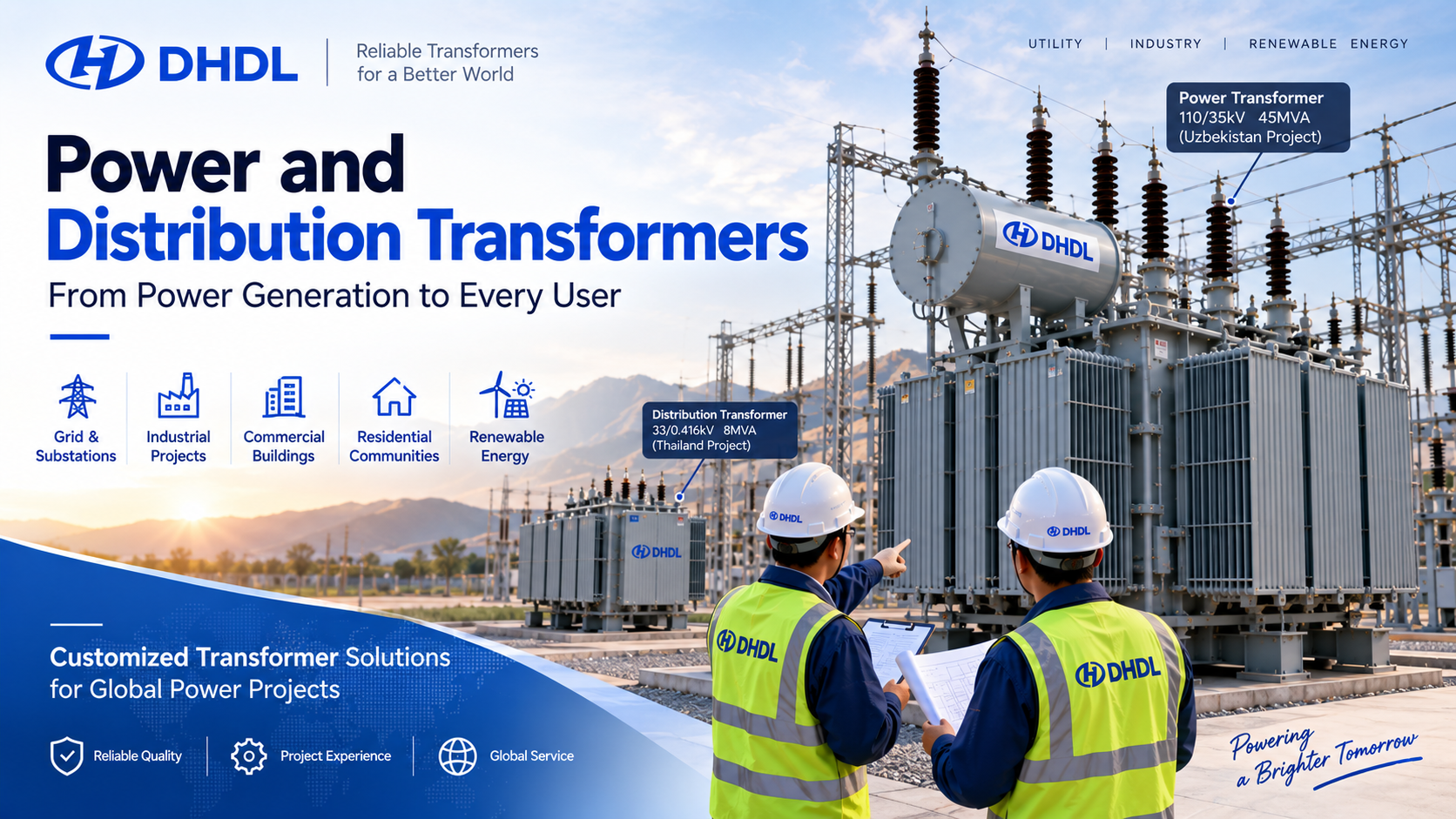
Power and distribution transformers are both essential parts of an electrical power system, but they are designed for different stages of power delivery.
A power transformer is typically used at generating stations, high-voltage substations, grid interconnections, and large industrial facilities where substantial electrical power must be transferred between voltage levels.
A distribution transformer is normally installed closer to the load, stepping medium voltage down to the level required by factories, commercial buildings, communities, and other end users.
For buyers, however, the real question is not simply:
“Do I need a power transformer or a distribution transformer?”
The more useful question is:
“What transformer configuration matches my voltage, capacity, load, site conditions, and future expansion requirements?”
Selecting the wrong transformer can result in excessive losses, incorrect protection coordination, insufficient capacity, installation problems, and unnecessary project costs.
This practical guide explains the key differences between power and distribution transformers, the technical specifications buyers should compare, and the information you should provide before requesting a quotation.
1. Transformador de potencia vs Transformador de distribución: The Key Differences
Both transformer types operate on electromagnetic induction and transfer AC electrical energy between circuits while changing voltage according to the transformer design.
Their roles within the electrical network, however, are different.
| Specification | Transformador de potencia | Transformador de distribución |
|---|---|---|
| Main Function | Bulk power transformation | Local power distribution |
| Typical Location | Main substations, power plants, large industrial systems | Local substations, industrial parks, commercial facilities, utility networks |
| Voltage | Usually high to extra-high voltage | Usually medium voltage to low voltage |
| Capacity | Generally larger | Generally smaller, but project-dependent |
| Typical Installation | Large outdoor substations | Indoor, outdoor, pole-mounted, or substation |
| Main Priority | High-capacity transfer and grid reliability | Reliable and efficient local power delivery |
| Typical Users | Utilities, power plants, large industries | Utilities, factories, commercial facilities, communities |
Power transformers may be designed for voltage classes such as 66kV, 110kV, 220kV, 330kV, or 500kV, depending on the project.
Distribution transformers are more commonly associated with medium-voltage systems such as 6kV, 10kV, 11kV, 20kV, 33kV, and 35kV, stepping voltage down toward the end user. DHDL states a core distribution range of 10–35kV and a high-voltage capability above 330kV.
These ranges are not universal boundaries. Final transformer classification and design depend on the actual system and project requirements.
2. When Should You Use a Power Transformer?
A power transformer is generally the better choice when the transformer forms part of a major transmission, grid, substation, or high-capacity industrial system.
Typical applications include:
- Power generation stations
- Transmission substations
- 66kV–500kV grid systems
- Large industrial plants
- Mining and metallurgical projects
- Renewable energy grid connections
- Regional power infrastructure
- Large industrial park substations
Consider an industrial park supplied through a 110kV grid connection.
The main transformer may reduce 110kV to 35kV for the site’s medium-voltage distribution system.
From there, additional distribution transformers can reduce 35kV to 10kV, 0.4kV, or another required utilization voltage.
This illustrates an important point:
Power transformers and distribution transformers are often used in the same project rather than being competing alternatives.
3. When Should You Use a Distribution Transformer?
A distribution transformer is normally used closer to the final electrical load.
Typical applications include:
- Factories
- Industrial parks
- Commercial buildings
- Residential communities
- Schools and hospitals
- Rural distribution networks
- Data centers
- EV charging infrastructure
- Solar and wind projects
DHDL’s utility power distribution architecture, for example, describes power moving from the primary substation through medium-voltage feeders before distribution transformers step the voltage down for local residential, commercial, and industrial users.
Distribution transformers are available in different configurations depending on the project.
These can include:
- Oil-immersed distribution transformers
- Dry-type distribution transformers
- Three-phase distribution transformers
- Single-phase pole-mounted transformers
- Pad-mounted transformers
For example, DHDL’s single-phase pole-mounted transformer range is designed for outdoor overhead distribution and can be configured for voltage levels up to 35kV, depending on the project.

4. Technical Parameters Buyers Should Compare
Do not select a transformer based only on kVA/MVA and price.
A proper technical comparison should include the following parameters.
| Parameter | Ejemplo |
|---|---|
| Tipo de transformador | Oil-Immersed Power Transformer |
| Capacity | 8MVA |
| HV Voltage | 33kV |
| LV Voltage | 0.416kV |
| Frecuencia | 50Hz |
| Fase | Trifásico |
| Vector Group | Project Specific |
| Impedance | Project Specific |
| Cooling | ONAN / ONAF |
| Material de bobinado | Copper / Aluminum |
| Tap Changer | OCTC / OLTC |
| Instalación | Indoor / Outdoor |
| Estándar | IEC / ANSI / IEEE |
| Environment | Temperature, humidity, altitude, dust, corrosion |
Three parameters deserve particular attention.
Impedancia de cortocircuito
Impedance affects:
- Fault current
- Voltage drop
- Protection coordination
- Parallel operation
- Downstream equipment ratings
Two transformers with the same capacity and voltage may not be interchangeable if their impedance values differ significantly.
Vector Group
Vector group affects:
- Phase displacement
- Grounding
- Neutral configuration
- Harmonic behavior
- Parallel operation
If a transformer will operate in parallel with an existing unit, send the manufacturer the existing transformer’s nameplate and technical data.
Tap Changer
Projects with voltage variation may require an Off-Circuit Tap Changer (OCTC) or an On-Load Tap Changer (OLTC).
The correct configuration depends on the grid and voltage-regulation requirements.
5. The Hidden Specification: Your Actual Load
One of the most common transformer purchasing mistakes is describing the application only as:
“Industrial use.”
That information is too broad.
The manufacturer should know what the transformer will actually supply.
For example:
Steel Plant → Large Motors + VFDs + Production Equipment
Data Center → UPS + IT Loads + Cooling Infrastructure
EV Charging Station → High-Power Chargers + Simultaneous Charging Loads
Wind Project → Turbine / Converter + Collection Network
Solar Project → Inverters + Step-Up System
This matters because motor starting, nonlinear loads, harmonics, load fluctuations, redundancy, and future expansion can affect transformer selection.
DHDL’s data-center solution similarly emphasizes matching transformer and distribution infrastructure to utility voltage, facility capacity, redundancy strategy, installation conditions, and future expansion rather than selecting equipment by a single capacity figure.
6. Real Project Example: 45MVA Power Transformer in Uzbekistan
A practical example of a power transformer application comes from DHDL’s Uzbekistan project.
For a textile industrial park expansion, increasing production loads led to a 110kV substation expansion project. DHDL’s published project information identifies the main transformer as a 45MVA, 110kV power transformer, with ONAN/ONAF cooling.
This is a typical power-transformer scenario.
The transformer is not simply supplying one building or one production machine.
It forms part of the main electrical infrastructure responsible for supplying a large industrial system.
For a project at this level, buyers need to evaluate much more than transformer capacity.
Important requirements can include:
- HV and LV voltage
- MVA capacity
- Insulation level
- Short-circuit impedance
- Cooling method
- Tap changer
- Grid requirements
- Site temperature
- Transportation limitations
- Factory testing
- Installation and commissioning requirements
7. Real Project Example: 8MVA Distribution Transformer in Thailand
Now compare the previous project with DHDL’s industrial park project in Thailand.
DHDL supplied an S-8000/33 oil-immersed distribution transformer for an industrial park power distribution expansion.
The published project parameters include:
| Parameter | Thailand Project |
|---|---|
| Capacity | 8,000kVA |
| Voltage | 33 / 0.416kV |
| Frecuencia | 50Hz |
| Cooling | Onán |
| Instalación | Al aire libre |
| Solicitud | Industrial Park Distribution |
The project was located in a high-temperature environment, so heat dissipation and insulation performance were important engineering considerations. The unit also underwent factory tests including insulation resistance, winding DC resistance, voltage ratio, vector group, no-load and load loss, impedance voltage, withstand-voltage, and sealing tests before shipment.
This example also reveals something buyers frequently misunderstand:
A distribution transformer is not necessarily a small transformer.
An 8MVA unit can still function as a distribution transformer because classification depends heavily on where and how the transformer operates in the electrical system, not simply its physical size or capacity.
8. The Hidden Cost of Choosing by Price Alone
Imagine receiving two quotations for the same transformer capacity.
Supplier A offers:
- Lower purchase price
- Aluminum winding
- Basic accessories
- Standard ambient-temperature design
- Higher guaranteed losses
Supplier B offers:
- Higher initial price
- Copper winding
- Lower guaranteed losses
- High-temperature design
- Additional monitoring
- More complete testing
These are not equivalent offers.
A proper transformer comparison should consider:
Technical Compliance + Purchase Price + Energy Losses + Installation + Maintenance + Expected Operating Conditions
For a transformer expected to operate for many years, purchase price is only one part of the total project cost.
DHDL’s own distribution-transformer guidance similarly emphasizes core and coil design, insulation, temperature rise, customization, factory testing, packaging, and delivery—not price alone—when evaluating long-term reliability.
9. Power and Distribution Transformer RFQ Checklist
Before requesting a quotation, prepare the following information:
| RFQ Item | Buyer Input |
|---|---|
| Tipo de transformador | Power / Distribution |
| Solicitud | __________ |
| Capacidad nominal | _____ kVA / MVA |
| HV Voltage | _____ kV |
| LV Voltage | _____ kV / V |
| Frecuencia | 50Hz / 60Hz |
| Fase | Single / Three Phase |
| Vector Group | __________ |
| Impedance | _____ % |
| Rango de toques | __________ |
| Tap Changer | OCTC / OLTC |
| Cooling | __________ |
| Material de bobinado | Copper / Aluminum |
| Instalación | Indoor / Outdoor |
| Maximum Temperature | _____ °C |
| Altitude | _____ m |
| Estándar | IEC / ANSI / IEEE / Other |
| Cantidad | _____ Units |
| Destino | __________ |
| Required Delivery | __________ |
For larger substations and industrial projects, also provide:
- Single-Line Diagram (SLD)
- Load schedule
- Technical specification
- Site conditions
- Existing transformer nameplate if replacing equipment
- Parallel-operation requirements
- Required factory tests
- Project delivery schedule
Providing these documents early can reduce repeated clarification and help the manufacturer prepare a more accurate technical and commercial proposal. DHDL’s current inquiry guidance likewise recommends capacity, HV/LV voltage, connection group, impedance, standard, application, and relevant project conditions.
Choose DHDL for Power and Distribution Transformer Projects
DHDL manufactures transformers and related power distribution equipment for utility, industrial, renewable-energy, and infrastructure projects.
Its current portfolio includes transformers, high- and low-voltage distribution cabinets, prefabricated substations, energy-storage cabinets, and EV charging equipment, with project adaptation for IEC, ANSI, different frequencies, winding materials, and operating environments.
Before requesting a transformer quotation, send your capacity, HV/LV voltage, application, load information, vector group, impedance, site conditions, applicable standard, quantity, and destination.
A complete specification makes it easier to select the correct transformer and compare quotations on a technically equivalent basis.
DHDL — Power and Distribution Transformer Solutions for Global Power Projects.
Preguntas frecuentes
1. What is the main difference between power and distribution transformers?
Power transformers are generally used for bulk power transfer, high-voltage substations, generation, and large industrial systems. Distribution transformers are normally positioned closer to end users and reduce distribution voltage to the level required by local loads.
2. Is a distribution transformer always smaller than a power transformer?
No. Distribution transformers are generally smaller, but classification should not be based on capacity alone. DHDL’s Thailand project, for example, uses an 8MVA distribution transformer in an industrial park distribution system.
3. What information is needed to order a power transformer?
Provide capacity, HV/LV voltage, frequency, vector group, impedance, tap-changer requirements, cooling method, winding material, site conditions, applicable standard, testing requirements, quantity, and destination.
4. Can distribution transformers be oil-immersed or dry-type?
Yes. The choice depends on installation environment, capacity, fire-safety requirements, maintenance strategy, environmental conditions, and project specifications.
5. Which transformer should be used for an industrial park?
It depends on the electrical architecture. A large industrial park may use a high-voltage power transformer at the main substation and multiple distribution transformers closer to individual factories or load centers.
6. Can DHDL customize transformers for different countries?
DHDL states that its transformer equipment can be adapted for IEC, ANSI/IEEE, different voltage and frequency requirements, winding materials, and project-specific environments such as high temperature, humidity, dust, corrosion, and outdoor installations.
Choose DHDL for Your Transformer Solutions
DHDL is a professional transformer manufacturer specializing in dry-type transformers, oil-immersed transformers, power transformers, distribution transformers, and complete power distribution solutions.
We support customized transformer designs based on project voltage, capacity, frequency, installation environment, and international standards.
Whether for industrial facilities, renewable energy projects, data centers, utilities, or infrastructure applications, DHDL delivers reliable, efficient, and customized power solutions worldwide.
Contact DHDL today for professional transformer selection support and a customized quotation.