
How to Calculate Transformer Capacity (kVA): Formula, Sizing Examples & Buyer’s Checklist

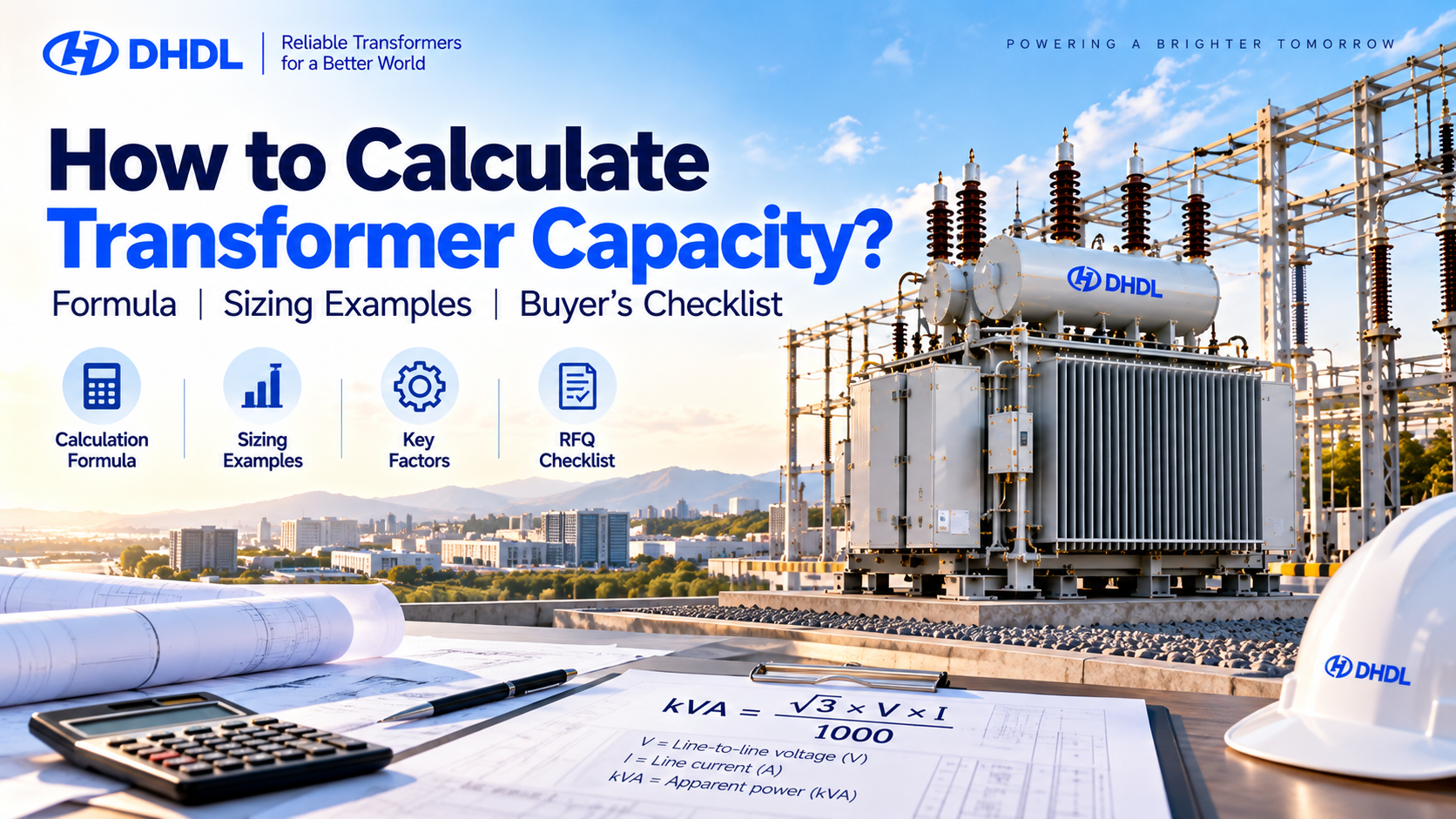
Choosing the right transformer capacity is not simply about selecting the next available kVA rating. An undersized transformer can overheat, experience excessive voltage drop, and limit future expansion. An oversized transformer may increase purchase costs and unnecessary no-load losses.
For industrial plants, commercial buildings, power distribution projects, and infrastructure developments in Ukraine, Ethiopia, Vietnam, Thailand, Myanmar, Uzbekistan, Russia, and Nigeria, transformer sizing should begin with the actual electrical load.
The key question is: How many kVA does your project really need?
This guide explains how to calculate transformer capacity, convert kW to kVA, estimate three-phase current, select a standard transformer rating, and prepare a complete procurement specification.
1. Understand kW, kVA and Power Factor
Before calculating transformer size, buyers need to distinguish three electrical quantities.
- kW (Kilowatts): Real power consumed by electrical equipment.
- kVA (Kilovolt-Amperes): Apparent power that determines the transformer’s electrical loading.
- Power Factor (PF): The ratio of real power to apparent power under the relevant operating conditions.
For a balanced three-phase system with approximately sinusoidal voltage and current, the basic relationship is:
\[ \text{kVA}=\frac{\text{kW}}{\text{Power Factor}} \]
For example, a factory with a maximum simultaneous demand of 800kW and a power factor of 0.90 requires:
\[ \frac{800}{0.90}=888.9\text{ kVA} \]
This is the apparent-power demand before adding any justified design allowance.
If a 20% capacity allowance is adopted:
\[ 888.9\times1.20=1{,}066.7\text{ kVA} \]
A 1,250kVA transformer may be a candidate, subject to actual load characteristics, operating temperature, applicable ratings, and engineering review.
Important: The power factor must represent the actual operating load. Harmonic distortion and nonlinear equipment may require additional current and thermal assessment beyond this simplified calculation.
2. How to Calculate Three-Phase Transformer Capacity
For most industrial and commercial distribution systems, transformer capacity can be calculated using line voltage and line current.
The three-phase apparent-power formula is:
\[ \boxed{\text{kVA}=\frac{\sqrt{3}\times V\times I}{1000}} \]
Where:
- V = Line-to-line voltage in volts
- I = Line current in amperes
- √3 ≈ 1.732
Example: Calculating Transformer Capacity for a 400V Factory
Suppose an industrial facility has:
- Three-phase voltage: 400V
- Maximum simultaneous current: 1,200A
- Frequency: 50Hz
The required apparent power is:
\[ \frac{1.732\times400\times1200}{1000} \approx831.4\text{ kVA} \]
If the project adopts a 20% allowance:
\[ 831.4\times1.20\approx997.7\text{ kVA} \]
A 1,000kVA transformer may be considered for this illustrative case.
However, the engineering team must still check motor starting, harmonic currents, temperature rise, load duration, and future expansion.
For factories in Vietnam, Thailand, Ethiopia, and Nigeria, this calculation provides an initial capacity estimate before evaluating site-specific electrical conditions.
3. Transformer Capacity Calculation Examples
The following table illustrates how different operating loads affect transformer sizing.
| Solicitud | Maximum Demand | Power Factor | Calculated kVA | With 20% Allowance | Candidate Standard Size |
|---|---|---|---|---|---|
| Small Factory | 400kW | 0.90 | 444 | 533 | 630kVA |
| Commercial Building | 650kW | 0.95 | 684 | 821 | 1,000kVA |
| Industrial Plant | 1,000kW | 0.90 | 1,111 | 1,333 | 1,600kVA |
| Manufacturing Facility | 1,500kW | 0.95 | 1,579 | 1,895 | 2,000kVA |
| Industrial Distribution | 2,000kW | 0.90 | 2,222 | 2,667 | 3,150kVA |
These are illustrative calculations, not fixed recommendations for every installation.
Standard transformer ratings and available configurations should be confirmed with the manufacturer and relevant local utility.
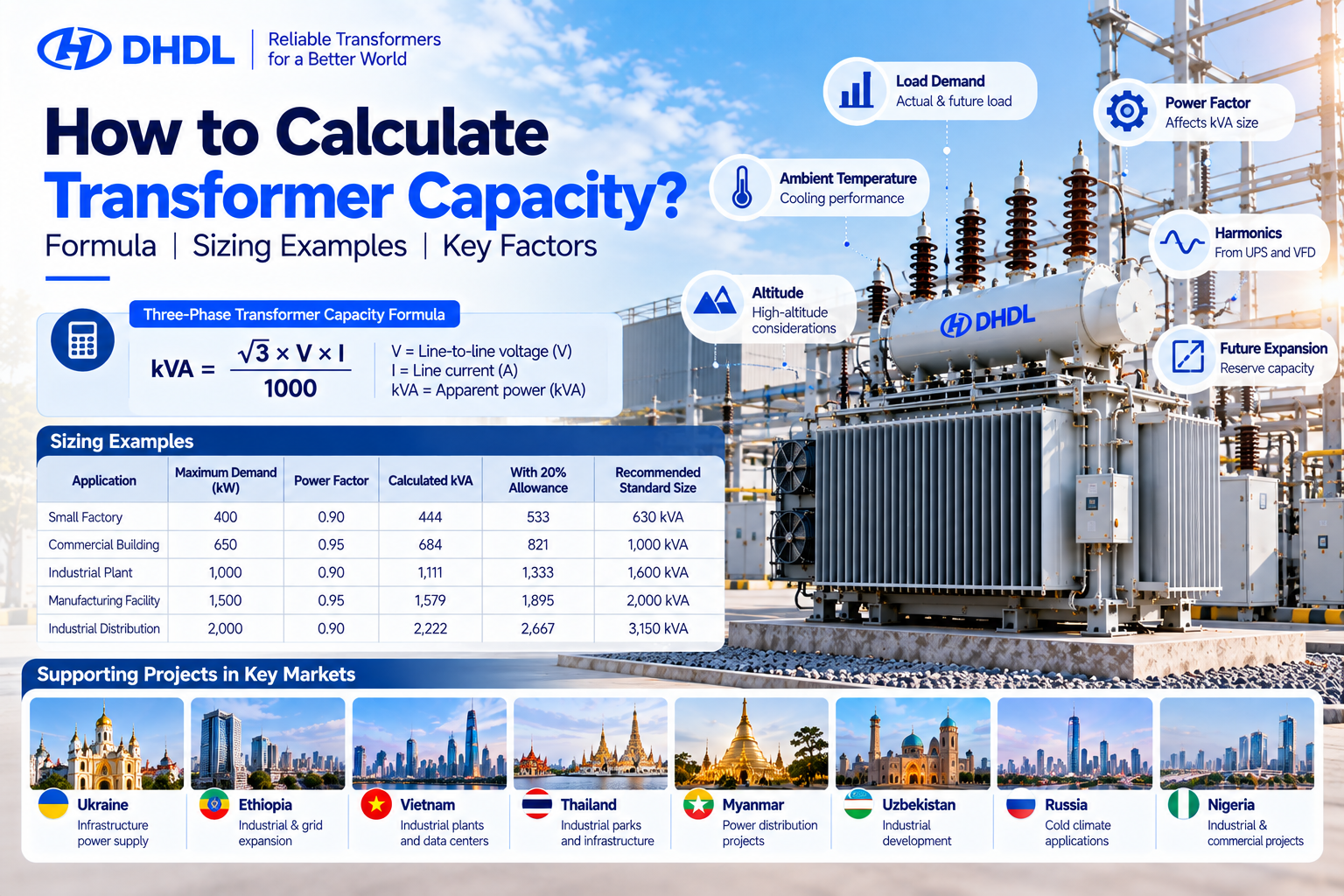
The correct rating is the smallest technically suitable option that satisfies the project’s continuous load, temporary overload, voltage regulation, thermal, reliability, and expansion requirements.
4. Five Factors That Change Transformer Capacity Requirements
4.1 Maximum Simultaneous Demand
The total installed equipment capacity is not necessarily the maximum operating demand.
A factory may have 1,500kW of connected equipment, but only 1,000kW may operate simultaneously.
The sizing calculation should use a defensible maximum-demand estimate rather than simply adding every equipment nameplate.
For new facilities without operating history, engineers may use load schedules, operating sequences, demand factors, and comparable installations.
4.2 Motor Starting and Temporary Loads
Industrial facilities often contain large motors, compressors, pumps, and production equipment.
A motor can draw substantially more current during starting than during normal operation.
For projects in Uzbekistan, Ukraine, Vietnam, and Nigeria, large motor loads should be identified before selecting the transformer.
Buyers should provide:
- Largest motor rating
- Starting method
- Expected starting current
- Number of simultaneous motor starts
- Acceptable voltage drop
- Motor starting frequency
Soft starters and variable-frequency drives may reduce some starting impacts, but their electrical characteristics must still be considered.
4.3 Future Expansion
A transformer selected only for today’s load may become inadequate when the factory expands.
For example, a project in Thailand may begin with a 900kVA demand but expect additional production lines within three years.
Instead of automatically purchasing a much larger transformer, the project team should compare the cost and efficiency of:
- Installing a larger transformer initially
- Adding another transformer later
- Reserving space for future expansion
- Designing switchgear and cables for planned capacity
4.4 Site Temperature and Altitude
Transformer cooling performance depends on installation conditions.
High ambient temperatures can affect thermal performance, while high altitude can reduce air-cooling effectiveness and influence insulation requirements.
For example:
- Ethiopia: Some project locations require high-altitude evaluation.
- Thailand and Myanmar: Hot and humid installation environments may require additional attention.
- Vietnam: Humidity, ventilation, and coastal exposure may influence enclosure and insulation specifications.
- Nigeria: High ambient temperature, dust, and outdoor installation conditions should be assessed.
- Russia, Ukraine, and Uzbekistan: Cold-weather operation, temperature variation, and condensation may be important.
These are regional engineering considerations rather than uniform conditions across each country.
4.5 Harmonics and Nonlinear Loads
Modern facilities frequently use UPS systems, variable-frequency drives, rectifiers, and other power-electronic equipment.
Such loads can produce harmonic currents that increase transformer heating.
A transformer should not be selected only from fundamental-frequency kW and power-factor values when significant harmonic distortion is present.
The buyer should provide the expected harmonic spectrum or relevant equipment data so the manufacturer can evaluate winding losses and temperature rise.
5. Real Project Case: DHDL’s 8,000kVA Transformer in Thailand
DHDL’s Thailand Industrial Park Power Distribution Expansion Project provides a practical example of transformer capacity planning.
The project involved supplying an oil-immersed transformer to support increasing electricity demand from factories and new production lines.
| Project Parameter | Published Specification |
|---|---|
| Country | Tailandia |
| Solicitud | Industrial Park Power Distribution |
| Transformer Model | S-8000/33 |
| Capacidad nominal | 8,000kVA |
| Voltaje primario | 33kV |
| Tensión secundaria | 0.416kV |
| Frecuencia | 50Hz |
| Cooling | Onán |
| Instalación | Al aire libre |
| Production and Testing | 38 Days |
The project illustrates why transformer selection must consider industrial expansion, electrical demand, and installation conditions rather than only current equipment ratings.
For reference, the rated secondary current of an 8,000kVA, 416V three-phase transformer is approximately:
\[ I=\frac{8{,}000{,}000}{\sqrt{3}\times416}\approx11{,}103\text{ A} \]
This calculated current demonstrates the importance of coordinating the transformer with the downstream distribution system.
It does not establish the actual project load or switchgear arrangement, which are not fully specified in the published case.
For similar projects in Vietnam, Myanmar, Nigeria, and Uzbekistan, buyers should evaluate transformer capacity together with low-voltage switchgear, busbar ratings, protection systems, and future expansion plans.
6. Transformer Sizing Considerations for Eight Target Markets
A transformer capacity calculation provides the starting point, but local operating conditions influence the final design.
| Country | Main Sizing and Procurement Considerations |
|---|---|
| Ucrania | Winter conditions, existing grid compatibility, backup loads and voltage stability |
| Etiopía | Site altitude, rural distribution requirements, ambient temperature and load growth |
| Vietnam | Industrial expansion, humidity, cooling conditions and motor loads |
| Tailandia | High ambient temperature, industrial park expansion and transformer cooling |
| Myanmar | Actual supply conditions, backup generation and fluctuating demand |
| Uzbekistán | Seasonal temperature variation, industrial loads and distribution-network expansion |
| Russia | Low-temperature performance, site-specific standards and industrial demand |
| Nigeria | Ambient temperature, voltage quality, backup generation and future load expansion |
These considerations are not universal requirements for every installation in a country. Final transformer ratings must be based on the specific project site, utility requirements, and electrical load study.
For Ethiopia, DHDL’s published Amhara rural grid project involved 160 oil-immersed distribution transformers across 15kV and 33kV networks, with a stated total capacity of approximately 58MVA. This demonstrates how a distribution project may require multiple transformer sizes rather than one large unit.
For Thailand, DHDL’s 8,000kVA industrial park project illustrates the importance of planning for growing manufacturing demand.
For Ukraine, Russia, and Uzbekistan, temperature-related specifications should be reviewed alongside the calculated electrical capacity.
For Vietnam, Myanmar, and Nigeria, buyers should assess the actual load profile, site conditions, and backup-power arrangement before confirming transformer size.
7. Hidden Costs of Choosing the Wrong Transformer Size
Transformer capacity affects more than the equipment purchase price.
An undersized transformer may lead to:
- Excessive operating temperature
- Reduced insulation life
- Voltage regulation problems
- Limited production expansion
- Increased risk of unplanned outages
An unnecessarily oversized transformer may result in:
- Higher initial purchase cost
- Larger installation footprint
- Higher no-load losses than a smaller alternative
- More expensive switchgear or infrastructure
- Unnecessary capital investment
Buyer tip: Compare guaranteed no-load losses, load losses, and expected operating profiles when evaluating different transformer capacities.
DHDL’s published product information includes no-load loss, load loss, impedance, voltage, and rated-capacity data that buyers can use when requesting technically comparable quotations.
8. Transformer Capacity RFQ Checklist
Before contacting a transformer manufacturer, prepare the following information.
| RFQ Item | Buyer Input |
|---|---|
| Destination Country | __________ |
| Solicitud | Industrial / Commercial / Utility / Other |
| Total Connected Load | _____ kW |
| Maximum Simultaneous Demand | _____ kW |
| Power Factor | _____ |
| Calculated Apparent Power | _____ kVA |
| Future Expansion Allowance | _____ % |
| Required Transformer Capacity | _____ kVA |
| Voltaje primario | _____ kV |
| Tensión secundaria | _____ V / kV |
| Frecuencia | 50 / 60Hz |
| Fase | Single / Three-Phase |
| Vector Group | __________ |
| Impedancia de cortocircuito | _____ % |
| Método de enfriamiento | AN / AF / ONAN / Other |
| Material de bobinado | Copper / Aluminum |
| Maximum Ambient Temperature | _____ °C |
| Altitude | _____ m |
| Motor Starting Requirements | __________ |
| Harmonic Load Requirements | __________ |
| Applicable Standards | IEC / ANSI / IEEE / Local |
| Cantidad | _____ Units |
| Delivery Destination | __________ |
| Required Delivery Date | __________ |
Adjuntos recomendados para RFQ
- Single-Line Diagram (SLD)
- Electrical load schedule
- Maximum demand calculation
- Motor starting information
- Existing transformer nameplate, if applicable
- Power factor information
- Short-circuit study
- Installation environment details
- Future expansion plan
- Applicable technical standards
- Project delivery schedule
A complete RFQ allows the manufacturer to review the proposed transformer capacity and identify missing technical requirements before production.
9. Choose the Right Transformer Capacity with DHDL
DHDL supplies oil-immersed transformers, dry-type transformers, power transformers, and supporting distribution equipment for industrial, commercial, utility, and infrastructure projects.
Its published product portfolio includes:
- Oil-Immersed Distribution Transformers: 6–38.5kV, 30–2,500kVA
- Dry-Type Distribution Transformers: 6–37kV, 20–6,300kVA
- Power Transformers: Project-specific higher-voltage and higher-capacity configurations
Availability depends on the selected model and technical specification.
For transformer procurement in Ukraine, Ethiopia, Vietnam, Thailand, Myanmar, Uzbekistan, Russia, and Nigeria, DHDL can review capacity, voltage, frequency, cooling, winding materials, installation conditions, and project requirements.
For an accurate quotation, send:
Maximum Demand + Power Factor + Calculated kVA + HV/LV Voltage + Site Conditions + Quantity + Destination
The goal is not simply to select the largest available transformer.
DHDL — Customized Transformer Solutions for Global Power Distribution Projects.
It is to choose a technically suitable capacity that supports reliable operation, reasonable lifecycle costs, and future project requirements.
Website: https://dinghongtransformer.com/
Read Related Articles: