
Transformer Earthing Explained: Grounding Requirements for Safe Operation

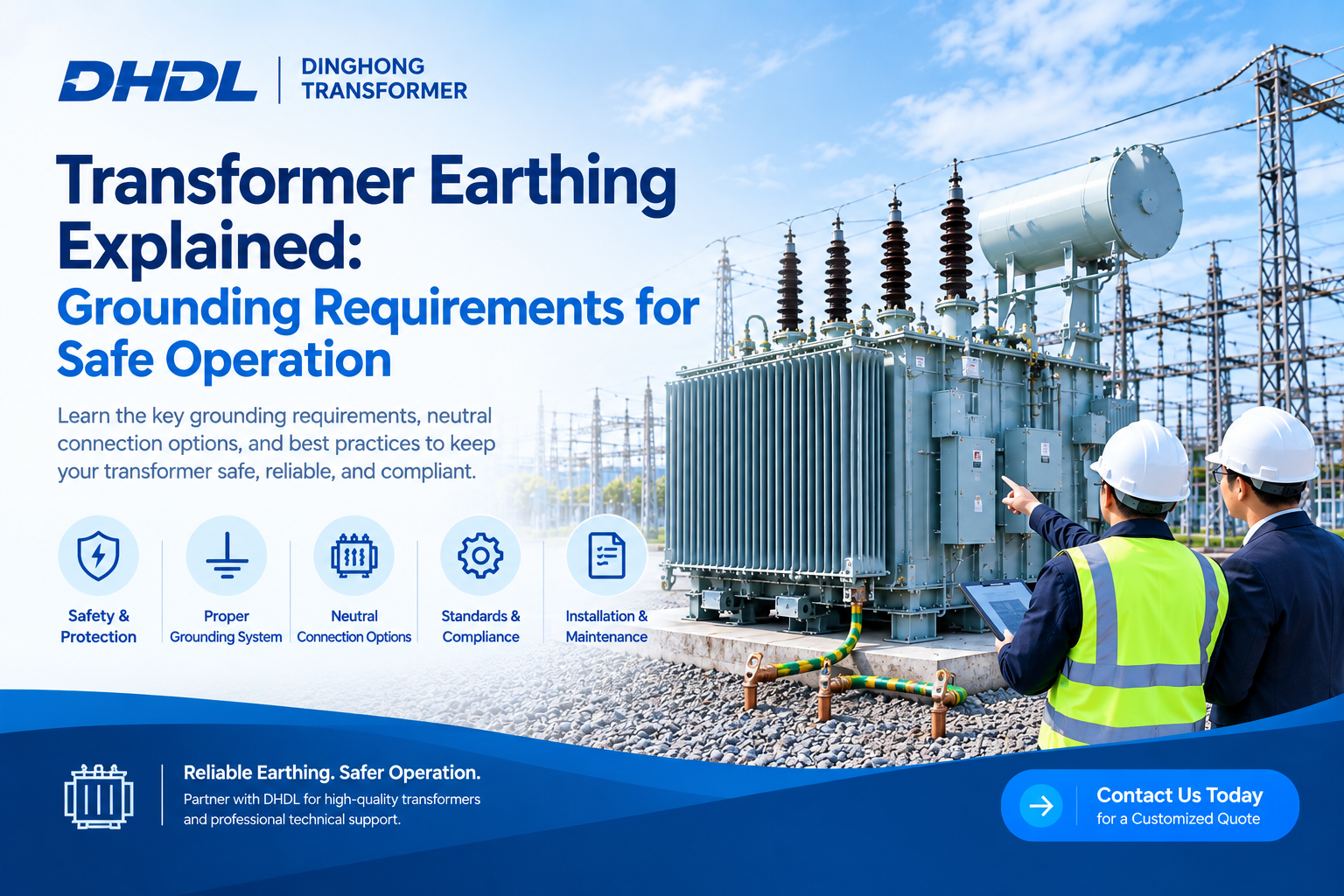
A transformer does more than transfer electrical energy between voltage levels. It must also be properly connected to the electrical grounding system to help control fault currents, protect equipment, and improve operational safety.
Transformer earthing is therefore an important consideration during transformer design, installation, commissioning, and maintenance.
The correct grounding arrangement depends on the transformer configuration, system voltage, neutral connection, fault-current requirements, installation environment, and applicable electrical standards.
This guide explains the main transformer earthing requirements that engineers, EPC contractors, and equipment buyers should consider before energizing a transformer.
What Is Transformer Earthing?
Transformer earthing, also called transformer grounding, is the connection of appropriate transformer conductive parts or system neutral points to earth.
The purpose is to provide a controlled path for fault current and help keep exposed conductive parts at a safer electrical potential.
A properly designed grounding system can help:
- Provide a path for ground-fault current
- Support protective relay operation
- Reduce dangerous touch voltages
- Protect transformer and connected equipment
- Improve system stability during electrical faults
- Support safe maintenance and operation
The exact grounding arrangement should be designed according to the complete electrical system rather than selected independently from the transformer.
Why Is Transformer Grounding Important?
When an insulation failure or other electrical fault causes a conductor to contact a grounded part, fault current needs a defined path back through the electrical system.
Without an appropriate grounding arrangement, fault detection and protection can become more difficult, while exposed metal parts may develop dangerous voltages.
Grounding is also closely connected with transformer protection.
DinghongTransformer’s technical guidance notes that grounding systems, protective relays, circuit breakers, and surge protection may all form part of a coordinated transformer protection system.
For this reason, grounding should be considered during transformer specification—not treated as an installation detail after the equipment arrives.
Key Transformer Earthing Requirements
| Requirements | what to check |
| Transformer type | Oil-immersed, dry-type, power or distribution transformer |
| System voltage | Primary and secondary rated voltage |
| Neutral | Neutral available, required, or isolated |
| Grounding method | Solid, resistance, reactance, or project-specific arrangement |
| Fault current | Expected ground-fault current and duration |
| Earthing conductor | Size, material, routing, and connection |
| Instalación | Indoor, outdoor, substation, industrial, or renewable-energy site |
| Standards | Applicable IEC, IEEE, ANSI, or local requirements |
1. Ground the Transformer Tank and Metal Parts
For oil-immersed transformers, the transformer tank and other specified conductive components need an appropriate connection to the site’s grounding system.
This connection provides a low-impedance path for fault current if insulation failure causes energized components to contact the transformer enclosure.
The grounding connection should be mechanically secure, electrically continuous, and protected against environmental deterioration.
2. Check the Neutral Grounding Arrangement
The transformer neutral is another important consideration.Depending on the winding configuration and electrical system, the neutral may be solidly grounded, grounded through an impedance, or configured according to a project-specific protection scheme.The transformer RFQ should therefore clearly state whether a neutral terminal is required and how the neutral is expected to be grounded. DinghongTransformer’s RFQ guidance specifically recommends providing the manufacturer with neutral requirements, expected neutral loading, and the grounding method.This becomes particularly important for systems with unbalanced or nonlinear loads
3. Consider Ground-Fault Current
Grounding is not simply about connecting equipment to an earth electrode.
Engineers must understand how much fault current could flow through the grounding system and how long the fault may remain before protective equipment operates.
Where controlled fault current is required, systems may use grounding impedance such as a neutral grounding resistor or reactor.
The appropriate arrangement depends on the system voltage, transformer configuration, protection philosophy, and project requirements.
4. Match Earthing With the Transformer Vector Group
The transformer’s vector group can affect neutral availability, grounding, phase displacement, and the path available for certain fault currents.Common vector groups include Dyn11, Yyn0, and other project-specific configurations.Therefore, buyers should not select a vector group simply because it is commonly used elsewhere. It should match the electrical network and protection requirements.
DinghongTransformer’s RFQ guidance also identifies vector group and neutral requirements as important specifications when purchasing a transformer.
Transformer Earthing Checklist Before Energization
Before commissioning a transformer, engineers should verify:
- Transformer tank and required metal parts are properly grounded.
- Grounding connections are tight and mechanically secure.
- Neutral grounding matches the approved project design.
- Grounding conductors are correctly sized and routed.
- Grounding connections are free from excessive corrosion or physical damage.
- Protective relays and circuit breakers are coordinated with the grounding arrangement
- .Ground-fault protection settings have been reviewed.
- The grounding system complies with applicable project and electrical standards.
- Transformer test results have been reviewed before energization.
- Any required grounding resistor, reactor, or grounding transformer is correctly connected.
Transformer Earthing and Transformer Selection
Grounding requirements should be communicated to the transformer manufacturer before production.
When requesting a quotation, provide information such as:
- Transformer capacity
- Primary and secondary voltage
- Frecuencia
- Fase
- Vector group
- Neutral requirements
- Grounding method
- Expected fault current
- Installation environment
- Applicable standard
- Project application
This information allows the manufacturer to evaluate the transformer configuration rather than supplying a generic design.
DinghongTransformer’s transformer selection guidance similarly recommends specifying voltage, frequency, vector group, impedance, cooling method, installation environment, and applicable standards when requesting a transformer quotation.
Preguntas frecuentes
Is transformer earthing the same as grounding?
Yes. “Earthing” and “grounding” generally describe connecting an electrical system or equipment to earth. The terminology varies by region, but the engineering objective is to provide an appropriate reference and fault-current path.
Does every transformer need a grounded neutral?
Not necessarily. The required neutral arrangement depends on the transformer winding configuration and the electrical system. The project grounding design should determine whether and how the neutral is grounded.
Why is transformer tank grounding important?
It helps provide a controlled path for fault current if an energized internal component comes into contact with the transformer tank or another conductive enclosure.
What information should buyers provide about grounding?
Buyers should communicate the system voltage, transformer configuration, vector group, neutral requirements, grounding method, expected fault current, applicable standards, and installation conditions.
Final Thoughts
Transformer earthing is an essential part of safe transformer installation and electrical system design. Proper grounding helps provide a controlled fault-current path, supports protection systems, and reduces risks associated with electrical faults.
However, grounding requirements cannot be determined from transformer capacity alone.
The transformer configuration, neutral arrangement, vector group, fault-current level, protection system, installation environment, and applicable standards must all be considered together.
If you are specifying a transformer for an industrial plant, utility substation, renewable-energy project, commercial facility, or other power application, discuss the grounding requirements with the manufacturer before finalizing the design.
Need Help Selecting the Right Transformer?
Contact TransformadorDinghong with your project voltage, capacity, neutral and grounding requirements, application, and destination. Our engineering team can help evaluate the required transformer configuration and provide a project-specific quotation.