How Transformer Harmonics Affect Industrial Power Systems

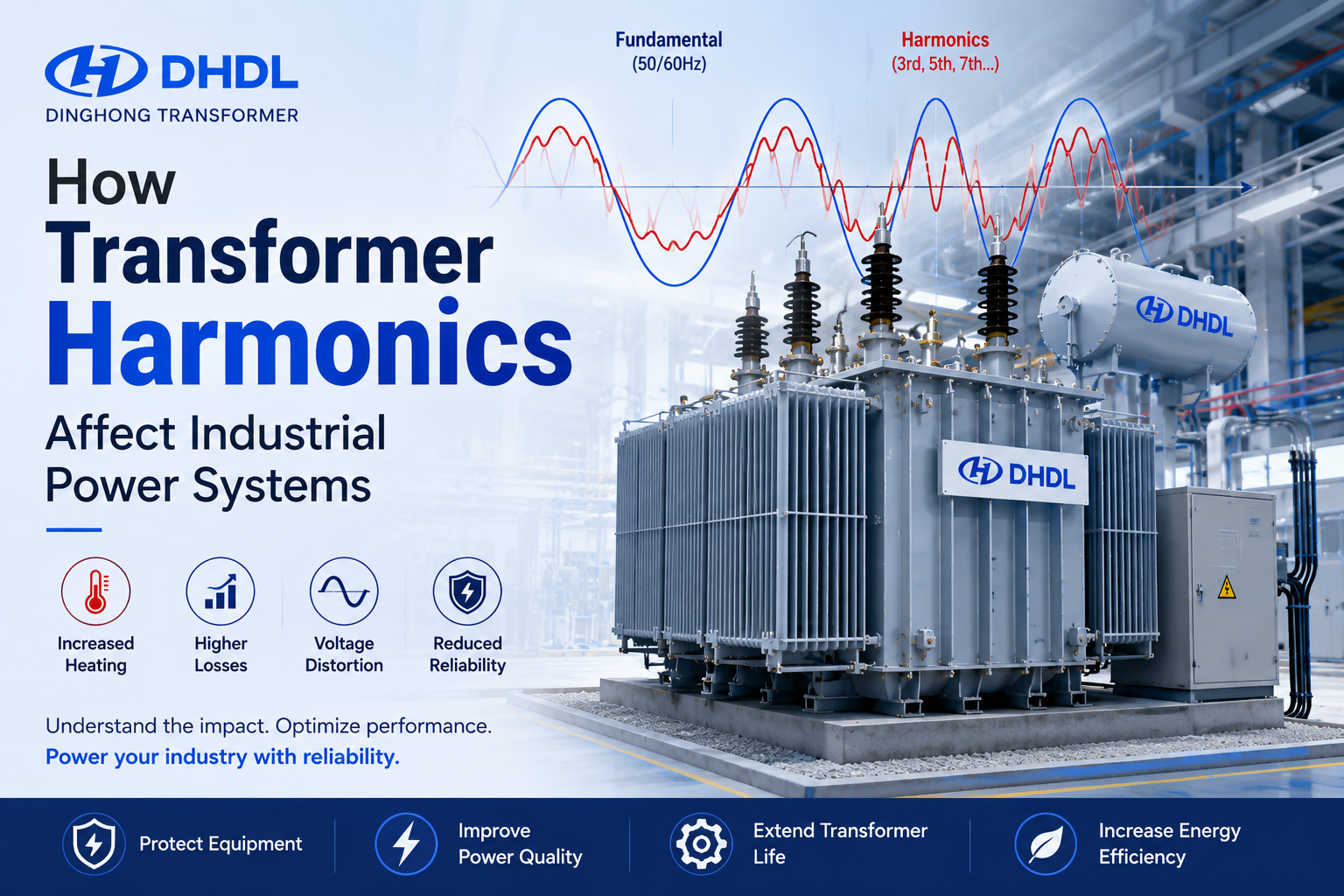
Modern industrial facilities rely on variable frequency drives, rectifiers, UPS systems, battery chargers, welding equipment, LED lighting, and other power electronic devices.
Many are nonlinear loads that introduce harmonic currents into electrical networks.
These currents can increase transformer heating, losses, voltage distortion, and operating stress.
Understanding transformer harmonics is therefore important when designing reliable industrial power systems and selecting transformer equipment for demanding loads.
What Are Harmonics in an Electrical System?
In an ideal AC power system, voltage and current follow a clean sinusoidal waveform at the fundamental frequency.
Harmonics are additional frequency components that occur at integer multiples of that fundamental frequency.Nonlinear equipment can draw current in a distorted waveform.
The resulting harmonic components can circulate through transformers, cables, switchgear, and other electrical equipment.
Why Do Industrial Loads Produce Harmonics?
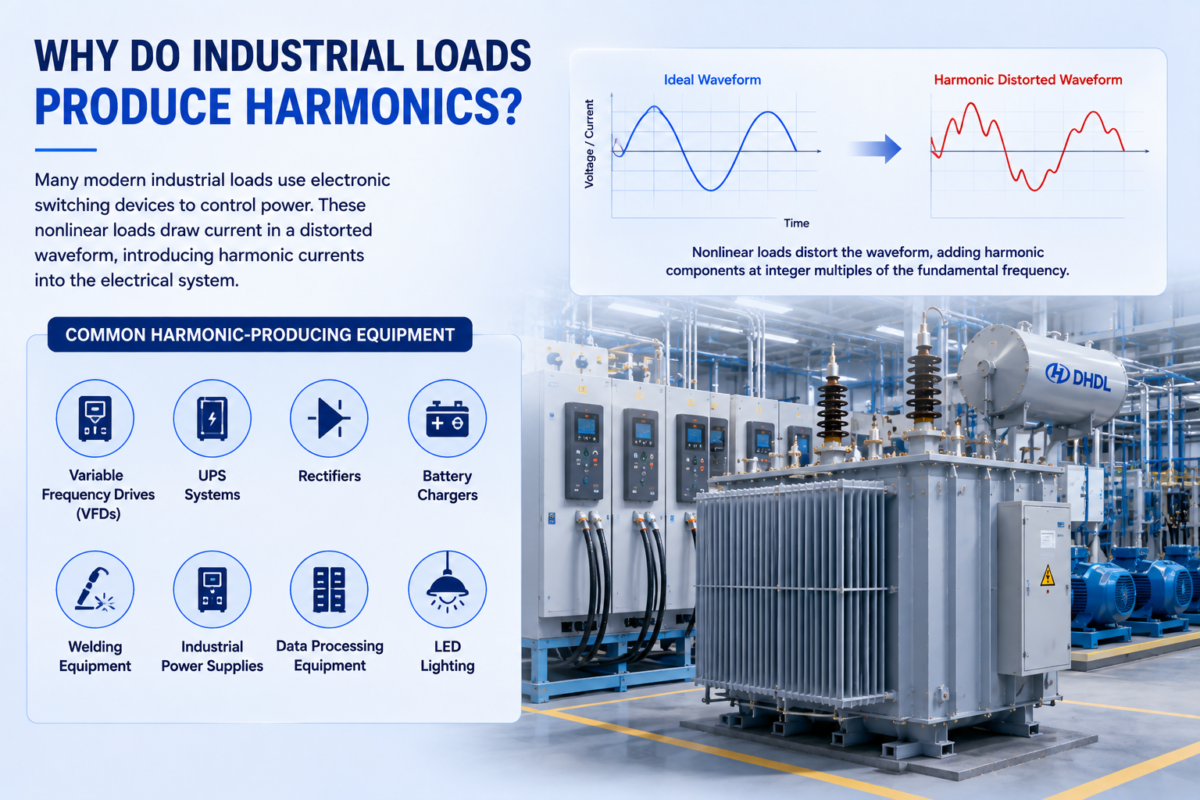
Many modern industrial loads use electronic switching devices to control power. Common harmonic-producing equipment includes:
- Variable frequency drives (VFDs)
- UPS systems
- Battery chargers
- Rectifiers
- Welding equipment
- Industrial power supplies
- Data-processing equipment
- Electronic lighting
As facilities add electronic equipment, harmonic management becomes increasingly important in transformer and power distribution design.
How Do Harmonics Affect Transformers?
One of the main concerns is transformer harmonic heating.
Harmonic currents can increase losses in transformer windings and structural components. Additional eddy-current and stray losses can make the transformer operate at a higher temperature.
Excessive heat can accelerate insulation aging and reduce the transformer’s expected service life.
A transformer supplying nonlinear loads should therefore be evaluated using the actual load profile, not only connected kVA.
Harmonics Can Increase Transformer Losses
Transformer efficiency depends partly on controlling electrical losses.
When harmonic currents are present, additional losses can occur because higher-frequency currents interact with conductors and magnetic components.
Even when RMS current appears acceptable, harmonic content can increase thermal stress.Over time, these losses can increase energy consumption and operating costs, especially in continuously operating facilities.
What Is a K-Factor Transformer?
A K-factor transformer is designed to handle the additional heating effects associated with nonlinear loads.
K-factor is a way of characterizing the heating effects of harmonic currents.
Transformers with an appropriate K-factor rating can be selected for applications where significant nonlinear loads are expected.K-factor is not a substitute for a complete harmonic study.
Engineers should evaluate harmonic spectrum, loading conditions, system impedance, and applicable requirements before specifying equipment.
How Harmonics Affect Transformer Sizing
Harmonic-producing loads can influence transformer capacity requirements.
Adding equipment nameplate ratings alone may not accurately represent transformer thermal conditions.
Engineers should consider:
- Total connected load
- Maximum demand
- Harmonic spectrum
- Load diversity
- Power factor
- Expected operating hours
- Ambient conditions
- Future expansion
A transformer designed with actual load characteristics in mind can provide better thermal performance and reliability.
The Effect of Harmonics on Voltage Quality
Harmonic currents flowing through system impedance can create harmonic voltage distortion.
This can affect sensitive electrical equipment and contribute to power-quality problems.
The severity depends on harmonic current, system impedance, network configuration, and connected loads.
For large industrial installations, engineers may perform a harmonic analysis before finalizing the transformer and distribution-system design.
How Can Industrial Facilities Reduce Harmonic Problems?
Harmonic mitigation can involve several strategies.
Depending on the application, facilities may use passive filters, active harmonic filters, line reactors, phase-shifting transformers, or appropriately designed power converters.
The transformer manufacturer should receive accurate information about the intended application so transformer construction, thermal capability, and other specifications can be considered appropriately.
Why Transformer Harmonics Matter When Selecting Equipment
For an industrial power transformer supplying VFDs, UPS systems, rectifiers, or other nonlinear equipment, buyers should discuss harmonic loading with the manufacturer.
The specification may need to address harmonic content, temperature-rise requirements, K-factor considerations, impedance, cooling, and applicable standards.
Dinghong Transformer for Industrial Power Applications
Dinghong Transformer(DHDL) manufactures transformers and power-distribution equipment for industrial, infrastructure, utility, and renewable-energy applications.
Its product range includes oil-immersed transformers, dry type transformer transformers, power transformers, distribution transformers, prefabricated substations, and related electrical equipment.
For industrial projects with significant nonlinear loads, Dinghong Transformer can evaluate capacity, voltage, impedance, cooling configuration, operating environment, and applicable standards.
Detailed load information helps match the transformer to the actual electrical system rather than nominal capacity alone.
Final Thoughts
For procurement teams, early harmonic assessment can also prevent unexpected transformer derating, unnecessary equipment upgrades, and avoidable commissioning delays later in the project costs.
Transformer harmonics are an important consideration for modern industrial power systems. Nonlinear loads can introduce harmonic currents that increase transformer heating, losses, voltage distortion, and insulation stress.
The solution is not simply to install a larger transformer. Engineers should understand the harmonic profile, evaluate thermal requirements, consider mitigation options, and select appropriate equipment.
By addressing harmonics during the design stage, industrial facilities can improve transformer reliability, manage power quality, reduce unnecessary losses, and support longer equipment life
.For projects with substantial VFD, UPS, rectifier, or other nonlinear loads, working with an experienced transformer manufacturer can help turn the harmonic study into an appropriate transformer specification.