Transformer FAT vs SAT: Testing Checklist, Required Documents & Buyer Responsibilities

A transformer can pass every factory test and still face problems during installation or commissioning.
Transport damage, incorrect connections, protection-setting errors, moisture ingress, or site wiring issues may only become apparent after the equipment arrives.
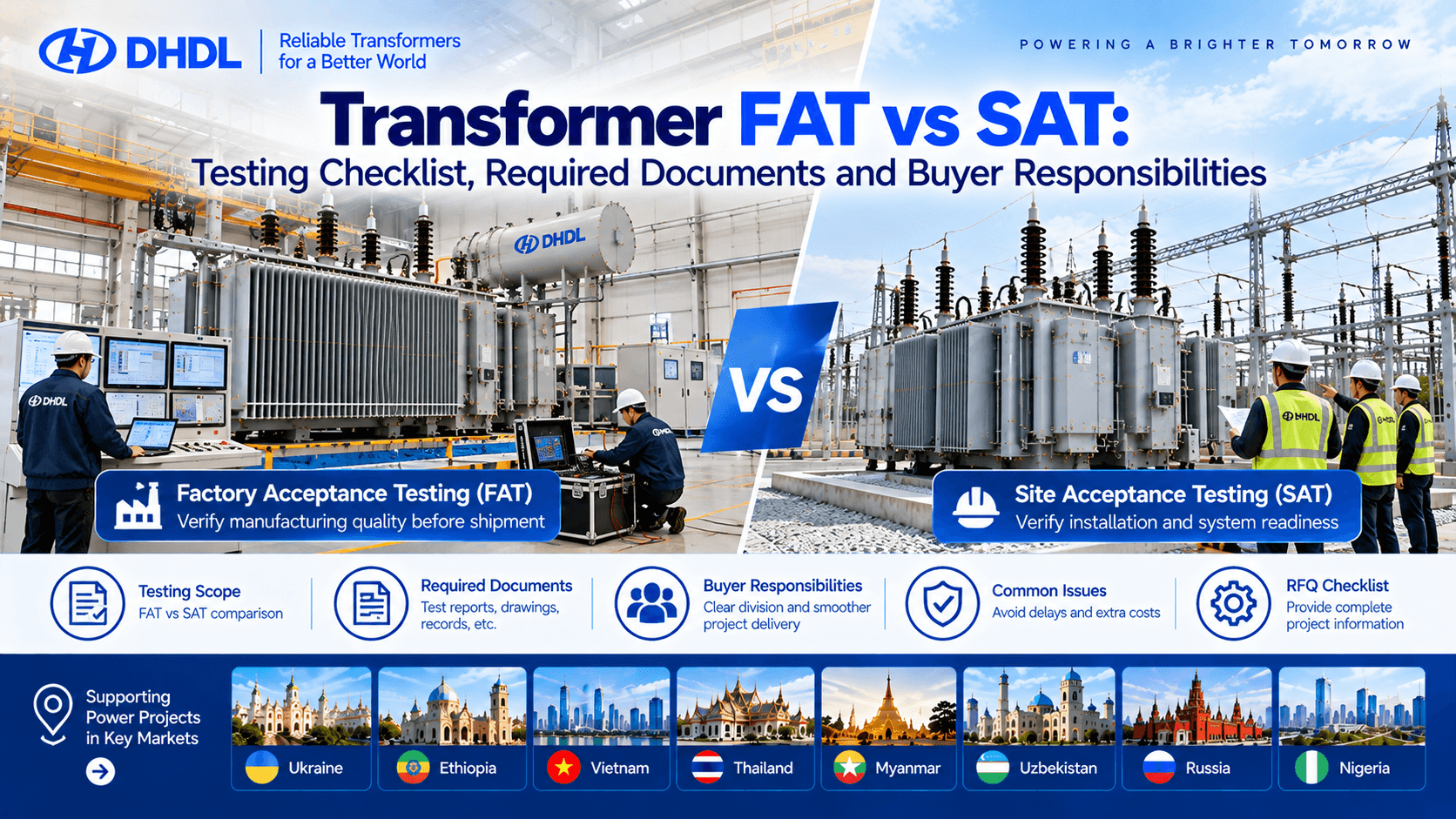
That is why transformer procurement should include two distinct acceptance stages: Factory Acceptance Testing (FAT) and Site Acceptance Testing (SAT).
For utilities, industrial plants, EPC contractors, and distribution projects in Ethiopia, Thailand, Vietnam, Uzbekistan, Nigeria, Ukraine, Myanmar, and Russia, understanding the difference between FAT and SAT can help prevent disputes, reduce commissioning delays, and establish clear acceptance responsibilities.
This guide explains the scope of both testing stages, typical technical requirements, essential documents, and the information buyers should confirm before requesting a transformer quotation.
1. What Is the Difference Between Transformer FAT and SAT?
Factory Acceptance Testing (FAT) is performed at the manufacturer’s facility before shipment. It verifies that the transformer meets the agreed design specifications, manufacturing requirements, and applicable factory test criteria.
Site Acceptance Testing (SAT) is performed after delivery and installation. It verifies the transformer’s condition, installation, connections, protection interfaces, and readiness for energization.
| Item | Factory Acceptance Testing (FAT) | Site Acceptance Testing (SAT) |
|---|---|---|
| Location | Manufacturer’s Factory | Project Installation Site |
| Main Purpose | Verify Manufactured Equipment | Verify Installed Equipment |
| Timing | Before Shipment | After Installation, Before Energization |
| Typical Participants | Manufacturer, Buyer, Inspector | EPC, Installation Team, Owner, Commissioning Engineer |
| Key Focus | Electrical Performance and Compliance | Transport Condition, Connections, Protection, Installation |
| Main Documents | Factory Test Reports, FAT Records | Site Test Reports, Commissioning Records |
| Acceptance Result | Release for Shipment | Approval to Proceed Toward Energization |
Important: Passing FAT does not automatically mean the transformer is ready to energize.

Likewise, SAT should not be treated as a complete replacement for the manufacturer’s factory testing.
2. What Should Be Included in Transformer FAT?
The exact FAT scope depends on transformer type, voltage class, applicable standards, and the purchase contract.
For oil-immersed and dry-type transformers, routine factory testing commonly includes the following checks.
| FAT Test | Purpose | Typical Reference |
|---|---|---|
| Winding Resistance | Check winding and connection integrity | IEC 60076 Series |
| Voltage Ratio | Verify HV/LV ratio and tap positions | IEC 60076-1 |
| Vector Group / Phase Displacement | Confirm winding connection | IEC 60076-1 |
| No-Load Loss and Current | Verify core-related performance | IEC 60076-1 |
| Load Loss and Impedance | Verify electrical performance | IEC 60076-1 |
| Applied Voltage Withstand | Check insulation withstand | IEC 60076-3 |
| Induced Voltage Test | Check insulation under induced voltage | IEC 60076-3 |
| Insulation Checks | Evaluate insulation condition | Applicable Test Procedure |
| Functional Checks | Verify accessories and controls | Approved FAT Procedure |
Additional type or special tests may include temperature-rise testing, lightning impulse testing, sound-level measurement, or other project-specific tests.
These should be agreed before manufacturing.
Example FAT Specification
For an illustrative 2,500kVA oil-immersed distribution transformer:
| Parameter | Example Requirement |
|---|---|
| Rated Capacity | 2,500kVA |
| HV Voltage | 11kV |
| LV Voltage | 0.4kV |
| Frequency | 50Hz |
| Vector Group | Dyn11 |
| Cooling | ONAN |
| Tap Range | ±2 × 2.5% |
| Applicable Standard | IEC 60076 Series |
The FAT report should confirm the actual measured values and compare them against the approved specifications and applicable acceptance criteria.
Hidden procurement risk: A supplier’s statement that a transformer is “100% tested” does not define which tests were performed or what acceptance limits were applied.
Buyers should request a detailed FAT test list before placing the order.
3. What Should Be Included in Transformer SAT?
Site Acceptance Testing focuses on the condition and integration of the transformer after transportation and installation.
Unlike FAT, site testing must account for the actual installation environment, electrical connections, protection system, and local commissioning requirements.
A typical SAT scope may include:
- Visual inspection for transportation damage
- Nameplate and serial number verification
- Foundation, mounting and clearance checks
- HV/LV cable and busbar connection inspection
- Grounding and earthing verification
- Insulation resistance measurements
- Winding resistance and transformer ratio checks, where required
- Insulating oil checks for oil-immersed units
- Cooling fan, alarm and accessory functional tests
- Protection relay and trip-circuit verification
- Tap changer position and operation checks
- Pre-energization inspection and authorization
The exact tests and test voltages must follow the approved commissioning procedure. Factory dielectric withstand tests should not be repeated on site without specific engineering justification and an approved procedure.
Why FAT Results Matter During SAT
Suppose a transformer passes its factory winding-resistance and voltage-ratio tests.
After transportation, the site commissioning team detects an unexpected difference in a measurement.
The team should compare the site result with the original FAT report, accounting for temperature, tap position, test method, and instrument accuracy.
This comparison helps identify whether further investigation is needed.
It does not automatically prove that transportation damage or manufacturing defects caused the difference.
4. Factory and Site Test Documents Buyers Should Request
Missing documents can delay equipment approval even when the transformer is technically acceptable.
| Document | FAT Stage | SAT Stage |
|---|---|---|
| Approved Technical Datasheet | Required | Reference |
| General Arrangement Drawing | Required | Reference |
| Nameplate Drawing | Required | Verify |
| Inspection and Test Plan (ITP) | Required | Reference |
| Routine Test Reports | Required | Reference |
| Type Test Reports | If Specified | Reference |
| Calibration Certificates | As Required | As Required |
| Packing List | Before Shipment | Verify on Arrival |
| Transport Inspection Record | — | Required |
| Installation Checklist | — | Required |
| Site Electrical Test Reports | — | Required |
| Protection and Alarm Test Records | — | Required |
| Commissioning Certificate | — | As Contractually Required |
A useful document package should identify the transformer serial number, test date, measured values, applicable acceptance criteria, test equipment, and responsible personnel.
DHDL’s existing FAT guide specifically discusses winding resistance, voltage ratio, insulation tests, losses, impedance, oil and accessories, and documentation before shipment.
5. Who Is Responsible for FAT and SAT?
One of the most common sources of disagreement is assuming that the transformer manufacturer is responsible for every activity up to energization.
In practice, responsibilities depend on the supply contract.
The following is an illustrative responsibility matrix, not a statement of DHDL’s standard contractual terms.
| Activity | Manufacturer | Buyer / EPC | Independent Inspector |
|---|---|---|---|
| Manufacturing Quality Control | Lead | Review | If Appointed |
| FAT Test Execution | Lead | Witness / Review | Witness if Contracted |
| FAT Report Submission | Lead | Approve / Review | Verify if Contracted |
| Export Packing | As Contracted | Confirm Requirements | Inspect if Contracted |
| Transport and Unloading | As Contracted | Coordinate | — |
| Foundation and Installation | Technical Support if Contracted | Usually Lead | — |
| SAT Execution | Support if Contracted | Usually Lead | If Appointed |
| Protection Coordination | Supply Equipment Data | System Engineering Lead | — |
| Energization Authorization | Technical Support | Owner / Authorized Operator | As Required |
Three Responsibilities to Define Before Ordering
1. FAT witness arrangements
Will the buyer attend in person, appoint an independent inspector, or review recorded test evidence?
2. SAT execution and technical support
Who supplies test instruments, performs site tests, resolves nonconformities, and signs the commissioning records?
3. Acceptance and payment milestones
Does payment depend on FAT approval, shipment, site delivery, SAT completion, or another contractually defined milestone?
Hidden procurement risk: A purchase agreement that only states “FAT included” may not include travel costs, third-party witness fees, repeat tests, or site commissioning support.
6. Real DHDL Project: 63MVA Transformer Supply in Ethiopia
DHDL’s published Ethiopia project provides a relevant example of why factory testing, export documentation, and overseas installation coordination matter.
The project involved supplying oil-immersed transformers for industrial facilities and regional power distribution infrastructure.
Published Project Information
| Project Parameter | DHDL Published Data |
|---|---|
| Destination | Ethiopia |
| Application | Industrial and Regional Power Distribution |
| Transformer Quantity | 20 Units |
| Individual Capacity | 3,150kVA |
| Combined Capacity | 63MVA |
| Transformer Type | Oil-Immersed |
| Project Activities | Manufacturing, Factory Testing, Export Delivery and Technical Support |
DHDL reports that the transformers were delivered and placed into operation, with manufacturing coordination, factory testing, export packaging, and installation support forming part of the project delivery process. Dinghongtransformer
The published project information does not provide individual FAT measurement results, SAT records, or detailed acceptance criteria. Therefore, it should not be presented as evidence that a particular site test procedure was performed.
What Buyers Can Learn from This Project
For a multi-unit transformer project, acceptance planning should cover more than a single factory inspection.
Buyers should confirm:
- Whether each transformer has an individual routine test report
- Whether test reports identify matching serial numbers
- How factory inspection and shipment release are documented
- Whether shipping damage is checked upon arrival
- Who provides installation guidance and commissioning support
- How nonconformities are reported and resolved
These requirements are relevant to distribution projects in Ethiopia, Nigeria, Vietnam, Thailand, and Uzbekistan, particularly when multiple transformers are delivered in batches.
7. FAT and SAT Requirements for Different Target Markets
DHDL’s target markets have different project environments, utility requirements, and logistics conditions.
The following considerations are intended for RFQ preparation. They are not substitutes for local standards or project-specific commissioning procedures.
| Market | FAT and SAT Planning Priorities |
|---|---|
| Ukraine | Cold-weather design verification, transport inspection, utility approval and documentation |
| Ethiopia | Altitude, dust, site access, transport condition and installation testing |
| Vietnam | Humidity, moisture ingress, corrosion exposure and insulation checks |
| Thailand | High ambient temperature, cooling accessories, humidity and site wiring |
| Myanmar | Moisture protection, transport handling, site access and maintenance capability |
| Uzbekistan | Seasonal temperatures, dust, tap changer checks and transport conditions |
| Russia | Low-temperature suitability, insulating oil specification and local acceptance requirements |
| Nigeria | Site temperature, dust, grounding, protection coordination and power-quality conditions |
For example, a transformer delivered to a high-altitude project in Ethiopia may require different design verification from equipment installed at a low-altitude industrial site in Thailand.
Likewise, an outdoor transformer installed in coastal Vietnam may need additional attention to corrosion protection and moisture exposure.
The buyer should specify these conditions during the RFQ stage so that both factory verification and site inspection requirements can be planned accordingly.
8. Hidden FAT and SAT Costs Buyers Often Overlook
Third-Party Inspection Costs
If an EPC contractor requires independent FAT witnessing, confirm who pays for inspection fees, travel, accommodation, and any additional testing.
Repeat Testing and Nonconformities
The contract should explain what happens when test results fall outside agreed acceptance criteria.
It should identify who investigates the issue, who pays for repeat tests, and how the corrected equipment is released.
Shipping and Storage Conditions
Large oil-immersed transformers may require special transportation, handling, storage, or reassembly arrangements.
Where accessories are shipped separately or insulating oil is handled on site, the installation and testing scope must reflect those activities.
Site Test Equipment
The commissioning team may need insulation testers, winding-resistance meters, transformer ratio testers, grounding test instruments, and protection test equipment.
Instrument availability and calibration should be confirmed before mobilization.
Energization Delays
A transformer can pass SAT but remain unenergized because the utility connection, protection coordination, or operating authorization is incomplete.
Buyer tip: Treat FAT approval, delivery acceptance, SAT completion, and permission to energize as separate project milestones.
9. Transformer FAT and SAT RFQ Checklist
Before requesting a quotation, define both the equipment specifications and the acceptance requirements.
| RFQ Item | Buyer Input |
|---|---|
| Destination Country | __________ |
| Project Application | Utility / Industrial / Substation |
| Transformer Type | Oil-Immersed / Dry-Type |
| Rated Capacity | _____ kVA / MVA |
| HV / LV Voltage | _____ kV / _____ V |
| Frequency | 50 / 60Hz |
| Vector Group | __________ |
| Cooling Method | ONAN / ONAF / AN / AF |
| Applicable Standard | IEC / IEEE / Utility |
| Routine FAT Tests | Required Scope |
| Type / Special Tests | Specify if Required |
| FAT Witnessing | Buyer / Third Party / Remote |
| FAT Acceptance Criteria | Standard and Contract Reference |
| FAT Report Language | __________ |
| Test Report Submission Date | __________ |
| Transport Inspection | Required / Not Required |
| SAT Test Scope | Approved Procedure |
| SAT Test Instruments | Supplier / EPC / Third Party |
| Site Technical Support | Remote / On-Site |
| Installation Responsibility | __________ |
| Commissioning Responsibility | __________ |
| Energization Authorization | __________ |
| Nonconformity Procedure | __________ |
| Quantity | _____ Units |
| Delivery Deadline | __________ |
Documents to Attach to the RFQ
- Transformer technical specification
- Single-Line Diagram (SLD)
- General Arrangement Drawing requirements
- Inspection and Test Plan (ITP)
- FAT test and acceptance requirements
- SAT and commissioning specification
- Protection and control interface requirements
- Project-site environmental information
- Shipping and unloading requirements
- Required technical documentation list
- Witness inspection requirements
- Project delivery and commissioning schedule
For projects in Ukraine, Ethiopia, Vietnam, Thailand, Myanmar, Uzbekistan, Russia, and Nigeria, buyers should also identify the relevant utility, EPC contractor, and authorized commissioning organization.
10. DHDL Transformer Testing and Quality Control
DHDL manufactures oil-immersed transformers, dry-type transformers, power transformers, and related distribution equipment.
According to its published manufacturing information, the company controls processes including winding, insulation preparation, assembly, and routine factory testing.
Its stated testing activities include transformer ratio, winding DC resistance, insulation, withstand-voltage, and loss measurements. Technical files, test reports, installation guidance, and remote support are also described on its website. Dinghongtransformer
For project-specific orders, buyers should confirm the FAT scope, required reports, witness arrangements, and any SAT support in the technical agreement.
DHDL’s existing article on factory acceptance testing provides further guidance on inspections before shipment. Dinghongtransformer
A complete transformer RFQ should include:
Transformer Specifications + Applicable Standards + FAT Test List + Witness Requirements + Required Documents + SAT Scope + Destination + Delivery Schedule
DHDL — Transformer Manufacturing, Quality Control and Power Distribution Solutions for Global Projects.
Website: https://dinghongtransformer.com/