Transformer Phase Sequence: Why It Matters During Installation and Commissioning

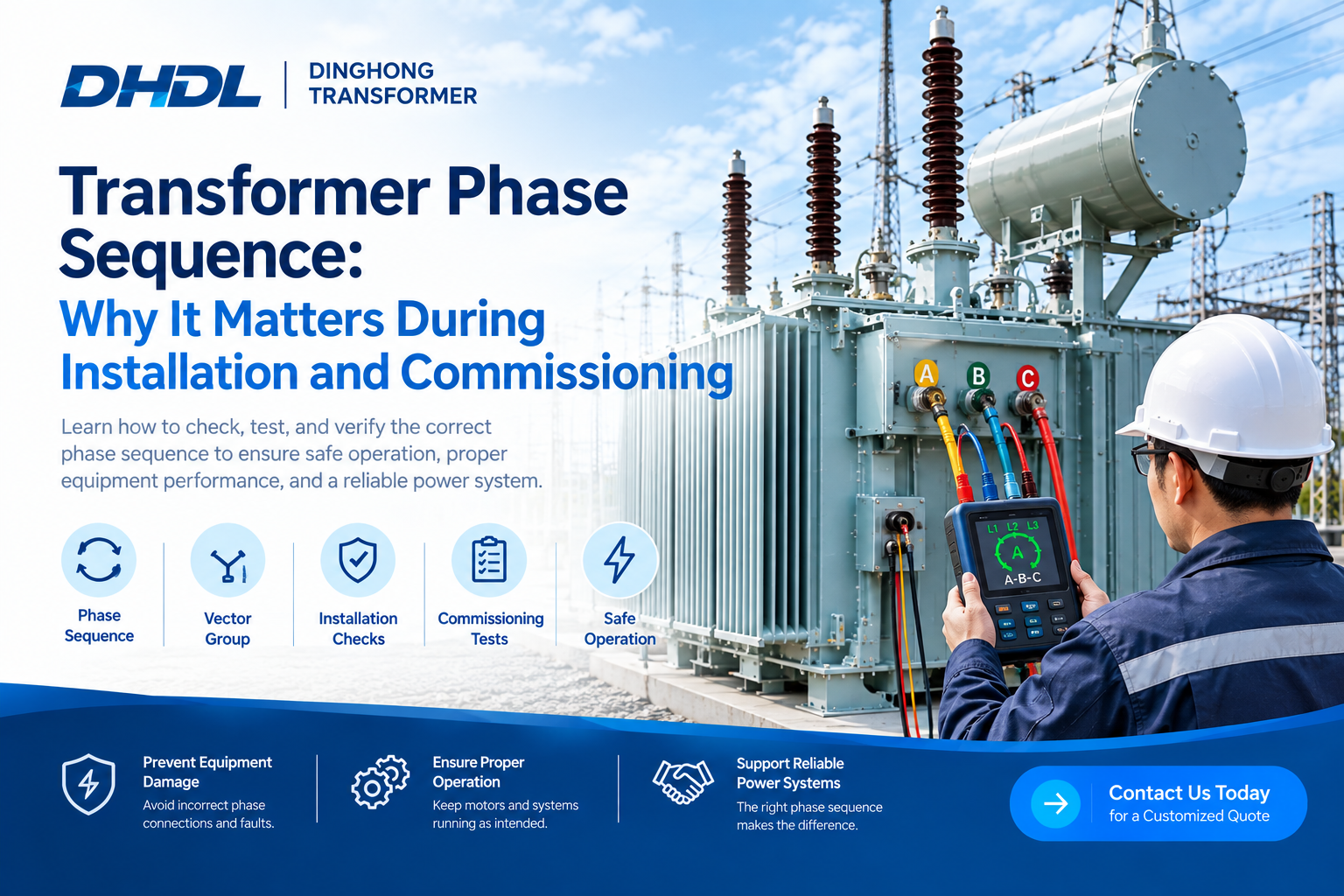
When installing a three-phase transformer, checking the voltage and capacity is only part of the commissioning process.
The transformer phase sequence must also match the requirements of the electrical system before the transformer is energized and connected to the load.
An incorrect phase sequence can cause problems with motors, parallel transformers, rotating equipment, and downstream electrical systems.
For this reason, phase sequence should be verified during installation and commissioning rather than assumed from cable labels alone.
This guide explains what transformer phase sequence means, why it matters, and what engineers should check before energization.
What Is Transformer Phase Sequence?
Transformer phase sequence refers to the order in which the three-phase voltages reach their respective phase positions.
A common phase sequence is:A-B-C or R-Y-BIf the phase connections are rearranged, the sequence can become A-C-B, which represents the opposite phase rotation.For a three-phase transformer, the relationship between the high-voltage and low-voltage terminals depends on the transformer winding arrangement and vector group.
This is why phase sequence should be considered together with terminal identification, winding configuration, polarity, and vector group.
DinghongTransformer’s technical specifications identify phase and vector group as important transformer requirements, while vector group determines the phase relationship between windings.
Why Does Transformer Phase Parallel Sequence Matter?
Phase sequence becomes particularly important when a transformer is connected to an existing three-phase electrical network.
An incorrect sequence can cause:
- Motors to rotate in the wrong direction
- Incorrect phase relationships at downstream equipment
- Problems when connecting transformers in parallel
- Incorrect operation of some protection and control systems
- Commissioning delays
- Potential equipment damage if rotating machinery is energized incorrectly
For example, a three-phase motor can rotate in the opposite direction if two phases are interchanged.
This can be especially important for pumps, compressors, fans, conveyors and other equipment where rotation direction affects mechanical operation.
Phase Sequence vs Transformer Vector Group
Phase sequence and vector group are related, but they are not the same thing.
Phase sequence describes the order of the three phases in the electrical system.
Vector group describes the winding connection and phase displacement between the transformer’s high-voltage and low-voltage windings.
Common vector groups include Dyn11, Yyn0 and Yzn11, depending on the transformer design and application.
DinghongTransformer’s published distribution transformer specifications include these configurations.
For this reason, engineers should verify both the external phase sequence and the transformer’s specified vector group during commissioning.
How to Check Transformer Phase Sequence
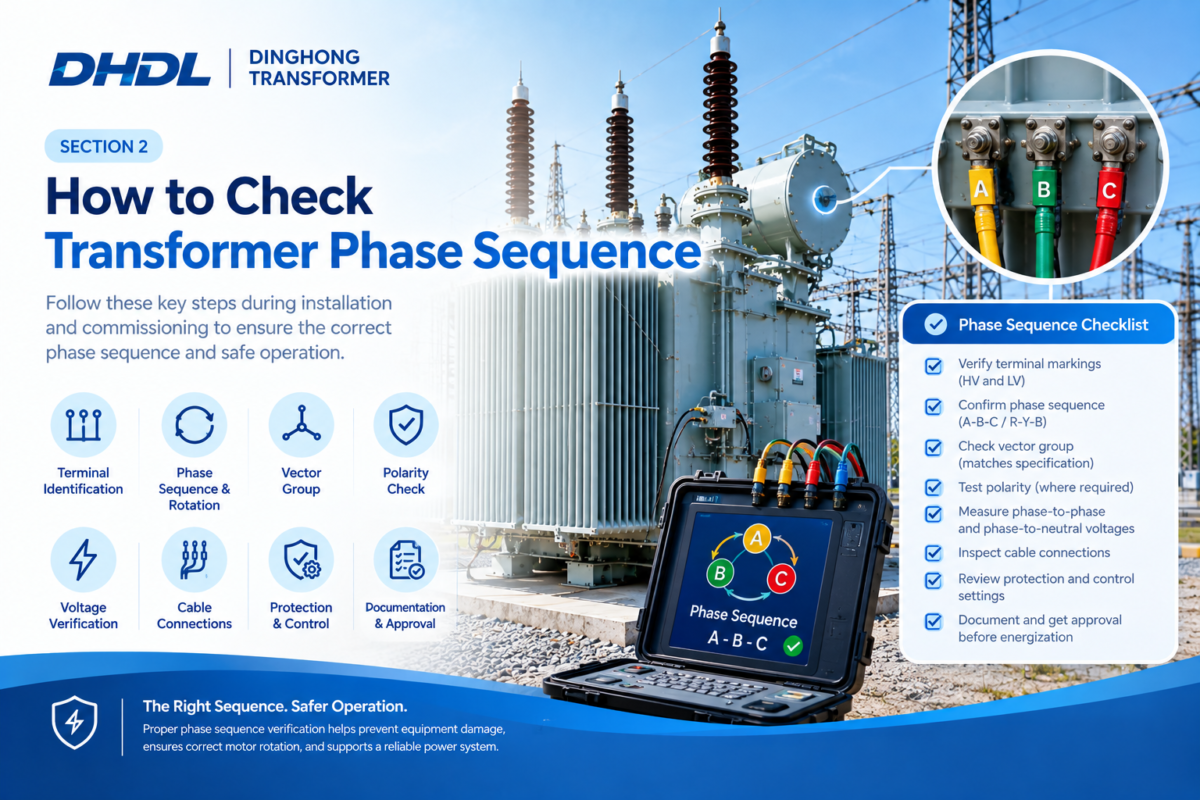
| Check | How to verify |
| Terminal identification | HV and LV terminals match approved drawings |
| Phase sequence | A-B-C/R-Y-B or specified project sequence |
| Phase rotation | Rotation matches the connected system |
| Vector group | Matches the approved transformer specification |
| Polarity | Correct relationship between corresponding terminals |
| Voltage | Phase-to-phase and phase-to-neutral values are within requirements |
| Cable connections | Incoming and outgoing phases are correctly connected |
| Protection | Relays and control circuits match the approved configuration |
The exact testing procedure should be performed by qualified electrical personnel using equipment appropriate for the system voltage.
Transformer Phase Sequence During Installation
Before connecting a transformer to the electrical network, installers should compare the physical terminal markings with the approved wiring diagram and transformer nameplate.
Do not rely only on assumptions such as “the red cable is phase A.” Cable colors and identification practices can differ between countries, contractors, and existing installations.Instead, verify the actual electrical relationship between the phases.
For transformer replacement projects, the existing equipment’s documentation can also be important. If a new transformer will connect to an existing busbar or operate alongside another transformer, engineers should review the existing transformer’s nameplate and technical data.
DinghongTransformer specifically recommends providing existing transformer nameplate and test information when a new transformer is intended for parallel operation.
Phase Sequence Checklist Before Energization
Before first energization, the commissioning team should verify:
- Transformer terminals correspond with approved drawings.
- HV and LV phase identification is correct.
- Phase sequence matches the project requirement.
- Transformer vector group matches the approved specification.Polarity has been verified where required.
- Phase-to-phase voltages are within the expected range.Neutral connections are correctly configured where applicable.
- Cable terminations are secure and correctly identified.
- Protection and control circuits have been checked.
- The commissioning results have been documented and approved.
These checks help identify wiring or configuration errors before they reach connected equipment.
Why Phase Sequence Is Important for Parallel Transformers
Phase sequence becomes even more critical when two or more transformers are intended to operate in parallel.
Parallel transformers generally need compatible voltage ratios, vector groups, impedance, phase sequence, polarity, frequency and tap positions.
If the phase relationship is incorrect, connecting the transformers together can create severe electrical conditions rather than allowing normal load sharing.
This is why engineers should verify compatibility before closing the common connection between transformers.
What Should Buyers Specify When Ordering a Transformer?
Phase sequence should not be considered only after the transformer reaches the project site.When preparing a transformer specification or RFQ, buyers should provide:
- Transformer capacity
- Primary and secondary voltage
- FrequencySingle-phase or three-phase configuration
- Required vector group
- Neutral requirementsImpedance
- Tap rangeInstallation environment
- Applicable electrical standards
- Parallel-operation requirements, if applicable
A complete RFQ gives the manufacturer enough information to design and supply equipment that matches the intended electrical system.
DinghongTransformer’s RFQ guidance similarly recommends providing voltage, frequency, phase, vector group, impedance, tap range, installation conditions and applicable standards.
Preguntas frecuentes
What happens if transformer phase sequence is wrong?
An incorrect phase sequence can reverse the rotation of three-phase motors and create compatibility problems with other equipment or transformers.
How is transformer phase sequence tested?
Qualified commissioning personnel can use appropriate phase-sequence or phase-rotation testing equipment to determine the order of the three phases.
Is phase sequence the same as vector group?
No. Phase sequence describes the order of the phases, while vector group describes transformer winding connections and the phase displacement between windings.
Does phase sequence matter when transformers operate in parallel?
Yes. Compatible phase sequence, polarity, vector group and other electrical parameters are essential for safe parallel operation.
Should phase sequence be checked before energizing a transformer?
Yes. It should be included in the commissioning and pre-energization verification process, together with terminal identification, voltage checks, protection checks and other required tests.
Final Thoughts
Transformer phase sequence is a small commissioning detail that can have major consequences for an electrical system.
Correct phase identification helps ensure that three-phase equipment operates as intended and that transformers are compatible with the network to which they are connected.
For new installations, transformer replacements and parallel-transformer projects, phase sequence should be verified alongside vector group, polarity, voltage ratio, impedance and protection requirements.
The safest approach is to confirm these requirements during transformer specification and then verify them again during installation and commissioning.
Need Help Selecting the Right Transformer?
Planning a new transformer installation or replacing an existing unit?
DinghongTransformer can help you specify the required capacity, voltage, phase configuration, vector group, impedance, cooling method and other project requirements.
Send your transformer specifications, application, quantity and destination to DinghongTransformer.com today for a project-specific quotation and technical support.