
Transformer & Low-Voltage Distribution Cabinet Lead Time: What Affects Production and Delivery Schedules?

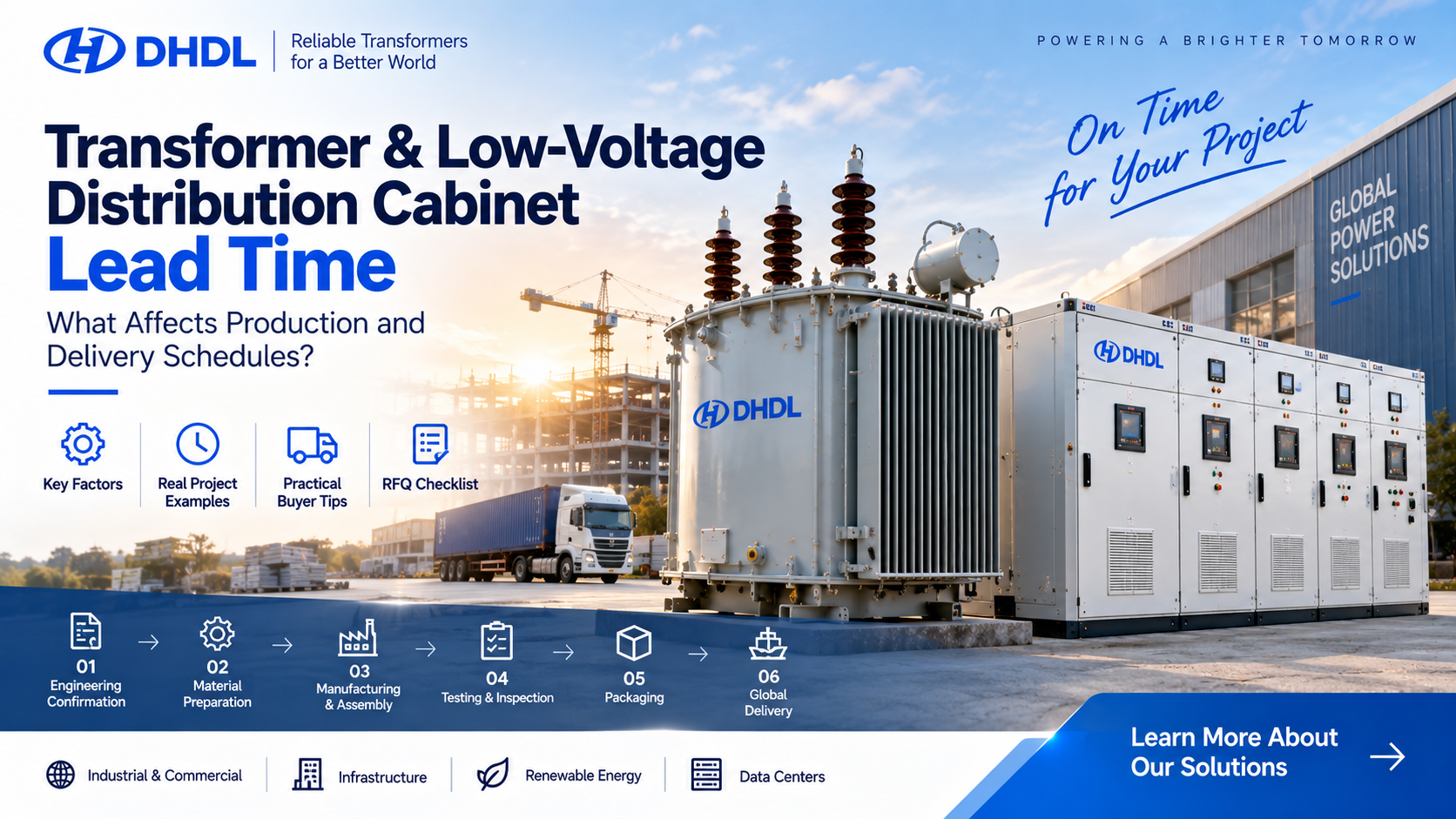
For an EPC contractor, industrial plant, data center, renewable energy project, or utility upgrade, equipment delivery is often just as important as equipment price.
A transformer or low-voltage distribution cabinet that arrives several weeks late can delay installation, testing, energization, and even the commercial operation date of an entire project.
This is why one of the first questions buyers ask is:
“What is your lead time?”
But there is no single lead time that applies to every transformer or low-voltage switchgear project.
Capacity, voltage, cabinet configuration, raw materials, circuit breakers, customization, drawings, factory testing, order quantity, packaging, and international shipping can all change the final schedule.
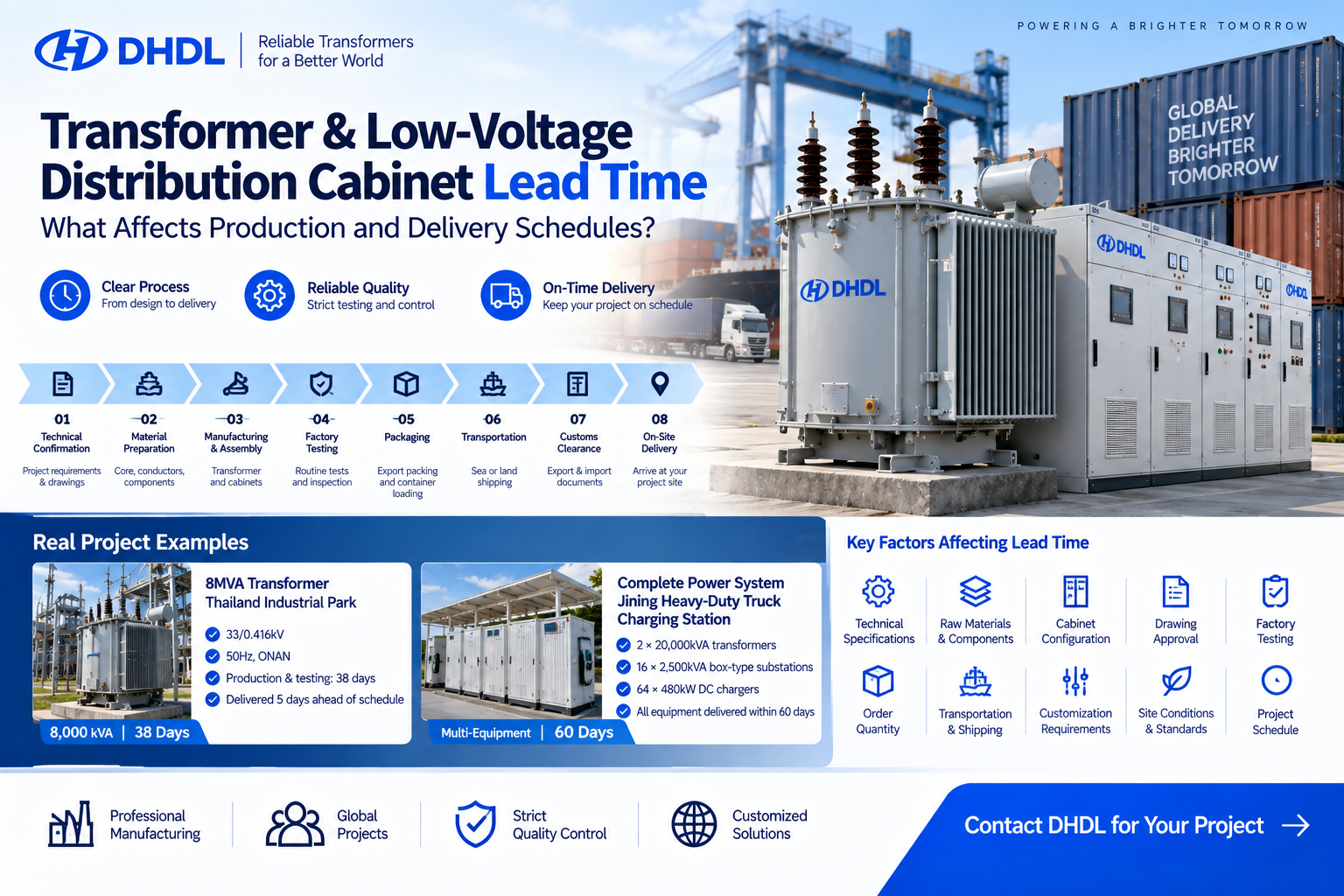
DHDL‘s published project experience demonstrates this clearly. For a Thailand industrial park project, an 8,000kVA, 33/0.416kV distribution transformer completed production and testing in 38 days. Another heavy-duty truck charging project involving transformers, substations, charging equipment, PV, and energy storage had all equipment delivered within 60 days.
The practical lesson for buyers is:
Lead Time = Engineering + Material Preparation + Manufacturing + Assembly + Testing + Packaging + Transportation
Understanding each stage helps buyers build a more realistic procurement schedule.
1. What Does Transformer Lead Time Actually Include?
When a supplier says “30-day lead time,” buyers should confirm exactly what those 30 days mean.
Does the schedule start from the purchase order?
Or does it start after the technical drawings are approved?
Does it mean production is complete?
Or does it mean the equipment is ready to ship?
These are very different milestones.
A typical project may include:
- Technical specification confirmation
- Single-Line Diagram review
- Drawing preparation
- Customer drawing approval
- Raw material procurement
- Core and winding production
- Transformer assembly
- Cabinet fabrication
- Busbar installation
- Breaker and component installation
- Internal wiring
- Factory testing
- Customer inspection or FAT
- Final documentation
- Export packaging
- Container loading
- Sea or land transportation
- Customs clearance
A supplier may complete manufacturing in 30–40 days, but this does not mean the equipment will arrive at the project site within 30–40 days.
Hidden buyer tip: Always ask suppliers to separate production lead time from shipping lead time.
2. Typical Production Schedule by Equipment Type
Actual production schedules depend on the project specification and current factory workload, so the following should be treated as planning logic rather than a guaranteed universal lead time.
| Equipment | Main Schedule Factors |
|---|---|
| Standard Distribution Transformer | Capacity, voltage, winding, materials |
| Custom Distribution Transformer | Impedance, vector group, cooling, accessories |
| Large Power Transformer | Voltage class, capacity, OLTC, testing |
| GGD LV Cabinet | Breakers, busbars, feeder quantity |
| Tablero MNS | Drawer quantity, protection, wiring |
| GGJ Compensation Cabinet | kvar, capacitor stages, harmonic requirements |
| Subestación prefabricada | Transformer + MV + LV integration |
| Complete Power System | Multiple equipment types + project coordination |
DHDL’s current published information states that production schedules vary with equipment type, voltage level, customization, order quantity, testing, and factory capacity. Its high-voltage lead-time guidance also notes that larger or highly customized units require project-specific scheduling.
For buyers, the most useful question is therefore not:
“What is your fastest lead time?”
Ask instead:
“What is the realistic production schedule for this exact specification?”
3. Seven Factors That Can Change Your Production Lead Time
3.1 Technical Specifications
A standard transformer is generally easier to manufacture than a highly customized unit.
For example, compare these two inquiries.
Project A
- 1,000kVA
- 10/0.4kV
- 50Hz
- Dyn11
- Onán
- Standard accessories
Project B
- 1,000kVA
- Custom voltage ratio
- Special impedance
- High-temperature design
- Additional monitoring
- Special enclosure
- Customer-specified components
- Additional factory tests
Although both transformers are rated at 1,000kVA, their engineering and manufacturing schedules may be different.
DHDL notes that special voltage ratios, unusual impedance, cooling requirements, monitoring equipment, accessories, and testing requirements can all affect production time.
3.2 Low-Voltage Cabinet Configuration
For a low-voltage distribution cabinet, the number of panels alone does not determine production time.
A quotation for “10 × 400V cabinets” tells the manufacturer very little.
The supplier still needs to know:
- Rated current
- Short-circuit rating
- Incoming breaker
- Outgoing feeders
- Bus coupler arrangement
- ACB/MCCB requirements
- Busbar material
- Metering
- Protection
- Communication
- Cable entry
- IP rating
- Cabinet type
- Required component brands
A simple GGD distribution lineup can have a very different production schedule from a large MNS system containing numerous withdrawable feeders, monitoring devices, interlocks, and communication functions.
DHDL’s published Harbin Intelligent Computing Center project included 156 MNS low-voltage switchgear panels, alongside 32 KYN28A-12 medium-voltage panels and 16 × 2,500kVA dry-type transformers. The project also had a tight delivery requirement because the data-center expansion needed to be energized on schedule.
3.3 Raw Materials and Key Components
Transformer manufacturing depends on materials such as:
- Electrical steel
- Copper or aluminum conductors
- Insulation materials
- Transformer oil
- Bushings
- Tap changers
- Radiators
- Enclosures
Low-voltage switchgear depends on components such as:
- ACBs
- MCCBs
- Contactors
- Relays
- Multifunction meters
- CTs
- Capacitors
- Controllers
- Communication modules
- Copper busbars
If the specification requires a particular international component brand or unusual breaker rating, component procurement may become part of the critical path.
This is why buyers should identify mandatory component brands during RFQ, not after the cabinet has already entered production.
3.4 Drawing Approval
This is one of the most underestimated causes of project delay.
Imagine that the factory can manufacture a cabinet in four weeks.
However, the customer spends two weeks reviewing the SLD and another week approving the General Arrangement Drawing.
The real project schedule has already increased significantly before manufacturing is complete.
Typical approval documents can include:
- Single-Line Diagram
- General Arrangement Drawing
- Technical Datasheet
- Cabinet Layout
- Foundation Drawing
- Terminal Diagram
- Nameplate Drawing
- Wiring Diagram
For EPC projects, define a drawing-approval deadline before placing the order.
A practical workflow is:
PO → Technical Confirmation → Drawings → Customer Approval → Production Release
Do not assume the manufacturing clock starts while major technical parameters are still changing.
3.5 Factory Testing
Testing is necessary, but project-specific testing can extend the schedule.
Typical transformer tests can include:
- Insulation resistance
- Winding DC resistance
- Voltage ratio
- Vector group
- No-load loss
- Load loss
- Impedance voltage
- Power-frequency withstand voltage
- Induced withstand voltage
- Sealing test
DHDL states that its transformer products undergo routine factory testing, and its Thailand 8MVA project completed a full test sequence before shipment.
Low-voltage cabinet inspection may also involve:
- Visual inspection
- Wiring verification
- Mechanical operation
- Interlocking verification
- Protection function checks
- Insulation checks
- Metering checks
- Communication verification where applicable
If the buyer requires a witnessed Factory Acceptance Test (FAT), include the FAT schedule in the procurement plan.
3.6 Order Quantity
A 10-unit order and a 160-unit order should not be scheduled in the same way.
Large orders may be more efficiently handled through batch production and batch delivery.
DHDL’s Ethiopia Amhara rural grid project involved 160 distribution transformers.
According to the published project schedule:
| Batch | Cantidad | Completion Time |
|---|---|---|
| Batch 1 | 60 Units | 35 Days |
| Batch 2 | 50 Units | 52 Days |
| Batch 3 | 50 Units | 65 Days |
The equipment was delivered in three batches so that project installation could progress without waiting for all 160 transformers to be completed at once.
This is a useful strategy for large transformer and switchgear orders.
Do not always ask: “When will all equipment be ready?”
Instead ask:
“Can critical equipment be manufactured and shipped in batches?”
3.7 Packaging and International Transportation
Factory completion is not the same as site delivery.
For international projects, the final schedule may also include:
- Export packaging
- Container booking
- Loading
- Port transportation
- Customs documentation
- Sea freight
- Destination customs clearance
- Inland transportation
- Site unloading
DHDL’s export guidance highlights reinforced packaging, moisture protection, container fixing, loading optimization, and shipping coordination as important parts of international transformer delivery.
For oversized transformers or complete prefabricated substations, transportation limitations should be reviewed during the design stage.
4. Real Project Example: 8MVA Transformer Delivered Ahead of Schedule
DHDL’s Thailand industrial park project provides a useful example of schedule management.
The project specification included:
| Parameter | Project Specification |
|---|---|
| Producto | Transformador de distribución sumergido en aceite |
| Model | S-8000/33 |
| Capacity | 8,000kVA |
| Voltage | 33/0.416kV |
| Frecuencia | 50Hz |
| Cooling | Onán |
| Instalación | Al aire libre |
| Environment | High Temperature & Humidity |
| Production & Testing | 38 Days |
The customer’s project was already in the construction stage, and the transformer had to be manufactured and shipped within a 45-day requirement to avoid delaying substation energization.
DHDL assigned a dedicated project manager, shared weekly progress updates, and coordinated material preparation, winding, assembly, testing, and final inspection.
Production and testing were completed in 38 days, and the project was completed five days earlier than the contractual delivery schedule.
The important lesson is not simply that one transformer was manufactured quickly.
The more useful takeaway is:
Clear Specifications + Early Engineering Confirmation + Production Tracking + Testing Plan = More Predictable Delivery
5. Real Project Example: Complete Charging Station Equipment Delivered Within 60 Days
Lead-time management becomes more difficult when a project includes multiple equipment categories.
DHDL’s published Jining Zoucheng heavy-duty truck charging station project included:
| Equipment | Project Requirement |
|---|---|
| Main Transformers | 2 × 20,000kVA |
| Voltage | 35/10.5kV |
| Box-Type Substations | 16 × 2,500kVA |
| DC Chargers | 64 × 480kW |
| PV System | 4MWp |
| Almacenamiento de energía | 10MW / 20MWh |
| Delivery | Within 60 Days |
DHDL reports that all equipment was delivered within 60 days and the project schedule finished seven days ahead of plan.
For buyers, this illustrates why a complete power project needs a system-level procurement schedule, rather than separate lead-time estimates for every piece of equipment.
Transformer production, switchgear, substations, chargers, testing, documentation, and logistics need to be coordinated around the same energization date.
6. The Hidden Lead-Time Killer: Changing Specifications After Order
One of the easiest ways to delay a project is to change major specifications after production has been released.
Examples include:
- Changing HV/LV voltage
- Changing transformer impedance
- Changing vector group
- Changing winding material
- Adding an OLTC
- Changing breaker brand
- Increasing short-circuit rating
- Adding outgoing feeders
- Changing busbar current
- Adding communication functions
- Changing cabinet dimensions
- Changing cable-entry direction
- Adding FAT requirements
Some changes can be accommodated easily.
Others may require new drawings, new components, redesign, or even rework of equipment already in production.
Therefore, buyers should freeze all critical technical parameters before production release whenever possible.
7. How Buyers Can Reduce Transformer and Cabinet Lead Time
Project teams can improve schedule reliability by taking several practical steps.
- Send a complete RFQ from the beginning.
- Provide the Single-Line Diagram early.
- Confirm voltage, capacity, current, impedance, and short-circuit requirements.
- Confirm IEC, ANSI/IEEE, or project-specific standards.
- Identify mandatory breaker and component brands.
- Confirm site temperature, altitude, humidity, and installation conditions.
- Set a clear drawing-approval deadline.
- Avoid unnecessary custom specifications.
- Confirm testing and FAT requirements before production.
- Ask for a dated production schedule.
- Request weekly progress updates for critical projects.
- Consider batch delivery for large orders.
- Include shipping and customs time in the overall project schedule.
DHDL’s own procurement guidance similarly recommends early manufacturer engagement and complete RFQ information, including voltage, capacity, impedance, vector group, cooling, standards, environment, and target delivery date.
8. What a Good Production Schedule Should Show
Do not accept a schedule that says only:
“Delivery: 45 Days.”
For a critical project, ask for milestone visibility.
A useful schedule should include:
| Milestone | Status / Target Date |
|---|---|
| Technical Confirmation | __________ |
| Drawing Submission | __________ |
| Drawing Approval | __________ |
| Material Preparation | __________ |
| Transformer Production | __________ |
| Cabinet Production | __________ |
| Assembly | __________ |
| Factory Testing | __________ |
| FAT | __________ |
| Documentation | __________ |
| Packing | __________ |
| Shipment | __________ |
| Estimated Arrival | __________ |
This allows the EPC contractor or project owner to connect equipment procurement with civil construction, cable installation, commissioning, and energization.
Transformer & Low-Voltage Distribution Cabinet RFQ Checklist
Before requesting a quotation and delivery schedule, provide:
| RFQ Item | Buyer Input |
|---|---|
| Equipment Type | Transformer / LV Cabinet / Complete System |
| Solicitud | __________ |
| Transformer Capacity | _____ kVA / MVA |
| HV/LV Voltage | __________ |
| Frecuencia | 50 / 60Hz |
| Vector Group | __________ |
| Impedance | _____ % |
| LV System Voltage | _____ V |
| Main Bus Current | _____ A |
| Short-Circuit Rating | _____ kA |
| Incoming Breaker | __________ |
| Outgoing Feeders | __________ |
| Busbar Material | Cu / Al |
| Cabinet Type | GGD / MNS / Other |
| Applicable Standard | IEC / ANSI / IEEE / Project |
| Site Conditions | __________ |
| Testing / FAT | __________ |
| Cantidad | __________ |
| Destino | __________ |
| Required Site Date | __________ |
Adjuntos recomendados para RFQ
Whenever available, attach:
- Single-Line Diagram
- Technical specification
- Transformer datasheet
- Load schedule
- Cabinet feeder schedule
- Short-circuit calculation
- Protection requirements
- Electrical room layout
- Mandatory component brands
- Testing requirements
- Site conditions
- Tender specification
- Required delivery schedule
DHDL’s current inquiry guidance specifically recommends sending rated capacity, voltage, frequency, vector group, impedance, standard, installation environment, quantity, SLDs, drawings, and tender specifications to improve technical review efficiency.
Planning a Transformer or Low-Voltage Distribution Project?
DHDL supplies transformers, low-voltage distribution cabinets, medium-voltage switchgear, prefabricated substations, and integrated power distribution equipment for industrial, utility, renewable-energy, data-center, and infrastructure projects. Its international project support includes IEC and ANSI adaptation, climate-specific design, technical documentation, export coordination, and routine factory testing.
For an accurate quotation and realistic production schedule, send:
SLD + Capacity + Voltage + Cabinet Configuration + Technical Standard + Quantity + Destination + Required Site Date
Do not ask only for the shortest possible lead time.
Ask for a realistic, milestone-based production and delivery schedule that can be integrated into the overall project plan.
DHDL — Project-Ready Power Equipment with Production and Delivery Planning Built Around Your Schedule.
Choose DHDL for Your Transformer Solutions
DHDL is a professional transformer manufacturer specializing indry-type transformers, oil-immersed transformers, power transformers, distribution transformers, and complete power distribution solutions.
We support customized transformer designs based on project voltage, capacity, frequency, installation environment, and international standards.
Whether for industrial facilities, renewable energy projects, data centers, utilities, or infrastructure applications, DHDL delivers reliable, efficient, and customized power solutions worldwide.
Contact DHDL today for professional transformer selection support and a customized quotation.
Preguntas frecuentes
1. How long does it take to manufacture a transformer?
There is no universal production time. Capacity, voltage, customization, materials, accessories, testing requirements, order quantity, and current factory workload can all affect the schedule.
For example, DHDL’s published Thailand project involved an 8,000kVA, 33/0.416kV transformer whose production and factory testing took 38 days. This is a project example rather than a guaranteed lead time for every transformer.
2. What affects low-voltage distribution cabinet lead time?
Major factors include:
- Number of panels
- Rated current
- Short-circuit rating
- ACB/MCCB configuration
- Number of outgoing feeders
- Busbar requirements
- Component brands
- Metering and protection
- Communication requirements
- Drawing approval
- Factory testing
- Order quantity
Highly customized MNS switchgear systems generally require more engineering and assembly coordination than simple standard cabinet configurations.
3. Does production lead time include shipping?
Not necessarily.
Buyers should ask suppliers to separate:
- Engineering time
- Production time
- Factory testing
- Packaging
- Export preparation
- International shipping
- Customs clearance
- Inland transportation
The required site arrival date is more useful for project planning than factory completion date alone.
4. Can large transformer orders be delivered in batches?
Yes, when the project and production plan allow it.
DHDL’s Ethiopia project used three production batches for 160 transformers: 60 units completed in 35 days, another 50 by 52 days, and the final 50 by 65 days.
Batch delivery can allow installation to begin before the complete order is finished.
5. What information is needed for an accurate lead-time quotation?
Provide:
- Equipment type
- Capacity
- Voltage
- Frecuencia
- Vector group
- Impedance
- Cabinet rated current
- Short-circuit rating
- Feeder configuration
- Applicable standard
- Accesorios
- Site conditions
- Testing requirements
- Cantidad
- Destino
- Required site delivery date
Providing the SLD and tender specification at the RFQ stage can significantly reduce technical clarification.
6. How can buyers reduce the risk of equipment delays?
The most effective approach is to finalize critical specifications early, submit complete RFQ documents, approve drawings quickly, identify long-lead components before production, avoid late design changes, agree on factory testing requirements, and track manufacturing milestones throughout the order.
For large projects, buyers should also discuss batch production and phased shipment rather than waiting for every unit or cabinet to be completed before shipping.
Humanize 363 words